
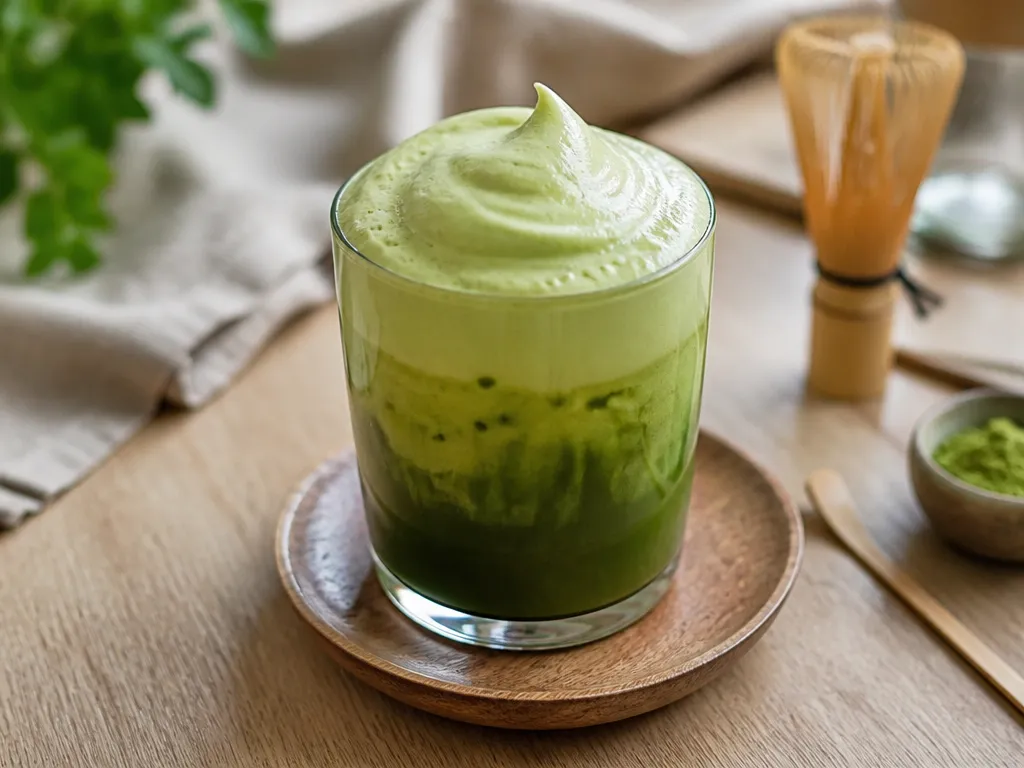
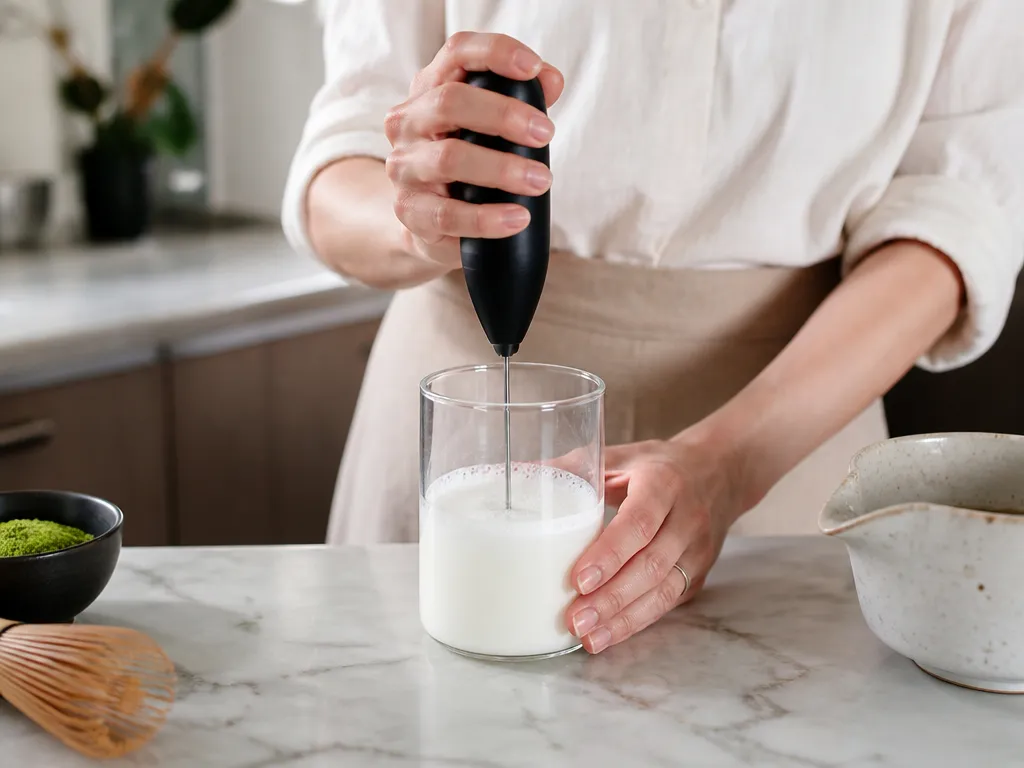
For a practical starting formula, use 100 ml of chilled matcha drink as the base and top it with about 25 to 40 ml of cold foam. Froth the milk separately, using a handheld frother for roughly 20 to 45 seconds as an initial timing guide, or use short blender pulses. Stop when the foam looks glossy and spoonable rather than dry or bubbly.
Keep the matcha base and foam separate until assembly. Use very cold dairy or non-dairy milk, froth in short bursts, and serve immediately. The measurements and timings below are starting points to test with your equipment and chosen milk, since brands and tools produce different results.
What Is The Tested Cold-foam Recipe For Matcha?
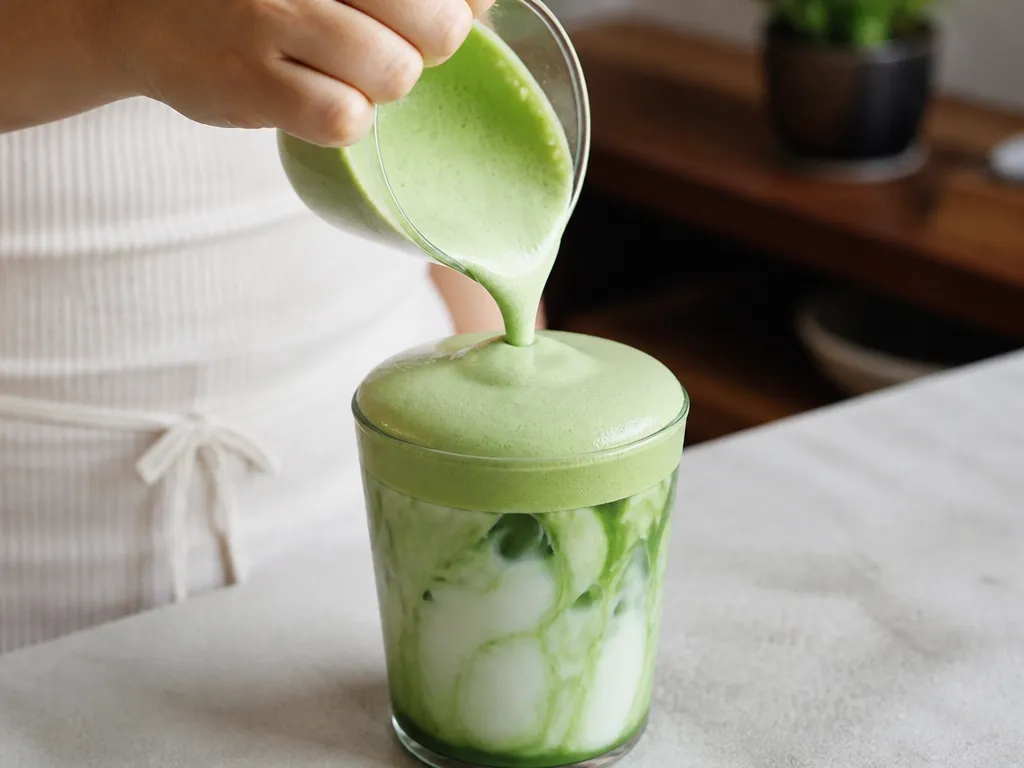
The following is a practical starting recipe rather than a guarantee for every milk or appliance. Build a matcha drink base with 100 ml total liquid. Separately, froth 80 ml of cold milk and use about 25 to 40 ml of the finished foam for each drink. Keep the foam cold and measure its ingredients separately from the matcha base.
| Version | Yield (foam) | Milk (or alternative) | Sweetener (optional) | Froth target |
|---|---|---|---|---|
| Dairy, handheld frother | Starting amount for 2 servings | 80 ml cold milk | Up to 5 g sugar, dissolved first | Thick, spoonable foam |
| Dairy, blender or steam wand | Starting amount for 2 servings | 80 ml cold milk | Up to 5 g sugar, dissolved first | Fine bubbles |
| Non-dairy, handheld frother | Starting amount for 2 servings | 80 ml cold barista-style oat milk, or another milk labelled for foaming | Up to 5 g sugar, dissolved first | Silky foam, often softer than dairy |
| Non-dairy, blender or steam wand | Starting amount for 2 servings | 80 ml cold barista-style oat milk, or another milk labelled for foaming | Up to 5 g sugar, dissolved first | Fine bubbles; use immediately |
Dairy Foam Recipe For Matcha With Handheld Frother (2 Servings)
Start with 80 ml of cold milk and, if wanted, up to 5 g of sugar dissolved in it. Prepare a separate matcha base containing 100 ml total liquid. Froth the milk until it looks glossy and spoonable, then divide about 25 to 40 ml of foam between the drinks. Adjust the amount or timing if your milk produces a different texture.
Dairy Foam Recipe For Matcha With Blender Or Steam Wand (2 Servings)
Start with 80 ml of cold milk and up to 5 g of dissolved sugar. Use short blender pulses, or aerate briefly with a steam wand before cooling the foam. Prepare the matcha separately with 100 ml total liquid, then top each drink with about 25 to 40 ml foam.
Non-dairy Foam Recipe For Matcha With Handheld Frother (2 Servings)
Use 80 ml of cold barista-style oat milk, or another plant milk whose label indicates that it is suitable for foaming. Add up to 5 g dissolved sugar if desired. Prepare a separate 100 ml matcha base and use about 25 to 40 ml foam per drink. Plant-milk results vary, so use the texture rather than the clock as your main guide.
Non-dairy Foam Recipe For Matcha With Blender Or Steam Wand (2 Servings)
Begin with 80 ml of cold barista-style plant milk and up to 5 g dissolved sugar. Blend in short pulses or aerate briefly with a wand, then cool the foam if the tool heats it. Top a separate 100 ml matcha base with about 25 to 40 ml foam and serve promptly.
Why Do The Ingredients And Technique Produce Stable Microfoam?
Foam lasts when the liquid can form a reasonably strong film around air bubbles and drain slowly. Dairy proteins help with that structure. Plant milks depend more heavily on their protein, oil, emulsifier, and thickener blend. Cold liquid and controlled aeration usually make it easier to produce fine bubbles, but the result depends on the product and equipment.
What Exact Measurements And Ratios Define Each Path?
Use the table as a repeatable starting framework, then adjust for the milk and tool in your kitchen. Each path begins with a 100 ml matcha base and about 25 to 40 ml of separate foam. The 80 ml foam mixture is larger than the final foam volume because air changes its volume and some liquid remains beneath the foam.
| Path | Base liquid | Base volume (ml) | Foam target (ml) | Foam weight (approx g) |
|---|---|---|---|---|
| Dairy path measurements: handheld frother | Whole milk | 100 | 25 to 40 | Not a reliable fixed measure; weigh only for your own batch |
| Dairy path measurements: blender/steam wand | Whole milk | 100 | 25 to 40 | Not a reliable fixed measure; weigh only for your own batch |
| Non-dairy path measurements: handheld frother | Plant-based milk labelled for foaming | 100 | 25 to 40 | Not a reliable fixed measure; weigh only for your own batch |
| Non-dairy path measurements: blender/steam wand | Plant-based milk labelled for foaming | 100 | 25 to 40 | Not a reliable fixed measure; weigh only for your own batch |
All four paths use the same starting relationship: a 100 ml drink base and 25 to 40 ml of topping. The blender and wand methods may produce foam quickly, so rely on appearance and temperature rather than trying to force a particular volume.
What Are The Step‑by‑step Directions For Each Path?
Use the times below as trial settings, not fixed requirements. Prepare the matcha base separately, chill it, and make the foam close to serving time.
What Are The Common Failure Modes And Fixes?
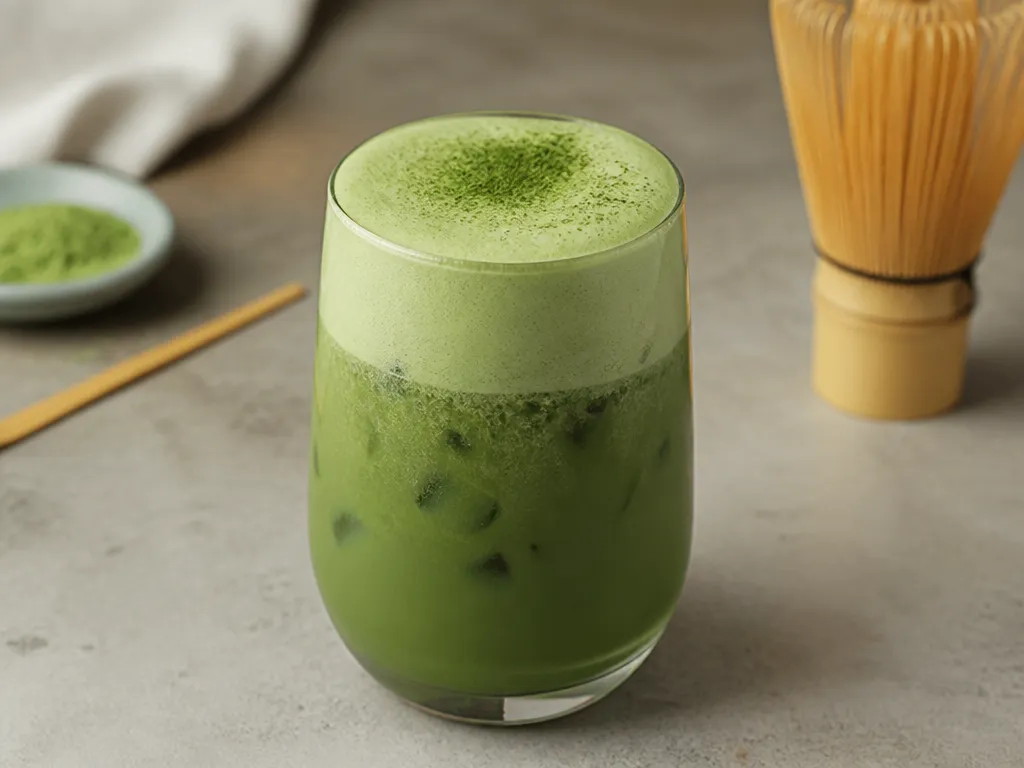
Most problems come from excess air, warm ingredients, a milk that does not foam well, or frothing beyond the point of stability. Change one variable at a time so you can identify the cause.
What Edge Cases Could Mislead The Obvious Recipe?
This recipe is most useful as a controlled starting point. Altitude, refrigerator temperature, vessel shape, equipment power, and product formulation can all change the result. Test the foam under the conditions in which you plan to serve it.
What Variations Can Customize Flavor, Sweetness, And Add‑ins?
Flavor additions can change foam texture. Put watery additions such as syrups, fruit purées, or citrus into the matcha base, or use only a small amount in the foam and test the result. Keep the foam close to the starting formula until you know how an ingredient behaves.
Sweeten the foam before frothing so the sweetener is evenly distributed. Sugar may dissolve slowly in cold milk, while powdered or superfine sugar dissolves more readily. Honey, maple syrup, and agave add water as well as sweetness and may thin the foam. Low-calorie sweeteners can add sweetness without the same body, so compare the finished texture rather than assuming a direct substitution will behave identically.
Vanilla extract adds aroma without the extra liquid in a syrup. Coconut flavor can come from a small amount of coconut cream or extract, although coconut products vary in thickness. Mix dry spices into the matcha base before adding water so particles do not remain on the foam surface.
Plant milk choice sets the starting point for foam quality.
| Plant milk | Foam behavior | How to use it |
|---|---|---|
| Soy, barista style | Often produces a firm foam, depending on the formulation | Start with the dairy technique |
| Oat, barista style | Often foams easily but may remain softer | Reduce added sweetener if the product is already sweet |
| Almond | Can be thin unless formulated for foaming | Choose a barista-style version before adding stabilizers |
| Coconut, canned | Rich and prone to separating | Blend a small amount into another milk and test |
| Pea or protein blends | May foam well but can have a distinct flavor | Pair with vanilla or cocoa if compatible |
Acidic ingredients may change the texture of dairy foam. Keep lemon, lime, and fruit purées in the matcha base unless you have tested them in the milk. Use alcohol-based flavorings sparingly, since larger additions can make foam less stable.
What Is The Quick-reference Cheat Sheet And Visuals?
Use these starting ratios and motions when you want a repeatable method. Record the milk, temperature, tool, and time for your own reliable version.
Quick Summary
Start with 80 ml of cold milk, optionally sweetened with up to 5 g sugar, and froth until glossy and spoonable. Add about 25 to 40 ml of foam to a separate chilled matcha base containing 100 ml total liquid. Treat those figures as a repeatable starting formula, then adjust for your milk and equipment.
Four conditions can change the result:
| Condition | What changes |
|---|---|
| Non-dairy base | Plant milks vary considerably. Choose one labelled for foaming and serve promptly. |
| Equipment | A handheld frother gives direct control. A blender or steam wand may aerate more quickly and requires closer texture checks. |
| Temperature and altitude | Use consistently cold ingredients and judge the result under your own conditions. |
| Add-ins | Put watery syrups, purées, and citrus in the matcha base unless you have tested them in the foam. |
Your next action: chill the milk, measure 80 ml, and begin frothing in short intervals. Stop when the whisk leaves a visible trail and the foam holds a soft mound, then spoon it onto the chilled matcha.
Frequently Asked Questions
How Much Will This Cost To Reproduce At Home, And What Factors Influence The Price?
The cost depends on whether you already own a frother, blender, or steam wand, and on the milk and flavorings you choose. Dairy and plant milks vary by brand and location. Optional ingredients such as gums, lecithin, and premium flavorings add to the total, while equipment is usually the largest one-time expense.
How Long Does A Batch Take From Start To Finish, And Does It Depend On The Equipment Or Milk Type?
Handheld frothing usually involves less setup than using a blender or steam wand. Begin with roughly 20 to 45 seconds of handheld frothing, but stop according to texture. Plant milks and different appliances may need more or less time.
Do I Need To Adjust The Method If I Have An Allergy Or Dietary Restriction?
Use a suitable dairy-free milk and prevent cross-contact by cleaning shared equipment carefully. Check the labels for allergens and other ingredients you need to avoid. Because plant milks vary, test a small batch before serving it to someone with a serious allergy or intolerance.
What Happens If I Skip Foaming Or Do Nothing And Just Drink The Base?
You will have a chilled matcha drink without the creamy foam layer. The base can still be served on its own, but it will not have the same texture or mouthfeel.
When Should I Seek Professional Help Or Switch To Cafe-grade Equipment?
Consider more specialized equipment if you need consistent foam for many servings or frequent service. For home use, a handheld frother is usually the simplest place to start. For larger batches, choose equipment that can handle the volume and clean it thoroughly between dairy and dairy-free preparations.
How Can I Verify At Home That A Foam Claim Is Accurate?
Prepare the same milk and volume several times, using the same tool and starting temperature. Record the foam height, texture, and how long it remains spoonable. Change only one factor at a time, such as the milk or frothing time, so you can identify which version works best in your kitchen.

- Espresso Bar Wedding: Ideas, Setup, Costs, and Tips for a Memorable Coffee Experience - November 11, 2026
- How Many Grams of Espresso Beans for a Double Shot? A Complete Brewing Guide - November 11, 2026
- Brasilia Espresso Machine: Features, Performance, Models, and Buying Guide - November 11, 2026