

A good cup of French press coffee starts with freshly ground beans, hot water, and the right coffee maker. But when choosing a French press, one question often comes up: Should you buy a glass or stainless steel French press?
Both options use the same brewing method, yet they offer different experiences. A glass French press lets you watch your coffee brew and often comes at a lower price. A stainless steel French press offers a sturdier design and, when double-walled, keeps coffee hot longer.
The better choice depends on how you drink coffee, where you brew it, and what matters most to you. Let’s compare glass vs. stainless steel French press coffee makers to help you find the right one for your daily routine.
What Is the Difference Between a Glass and Stainless Steel French Press?
The main difference between a glass and stainless steel French press is the material used to make the brewing container, also called the carafe. This affects how the coffee maker looks, feels, and handles everyday use.
Both types brew coffee by steeping ground beans in hot water and separating the grounds with a plunger and mesh filter. The brewing process stays the same regardless of the material.
How Does a Glass French Press Work?
A glass French press uses a transparent carafe, usually made from heat-resistant borosilicate glass, to hold coffee grounds and hot water during brewing.
You add coarsely ground coffee, pour in hot water, and let it steep for around four minutes, depending on your preferred recipe. Once the coffee has brewed, you slowly press down the plunger to separate the grounds from the liquid.
The clear glass makes it easy to see the coffee as it brews. You can check the water level, observe the grounds, and see how much coffee remains in the carafe.
How Does a Stainless Steel French Press Work?
A stainless steel French press follows the same immersion brewing process as a glass model.
- Add coarsely ground coffee to the stainless steel container.
- Pour hot water over the grounds.
- Stir gently if your brewing recipe requires it.
- Allow the coffee to steep for your preferred brewing time.
- Push the plunger down slowly to separate the grounds.
- Pour the brewed coffee into your cup.
Many stainless steel models feature double-wall insulation, which helps reduce heat loss during brewing and serving.
What Makes Their Design and Construction Different?
Glass French presses typically have a removable glass carafe supported by a metal or plastic frame. Their transparent construction gives them a classic appearance, and some models allow you to replace the carafe if it breaks.
Stainless steel French presses usually have a solid metal body, often with an integrated handle and lid. Some use single-wall construction, while others feature two layers of steel with an insulating space between them.
Both designs can include stainless steel mesh filters, although the quality of the plunger, lid, and filter varies by manufacturer.
Glass vs. Stainless Steel French Press: Key Differences

When comparing these French press coffee makers, the most useful differences involve construction, brewing visibility, handling, and everyday convenience.
Understanding these features can help you decide which design fits your kitchen and coffee-making habits.
Material and Overall Build Quality
Glass French presses are commonly made with borosilicate glass, which is designed to tolerate temperature changes better than ordinary glass. However, the carafe can still crack or break if dropped or handled roughly.
Stainless steel French presses use a metal brewing chamber that can withstand everyday bumps without shattering. Build quality depends on factors such as steel thickness, welding, handle attachment, and lid design.
A well-made model of either type should feel stable, have a comfortable handle, and include a plunger that moves smoothly.
Heat Retention and Temperature Control
- Glass French press: An uninsulated glass carafe generally loses heat faster than a well-insulated stainless steel model.
- Single-wall stainless steel: Provides limited insulation and may become hot on the outside.
- Double-wall stainless steel: Reduces heat transfer and helps coffee stay warm longer.
- Brewing temperature: Both materials can brew coffee effectively when you use appropriately heated water.
- Preheating: Warming the carafe before brewing can help reduce the initial temperature drop.
Durability and Resistance to Damage
Stainless steel is generally the stronger choice when it comes to handling accidental knocks and drops. Its metal construction is less likely to suffer serious damage during normal use.
Glass requires more careful handling, particularly when washing the carafe or placing it on hard surfaces. Even heat-resistant glass can break from physical impact.
However, stainless steel is not completely damage-proof. It can dent, scratch, or develop problems with its handle or plunger over time.
Visibility and Ease of Brewing
- Glass models let you see the coffee grounds, water level, and brewing process.
- Stainless steel models usually have opaque walls, so you cannot see inside without removing the lid.
- Glass carafes make it easier to notice leftover coffee or residue.
- Stainless steel carafes may include measurement markings inside the container.
- Both types can produce consistently brewed coffee when you measure the coffee and water accurately.
Which French Press Keeps Coffee Hot Longer?
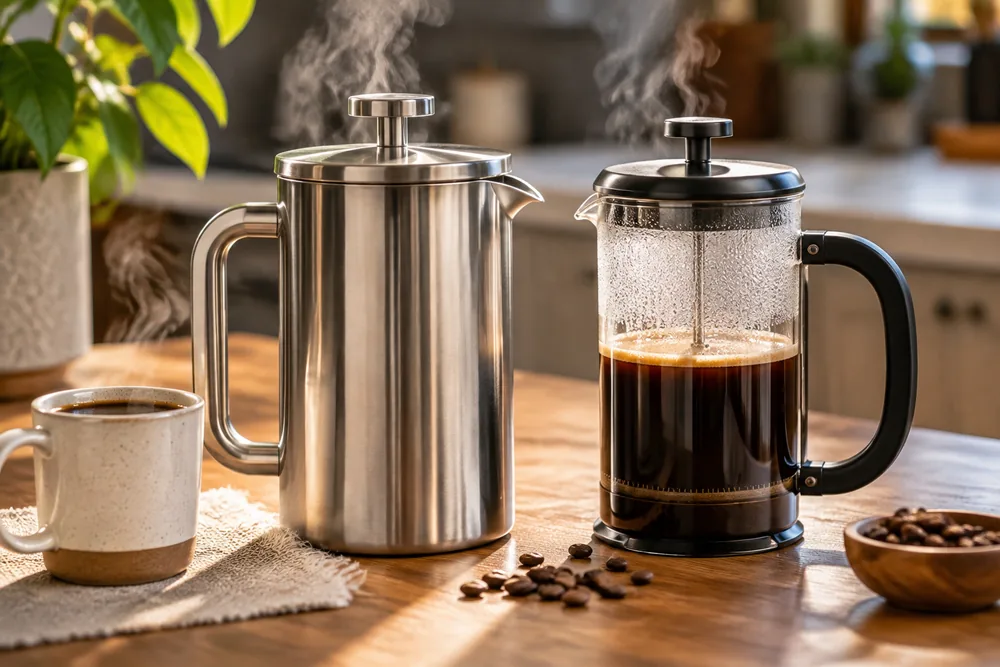
A double-wall stainless steel French press generally keeps coffee hot longer than a standard glass French press.
This difference matters if you brew several cups at once or prefer to enjoy your coffee slowly. However, the actual heat retention depends on the carafe’s insulation, lid construction, room temperature, and the amount of coffee inside.
How Glass French Presses Retain Heat
Glass French presses rely mainly on the carafe walls to separate hot coffee from the surrounding air. Standard glass models do not have an additional insulating layer, so heat gradually escapes through the glass and exposed surfaces.
You can reduce heat loss by preheating the carafe with hot water before adding the coffee grounds. This prevents a cold container from absorbing as much heat at the beginning of brewing.
For someone who pours coffee immediately after brewing, the heat retention of a glass French press may be perfectly adequate.
Why Stainless Steel French Presses Offer Better Heat Retention
Stainless steel models with insulated construction can maintain coffee temperature more effectively.
- Double-wall construction slows heat transfer to the surrounding environment.
- Insulated models can keep coffee warmer between servings.
- A well-fitting lid helps limit heat loss from the top.
- Heat retention varies depending on the insulation design and carafe capacity.
- Single-wall stainless steel models may cool much faster than insulated versions.
How Double-Wall Insulation Helps Maintain Coffee Temperature
A double-wall stainless steel French press has two metal walls separated by an insulating space. This space reduces heat transfer between the hot coffee and the outside environment.
Some models use vacuum insulation, while others use an air gap. Vacuum-insulated designs can provide particularly effective temperature retention.
However, keeping coffee hot is not always the same as keeping it at its best flavor. Coffee left in contact with the grounds may continue extracting after you press the plunger.
If you plan to drink your coffee over a longer period, transferring it to a separate insulated server can help maintain its flavor.
Does Glass or Stainless Steel Affect Coffee Taste?
The carafe material alone usually has little direct effect on coffee flavor when both French presses are made from food-safe materials and properly maintained.
Coffee taste depends more on bean quality, grind size, coffee-to-water ratio, water temperature, extraction time, and filter performance.
A clean glass French press and a clean stainless steel French press can produce very similar coffee when used under the same brewing conditions.
Does a Glass French Press Preserve Coffee Flavor?
Glass is a nonporous material that does not normally react with brewed coffee. It does not add a noticeable flavor when the carafe is clean and undamaged.
This makes glass a reliable choice for people who want to enjoy the natural characteristics of their coffee beans.
However, glass itself does not guarantee better-tasting coffee. Using an inconsistent grind size or an unsuitable brewing ratio can still produce a disappointing cup.
Can Stainless Steel Change the Taste of Coffee?
High-quality, food-grade stainless steel is generally suitable for coffee brewing and should not create a noticeable metallic flavor under normal conditions.
- Food-grade stainless steel is designed for contact with beverages.
- A clean steel carafe generally preserves the intended coffee flavor.
- Old coffee oils and residue can create unpleasant tastes if the container is not cleaned.
- Damaged or poor-quality interior surfaces may affect the brewing experience.
- Proper cleaning and rinsing help prevent unwanted odors or flavors.
Which Material Offers a Cleaner Coffee Experience?
Neither material automatically produces cleaner-tasting coffee. The filter system has a greater influence on how much sediment and coffee oil reach your cup.
Traditional French presses use metal mesh filters that allow more natural coffee oils and some fine particles to pass through than paper filters.
Some models include multiple filter screens to reduce sediment. If you prefer coffee with fewer fine particles, look for a French press with a well-fitting, high-quality filtration system rather than choosing based on carafe material alone.
Glass vs. Stainless Steel French Press: Pros and Cons

Every French press material has advantages and limitations. Glass models appeal to people who prefer a classic appearance and visible brewing process, while stainless steel models suit those who want a more rugged coffee maker.
Comparing the advantages and disadvantages can help you decide which features matter most.
Advantages of a Glass French Press
- Lets you watch the coffee brewing process.
- Usually available at affordable prices.
- Offers a classic and attractive design.
- Makes it easy to see the remaining coffee level.
- Often features a removable, replaceable glass carafe.
- Has a nonporous interior that is easy to inspect for residue.
Disadvantages of a Glass French Press
The biggest disadvantage of a glass French press is its vulnerability to breakage. Although borosilicate glass is designed to handle hot beverages, it can still crack or shatter if dropped.
Standard glass models also provide limited insulation, which means coffee may cool relatively quickly after brewing.
Additionally, the glass carafe requires careful handling during cleaning and storage. If you have a busy kitchen or frequently move your coffee maker, these limitations are worth considering.
Advantages of a Stainless Steel French Press
- More resistant to accidental drops and impacts.
- Available with double-wall or vacuum insulation.
- Suitable for both indoor and outdoor coffee preparation.
- Often features a sturdy, integrated construction.
- Does not have a fragile glass carafe.
- Available in several capacities and designs.
Disadvantages of a Stainless Steel French Press
Stainless steel French presses can cost more than basic glass models, especially when they include high-quality insulation.
Their opaque construction also prevents you from seeing the coffee during brewing or checking the remaining liquid at a glance.
Some models are relatively heavy, and poorly insulated metal handles or exterior surfaces may become uncomfortable to touch.
Additionally, scratches, dents, and coffee residue can affect their appearance over time.
Which French Press Is Easier to Clean and Maintain?
Both glass and stainless steel French presses are relatively easy to clean when maintained properly. The biggest cleaning challenge is usually the metal mesh filter and plunger assembly rather than the carafe itself.
Coffee oils and fine grounds can collect between filter components, so regular cleaning is necessary to maintain good brewing performance.
Cleaning a Glass French Press
Cleaning a glass French press is straightforward because its transparent walls make residue easy to spot.
After brewing, allow the carafe to cool sufficiently, remove the used coffee grounds, and rinse it with warm water. Wash the glass with mild dish soap and a soft sponge.
Avoid sudden temperature changes and rough scrubbing tools that could damage the glass. If the carafe is removable, handle it carefully when taking it out of the frame.
Cleaning a Stainless Steel French Press
Stainless steel French presses require a similar cleaning routine.
- Empty the used coffee grounds after brewing.
- Rinse the carafe with warm water.
- Use mild dish soap and a soft sponge.
- Clean the bottom and inside walls to remove coffee oils.
- Avoid abrasive cleaning tools that may scratch the surface.
- Rinse thoroughly before the next use.
Removing Coffee Oils and Grounds from the Filter
The mesh filter is one of the most important components to clean because coffee oils and fine grounds can become trapped between its layers.
Depending on the model, you may be able to unscrew the filter assembly and separate its components. Wash each part with warm water and mild detergent, then rinse thoroughly.
Reassemble the filter correctly once the components are clean and dry. Regular maintenance helps the plunger move smoothly and prevents old residue from affecting your next cup.
Dishwasher Safety and Daily Maintenance
- Check the manufacturer’s instructions before placing any French press in the dishwasher.
- Some glass carafes are dishwasher-safe, but frames, lids, and handles may require handwashing.
- Some stainless steel models are dishwasher-safe, while others require handwashing to protect their finish or insulation.
- Remove used coffee grounds promptly after brewing.
- Dry the components thoroughly before storage.
- Inspect filter screens and seals periodically for wear.
Glass vs. Stainless Steel French Press: Price and Long-Term Value
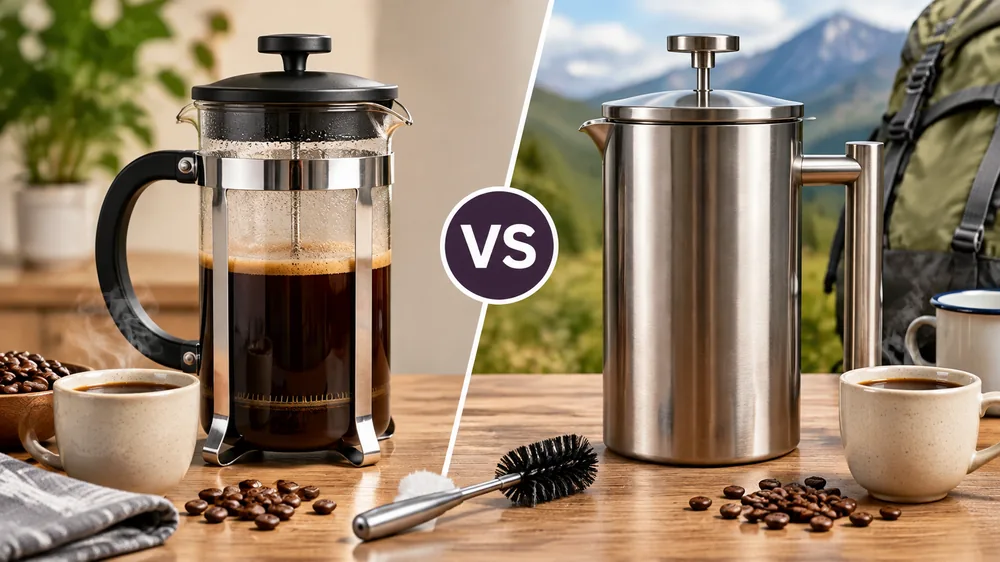
The price of a French press depends on its size, brand, construction quality, filtration system, and insulation features.
Basic glass models are often less expensive than insulated stainless steel alternatives. However, premium glass French presses can cost more than entry-level stainless steel models.
The better value depends on how often you brew coffee and how long you expect to use the coffee maker.
Initial Purchase Cost
Glass French presses are widely available in entry-level price ranges, making them an accessible option for beginners.
Stainless steel French presses can have a higher purchase price, particularly when they feature double-wall insulation, premium finishes, or advanced filtration systems.
However, material alone does not determine quality. A well-designed budget model may provide better everyday performance than a poorly constructed premium alternative.
Replacement Parts and Repair Costs
- Glass carafes may need replacement if they crack or break.
- Some manufacturers sell replacement glass containers separately.
- Stainless steel bodies are less likely to need replacement because of impact damage.
- Both types may require replacement mesh filters or plunger components.
- Replacement parts are not always interchangeable between brands.
- Checking spare-part availability before purchasing can reduce future expenses.
Durability and Long-Term Ownership Value
A stainless steel French press can offer better long-term value in environments where accidental drops are likely. Its resistance to breakage may reduce the need to purchase replacement carafes.
A glass French press can also last for years with careful handling, particularly when replacement components are readily available.
For either material, long-term value depends on construction quality, maintenance habits, and the availability of spare parts.
Which French Press Is Better for Everyday Use and Travel?
The best French press for everyday use depends on where you prepare coffee and how often you move your equipment.
A glass French press may be convenient for a home kitchen, while a stainless steel model can be more practical for workplaces, camping trips, or other environments where durability matters.
Best Option for Home Coffee Brewing
A glass French press is a practical choice for home brewing when you have a stable counter space and prefer watching the coffee extraction process.
Its traditional appearance fits well in many kitchens, and the transparent carafe makes it easy to monitor the coffee level.
A stainless steel model is equally suitable for home use, especially when you brew multiple servings or want a more impact-resistant design.
Best Option for Office and Daily Use
- Glass French press: Suitable for careful use in a personal workspace.
- Stainless steel French press: Better suited to shared environments where accidental knocks may happen.
- Insulated steel models: Useful when you cannot drink your coffee immediately.
- Compact models: Convenient for preparing one or two servings.
- Easy-clean designs: Helpful when you have limited time for washing equipment.
Best Option for Camping and Travel
A stainless steel French press is generally the more practical option for camping and travel because its metal body is less likely to break in a packed bag.
Some stainless steel models are specifically designed for outdoor use and feature compact construction, sturdy handles, and insulated walls.
Glass French presses are less suitable for rough travel conditions unless they have protective storage and are handled carefully.
Regardless of the material, consider the coffee maker’s weight, size, and cleaning requirements before taking it outdoors.
Portability, Weight, and Storage Considerations
- Compact French presses are easier to pack and store.
- Stainless steel models resist impact better during transportation.
- Glass models may require protective packaging.
- Double-wall stainless steel construction can increase bulk or weight.
- Capacity affects the overall size of the coffee maker.
- A secure lid and sturdy handle make transportation and pouring easier.
How to Choose the Right French Press for Your Needs
Choosing a French press becomes easier when you focus on practical features rather than appearance alone.
Think about how many cups you prepare, how much time you spend brewing, and whether you need a coffee maker for home use or travel.
The best French press should make your daily coffee routine convenient without requiring unnecessary maintenance or expense.
Consider Your Coffee Drinking Habits
Start by thinking about how you normally drink coffee.
If you brew a single cup each morning and drink it immediately, a simple glass French press may provide everything you need.
If you prepare several servings or prefer coffee that stays warm between pours, an insulated stainless steel model may be more convenient.
Also consider how much effort you want to spend on cleaning and whether you enjoy watching the brewing process.
Choose the Right Capacity and Size
- Small French press: Suitable for individuals who brew one serving at a time.
- Medium French press: Useful for preparing coffee for two people.
- Large French press: Better for households or shared coffee preparation.
- Counter space: Check the carafe dimensions before purchasing.
- Serving size: Look at the actual capacity in milliliters or fluid ounces, since manufacturers may define a “cup” differently.
- Brewing habits: Choose a size that matches the amount of coffee you regularly prepare.
Check the Filter, Plunger, and Handle Quality
A good French press should have a mesh filter that fits closely against the inside of the carafe. This helps separate the coffee grounds from the brewed liquid.
The plunger should move smoothly without excessive resistance, and the handle should feel comfortable and secure when pouring.
Look for a lid that fits properly and a filter assembly that can be removed for cleaning.
These components have a direct effect on usability and can be just as important as the material of the carafe.
Consider Your Budget and Maintenance Preferences
- Set a budget based on your expected usage.
- Compare build quality rather than choosing only by price.
- Check whether replacement filters and other parts are available.
- Look for removable components that simplify cleaning.
- Review the manufacturer’s care instructions.
- Choose a design that fits your daily brewing routine.
Final Verdict: Should You Choose a Glass or Stainless Steel French Press?
Both glass and stainless steel French presses can brew rich, full-bodied coffee. The right choice depends on which features you value most.
A glass French press is a strong option for people who prefer a traditional design, visible brewing, and an affordable coffee maker.
A stainless steel French press is generally better for people who prioritize impact resistance, outdoor usability, and heat retention in insulated models.
When a Glass French Press Is the Better Choice
- You prefer a classic, transparent coffee maker.
- You enjoy watching coffee brew.
- You want an affordable French press for home use.
- You usually drink your coffee shortly after brewing.
- You can handle and store the glass carafe carefully.
- You prefer a design that makes coffee residue easy to see.
When a Stainless Steel French Press Makes More Sense
A stainless steel French press is a better choice if you want a durable coffee maker that can withstand frequent handling and occasional knocks.
It is particularly useful for busy kitchens, offices, and outdoor activities where glass might be more vulnerable to damage.
If keeping coffee hot is a priority, choose a double-wall insulated stainless steel model rather than assuming every metal French press offers the same heat retention.
Which French Press Offers the Best Overall Experience?
For most people who want a durable, versatile French press, a well-made, double-wall stainless steel model is the better overall choice. It combines reliable brewing performance with practical insulation and a sturdy construction.
However, a glass French press remains an excellent option for home coffee drinkers who appreciate a simple design, easy brewing visibility, and a lower entry price.
Neither material automatically makes better-tasting coffee. The quality of your beans, grind consistency, brewing technique, and filter system matter far more.
Choose glass if you value simplicity and visibility. Choose stainless steel if you value durability and insulation. Either can deliver an enjoyable cup of French press coffee when used correctly.

- Espresso Bar Wedding: Ideas, Setup, Costs, and Tips for a Memorable Coffee Experience - November 11, 2026
- How Many Grams of Espresso Beans for a Double Shot? A Complete Brewing Guide - November 11, 2026
- Brasilia Espresso Machine: Features, Performance, Models, and Buying Guide - November 11, 2026