
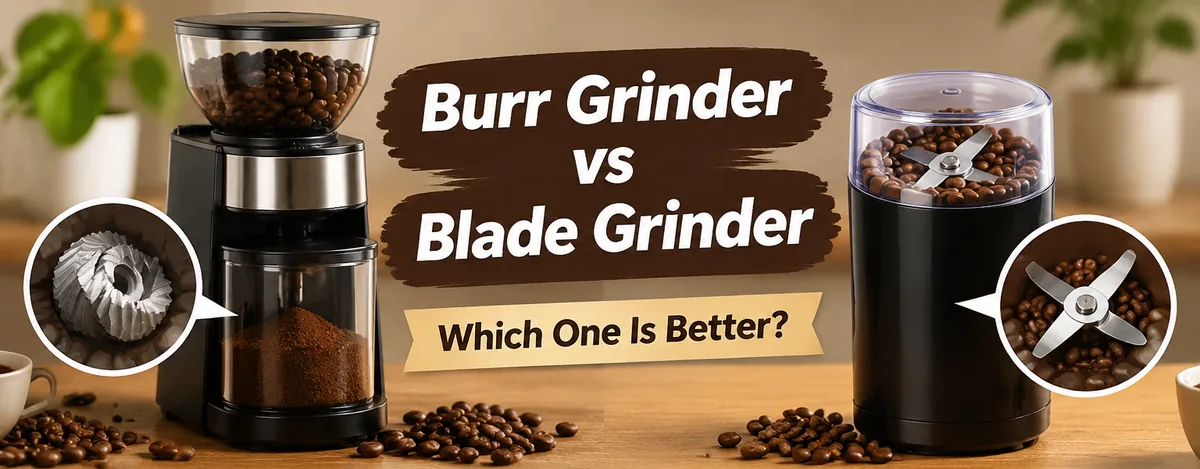
Choosing between a burr grinder and a blade grinder can make a noticeable difference in your daily coffee experience. Both machines grind whole coffee beans, but they use different mechanisms to break them into smaller pieces. This affects grind consistency, flavor, brewing results, convenience, and price.
A burr grinder is generally preferred by coffee enthusiasts because it produces more consistent grounds and offers better control over grind size. A blade grinder, on the other hand, is usually more affordable, compact, and easier to use.
Understanding how these two grinders work will help you choose the right option for your brewing style, budget, and coffee preferences.
What Is the Difference Between a Burr Grinder and a Blade Grinder?
The main difference between these two grinders is how they break down coffee beans. A burr grinder crushes beans between two abrasive surfaces, while a blade grinder chops them using rapidly spinning blades. This difference affects the size and consistency of the coffee grounds.
How Does a Burr Grinder Work?
A burr grinder uses two abrasive surfaces called burrs to crush coffee beans into smaller particles. One burr remains stationary while the other rotates, creating a small gap through which the beans pass. You can adjust this gap to control how coarse or fine the coffee grounds become.
Because the beans are crushed rather than randomly chopped, burr grinders generally produce more uniform coffee grounds. They are available in two common designs: flat burr grinders and conical burr grinders. Both are designed to provide consistent grinding, although their construction and performance can vary.
How Does a Blade Grinder Work?
- A blade grinder uses sharp, rotating blades to chop coffee beans into smaller pieces.
- The motor spins the blades at high speed, breaking down the beans through repeated cutting.
- Grinding consistency depends on how long you operate the machine.
- Longer grinding times generally produce finer grounds, but the particle sizes may remain uneven.
- Blade grinders are usually compact, affordable, and simple to operate.
- They do not offer precise grind-size adjustments like most burr grinders.
Burr Grinder vs. Blade Grinder: Key Differences
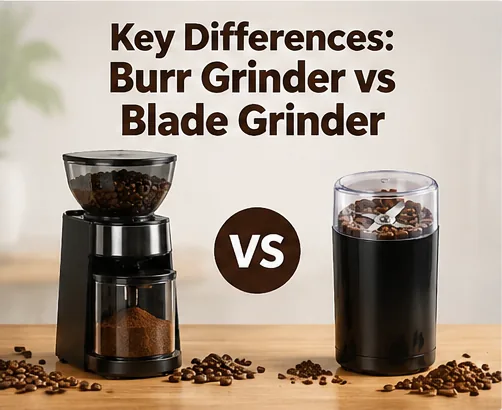
Although both grinders perform the same basic function, their performance differs in several important areas. Burr grinders generally provide better control and consistency, while blade grinders focus on simplicity and affordability.
Grinding Consistency
Grinding consistency refers to how similar the coffee particles are in size. Burr grinders produce more uniform grounds because coffee beans pass through a controlled gap between two grinding surfaces.
Blade grinders produce less consistent results because their rotating blades chop beans randomly. Some particles become very fine, while others remain relatively large. This difference can affect how evenly water extracts flavor from the coffee during brewing.
Grind Size Control
- Burr grinder: Offers adjustable grind settings for different brewing methods.
- Blade grinder: Relies mainly on grinding time to determine particle size.
- Burr grinder: Makes it easier to repeat the same grind setting for consistent results.
- Blade grinder: Requires more manual attention to achieve the desired texture.
- Burr grinder: Provides better control over fine, medium, and coarse grounds.
- Blade grinder: May produce a mixture of different particle sizes even after careful grinding.
Coffee Flavor and Aroma
Grind consistency plays an important role in the final taste of coffee. Burr grinders help produce a more balanced extraction because the coffee particles are closer in size. This allows water to extract flavor more evenly.
Blade grinders can create uneven extraction because smaller particles release flavor faster than larger ones. As a result, the brewed coffee may taste bitter, sour, or less balanced. However, coffee bean quality, freshness, water temperature, and brewing technique also influence the final flavor.
How Does Grinding Consistency Affect Coffee Quality?
Grinding consistency directly influences how water interacts with coffee particles during brewing. When coffee grounds have similar sizes, water can extract their soluble compounds more evenly. Uneven grounds can create an imbalance between over-extraction and under-extraction, affecting the overall taste.
Why Uniform Coffee Grounds Matter
Uniform coffee grounds help maintain a more predictable extraction process. When particles are similar in size, water passes through them at a relatively consistent rate, allowing desirable flavors to develop more evenly.
This is particularly important for brewing methods such as espresso and pour-over, where small differences in grind size can noticeably affect extraction time and flavor. A consistent grind also makes it easier to adjust brewing variables and achieve repeatable results.
How Uneven Grinding Affects Extraction
- Over-extraction: Very fine coffee particles release soluble compounds quickly, which can contribute bitterness and harsh flavors.
- Under-extraction: Larger particles extract more slowly and may produce sour or weak-tasting coffee.
- Uneven flavor: A mixture of particle sizes can create an unbalanced combination of bitter, sour, and weak flavors.
- Inconsistent brewing: Different particle sizes can affect water flow and extraction time.
- Reduced control: Uneven grounds make it harder to repeat the same brewing results consistently.
Burr Grinder vs. Blade Grinder: Pros and Cons
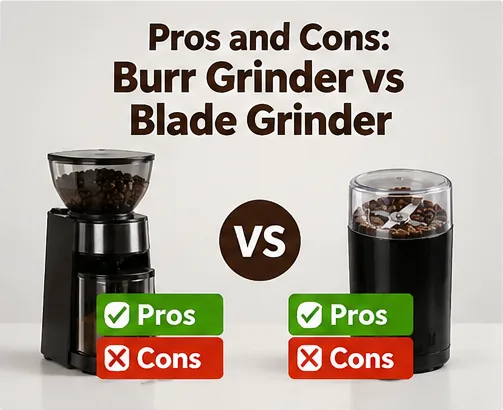
Both grinder types have advantages and disadvantages. The right choice depends on how frequently you make coffee, how much control you want, and how much you are willing to spend.
Advantages of Burr Grinders
- Produce more consistent coffee grounds.
- Offer adjustable grind settings for different brewing methods.
- Provide better control over coffee extraction.
- Help achieve more repeatable brewing results.
- Available in manual and electric models.
- Suitable for coffee enthusiasts who value flavor and precision.
Disadvantages of Burr Grinders
- Generally cost more than blade grinders.
- Some electric models require more counter space.
- Cleaning can be more complicated because coffee particles may collect around the burrs.
- Certain models can produce noticeable noise during operation.
- High-quality burr grinders may require a larger initial investment.
Advantages and Disadvantages of Blade Grinders
Advantages:
- Usually less expensive than burr grinders.
- Compact and easy to store.
- Simple operation with minimal learning required.
- Suitable for occasional home coffee preparation.
- Widely available in different price ranges.
Disadvantages:
- Produce inconsistent coffee particle sizes.
- Offer limited control over grind settings.
- Can generate heat during extended grinding.
- Require manual attention to achieve a suitable grind.
- Make precise extraction more difficult.
Which Grinder Offers Better Grind Size Control?
Grind size control determines how finely or coarsely coffee beans are ground. Different brewing methods require different particle sizes to achieve suitable extraction. Burr grinders generally provide much better control because their adjustable settings change the distance between the grinding surfaces.
Burr Grinder Settings for Different Brewing Methods
Burr grinders allow users to select specific grind settings depending on their preferred brewing method. Although the exact settings vary between grinder models, the following general guidelines can help:
- Espresso: Requires a fine grind to create sufficient resistance during pressurized brewing.
- Pour-over: Usually works best with a medium to medium-fine grind.
- Drip coffee: Generally requires a medium grind for balanced extraction.
- French press: Uses a coarse grind to support immersion brewing and easier filtration.
- Cold brew: Typically requires a coarse grind because coffee steeps in water for an extended period.
Why Blade Grinders Offer Less Control
- Grinding time is the primary way to influence particle size.
- There are no precise mechanical settings for selecting a specific grind size.
- Longer grinding does not guarantee uniform fine particles.
- Short grinding cycles may leave larger pieces of coffee beans.
- Users often need to stop and shake the grinder to redistribute the beans.
- Achieving repeatable results requires experimentation and careful timing.
Does a Burr Grinder Make Better-Tasting Coffee?
A burr grinder can improve coffee quality by producing more consistent grounds and supporting better extraction control. However, the grinder alone does not determine how good the coffee tastes. Bean freshness, roast level, water quality, brewing temperature, and preparation technique also matter.
How Grind Uniformity Affects Flavor
When coffee grounds have similar particle sizes, water can extract their flavors more consistently. This helps preserve the intended characteristics of the coffee beans, including sweetness, acidity, and aroma.
A burr grinder makes it easier to adjust the grind size according to the brewing method. This level of control can help users achieve a more balanced cup and reduce unwanted flavor variations. For people who enjoy specialty coffee, grind uniformity can make a noticeable difference.
Preventing Over-Extraction and Under-Extraction
- Choose an appropriate grind size for your brewing method.
- Avoid grinding coffee too finely when using immersion brewing methods.
- Use a consistent grind setting to maintain repeatable extraction.
- Adjust the grind size if your coffee tastes excessively bitter or sour.
- Keep your grinder clean to prevent old coffee residue from affecting flavor.
- Use freshly roasted coffee beans and grind them shortly before brewing.
Burr Grinder vs. Blade Grinder: Price and Value
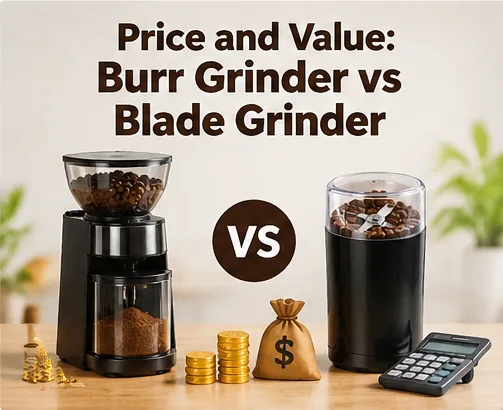
Price is another important factor when choosing a coffee grinder. Blade grinders are generally more affordable, making them suitable for people who want a basic grinding solution. Burr grinders usually cost more because of their adjustable grinding mechanisms and greater control over particle size.
However, the initial purchase price should not be the only consideration. Grinding performance, durability, maintenance, and daily usage also influence the overall value of a grinder.
Initial Purchase Cost
Blade grinders generally have a lower starting price and are widely available in budget-friendly models. They are a practical option for beginners who occasionally prepare coffee at home.
Burr grinders come in a wider range of prices, depending on their design, materials, motor quality, and adjustment system. Manual burr grinders can be relatively affordable, while advanced electric models can be considerably more expensive.
Long-Term Value and Durability
- Burr grinders: Often provide better long-term value for people who regularly prepare coffee.
- Blade grinders: Offer an affordable solution for occasional coffee preparation.
- Maintenance: Both types require regular cleaning to remove coffee residue and maintain performance.
- Durability: The lifespan depends on build quality, motor performance, materials, and usage.
- Replacement parts: Some burr grinders offer replaceable burrs, which can extend their useful lifespan.
- Overall value: A more expensive grinder may be worthwhile if it provides the consistency and control you need every day.
Which Coffee Grinder Is Best for Different Brewing Methods?
Not every coffee brewing method requires the same grind size or level of precision. Espresso, pour-over, French press, and drip coffee all have different grinding requirements. Choosing a suitable grinder can help improve extraction and make the brewing process more predictable.
Best Grinder for Espresso
A burr grinder is generally the better choice for espresso because this brewing method requires precise grind-size adjustments. Small changes in particle size can significantly affect water flow, extraction time, and espresso flavor.
A suitable espresso grinder should offer fine adjustments, consistent grinding, and enough control to help you dial in your preferred shot. Most basic blade grinders cannot provide the precision required for consistent espresso preparation.
Best Grinder for French Press and Pour-Over
- French press: A burr grinder is preferable because it produces more consistent coarse grounds and helps reduce excessive fine particles in the brewed coffee.
- Pour-over: A burr grinder provides better control over medium and medium-fine grind settings, supporting more predictable water flow and extraction.
- Manual brewing: Manual burr grinders are useful for people who want greater control without purchasing an electric machine.
- Budget brewing: A blade grinder can work for basic coffee preparation, although the results may be less consistent.
Best Grinder for Drip Coffee and Cold Brew
For drip coffee, a burr grinder is generally the better option because it produces more uniform medium-sized grounds. This helps maintain consistent extraction during the brewing process.
Cold brew is more forgiving because coffee grounds remain in water for several hours. A blade grinder can work for basic cold brew preparation, but a burr grinder still offers better control over coarse particle sizes. If you regularly prepare large batches, choosing a grinder with suitable capacity can also make the process more convenient.
How to Choose Between a Burr Grinder and a Blade Grinder
Choosing the right coffee grinder depends on your brewing habits, budget, and expectations. Before purchasing one, consider how often you prepare coffee and whether consistent grind size is important to your daily routine.
Consider Your Coffee Preferences
Your preferred coffee style should influence your grinder choice. If you enjoy espresso, pour-over, or specialty coffee, a burr grinder offers the precision needed to experiment with different grind settings.
If you mainly prepare simple drip coffee or occasionally grind beans for everyday use, a blade grinder may be sufficient. Think about the level of control you want before making your decision.
Think About Your Budget and Daily Usage
- Set a realistic budget before comparing different grinder models.
- Consider how frequently you prepare coffee at home.
- Choose a burr grinder if grind consistency is a priority.
- Consider a blade grinder if affordability is your main concern.
- Compare manual and electric models based on your daily routine.
- Look at long-term maintenance costs rather than focusing only on the purchase price.
Check Ease of Use and Maintenance
A grinder should fit comfortably into your daily coffee routine. Blade grinders are generally easier to operate because they have a simple design and fewer adjustable components.
Burr grinders may require more attention when selecting grind settings and cleaning the grinding mechanism. However, many modern models are designed with removable components that make maintenance easier. Check the cleaning instructions, available replacement parts, and overall build quality before purchasing.
Final Verdict: Should You Choose a Burr Grinder or a Blade Grinder?
Both burr grinders and blade grinders can turn whole coffee beans into grounds, but they serve different needs. Burr grinders offer greater precision, better consistency, and more control over the brewing process. Blade grinders provide a simpler and more affordable way to grind coffee at home.
For people who regularly prepare coffee and care about flavor consistency, a burr grinder is generally the better investment. However, a blade grinder can still be a reasonable choice for occasional use and basic coffee preparation.
When a Burr Grinder Is the Better Choice
- You want consistent coffee grounds for better extraction.
- You regularly prepare espresso, pour-over, or French press.
- You prefer controlling grind size for different brewing methods.
- You enjoy experimenting with coffee flavors and brewing techniques.
- You want more repeatable results from one cup to another.
When a Blade Grinder Makes More Sense
- You have a limited budget.
- You prepare coffee occasionally rather than every day.
- You prefer a compact and straightforward appliance.
- You do not need precise grind-size adjustments.
- You are comfortable with some variation in coffee texture and flavor.
Which Coffee Grinder Is Right for You?
If coffee quality, grind consistency, and brewing control are your priorities, choose a burr grinder. It provides greater flexibility and generally produces more predictable results across different brewing methods.
If you simply want an affordable way to grind coffee beans without spending much money, a blade grinder can meet your basic needs.
Ultimately, the best grinder is the one that matches your coffee preferences, brewing habits, and budget. However, if you plan to improve your home coffee experience over time, investing in a quality burr grinder is the smarter choice.

- Espresso Bar Wedding: Ideas, Setup, Costs, and Tips for a Memorable Coffee Experience - November 11, 2026
- How Many Grams of Espresso Beans for a Double Shot? A Complete Brewing Guide - November 11, 2026
- Brasilia Espresso Machine: Features, Performance, Models, and Buying Guide - November 11, 2026