
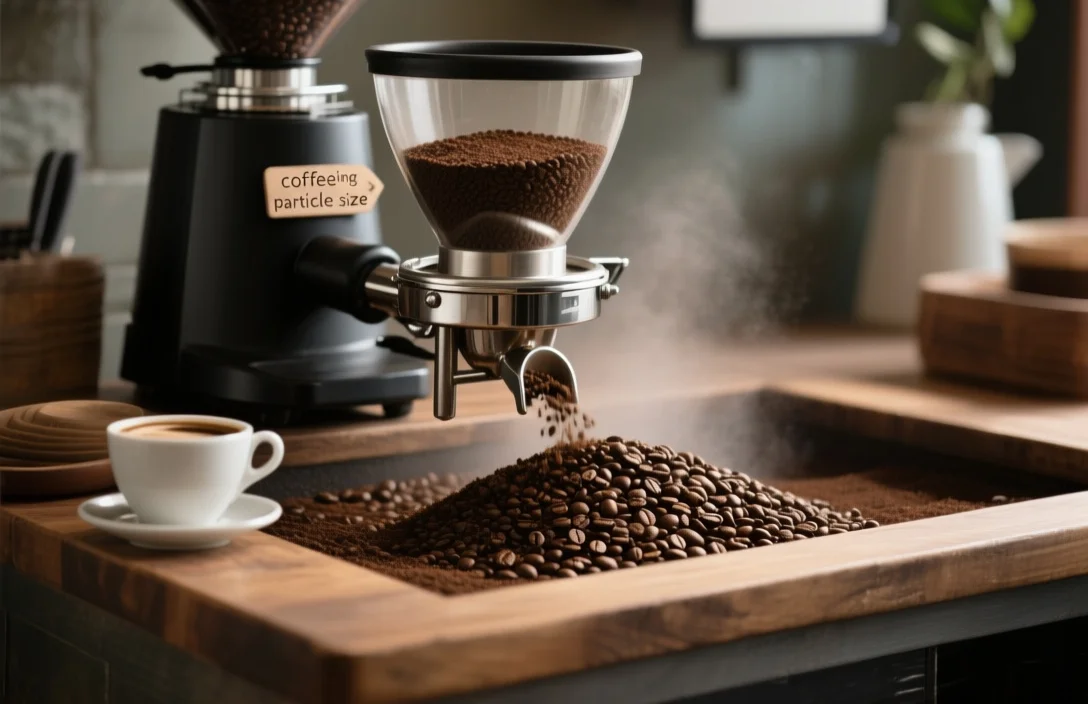
Aim for a median particle size that matches your brew method: espresso targets about 200-300 μm, pour-over sits around 400-700 μm, and French press or cold brew use roughly 1000-1400 μm. Coffee grinding particle size dictates extraction rate and flavor balance; finer particles extract faster and emphasize acidity and bitterness, while coarser particles extract slower and emphasize body and sweetness.
What particle size is – plain and practical
Particle size refers to the measured diameter of ground coffee particles, usually reported in micrometers (μm). Median values (x50) and distribution shape both matter: a median of 212 μm is typical for espresso and a median of 342 μm is common for filter coffee in laboratory measurements. Grind size translates directly to how quickly water dissolves flavor compounds during brewing.
Grinding produces a spread of particle sizes rather than a single number. Expect a bell curve with some fines (very small particles) and some boulders (large chunks). Practical decisions depend on the median plus how many fines are present, because fines speed extraction disproportionately and can cause bitterness if they dominate.
How grind size controls extraction and taste
Finer particles present more surface area to water, increasing extraction rate for a given time and temperature. Faster extraction intensifies acids and bitter compounds first, then sweetness and body as extraction proceeds. Adjusting grind size is the primary way to move extraction into the desirable window for your method.
Coarser particles slow extraction and reduce the proportion of soluble solids pulled into the cup during the brew time. Under-extraction tends to taste sour, thin, or grassy. Over-extraction usually tastes bitter, hollow, or astringent. Matching particle size to brew time and method keeps dissolved solids and flavor balance where you want them.
Micron ranges for coffee grinding particle size
Comparing published grind charts side by side gives a reliable set of starting ranges for home brewing. The table below lists commonly cited median particle ranges and what each range is best for.
| Brew Method | Particle Size (μm) | Best For |
|---|---|---|
| Turkish / ibrik | 100-200 | Traditional simmered cups; very fine powder |
| Espresso | 200-300 | Pressurized extraction, ~25-30 seconds |
| Moka pot | 250-350 | High-pressure stovetop extraction |
| AeroPress (short) | 350-500 | Short immersion or quick press |
| Pour-over | 400-700 | V60, Kalita, Chemex (finer for faster draw-down) |
| Drip machine | 500-800 | Automatic gravity or showerhead machines |
| French press | 1000-1400 | Metal-mesh immersion, 4 minutes steep |
| Cold brew | 1000-1400 | Long steep (12-24 hours) for gentle extraction |
Practical note: those ranges reflect median particle sizes and are intended as starting points. Grinder model, roast level, and recipe will require you to tweak these numbers.
Why particle distribution and fines matter more than a single number
Most grinders do not produce uniform particles; every grind contains a distribution. Consumer blade grinders commonly produce a bimodal distribution with particles ranging roughly from 50 μm up to 2,000 μm for a single target setting. That wide spread causes simultaneous over-extraction (from fines) and under-extraction (from boulders), which yields muddled flavor.
High-resolution particle analysis in industry settings reports average particle sizes and distribution features. Laboratory measurements show espresso x50 around 212 μm and filter coffee x50 around 342 μm. Those medians carry meaning only when accompanied by distribution shape (for example, D10, D90). The D10 value indicates the size below which 10% of particles fall; very small D10 values signal lots of fines.
Grinding technology and burr geometry affect distribution. Larger burrs tend to reduce extremes and deliver a tighter distribution. Flat burrs often produce a more monomodal distribution while conical burrs can produce a more bimodal pattern. Practical taste differences will follow those mechanical differences.
Choosing a grinder
After comparing grinders side by side, pick a burr grinder for control and consistency; skip blade grinders for methods that demand precision, like espresso. Burr grinders crush beans between two surfaces and allow repeatable micron-scale adjustments. Conical and flat burrs each have trade-offs: flat burrs often yield a tighter particle distribution, while conical burrs can be quieter and generate fewer fines at some settings.
Smaller grinders and consumer models will still produce a spread, so expect to use adjustments and multiple grinds to find a sweet spot. Some published mappings translate consumer grinder numbers into target ranges; for example, recommended Baratza settings often used in guides include 12-16 for medium-fine, 18-24 for medium, and 28-32 for coarse. Use those numbers as a starting point, not as absolute rules.
Budget considerations influence burr diameter and motor quality. Larger burrs (65 mm and up) and heavier-duty motors stabilize grind temperature and particle distribution during extended use. For home espresso and frequent use, prioritize a grinder with consistent adjustments and low retention over flashy features.
How to dial in grind size – step-by-step routine
- Choose a baseline recipe using a known brew ratio and target brew time.
- Grind to the recommended starting range for your method (see table).
- Brew and taste the shot or cup, noting clarity, sourness, bitterness, and body.
- If the brew tastes sour or under-extracted, grind finer in small steps.
- If bitterness or harshness appears, move coarser in small steps.
- Record the grinder setting and the change in flavor; repeat until balanced.
- Stabilize by adjusting dose, temperature, or brew time after finding an acceptable grind.
Begin each adjustment with single-click or one-step changes on your grinder and avoid large jumps. Micron-scale changes matter, especially for espresso; tiny adjustments can shift extraction from sour to bitter. Keep a simple log: date, roast, dose, setting, brew time, and tasting notes. That habit dramatically shortens future dialing-in.
Common mistakes, how to spot them, and quick fixes
Grinding too coarse for immersion methods often produces watery, thin cups. Taste will lack sweetness and feel insubstantial. Fix by grinding finer and checking steep time; extend time only after grind adjustments fail.
Overly fine grinds for metal-filter methods produce muddiness and excessive body because fines pass through the mesh. Visual clues include sediment and an oily or sludgy cup. Fix by shifting coarser and using a coarser filter where possible.
Using a blade grinder for espresso or pour-over leads to inconsistent extraction. Signs include an unclear shot with both bitter and sour notes intermingled. Upgrade to a burr grinder or accept a coarser method like French press for blade-ground coffee.
Not adjusting for roast or freshness changes causes inconsistent results. Freshly roasted beans degas and can behave differently in the first days after roast; older beans may require finer grind to reach the same extraction. Tweak settings and taste – don’t assume a setting is permanent.
what tools and numbers mean
Consumer-level measurement of micron distributions is rare. Industry instruments measure ranges from 0.25 µm up to 3,500 µm and provide fast, reproducible particle size distributions for quality control. Those tools report median values, D10, D50 (x50), and D90. Practical home brewing rarely needs a full report, but understanding x50 and the spread is useful.
Expect lab data to show espresso x50 in the low 200s μm and filter x50 in the low 300s μm. Those numbers help translate descriptive cues like “table salt” or “fine sand” into precise targets. Keep in mind that sampling method, grinder retention, and sieving technique change measured distributions. Use measured numbers as a guide, not an absolute guarantee.
When to change grind size for special circumstances
Cold extraction methods and percolators require coarser grinds because reaction time is very long; use the 1000-1400 μm range for cold brew steeping. High-altitude brewing, very dark roasts, or espresso machines with different pressure profiles may need minor grind-step adjustments. Adjust grind before changing dose or temperature, because size is the most direct knob to alter extraction rate.
Single dosing or adjusting dose between shots also affects how fines distribute in the puck or bed. Smaller doses can compact differently and change flow; consider minor grind tweaks when changing dose by more than a few grams. Remember that grind interacts with every other variable – water temperature, agitation, and brew vessel geometry – so change one thing at a time.
quick reference recipes
- Espresso (single origin, medium roast): dose 18 g, yield 36 g, 25-30 s, target 200-300 μm.
- Pour-over (V60, medium roast): 16 g coffee: 250 g water, 2.5-4 min drawdown, target 400-700 μm.
- French press (coarse roast): 30 g coffee: 500 g water, 4 min steep, target 1000-1400 μm.
- Cold brew (coarse grind): 1000-1400 μm, 12-24 hour steep, adjust steep time for strength.
Treat these recipes as starting templates. Change grind in small increments if taste shows sourness, bitterness, or excessive body.
FAQ
What is the single most important grind-related change I can make?
Adjust the median particle size to match your brew time. Grinding finer speeds extraction; grinding coarser slows it. That single change will move your cup out of obvious sour or bitter zones faster than any other tweak.
How large is a micron compared to everyday objects?
A micron (μm) equals one-thousandth of a millimeter. Human hair ranges roughly 50-100 μm in diameter, so a 200 μm coffee particle is a few times wider than a single hair.
Can I measure grind size at home?
Home measurement of particle size distribution requires specialized lab equipment. Practical home metrics are visual texture, timing (brew time), and tasting notes. Use consistent dosing and a grinder log instead of lab measurements for routine adjustments.
Are grind charts exact for every grinder and roast?
No. Grind charts give median ranges as starting points. Grinder design, burr wear, roast level, and bean origin all shift the required setting. Expect to fine-tune by taste.
Why do my shots taste both sour and bitter?
That combination usually indicates a wide particle distribution with many fines and boulders. Fines over-extract and produce bitterness while boulders under-extract and leave sour or underdeveloped flavors. A tighter grind distribution or a different grinder can reduce that problem.
Should I change grind when using a darker roast?
Often yes. Darker roasts extract a bit faster because cell walls are more fragile; coarsening the grind by a small amount can prevent over-extraction and harshness.
Practical verdict and next ste
Match median particle size to your brew method, then focus on distribution and small adjustments by taste. Start with the micron ranges provided, pick one variable to change at a time, and keep a simple log of settings and results. Your next step: pick one recipe from the Practical examples, set your grinder to the recommended starting range, brew, and then adjust finer or coarser by one setting until the cup balances.

- How to Fix a Portafilter: Size, Locking Mechanism, and Troubleshooting Guide - October 22, 2026
- 35 Coffee Machine Parts and Functions: Complete Guide With Names and Uses - October 22, 2026
- 25 Espresso Machine Parts Names and Their Functions Explained - October 22, 2026