
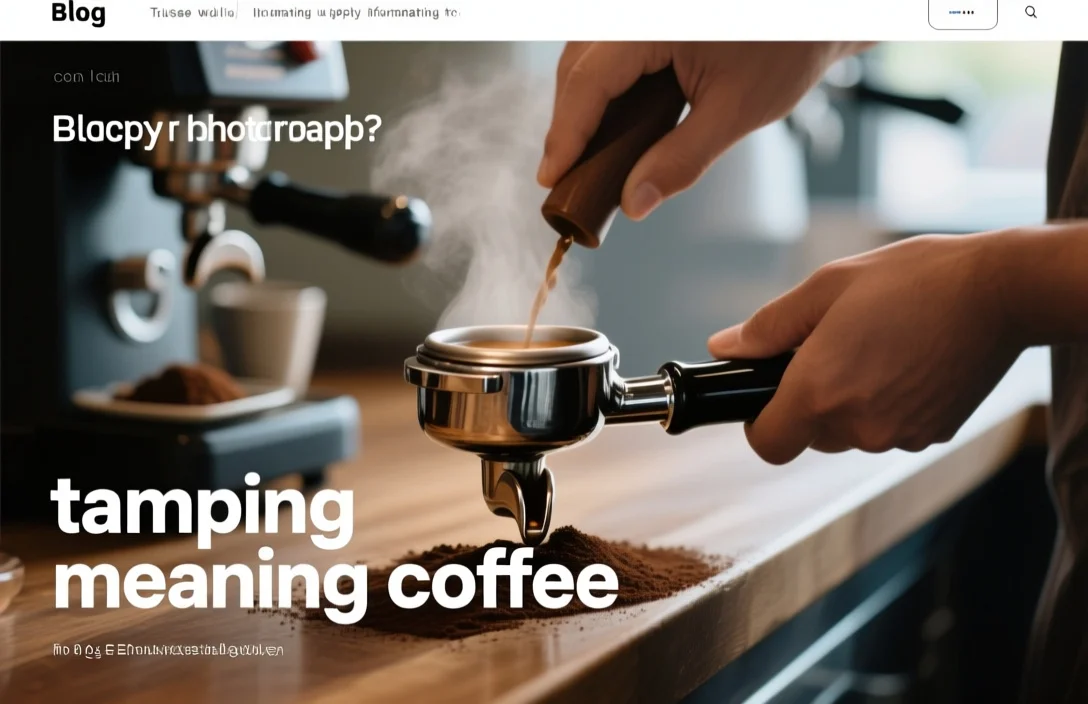
Tamping meaning coffee is the act of compressing finely ground coffee inside a portafilter basket so the grounds form a uniform, level puck for espresso extraction. Do this correctly and you reduce channeling, stabilize flow, and get a more consistent shot; do it poorly and extraction becomes uneven and unpredictable.
Tamping meaning coffee in practice
Tamping in espresso brewing refers specifically to pressing the dosed, ground coffee into the filter basket with a tamper until the surface is flat and the grounds are compacted. The goal is predictable water flow through the puck so that hot water sees an even resistance and extracts soluble flavors uniformly.
Barista practice treats tamping as one part of a three-step puck-preparation chain: dose, distribute, tamp. Dose is the amount of grounds in the basket, distribution means rearranging particles to avoid dense clumps, and tamping sets the final density and level. Machines, grinders, bean age, and tamping technique all interact; changing one without adjusting the others usually changes taste and extraction time.
Why tamping matters for extraction
Water follows the path of least resistance. If the coffee puck has low-density zones, cracks, or an angled surface, water will carve channels through those paths and bypass large areas of coffee. Channeling produces fast, sour-tasting, under-extracted portions alongside slow, bitter, over-extracted pockets. A consistent tamp reduces the chance that a single pathway dominates the flow.
Even pressure and a level surface give the espresso machine a repeatable resistance – that resistance affects shot time and flow rate. Crema formation, body, and clarity of flavors depend on how evenly the water contacts the coffee puck. Small, repeatable changes in tamping technique or pressure can be used to fine-tune extraction once dose and grind are in the right ballpark.
The mechanics: pressure, level, and distribution
Press until the tamper cannot go further is practical advice many baristas use. Some sources note that “somewhere between 20-30 lbs is often quoted” as a tamp pressure guideline; that range is commonly cited for training because it’s a human-feasible force that compacts the grounds without overexerting the wrist. Practice on a kitchen scale or a training rig to feel what 20-30 lbs of force feels like if you want reproducibility.
Level tamping matters at least as much as pressure. A 90-degree – perpendicular – tamper angle produces an even surface and equal resistance. An off-angle tamp creates a thicker mass on one side, which encourages channeling along the thinner edge; that produces asymmetric extraction. Distribution steps before tamping remove large voids and clumps so tamping compresses an already-even bed of grounds.
Tampers come in flat, convex, and calibrated designs; each changes how the puck compacts under force. Flat tampers leave a precise planar surface. Convex faces can compact a bit more at center and reduce edge channeling on shallow baskets. Calibrated tampers click or stop at a preset force to standardize pressure across users. Distribution tools and WDT (Weiss Distribution Technique) needles help arrange particles so the tamp compresses evenly.
Common tamping mistakes and their effects
Uneven tamping is the single biggest manual error most home baristas make. If the tamper is tilted, extraction will favor the low-resistance side. That yields thin espresso on one edge and over-extracted bitterness on the other. An off-center tamper also raises the chance of puck separation and dry spots.
Over-tamping and under-tamping are both issues with trade-offs. Excessive force can compact the puck so tightly that flow becomes obstructed, lengthening shot time and risking over-extraction and bitterness. Too little pressure lowers resistance, allowing water to rush and under-extract acids. Many baristas avoid obsessing over exact pounds of force and instead tamp until the puck resists further compression.
Skipping distribution and tamping right after dosing leaves clumps and air gaps that cause channeling. A dirty basket, wet coffee, or inconsistent grind size complicates tamping’s effect, because tamping can’t turn a poor grind or an incorrect dose into a good extraction.
Bulleted list – frequent tamping mistakes
- Tilting the tamper so the surface is not level.
- Applying wildly different pressure shot-to-shot.
- Bumping the portafilter after tamping and before locking into the group head.
- Tamping over a surface that still contains large clumps or voids.
- Using the wrong tamper diameter for the basket, leaving compressed edges.
Tools compared: tampers, distribution tools, and levelers
Choosing the right tool depends on your goals: portability, repeatability, or pro-level consistency. After comparing common options side by side, the practical trade-offs are ease-of-use, diameter fit, and whether the tool enforces a specific pressure.
| Name | Price/Key Spec | Best For |
|---|---|---|
| Basic flat tamper | budget; solid base, fixed diameter | Home users who want a durable, no-friction tool |
| Calibrated tamper (click or weighted) | mid-range; preset stop or spring mechanism | Users who want consistent tamp pressure across operators |
| Stainless steel pro tamper (ergonomic handle) | premium; heavy base, precision fit | Professional cafés or enthusiasts who tamp many shots daily |
| Distribution tool / leveler | mid-range; adjustable depth, spins to level | People who want smoother initial distribution before tamping |
| WDT needles (needle stirrer) | budget; set of thin needles | Users with clumpy or static-prone coffees who need manual distribution |
| Convex-face tamper | mid-range; slight dome on tamper face | Machines with shallow baskets or for reducing edge channeling |
| Pressurized basket | n/a; built into basket design | Super-automatic or portable machines where tamp consistency is less crucial |
Table notes: “Price/Key Spec” uses relative tiers rather than dollar figures because market prices vary widely by brand and retailer. Fit to the basket diameter is the single, non-negotiable spec: a tamper must match the basket within 0.5 mm for predictable results.
How to tamp a portafilter correctly
- Dose the basket to the target weight or fill level.
- Distribute the grounds by tapping the portafilter, using a distribution tool, or applying a short WDT stir.
- Level the surface with a gentle back-and-forth motion so the coffee sits flat.
- Place the tamper squarely on the puck with the handle vertical.
- Press down using steady force until the tamper cannot go further or you feel firm resistance.
- Polish the surface with a short clockwise twist if desired, but avoid excessive rotation that grinds particles.
- Wipe any loose grounds from the portafilter lip, then lock the portafilter into the group head immediately.
Each step reduces variability before the machine applies water. Practice the motion slowly until muscle memory replicates the same pressure and angle. If you use a scale to dose, tamping becomes the final repeatable variable rather than a compensatory move to fix inconsistent dosing.
How grind, dose, and tamp interact
Grind size and dose often drive tamping’s practical effect. Finer grinds increase surface area and raise puck resistance; the same tamp pressure on finer grounds usually lengthens shot time, so you typically coarsen the grind to compensate. Higher dose raises puck thickness; a deeper puck compresses differently and may need a slightly different tamp technique to keep flow even.
Dose consistency is easier to maintain than tamp pressure for many home users. Establish a target dose by weight, lock it in, then adjust grind before tamp to hit your shot time and taste targets. If taste shows channeling despite careful tamping, revisit grind distribution rather than increasing tamp force.
Machines with high pump pressure or different pre-infusion behaviors change how tamping alters results. Slow pre-infusion and lower pump pressure tend to forgive minor tamp inconsistencies, while powerful, instant high-pressure machines will emphasize channeling faults quickly.
Advanced techniques and when to skip tamping
Some baristas use pressure-profiled tamping methods like “gentle initial tamp, heavier follow-up tamp” to shape puck density. Others prefer anti-channeling strategies such as needle distribution plus a calibrated tamper to remove operator variance. Bottomless (naked) portafilters are a valuable learning tool because they make channeling visible; they don’t change the tamp action so much as display the result.
Pressurized baskets and many single-serve systems exist precisely because they reduce the need for a precise tamp: a pressure-actuated path and specialized basket design create resistance for the water regardless of user tamp variability. Choose these systems if convenience and consistency across inexperienced operators is the priority rather than craft control.
Calibrated tampers and automated tamping stations make sense in busy shops where multiple baristas must produce identical shots quickly. Home users often get better returns by focusing first on dose consistency and grinder quality before buying an expensive calibrated tamper.
Troubleshooting common tamping problems
If your shots run too fast despite correct grind and dose, check for a loose or undersized tamper that left an uncompressed rim. A short, sour shot usually indicates under-extraction, which can be caused by insufficient tamp pressure or overly coarse grind. Conversely, a slow, bitter shot often signals over-extraction from compaction that’s too tight or grind that’s too fine.
Channeling appears as uneven flow from the spouts or as spray from the portafilter; the fix flowchart should start with checking distribution, confirming basket cleanliness, and verifying tamper diameter. Baskets with visible voids show the need for improved distribution before tamping. If you change beans, retune grind and dose rather than chasing tamp pressure as the first adjustment.
Practical checks to run quickly:
- Confirm tamper matches basket diameter within 0.5 mm.
- Re-dose and distribute if the portafilter shows clumps.
- Use a bottomless portafilter to observe where flow focuses.
- Try a calibrated tamper for a few shots to evaluate whether pressure variance was the issue.
Which tamping habits are worth automating or standardizing
Standardize dose by weight and grinder settings before anything else. Automate or control the variable that most often causes operator error: pressure. Calibrated tampers or tamp stations remove human-tamp variance and are cost-effective in multi-barista environments.
Automated tamping on commercial machines prevents wrist injuries for high-volume operators and ensures every shot starts from the same baseline density. Home users can buy a mid-range calibrated tamper or practice tamping on a scale until the same feel is repeatable; that typically yields most of the benefit without spending on a machine.
Practical
A grinder that became slightly finer after cleaning may turn a 28-second double into a 40-second over-extracted syrup. Reducing grind by one step and maintaining the same tamp restores balance more predictably than increasing tamp pressure. Swapping a convex tamper to a flat tamper on a shallow basket can reduce edge-channeling in one or two shots, showing how tool choice and tamp face interact.
If a single operator sees shot time drift across a set of pulls, check for inconsistent dosing first. If dose is constant, inspect tamp angle and whether the tamper skirt is hitting the basket lip before full compression. Small technique corrections often fix flavor issues faster than changing beans or pump pressure.
FAQ
Do I always need to tamp for espresso?
Most traditional espresso setups require tamping because they use non-pressurized baskets and rely on the user to set puck density. Machines with pressurized baskets or capsule systems often bypass the need for a user tamp.
How hard should I tamp?
Many baristas train with a practical target: press until the tamper no longer moves easily. Somewhere between 20-30 lbs is often quoted as a common guideline, but consistency between shots matters more than hitting an exact pound count.
Can tamping damage my portafilter or tamper?
Using a tamper that is too large or banging the tamper against the basket lip can cause wear. Keep tamper diameter matched to the basket and avoid excessive lateral force that stresses the portafilter handle.
Will a calibrated tamper make my espresso better?
A calibrated tamper removes one source of variability – pressure – so it makes sense where operator inconsistency is the main problem. It doesn’t fix wrong dose, poor grind, or stale beans.
Does tamping replace distribution?
Tamping compresses the bed; it does not reliably distribute particles. Distribution tools or a deliberate WDT stir before tamping give a more even starting bed, which improves tamp results.
What’s the difference between a flat and a convex tamper face?
A flat face leaves a planar surface and is predictable in tall baskets. A convex face compresses slightly more at the center and can reduce edge channeling in some shallow-basket setups. Try both if channeling persists.
A short practical verdict and next ste
Tamping is the simple, repeatable act of compressing coffee grounds to create even resistance for espresso extraction. For most home users, lock down dose and grind first, then practice tamping until your pressure and angle feel consistent. If you want measurable repeatability across different operators, test a calibrated tamper or a distribution tool; otherwise, practice on a scale and use a bottomless portafilter to learn what poor tamping looks like.

- How to Fix a Portafilter: Size, Locking Mechanism, and Troubleshooting Guide - October 22, 2026
- 35 Coffee Machine Parts and Functions: Complete Guide With Names and Uses - October 22, 2026
- 25 Espresso Machine Parts Names and Their Functions Explained - October 22, 2026