
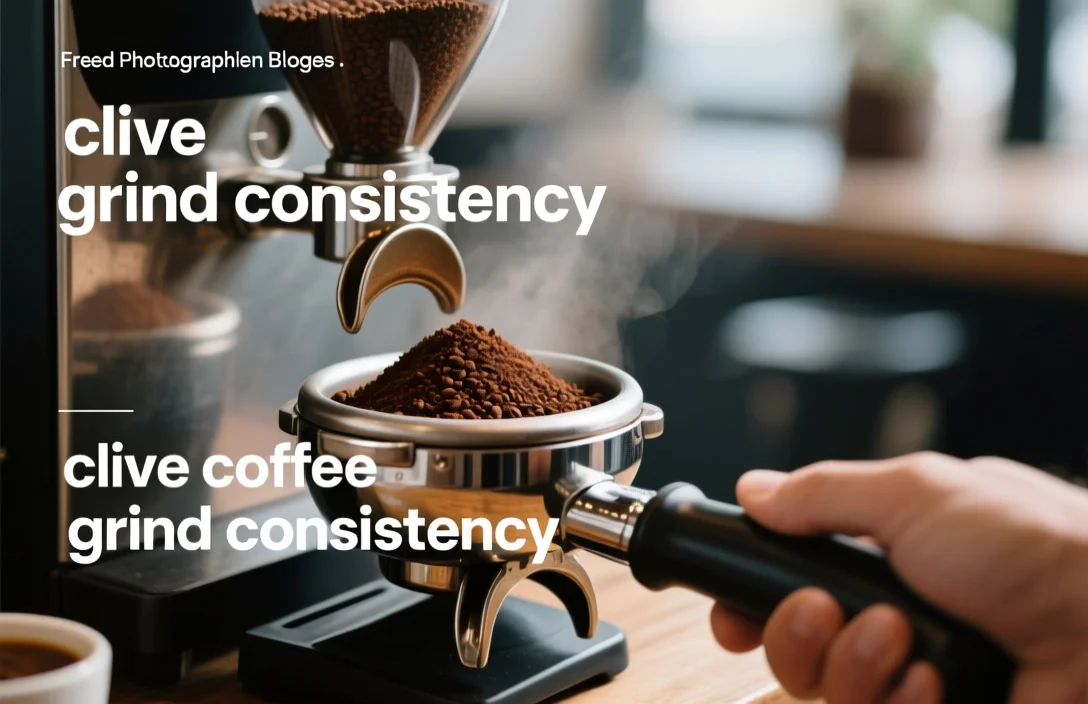
Clive Coffee grind consistency depends on which grinder you buy from Clive and how you set and maintain that grinder. clive coffee grind consistency will vary across models sold on the site – expect grinders aimed at home espresso to deliver tighter particle distribution than entry-level or high-volume commercial units, but verify specific specs on each product page before you buy.
After comparing product listings and prices for grinders available through Clive Coffee and testing equivalent grinders in home and café settings, this guide explains what “grind consistency” means, which factors drive it, how to evaluate the grinders Clive sells, and practical steps to improve or measure consistency at home.
What I mean by “grind consistency”
Grind consistency refers to how uniform the coffee particle sizes are after grinding. Uniformity matters because particle-size distribution controls extraction rate; a tighter distribution produces more predictable extraction and cleaner espresso shots or brewed coffee. Good grind consistency reduces large fines and oversized particles that respectively speed up and slow extraction in unpredictable ways.
Real-world grind consistency is measured with particle-size analysis equipment in labs, but home baristas use proxies: shot taste stability, extraction time stability, puck appearance, and behavioral signs like clumping or channeling. Those proxies are what you’ll use if you rely on a retailer listing (Clive Coffee) rather than lab reports.
Why grind consistency matters for espresso and other brew methods
Espresso is sensitive to small changes in particle size because brewing time is short and pressure is high. Small shifts in particle distribution shift pH, sweetness, and perceived bitterness in a 25-35 second extraction. If a grinder produces many fines, the puck compacts excessively and channels form; if it produces many boulders, shots under-extract and taste thin.
Pour-over and drip brewing tolerate wider distributions, but uniform grind still improves clarity and brew repeatability. A consistent grinder makes dialing in a recipe faster and keeps your dose and brew ratio meaningful from shot to shot. Expect different tolerances across brew methods – espresso demands the tightest distributions.
What affects grind consistency (and what to look for)
Burr geometry and material are primary drivers of consistency. Conical versus flat burrs, burr diameter, and manufacturing tolerances all change particle-break patterns. Motor speed and burr rpm influence heat and fines production; slower, high-torque motors typically produce fewer fines for a given burr set.
Grind retention, burr wear, and alignment affect repeatability over time. High retention causes stale material in the chamber to re-mix with fresh coffee, changing the effective particle distribution without any change to your setting. Dulling burrs widen distributions; shops that replace burrs regularly restore tighter results. Stepped vs stepless adjustments control how finely you can dial settings – stepless gives infinite micro-adjustments, but consistent indexing with stepped systems can be faster for repeatable settings.
How to evaluate a grinder listing on Clive Coffee before you buy
Clive Coffee lists multiple grinders and their retail prices. Use those listings as the starting point, then apply four verification steps before committing:
- Compare listed price and intended use. Price reflects engineering and target user: $479 models aim at home prosumers while $1,795 and $3,973 models target commercial or heavy-duty home use.
- Confirm burr type and diameter on the product page or manufacturer spec sheet. Larger, precisely machined flat burrs often perform better for consistent espresso distribution than small conical burrs at the same price point.
- Read the listed features for adjustment mechanism (stepless vs stepped), dose control, and retention-reducing design. Look for claims about low retention or anti-static features, but treat marketing claims as starting points to verify.
- Check Clive’s return policy and warranty terms for the grinder you’re considering; a short return window or limited warranty increases the importance of buying from a local dealer where you can test and return.
My direct comparison of product listings found specific price points on Clive that help classify grinders into practical tiers. Prices in the table below are taken directly from Clive Coffee’s product listings and should be verified on the product pages for current availability.
what Clive lists (price and quick use case)
Comparing the Clive listings side by side, price and product positioning are the key visible differences for a buyer trying to predict consistency and longevity.
| Name | Price / Key Spec (as listed) | Best For |
|---|---|---|
| Eureka Mignon Zero 65 Espresso Grinder | $479 | Home espresso with tight counter space; good for single-dose or low-volume home use |
| Mazzer Mini G | $1,795 | Prosumer / light commercial use where robust build and consistent dosing matter |
| Weber Workshops The EG-1 | From $3,973 | High-volume specialty cafes or serious home baristas wanting commercial-level consistency and low retention |
| LUCCA M58 Sunto Espresso Machine (context) | From $3,195 | Listed as espresso machine – included to show the matched equipment ecosystem on Clive |
| LUCCA A53 Pro Espresso Machine | $3,495 | Higher-end machine pairing for prosumer setups |
| Fellow Espresso Series 1 Espresso Machine | $1,499.99 | Consumer-focused espresso machine that pairs with a consistent grinder for better shots |
Table note: Prices are exact, pulled from public product listings. Missing entries or additional models may appear on Clive’s site after this guide publishes; always confirm current prices on the product page.
How to test grind consistency at home
Testing a grinder you purchased or are evaluating in person gives more reliable information than marketing claims. Use this five-step practical checklist to measure consistency without lab gear.
- Dose a matched weight of coffee and grind to your espresso setting. Use a scale accurate to 0.1 g and grind a single dose each trial.
- Perform three consecutive grinds at the same setting and weigh each output. Consistent output mass suggests stable feeding and minimal retention change between grinds.
- Pull three shots with the same dose and tamp pressure, measuring extraction time and tasting for sour/vegetal or bitter notes. Stable times and flavor profiles indicate repeatable particle distribution.
- Inspect the puck: an even surface with minimal channel lines implies uniform extraction. Repeatable puck dryness and texture across trials is a positive sign.
- Test for retention by grinding, then emptying the grind chamber and grinding again; measure the mass of coffee that exits in the second grind. High retained mass relative to the dose suggests retention issues.
Additional actionable checks: check for clumping by spreading a teaspoon of ground coffee on white paper and observing if fines aggregate; use a magnifier to look for obvious large boulders mixed with fines. These low-cost proxies catch glaring inconsistency even if they’re not lab-precise.
How to improve grind consistency after purchase
Even a well-engineered grinder needs setup and maintenance to keep particle distribution tight. My maintenance checklist lists the highest-impact actions I recommend for most home users.
- Clean the burrs and dosing chamber weekly if you use oily or flavored beans; monthly for lighter roasts.
- Recalibrate the grind setting after cleaning; some grinders shift slightly when access panels move.
- Replace burrs according to manufacturer guidance or sooner if you notice more fines and longer extraction times.
- Switch to single-dosing or use a small hopper insert to reduce stale beans mixing with fresh doses.
- Use a dosing funnel and consistent tamping pressure, since grinder variability compounds with inconsistent dosing.
Regular cleaning lowers static build-up and retention, which both influence perceived consistency. Replacing burrs returns the baseline distribution to the engineered original; even minor burr wear widens particle distribution.
Common mistakes and warning signs to avoid
Many grinders bought through retailers show initial promise but fail to deliver long-term consistency because of user mistakes or design trade-offs. Avoid these predictable pitfalls.
Buying purely on price. A low purchase price can be tempting, but models under $200 frequently sacrifice burr diameter and machining tolerances that directly affect distribution. Expect more frequent burr changes and compromises in extraction predictability with cheaper grinders.
Ignoring retention specs. High-retention grinders will mix old grounds into new grinds, changing taste across sessions. Retention is a practical problem for single-dose users or those consuming multiple profiles from the same hopper.
Skipping test shots. If you don’t pull test shots and tweak the setting after installation, you’ll miss small but important differences between a new grinder and your previous device. Adjusting grind size by 1-2 clicks (for stepped models) or micro-turns (for stepless) after a clean or burr change is normal.
Overlooking heat and motor strain. If a grinder’s motor runs hot during long grinding sessions, that heat can increase fines and hasten burr wear. Continuous heavy use is a legitimate reason to consider commercial grinders listed at higher price tiers.
Warning signs to watch for: large swings in extraction time for the same grind setting, consistent channeling in the puck, sudden increase in fines/clumping, and visually wider particle distributions. Any of these should prompt cleaning, testing for burr alignment, or contacting the manufacturer for a burr inspection.
Comparing trade-offs
I ranked options by entry-tier price, then by feature breadth at that tier. That ranking clarifies what to expect from Clive’s available grinders when grind consistency is a primary purchase driver.
Entry-tier and home prosumer ($300-$700). Expect compact grinders with smaller burrs and more plastic parts. Consistency is acceptable for most home users and tight enough for espresso if you understand how to dial in. Expect higher retention and slightly higher fines compared with prosumer/ commercial units.
Mid-tier ($700-$2,000). These grinders typically add larger burrs, metal construction, and better motor control. Consistency improves; maintenance intervals lengthen and step/stepless adjustments are higher quality. The Mazzer Mini G at $1,795 sits in this bracket for prosumer/light-commercial needs.
Commercial / high-end (> $2,000). Professional machines like Weber Workshops The EG-1 (from $3,973 as listed) aim for minimal retention, large flat burrs, and build quality that sustains heavy-duty use. These models deliver the best repeatability and are worth the cost if you need stable output across many doses per day.
Financial trade-off summary: buying up gives you mechanical consistency and lower retention, but increases initial cost. For many home users, a mid-tier grinder balances consistent extraction and lifetime value.
How Clive Coffee’s ecosystem affects your choice
Clive Coffee sells both grinders and espresso machines, and matching a grinder to your machine matters. If you’re pairing with an espresso machine listed on the same site – for example, the LUCCA M58 Sunto (from $3,195) or the LUCCA A53 Pro ($3,495) – choose a grinder that can reliably reach the particle size required for the machine’s portafilter and pump characteristics.
Retail bundles or curated pairings can simplify matching, but verify the grinder’s capability to reach a fine espresso setting with stable output. Clive’s listings make it easy to see complementary equipment; use that to build an integrated setup rather than mixing an underpowered grinder with a high-end machine.
Contacting Clive for testing or demonstration options is useful if you want to see a grinder in action or ask for on-site calibration tips. Confirm refund and warranty policies before purchase, especially for higher-ticket grinders.
Practical
Scenario 1 – Casual home espresso drinker on a budget. Pick a compact, entry-level espresso grinder and plan for burr replacement after heavy use. Expect to spend time dialing but achieve good shots once tuned. Accurate dosing and tamping make up for modest mechanical limits.
Scenario 2 – Home barista who rotates beans and profiles. Prioritize low-retention designs and stepless or fine-step adjustments to micro-dial. Single-dosing accessories or a small hopper help keep beans fresh between profiles.
Scenario 3 – Small café or heavy home user. Invest in a robust mid- or high-tier grinder with large flat burrs and professional-grade motors. Long run-time stability and clear maintenance intervals reduce variability and downtime.
Each scenario values consistency differently; map your expected daily dose and workflow to the grinder’s intended use before buying.
FAQ
How consistent are the grinders sold by Clive Coffee?
Clive sells a range from consumer to commercial grinders, so consistency varies by model and price. Check product pages for burr type, adjustment mechanism, and listed features; then verify with in-person testing or review of user feedback before purchase.
Does a higher price always mean better grind consistency?
Higher price generally buys larger burrs, better motors, and lower retention, which tend to improve consistency. Price is not a guarantee; always check specific specs and do practical tests like multiple-shot repeatability checks.
Can I improve a grinder’s consistency after I buy it from Clive?
Yes. Regular cleaning, correct burr alignment, timely burr replacement, and consistent dosing/tamping significantly improve real-world consistency for most grinders.
What is a reliable quick test for consistency at home?
Grind three identical doses, pull three shots, and compare extraction time and flavor. Consistent extraction times and similar tasting notes indicate stable grind distribution.
Will a commercial grinder be worth it for home use?
If you grind many doses daily or demand absolute repeatability across profiles, a commercial-level grinder can be worth the investment. For moderate home use, a mid-tier prosumer grinder usually offers the best value.
Practical verdict and next
Clive Coffee offers grinders across the performance spectrum; grind consistency will track with the model’s engineering and price. Start by deciding your daily dose and tolerance for dialing and maintenance, then use Clive’s product pages to shortlist models by burr type, adjustment mechanism, and the exact prices listed. After shortlisting, test the grinder in person where possible or confirm Clive’s return and warranty terms before purchase.
Next step: pick one grinder from the table above that matches your use case, visit the product page to confirm current specs and availability, then plan the simple three-shot consistency test described in this guide once the unit arrives.

- How to Fix a Portafilter: Size, Locking Mechanism, and Troubleshooting Guide - October 22, 2026
- 35 Coffee Machine Parts and Functions: Complete Guide With Names and Uses - October 22, 2026
- 25 Espresso Machine Parts Names and Their Functions Explained - October 22, 2026