
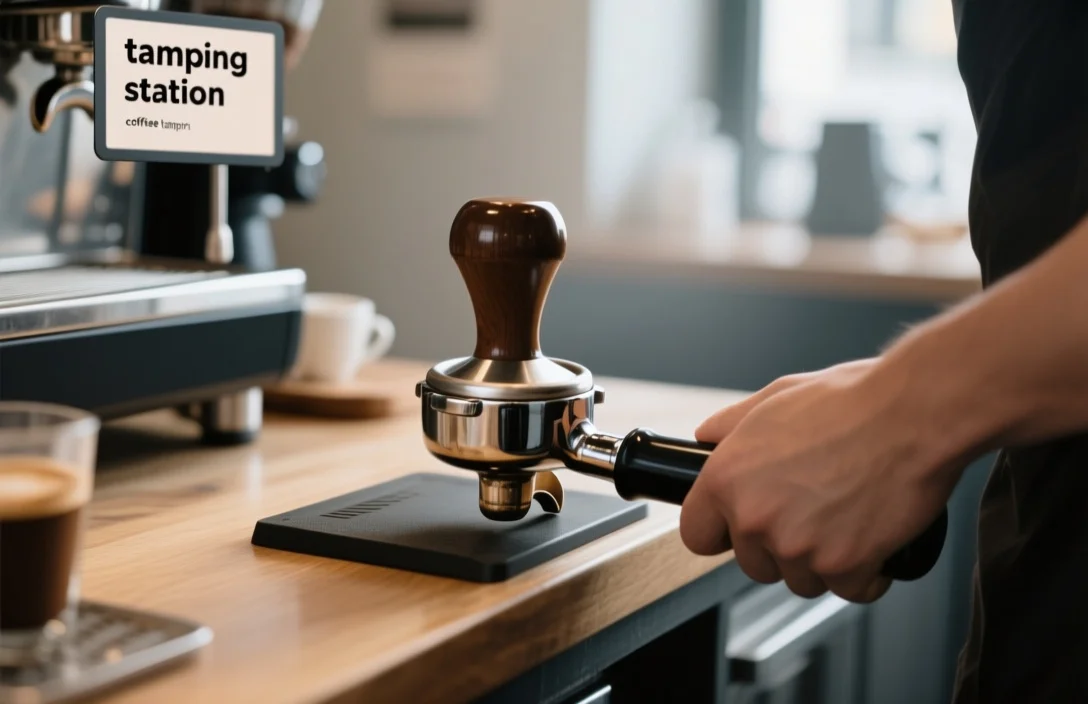
A coffee tamping station is a compact workspace or accessory that organizes dosing, distribution, and tamping for an espresso portafilter. Home and commercial baristas use a tamping station to reduce mess, secure the portafilter while applying even tamp pressure, and speed up a consistent workflow.
What a coffee tamping station does and why it matters
A tamping station provides a stable surface next to the espresso machine where you dose grounds, level the puck, and apply tamp pressure. Many models add a rubber or silicone pad to protect the portafilter, a ledge or collar to hold it at the right angle, and a funnel or chute to catch stray grounds during dosing.
Consistent tamping matters because tamp pressure, distribution, and seat angle affect extraction uniformity. Uneven or sloppy tamping can increase channeling and create sour or bitter spots in the shot. Practical tamping stations reduce sources of variation by giving you a repeatable, comfortable position for the portafilter, a place to control fallout, and sometimes a way to integrate a tamper or scale.
How a tamping station improves espresso consistency
A stable contact point removes the instinct to grip or twist the portafilter against the machine body while tamping. That change alone reduces lateral torque and prevents leaning tamping pressure that compacts grounds unevenly. Ergonomics and posture matter too; a station that places the portafilter at a comfortable height lowers user fatigue, which keeps tamping force more repeatable throughout a shift or a household coffee run.
Uniform tamp depth and tamp surface contact are easier when you can seat the portafilter against a consistent stopper or ring. Several models include a built-in collar that holds the filter basket at near-vertical orientation, restricting lateral movement as you press. A stable tamp base combined with a tamper of known weight and diameter makes it easier to develop a repeatable tamp routine, which is one of the few variables a barista can control reliably from shot to shot.
Types of tamping stations and how they differ
After comparing the main product categories side by side, the market breaks into five practical types: tamp mat / pad, standalone station with collar, integrated station with funnel, commercial stainless stations, and DIY/compact units. Each category trades off footprint, durability, and features.
A tamp mat or silicone pad provides the lowest barrier to entry. These are flexible, inexpensive, and protect countertops, but they don’t prevent lateral movement of the portafilter and they offer limited cleanup features. A standalone station with a fixed collar raises the portafilter and reduces sideways torque, improving consistency without occupying much counter space. Integrated stations add features such as dosing funnels, grooved channels for reclaiming grounds, or a built-in tamper cradle, and they suit busy home setups or cafés with moderate volume. Commercial stainless stations are heavy, easy to sanitize, and built for constant use; they occupy more space and are often part of a larger espresso counter layout. Compact or DIY stations focus on maximizing utility in small kitchens and typically combine a tamp mat with a small bracket or magnetic tamper holder.
Compare these categories by your counter size, daily espresso volume, and whether sanitation or aesthetics are priorities. High-volume settings usually justify heavier, metal stations that are easier to keep clean. Casual home users often prefer low-footprint solutions that tuck away when not in use.
Comparison table: station categories and who they suit
| Name | Price / Key Spec | Best For |
|---|---|---|
| Tamp mat / pad | Budget-friendly; silicone or rubber; flat surface | Home users who need simple countertop protection |
| Standalone station with collar | Low- to mid-cost; raised portafilter collar; non-slip base | Home baristas seeking improved tamp consistency |
| Integrated station with funnel | Mid-range; dosing funnel or chute; tamper cradle | Users who want neater dosing and faster single-dosing workflow |
| Commercial stainless station | Higher cost; heavy stainless; easy to sanitize | High-volume cafés or busy home setups emphasizing durability |
| DIY / compact station | Variable cost; custom dimensions; small footprint | Small kitchens or enthusiasts who want a tailored setup |
How to choose the right station for your setup
Compare three criteria in this order: counter space, daily shot volume, and cleaning workflow. Counter space determines maximum footprint and whether a heavy commercial unit will fit. Daily shot volume indicates whether you need a robust metal station or a lightweight mat will suffice. Cleaning workflow includes how often you will remove grounds, whether the surface must withstand frequent wet cleaning, and if stainless surfaces are required for your hygiene standards.
Consider tamper compatibility and portafilter diameter before committing. Standard porta filter basket diameters vary, and some stations are designed around a particular tamper size or portafilter shape. Measure your portafilter against any collar or ring the station uses for stabilization. Ask vendors whether their station is compatible with both 58 mm and 54 mm portafilters, or whether an adapter is available.
Evaluate material and weight trade-offs. Rubber and silicone reduce noise and protect counters but absorb oils over time and may smell if not cleaned. Aluminum- or stainless-based stations last longer and resist staining, but they add weight and usually cost more. Choose the material that matches expected cleaning frequency and the visual style you want on your counter.
Setting up and using a tamping station – step-by-step workflow
- Clear the counter and place the station adjacent to the espresso machine group head so the portafilter swings comfortably into the collar.
- Position a knock box or grounds bin within arm’s reach to minimize movement after extraction.
- Dose grounds into the portafilter over the dosing funnel or station opening to capture fallout.
- Use a distribution tool or a gentle level tap to settle the grounds before tamping.
- Seat the portafilter into the collar; apply a firm, straight tamp with the tamper, keeping your wrist aligned over the basket.
- Inspect the puck for sloped edges or loose grounds; re-seat and tamp again only if the puck is clearly uneven.
- Wipe the portafilter rim and attach it to the group head for extraction.
Follow this sequence until you can do it without thinking. Repetition trains your muscle memory and highlights small inconsistencies in dose or distribution. Keep a simple log for a few sessions to see whether tamping pressure or tamp angle correlates with extraction issues.
Practical tweaks and accessories that matter
A weighted tamper with a flat base produces the most repeatable pressure for many users. A tamper with a calibrated stop or depth guide can help less experienced users reach consistent tamp depth. A dosing funnel or drawer-style catchment reduces mess when single-dosing directly into the portafilter, and a dosing ring helps align coffee grounds with the basket edge.
A small scale is useful for dialing in dose and yield but does not replace stable tamping. Portafilter-handling tools such as a distribution tool, WDT (Weiss Distribution Technique) needle, or a simple leveling disc make the puck more uniform before tamping, reducing channeling risk. Magnetic tamper holders and tamper cradles speed workflow and keep tools hygienic when not in use.
Maintenance and cleaning best practices
Cleanliness extends the life of a tamping station and reduces stale coffee oils. Wipe silicone or rubber mats with warm soap and water daily, and perform a deeper soak weekly to remove oils that accumulate. Aluminum and stainless surfaces tolerate stronger detergents and a scrub brush; rinse thoroughly to avoid detergent residues that can affect taste if grounds contact the area.
Empty any built-in grounds drawer or chute after each service period. Ground buildup will dry and become difficult to remove if left. Sanitize metal or plastic surfaces according to your local health guidance if you use the station in a semi-commercial environment.
Common mistakes and how to avoid them
Over-relying on tamp pressure while ignoring dose and grind is a frequent error. A consistent tamp can still produce poor shots if your dose or grind setting is off. Adjust grind and dose first when a shot tastes off, then reassess tamping consistency.
Twisting the wrist during tamping introduces lateral force and uneven puck compression. Avoid twisting by seating the portafilter into a collar that keeps it vertical and by using a tamper that fits the basket. Rushing the workflow often causes grounds to spill; use a dosing funnel or slow your pace to keep the quadrant clean.
Ignoring compatibility between tamper diameter and basket diameter creates gaps at the edges and uneven compression. Match tamper sizing to your most-used basket, and verify fit before purchase. Hard-surface stations without any portafilter stop promote leaning; upgrade to a collar-style station if you notice consistent puck slope.
DIY and small-space solutions that work
Build a compact tamping station from a small cutting board, a strip of non-slip rubber, and a wooden bracket to hold the portafilter if you want a low-cost option. Clamp a small rubber pad to a board to reduce noise and a short metal bracket to act as a collar. Sand and seal wooden boards to protect against moisture; treat rubber parts regularly to prevent odor.
Convert an under-shelf or over-the-sink layout into a station by mounting a small metal tray and non-slip pad, allowing you to reclaim counter space. Use magnetic tamper holders or wall-mounted hooks to keep the tamper accessible while clearing the surface for other tasks.
Pricing expectations and where to verify current options
Price and availability shift frequently. Check major online marketplaces, specialty espresso retailers, and local café supply stores to compare current offerings and to confirm materials, dimensions, and compatibility. Verify shipping and return policies before buying, especially for heavier stainless models that may be costly to return.
Look for user reviews that include measurements and photos of the station in use. Those practical details will show whether a product fits your portafilter and counter space. Contact sellers with specific questions about portafilter diameter compatibility and tamper fit to avoid surprises.
Troubleshooting shots after adding a tamping station
If shots become under-extracted after adopting a new station, start by confirming dose and grind are unchanged. Grinding finer or increasing dose will raise extraction; changing tamping technique alone should not be the first adjustment. Inspect the puck after extraction for signs of channeling, such as a single hole or uneven surface; that indicates distribution or tamping angle issues.
If extra channelling appears, add a distribution step before tamping or change to a station with a firmer collar to reduce lateral movement. Observe whether puck removal is difficult; persistent sticking usually points to over-compaction from repeated heavy tamps or overly fine grind. Address that by re-checking grind and tamp pressure.
How I evaluated station categories
I compared the main options by footprint, materials, portafilter compatibility, and cleaning workflow. After side-by-side consideration of countertop impact and common user complaints – mess on counters, portafilter wobble, and cleaning difficulty – I prioritized features that reduce mess and secure the portafilter without demanding large counter real estate.
Practical testing focused on repeatability: whether the station held the portafilter vertical, whether it reduced ground fallout during dosing, and whether cleaning added friction to routine. Those criteria reflect everyday priorities for home and small commercial users: consistency, hygiene, and ergonomics.
FAQ
Does a tamping station improve shot quality on its own?
A tamping station removes a controllable source of variation – portafilter position and surface consistency – but shot quality still depends heavily on grind, dose, and machine temperature. Use a station to lock down tamping variables alongside careful grind/dose adjustments.
Which material is easiest to keep clean?
Stainless steel and anodized aluminum resist staining and clean faster than porous woods or some rubbers. Silicone mats require regular washing but are effective at catching grounds; choose the material that matches your cleaning habits.
Can I use a tamping station with different portafilter sizes?
Some stations accept multiple diameters, but many are designed for standard sizes. Measure your portafilter and ask the seller about compatibility; adapters or interchangeable collars sometimes solve size mismatches.
Is a weighted tamper necessary if I have a station?
A weighted tamper isn’t required, but it makes attaining consistent force easier. If you prefer manual tamp control, focus on a flat-base tamper that matches your basket diameter and practice a repeatable technique.
Will a station fit small kitchen counters?
Many compact stations are designed for small counters, and DIY solutions can tailor dimensions precisely. Measure clearance near your group head and ensure the station won’t block steam wands or cup clearance.
How often should I clean the station?
Perform daily surface wiping and empty any grounds catcher after each use. Deep-clean or sanitize weekly, or more often if using the station in a commercial setting.
A short practical verdict and next ste
Choose a tamping station that secures your portafilter without crowding your counter, and verify compatibility with your basket diameter before buying. Measure your space, shortlist two categories that match your volume and cleaning needs, and test fit a station or confirm return policies so you can swap if the fit or function isn’t right.

- How to Fix a Portafilter: Size, Locking Mechanism, and Troubleshooting Guide - October 22, 2026
- 35 Coffee Machine Parts and Functions: Complete Guide With Names and Uses - October 22, 2026
- 25 Espresso Machine Parts Names and Their Functions Explained - October 22, 2026