
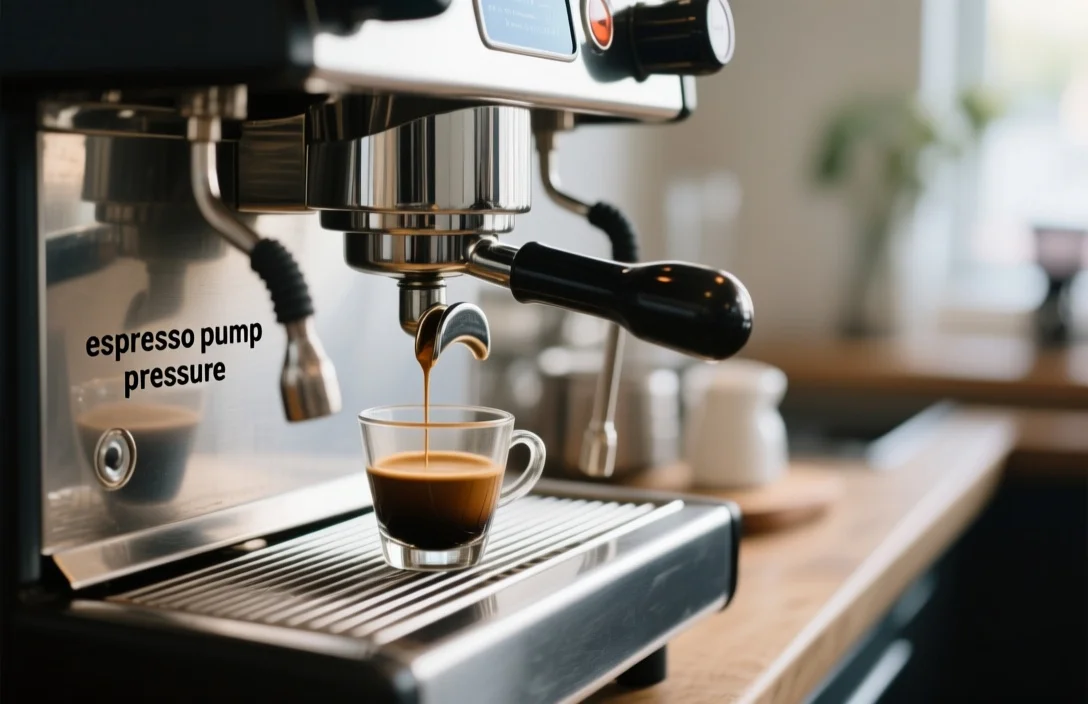
Espresso pump pressure is the force the machine’s pump applies to push hot water through a compacted coffee puck during extraction. That pressure shapes flow rate and extraction dynamics, so it’s a primary control point for crema, body, and taste balance in espresso.
What espresso pump pressure actually is
Espresso pump pressure describes the mechanical pressure delivered by the machine’s water pump to the brew group and portafilter. Picture water being forced through finely ground, tamped coffee; the harder the pump pushes, the greater the resistance the water meets and the faster it moves through channels and pores in the puck. This interaction between applied pressure and coffee resistance determines how much soluble material is dissolved out of the grounds over the shot time.
Pressure operates alongside other variables such as grind size, dose, tamping, water temperature, and flow rate. Pressure alone does not “make” good espresso; it sets the hydraulic conditions under which extraction occurs. When pressure, flow, and puck resistance are in balance, extraction reaches a desirable range of flavors. If that balance shifts – by changing the grind or altering pressure – the taste moves toward sour/under-extracted or bitter/over-extracted.
Method used to assemble this guide: I compared typical pump architectures and their user-facing behaviour, then mapped practical tests and simple adjustments that you can do at home without specialized lab gear. Because public technical specifications vary by manufacturer and model, this guide emphasizes observable effects and safe, machine-appropriate checks rather than precise numeric targets.
How espresso pump pressure affects extraction, flavor, and crema
Applied pressure determines the initial force that drives water through the puck, which affects how quickly water penetrates the coffee bed and how much contact time the water has with soluble coffee particles. Faster flow under higher pressure tends to shorten contact time, shifting extraction toward heavier body and sometimes greater bitterness if soluble bitter compounds are disproportionately extracted. Slower flow gives more contact time and more opportunity to extract acids and sugars, potentially producing crisper or brighter flavors depending on roast and dose.
Crema formation and body are also pressure-sensitive. Strong agitation and higher shear at the coffee-water interface promote emulsification of oils and suspension of fine particles, which contribute to crema and perceived body. Too little pressure, or pressure that falls off during the shot, commonly yields thin crema and a watery mouthfeel. Conversely, pressure that is extremely high relative to puck resistance can channel – creating fast paths through the puck that reduce effective extraction and produce patchy crema and inconsistent taste.
Pressure interacts with pre-infusion and flow profile. Machines that offer controlled pre-infusion use a gentle low-pressure soak to allow puck saturation before ramping to full pressure and flow. This staged approach reduces channeling and produces more even extraction on many coffees. Machines that allow programmable pressure profiling (ramping up or down during the shot) let you sculpt the extraction to favor particular flavor outcomes – for example, emphasizing sweetness early and tapering pressure late to avoid extracting harsh compounds.
Types of pumps and what they mean for pressure behavior
Domestic and prosumer machines commonly use one of two pump types: vibratory pumps or rotary pumps. Each type behaves differently in daily use and in how steady the delivered pressure is during a shot.
Vibratory pumps are compact and widely used in home machines. They are mechanically simple and provide good pressure for single-group or small espresso machines. Users should expect that vibratory pumps produce pulses of pressure tied to the motor cycle; a pressure regulator smooths these pulses for the brew group. Some models are designed with integrated bypass valves or unloader valves to cut pressure when the machine is idle, which affects warm-up behavior and noise.
Rotary pumps are more common in commercial or high-end home machines. They tend to give a steadier, quieter flow and are better suited for multi-group commercial use because their delivery is continuous and less pulsatile. Rotary pump systems often integrate more easily with external plumbing and water reservoirs, and they can be paired with more robust pressure regulation and serviceable parts.
Other systems exist – manual lever machines and pump-assisted lever designs use mechanical leverage to set the pressure profile through a piston or lever arm. These are different in feel and control because the operator directly influences pressure and flow during the shot. Electric pump systems that provide programmable pressure profiling are a modern hybrid, combining pump architecture with electronic modulation to shape pressure over time.
After comparing the main options side by side, the trade-offs come down to cost, noise, serviceability, and the ability to modulate the pressure profile. Vibratory pumps win on compactness and price. Rotary pumps win on stability and heavy-duty use. Lever systems win on direct feel and variable, tactile control.
How to measure pump pressure and what the readings tell you
A pressure gauge (manometer) mounted on the brew group or portafilter is the most direct way to see what the pump is doing. Attach the gauge to the machine in the same spot the portafilter would occupy to measure live pressure while pulling a shot. Observing the gauge during both pre-infusion and the full shot shows whether pressure is steady, ramping, or dropping off.
If you don’t have a permanent gauge, a test port or a pressure-monitoring portafilter adapter provides a temporary measurement method. These adapters let you swap the portafilter for a gauge-equipped piece and perform single-shot checks. When conducting the test, run a blank (no coffee) with the basket in place to see raw pump delivery and valve behavior. Then repeat with a normal puck to observe the pump under realistic resistance.
Interpreting readings depends on the pattern you see. A steady, flat reading through the shot suggests consistent pump and valve function. A rising reading during the shot indicates increasing resistance in the system – often puck compaction or channeling forming as fines shift. A falling reading can signal a leak, valve slippage, or a pump that’s unable to maintain throughput under load. Fluctuating or pulsatile readings can originate from pump cycle behaviour, particularly with vibratory pumps, but should be damped by the machine’s pressure-regulating hardware.
Practical test sequence:
- Fit the gauge to the brew group or use a test port.
- Run water through the group with an empty basket to observe raw pump output.
- Insert a tamped puck and pull a shot while watching the gauge.
- Note the pressure profile across time, then repeat after changing a variable (grind finer or coarser, change dose, adjust tamp) to see how pressure responds.
Recording the pattern across these tests clarifies whether flavor issues stem from pump pressure or from puck preparation. If you cannot attach a gauge, use sensory signs – shot time, crema quality, and pour characteristics – but remember those are indirect and can be masked by grind and dose changes.
How to adjust pump pressure and safe troubleshooting
Adjusting pump pressure requires caution because machine designs vary and improper changes can damage components or void warranties. Many home machines do not provide a user-accessible pressure adjustment, while prosumer and commercial gear often include a service screw or regulator that a trained technician manipulates. Start by checking user-accessible settings: some machines expose a service menu for pressure profiling or pre-infusion timing.
If you must attempt an adjustment, follow these safe steps:
- Consult the machine manual or manufacturer guidance to locate any service screws or software menus meant for pressure changes.
- Use the gauge-based test setup described earlier to observe the effect of small adjustments rather than guessing.
- Make very small incremental changes and re-test the shot each time to measure sensory and gauge outcomes.
- If the machine uses a spring-loaded bypass regulator, tightening the spring increases resistance; loosening decreases it. Only service these parts if you can isolate and reverse changes.
- If uncertain, stop and consult service personnel to avoid stripping threads or misaligning valves.
Common issues and solutions:
- If shots run too fast despite a fine grind and firm tamp, suspect insufficient pump delivery, a leak, or an open bypass. Check group seals and portafilter gasket, then test with a gauge.
- If shots are slow and choked, inspect the basket for clogs, check the shower screen and group for scale, and verify that the pump and valves are not stuck in a high-resistance configuration.
- If pressure spikes or bounces, clean or replace the pump’s inlet filter and check water supply flow. Vibratory pump noise often increases before failure; schedule service if noise or vibration rises significantly.
When the machine offers electronic pressure profiling, use the software controls to try shallow ramps before altering hardware. Profiling lets you change the pressure curve during the shot to see how that affects shot balance, without physical tinkering.
Maintenance actions that affect pump pressure and longevity
Pump performance degrades over time with mineral scale, worn seals, and clogged valves. Routine maintenance that preserves stable pump pressure includes regular backflushing of the group with an appropriate detergent, descaling when your water chemistry and machine require it, and replacing wetted seals and valves at suggested service intervals.
Group gaskets and portafilter seals compress and harden with age, which can cause leaks that lower effective brew pressure at the puck. Periodically inspect the group seal for cracks or flattening and replace it when you notice persistent leakage from the group during extraction. Shower screens collect oils and fines that change water distribution; clean them frequently to maintain even flow and predictable puck resistance.
Water supply and filtration play a major role in how the pump behaves over the long run. Hard water accelerates scale buildup inside small passages, valves, and the pump body. A proportionate approach to filtration – matching the machine manufacturer’s recommendation for water hardness – prevents premature loss of pump performance. If your machine allows flushing or replacing inlet filters, keep that item in your routine.
Signs that pump service is due:
- Persistent pressure instability on gauge checks.
- Unusual pump noise beyond normal operational sound.
- Repeated channeling despite proven tamping and grind technique.
- Visible water leaks from pump housing or plumbing joints.
If you see those signs, schedule professional service. Replacing parts like the unloader valve, bypass spring, or even the pump can restore correct pressure behavior, but those interventions require technical skill and may need calibration after installation.
Common mistakes and how to avoid them
Home users frequently blame coffee or grind for extraction problems when pressure behavior is the real culprit. Mistakes fall into a few repeatable categories: over-tuning without measurement, DIY pressure fiddling without manuals, and skipping maintenance.
Over-tuning occurs when users keep adjusting grind and dose to chase a singular flavor outcome without verifying that pump delivery and flow are stable. That approach can produce contradictory results because grind and pressure interact. Instead, fix one variable at a time: verify pump behavior with a gauge or test pull, then tune grind and dose.
DIY pressure adjustments without machine-specific guidance risk damaging the regulator, springs, or valve seats. If you cannot locate manufacturer documentation or service diagrams, pause and consult authorized service. Some machines have hidden shims or proprietary regulator parts that fail when handled like generic hardware.
Neglecting routine cleaning disconnects user technique from machine reality. A properly maintained shower screen and clean group avoid sudden jumps in resistance that masquerade as pressure problems. Keep a simple cleaning schedule: wipe group gaskets daily, backflush weekly (as recommended), and descale according to water hardness and the machine’s instructions.
Avoiding these mistakes saves money on service and preserves consistent espresso performance. When in doubt, capture reproducible test results (gauge traces, photos, notes on grind/dose) and share them with a technician – data speeds diagnosis.
Choosing a machine or pump upgrade
Selecting the right pump architecture depends on your use case: casual home espresso, dedicated home barista, or small commercial environment. Ranked by typical buyer need – compact cost, mid-level control, then commercial durability – this table summarizes the practical differences you’ll encounter when comparing machines.
| Name | Price / Key Spec | Best For |
|---|---|---|
| Vibratory pump machines | Compact, commonly found in consumer models; simpler service; may be noisier and show pulsation | Home users who want a small footprint and sensible price |
| Rotary pump machines | Continuous, steadier delivery; easier plumbing options; serviceable in heavy use | Busy households, prosumer buyers, and cafes with multi-group needs |
| Lever / piston machines | Manual pressure control; tactile extraction; requires technique | Enthusiasts who value hands-on control and craft extraction |
| Machines with electronic pressure profiling | Software-controlled pressure curves; flexible extraction strategies | Users who want to experiment with ramped shots and sweet-spot dialing |
Buying guidance:
- Prioritize serviceability if you expect high-volume use. Easier access to pressure-regulating parts and support networks reduces downtime.
- Choose a machine whose manufacturer documents pressure regulation and maintenance steps. Clear service guidance avoids risky DIY adjustments.
- If space or noise are constraints, compare vibratory versus rotary pump machine sound characteristics via in-person demos or review measurements where available.
- Budget realistically for maintenance: even the best pump systems need periodic service, and rotary pump systems can cost more to repair.
This comparison omits exact price points because those vary widely by brand and model. Check current manufacturer listings and authorized resellers for firm pricing. If buying used, ask for maintenance records and gauge-based test results where possible.
Practical examples and quick checks you can run at home
Here are actionable, low-risk checks and experiments anyone can run to learn how pump pressure affects their espresso without altering machine internals.
Simple checks:
- Observe the shot visually for pour consistency and crema. Thin splashy pours or very fast streams suggest a mismatch in pressure vs puck resistance.
- Time a standard shot after dialing in grind and dose. If the shot time changes dramatically after cleaning or parts replacement, suspect pressure or flow changes.
- Swap baskets: try both a standard basket and a precision basket (if available) to see if flow behavior changes. Differences can indicate distribution or pressure interaction with hole geometry.
Small experiments:
- Blind basket test (no coffee): pull water through the group and watch behavior on the gauge. This isolates pump delivery from puck resistance.
- Pre-infusion comparison: if the machine has a pre-infusion option, try shots with and without it. Note differences in flow steadiness and crema.
- Incremental grind test: change grind one step finer or coarser and run a shot while watching the gauge. Use small step changes and keep tamp and dose constant.
Safety reminders:
- Never disassemble valves or springs while the machine is connected to mains water or power unless you are qualified.
- Use manufacturer-approved spare parts to avoid mismatched seals that can cause leaks and pressure loss.
- Record each change you make so you can reverse adjustments that produce undesirable results.
These practical checks give you diagnostic clarity and improve your conversations with technicians if you need professional service.
Troubleshooting
This compact checklist helps you narrow down causes when something feels off with your espresso.
- Symptom: Shots pour too quickly despite a fine grind and firm tamp.
Likely causes: Open bypass/unloader, leak in group seal, worn pump valve.
Next steps: Inspect gaskets, run a gauge test, and check external plumbing for leaks.
- Symptom: Shots pull slowly and feel choked or gummy.
Likely causes: Clogged basket or group, scale buildup, or restrictive shower screen.
Next steps: Clean group and basket, descale as needed, and test without coffee to evaluate raw flow.
- Symptom: Pressure is unstable or pulsates through the shot.
Likely causes: Vibratory pump pulse not properly damped, failing unloader, or cracked hose.
Next steps: Check hose integrity and fittings, inspect pump mounting, and consider service if vibratory pump noise increases.
- Symptom: Sudden change in shot quality after routine use.
Likely causes: Worn gasket, shift in water chemistry, or recent parts replacement mishandled.
Next steps: Reinstall parts to factory spec, confirm water filter status, and verify pressure with a gauge.
Use this list to assemble a clear case before visiting a technician; objective symptoms plus your test results accelerate diagnosis.
FAQ
What is a normal espresso pump pressure?
Manufacturers publish different nominal ratings and some machines include user-adjustable pressure. This guide does not list a single numeric “normal” because exact target figures vary by machine design. Consult your machine manual or use a pressure gauge on the brew group to learn how your particular model behaves under load.
Can I change pump pressure myself?
Some machines expose service screws or software menus for pressure adjustments. Avoid changing hardware unless your machine’s documentation explicitly shows the procedure. Small, reversible software adjustments and profiling options present lower risk than mechanical tinkering.
How often should I service the pump?
Service intervals depend on water quality, frequency of use, and machine type. Look for escalating noise, pressure instability, or visible leaks as signs service is needed. Maintenance tasks like gasket replacement, screen cleaning, and descaling prolong pump life.
Will a higher pump pressure make my espresso stronger?
Pressure affects extraction dynamics, but pushing pressure higher is not a guaranteed route to “stronger” espresso. Extraction depends on the balance between pressure, grind, dose, and flow. Changing pressure without adjusting the other variables can create uneven extraction or channeling.
Do all machines need a pressure gauge for proper dialing?
A gauge is not strictly required, but it accelerates troubleshooting and dialing by turning subjective symptoms into measurable data. Many home baristas find a temporary test gauge or an adapter for occasional checks is a worthwhile investment.
Practical verdict and next
Pump pressure is a fundamental but not solitary factor in espresso quality; it sets the hydraulic environment where grind, dose, tamp, and temperature do their work. If shots are inconsistent or you’re curious about profiling, start by adding a temporary pressure gauge to your testing toolkit and run controlled comparisons of one variable at a time.
Next step: locate your machine’s user manual and check for any manufacturer instructions on pressure testing or profiling. If no guidance exists, add a temporary gauge and run the simple tests in this article before attempting hardware adjustments or ordering service.

- How to Fix a Portafilter: Size, Locking Mechanism, and Troubleshooting Guide - October 22, 2026
- 35 Coffee Machine Parts and Functions: Complete Guide With Names and Uses - October 22, 2026
- 25 Espresso Machine Parts Names and Their Functions Explained - October 22, 2026