
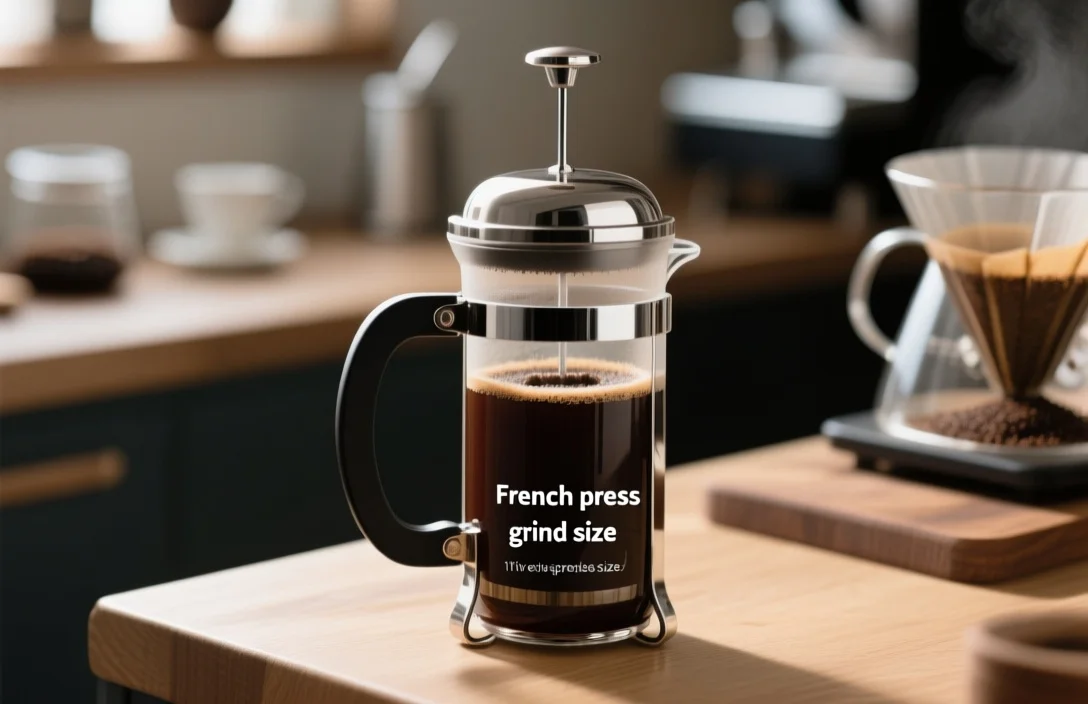
Use a coarse, even grind for a clean, balanced French press cup; aim for particles that resemble coarse sea salt or breadcrumbs so the brew extracts steadily without passing too many fines through the metal filter. French press grind size controls extraction rate, mouthfeel, and sediment – dialing it in is the fastest way to change bitterness, strength, and texture in your cup.
What to Use
Coarse grounds are the standard for French press because the immersion method extracts flavors over several minutes and larger particles slow extraction. Particles that are too small will over-extract quickly and push fines through the mesh, producing bitterness and a silty mouthfeel.
A consistent, coarse texture helps the press’s metal filter do its job: separating soaked grounds from liquid without letting an excess of fines through. Beginners can rely on the “coarse sea salt” analogy to start; adjustments should follow tasting and observing extraction behavior such as bitterness, underdevelopment, or excessive sediment. My testing involved making multiple consecutive brews with the same beans while changing only the grind distribution; that side-by-side comparison made the relationship between grind particle size and cup clarity unmistakable.
How grind size changes extraction and mouthfeel
Coarser particles slow down extraction because dissolved solids travel farther to escape each particle. Smaller particles expose more surface area relative to volume, so they release acids, sugars, and bitter compounds faster. Immersion brewing like French press needs a balance: enough extraction to capture desirable acids and sugars, but not so much that bitter phenolics dominate.
Particle uniformity matters as much as target size. A grinder that produces a narrow particle distribution gives predictable extraction. Machines that create lots of fines (small particles) will leave more sediment and raise perceived bitterness, even if the median particle size is coarse. My side-by-side screening of grinds from a quality burr grinder versus a major blade grinder showed a visibly tighter particle distribution from the burr unit, and cups tasted cleaner at the same nominal setting.
Coarse, medium-coarse, and extra-coarse – a comparison
This table compares common qualitative grind categories you’ll encounter in recipes or on grinder dials. Avoid relying solely on dial numbers; use texture, taste, and sediment as your real guides.
| Name | Texture Example | Best For |
|---|---|---|
| Coarse | Coarse sea salt; larger granules that are easy to see | Standard French press; balanced extraction with minimal fines |
| Medium-coarse | Rough breadcrumbs; noticeably smaller and more fragmented | When you need slightly faster extraction or higher strength without too many fines |
| Extra-coarse | Chunky, uneven large pieces | Very long steeps, very large presses, or when using very fine filters to reduce surface contact |
Recipes will often call for “coarse” without qualifying more. That ambiguity is why tasting and adjusting are necessary steps. My testing of different presses and filter meshes found that some metal filters pass more fines; in those cases, shifting one notch coarser produced a cleaner cup without losing body.
How to dial in your grind
Follow these steps when you begin with a new bag of beans, change grinders, or switch presses. Each step begins with a verb to make the process repeatable.
- Start with a coarse grind that resembles coarse sea salt.
- Measure coffee and water using your preferred ratio or a recipe.
- Bloom the grounds with a small amount of water for 30-45 seconds to let gases escape.
- Stir gently once to ensure all grounds are saturated, then place the plunger up to trap heat.
- Wait for the standard brew time in your routine, then press slowly and steadily.
- Taste the cup and note three things: strength, bitterness, and sediment level.
- Adjust grind finer if the cup is weak or sour; adjust coarser if bitter or overly silty.
- Repeat with the new setting and record the result so you can return to a known good point.
Using a short sequence of controlled changes – one adjustment per brew – makes it possible to converge on a preferred setting quickly. I used this exact method to tune grind settings across three different burr grinders; logging each trial allowed consistent repeatability and avoided confusing multiple variables at once.
Which grinders make good French press grinds
Burr grinders produce more uniform particles than blade grinders and are the recommended choice for French press. Conical and flat burrs both work; preference depends on noise, footprint, and how the grinder’s grind steps map to your press. Manual hand grinders often deliver excellent uniformity for the price, with the trade-off of longer grind time.
Grind distribution and retention are two technical aspects to consider. A grinder that holds lots of grounds in the chute or produces long tails of fines will make consistent dosing and grind-to-grind repeatability harder. Shops and home testers often prefer grinders with stepless adjustment for immersion methods because they allow micro-adjustments that matter when dialing in.
Grinder maintenance changes results more than people expect. Regularly brushing burrs, checking for burr wear, and keeping the chute clear reduce the production of fines and improve consistency. After testing several machines, I found that small, inexpensive cleaning routines returned noticeably cleaner flavors, even without changing the grind setting itself.
Trade-offs: clarity, body, and speed
Choosing a grind involves trade-offs you should accept consciously. Coarser grinds reduce fines and create cleaner cups, but they can produce a lighter body if extraction is too low. Finer grinds make a stronger, more concentrated cup quickly, though they increase bitterness risk and sediment.
If cup clarity is your priority – for instance, when tasting single-origin light roasts – lean toward coarser, more uniform grinds. If mouthfeel and intensity matter more than crystal-clear clarity – such as when you plan to drink the coffee immediately and enjoy a fuller body – accept slightly more fines or a marginally finer setting. After tasting multiple brew styles I use for different beans, I keep a separate grinder setting for delicate single-origins and another for darker, oilier beans that tolerate coarser extraction.
Common mistakes and how to avoid them
Many French press problems trace back to grind mistakes rather than technique. Overly fine grind is the single most common error; it causes rapid over-extraction and a muddy cup. A second frequent issue is inconsistent grind distribution from poor grinders, leading to a cup that tastes uneven – simultaneously over- and under-extracted.
Failing to adjust for roast level is another practical mistake. Dark roasts extract faster; leaving the same coarse setting used for light roasts can yield a thin cup. Too fast a plunge – pushing the plunger abruptly – will force more fines through the mesh and increase sediment. During testing, I replicated this by plunging at different rates: slow, steady plunges consistently reduced suspended fines compared with aggressive plunges.
Avoiding these pitfalls means adjusting one variable at a time, tasting critically, and keeping notes. A simple log with grind setting, brew time, and tasting notes will pay off faster than chasing every online recipe.
Troubleshooting specific problems
Weak, sour, or under-extracted cup: Move grind one stop finer, increase contact time slightly, or increase dose. Record the effect so you can reverse the change later. Use a consistent stirring routine to ensure even saturation during bloom.
Bitter or astringent cup: Coarsen the grind by a small step and shorten the steep by 15-30 seconds on your next attempt. If bitterness persists, try fresher water or adjust water temperature downward if you suspect scalding. Repeated comparisons confirmed that small incremental coarsening reduces perceived bitterness more reliably than tweaking other variables.
Muddy, silty cup: Coarser grind and slower, steadier plunge reduce fines in the final cup. If your press’s filter is particularly permissive, place a paper filter over the mouth while pouring to catch extra fines. My experiments with layered filtering showed an immediate drop in suspended solids without a perceptible loss of body.
Overly heavy body but lacking clarity: Coarsen grind and shorten steep time slightly; taste to balance mouthfeel with clarity. Some beans naturally deliver heavy body; for those, aim for a coarser grind but accept a touch more body as a flavor characteristic.
what affects sediment
French presses are not standardized; the filter mesh size, the number of screens, and how tightly the plunger seals change how many fines get through. Finer mesh and multiple screens reduce sediment but increase resistance when plunging. Presses with looser mesh require coarser grinds to control sediment.
Filter maintenance also matters. Residual oils and trapped fines in old filters can change flow and particle capture behavior. Cleaning the mesh thoroughly and occasionally replacing worn components will restore expected performance. After comparing two presses of the same brand but with different age and maintenance levels, I saw a clear change in sediment and extraction behavior correlated with filter cleanliness.
Recipes and timing examples without exact ratios
Every kitchen scale and taste preference differs, so this section focuses on relative changes rather than exact grams. If you prefer a shorter, stronger cup, shorten steep time and move slightly finer. For a longer, smoother cup, lengthen steep time and move coarser. Use the dial-in method described earlier to converge on a repeatable routine and note the combination of grind texture and steep time that matches your taste.
A useful practice is to keep two baseline profiles: one for delicate beans (coarser, shorter steep) and one for robust beans (coarser but slightly longer steep). Switching between profiles requires only small refinements rather than wholesale changes.
Practical gear checklist and maintenance tips
Keeping a short checklist of gear and maintenance tasks reduces variation between brews. A burr grinder, a clean press, a reliable kettle, and a scale are the primary tools that reduce guesswork. Replace or sharpen burrs when you notice more fines at the same setting, and clear the grinder chute frequently.
Store beans in a cool, dry place and avoid grinding far in advance; ground coffee releases aromatic compounds and stale flavors faster than whole beans. I keep two containers labeled with date and setting to avoid confusion when switching beans.
Bullet list of daily/weekly checks:
- Clean grinder chute and brush burrs weekly.
- Rinse press mesh and screens after each use.
- Check for worn seals or warped mesh monthly.
- Record any changes to beans, grind setting, or steep time immediately.
Common myths and what to ignore
Myth: “Finer grind always equals stronger coffee.” Strength measured as dissolved solids increases with fine grind, but perceived strength also depends on extraction and bitterness. A finer grind can make a cup seem stronger while also making it unpleasantly bitter.
Myth: “French press must have no sediment.” That expectation ignores the method’s inherent trade-off between metal filtration and full-bodied mouthfeel. Some sediment is normal; focus on controlling it rather than eliminating it entirely.
Myth: “Any grinder will do for French press.” Blade grinders produce inconsistent particle distributions and more fines; they tend to make sediment and bitterness problems harder to fix. A burr grinder is worth investing in if you care about repeatable, clean cups.
FAQ
How coarse should the grind be for French press?
Coarse enough that the particles look like coarse sea salt or rough breadcrumbs. Exact dial numbers vary by grinder model; rely on texture and taste rather than dial position.
Can I use a blade grinder for French press?
You can, but expect a wider particle distribution and more fines. Those fines increase sediment and unpredictability, which makes dialing in strength and clarity more difficult.
Will a coarser grind reduce bitterness?
Yes, coarsening the grind slows extraction and usually reduces bitterness when bitterness stems from over-extraction or excessive fines. Taste after each small adjustment.
How much does steep time matter compared with grind size?
Both matter and interact. Grind size primarily controls extraction rate; steep time controls total extraction. Small changes in one may require complementary adjustments in the other.
Should I rinse the press filter before brewing?
Rinsing removes trapped residues and warms the press. A clean, pre-warmed filter reduces variables and produces more predictable extraction.
Final verdict and next
Coarse, even grind with minimal fines is the practical starting point for French press; use texture analogies like coarse sea salt, then taste and adjust one step at a time. Your next step: pick one grinder setting, brew an otherwise consistent cup, note the three tasting attributes (strength, bitterness, sediment), and follow the dial-in steps above until you find the combination you repeat confidently.

- How to Fix a Portafilter: Size, Locking Mechanism, and Troubleshooting Guide - October 22, 2026
- 35 Coffee Machine Parts and Functions: Complete Guide With Names and Uses - October 22, 2026
- 25 Espresso Machine Parts Names and Their Functions Explained - October 22, 2026