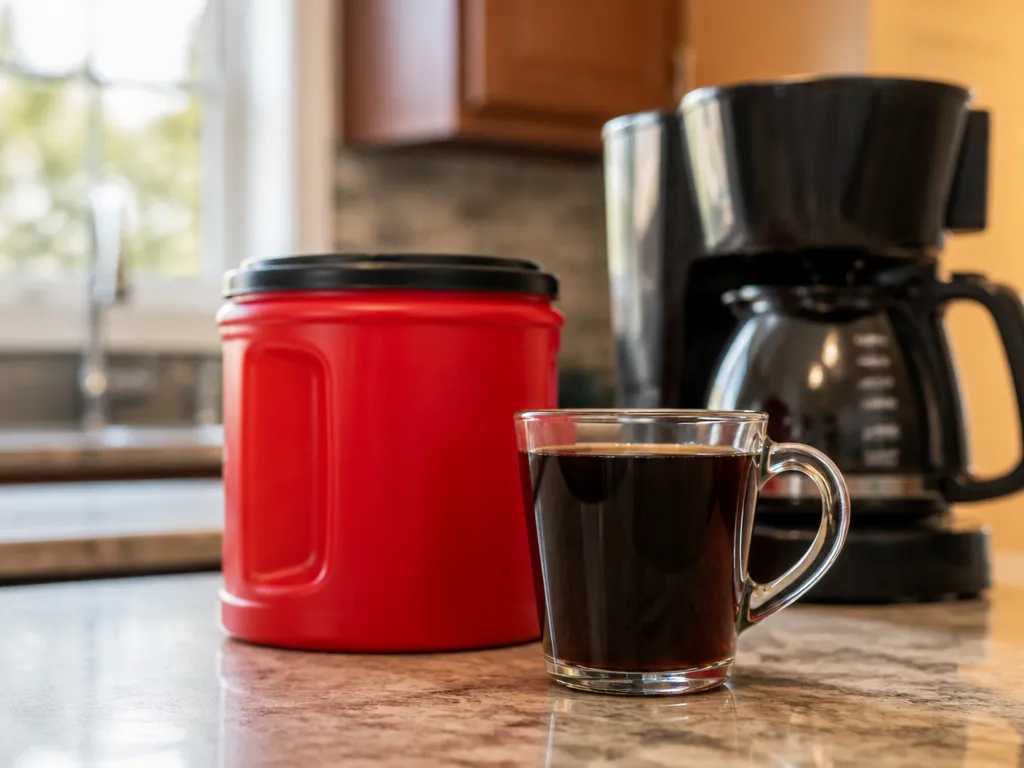
An 8-ounce cup of medium-roast drip coffee delivers between 95 and 165 milligrams of caffeine, and the red canister in most American pantries sits right in that range. Folgers Classic Roast averages roughly 100 to 130 milligrams per 8-ounce cup when brewed using the manufacturer’s recommended ratio of one tablespoon of ground coffee per six ounces of water. A full 12-ounce mug pushes that total closer to 200 to 260 milligrams depending on extraction time and water temperature.
Key Takeaways
- Standard cup average. An 8-ounce cup brewed from Folgers Classic Roast grounds contains roughly 100 to 130 milligrams of caffeine.
- Instant coffee difference. Folgers Classic Roast instant delivers about 57 to 70 milligrams per teaspoon dissolved in eight ounces of water.
- Roast level reality. Medium roasts like Classic Roast pack slightly more caffeine by volume than dark roasts because the beans are denser.
- Decaf is not zero. Folgers decaf versions still contain 2 to 5 milligrams of caffeine per 8-ounce serving.
- Scoop size matters. Using a heaping tablespoon instead of a level one increases your caffeine intake by up to 30 percent.
- Water temperature impact. Brewing between 195°F and 205°F extracts caffeine efficiently without pulling excessive bitter compounds.
Folgers Classic Roast caffeine content per cup
One level tablespoon of Folgers Classic Roast ground coffee yields approximately 100 to 130 milligrams of caffeine when brewed into an 8-ounce cup. That baseline assumes you follow the standard drip coffee ratio printed on the canister. Change the amount of coffee or the volume of water, and the math shifts immediately.
Caffeine extraction depends heavily on contact time and grind size. Folgers Classic Roast pre-ground coffee is milled for automatic drip machines, meaning the particles are uniform enough to extract evenly over a standard 4-to-6-minute brew cycle. Pour that same water through a French press with this grind, and you will over-extract the finer dust, resulting in a bitter cup that might actually have slightly less bioavailable caffeine due to trapped oils.
For instance, brewing a 12-ounce travel mug using two level tablespoons of grounds pushes your caffeine intake to around 200 to 260 milligrams. If you prefer a stronger cup and use three tablespoons for that same 12 ounces, you are looking at well over 200 milligrams. The FDA recommends keeping total daily caffeine intake under 400 milligrams for healthy adults, so two strong mugs of Classic Roast will put you near that ceiling.
- 8-ounce cup (1 tbsp grounds): 100 – 130 mg caffeine
- 12-ounce mug (2 tbsp grounds): 200 – 260 mg caffeine
- 16-ounce travel tumbler (3 tbsp grounds): 300 – 390 mg caffeine
How much caffeine is in Folgers Classic Roast vs other brands
Folgers Classic Roast lands squarely in the middle of the commercial coffee spectrum, delivering roughly 12 to 16 milligrams of caffeine per fluid ounce. Mass-market supermarket blends generally share this same window because they rely on similar ratios of Arabica and Robusta beans. Where Folgers diverges is in its specific blend consistency across massive production batches.
Specialty “high-octane” brands achieve their extreme numbers by using 100 percent Robusta beans, which naturally contain nearly double the caffeine of Arabica varieties. Folgers Classic Roast uses a proprietary blend of both species, optimized for a smooth, approachable flavor rather than maximum stimulant load. You get enough to wake up without the jittery spike associated with pure Robusta roasts.
| Coffee Brand / Type | Estimated Caffeine (8 oz) | Bean Blend Profile |
|---|---|---|
| Folgers Classic Roast | 100 – 130 mg | Arabica and Robusta blend |
| Maxwell House Original | 100 – 140 mg | Arabica and Robusta blend |
| Dunkin’ Original Blend | 120 – 150 mg | Primarily Arabica |
| Starbucks Pike Place | 155 – 180 mg | 100% Arabica |
| Death Wish Coffee | 300 – 350 mg | 100% Robusta focus |
Starbucks Pike Place often tests higher per ounce simply because many coffee shops use a heavier dose of grounds per pot than home brewers do. A standard commercial cafe recipe might use 60 grams of coffee per liter of water, while the Folgers canister suggests closer to 45 grams per liter for home drip machines. The bean itself is only half the equation; the recipe dictates the final milligram count.
In practice, switching from a high-caffeine brand back to Folgers Classic Roast means you will likely need to add an extra half-tablespoon of grounds to your filter basket to match your previous morning buzz. Measure by weight rather than volume if you want exact parity between different brands.
Caffeine in Folgers Classic Roast ground vs instant coffee
Ground Folgers Classic Roast contains significantly more caffeine per serving than the instant version of the same name. An 8-ounce cup made from the traditional grounds delivers 100 to 130 milligrams, while a cup made from one rounded teaspoon of Folgers Classic Roast instant crystals typically provides 57 to 70 milligrams. The difference comes down to manufacturing, not bean selection.
Instant coffee is brewed at industrial scale, then dehydrated through freeze-drying or spray-drying. During that intense processing, some volatile compounds and soluble solids are lost. To make a cup, you are simply rehydrating a concentrated powder, but the standard consumer habit – stirring one teaspoon into hot water – results in a weaker beverage than running fresh water through a basket of grounds.
If you want your instant cup to match the kick of the drip-brewed version, you need to use more powder. Two level teaspoons of Folgers instant dissolved in eight ounces of water will bring you closer to the 110-milligram mark. Keep in mind that adding more instant coffee also amplifies the slightly flat, metallic flavor notes inherent to the dehydration process.
For example, camping or traveling often forces a switch from ground to instant. If you rely on a specific caffeine threshold to function in the morning, packing a small digital scale to weigh out 4 to 5 grams of instant coffee instead of eyeballing a teaspoon ensures you hit your target milligrams without guessing. Ground coffee remains the superior choice for both flavor and reliable caffeine density at home.
Does Folgers Classic Roast have more caffeine than dark roast?
Folgers Classic Roast is a medium roast, and it contains slightly more caffeine per scoop than a dark roast coffee from the same brand. The long-standing myth that darker roasts give you more energy gets the chemistry exactly backward. Heat destroys caffeine molecules during the roasting process, albeit slowly.
When green coffee beans enter the roaster, they are dense and heavy with moisture. As they reach the temperatures required for a dark roast – often exceeding 430°F – they expand, lose water weight, and become physically larger and lighter. Caffeine is highly stable compared to sugars and acids, but prolonged exposure to extreme heat does degrade a small percentage of it.
The real difference emerges when you measure by volume. One tablespoon of medium-roast Classic Roast beans weighs more than one tablespoon of dark-roast beans because the medium beans have not expanded as much. More mass in your filter basket means more caffeine extracted into your cup. If you measure your coffee by weight on a kitchen scale – say, exactly 15 grams – the caffeine difference between medium and dark shrinks to almost nothing.
Folgers Black Silk, the brand’s prominent dark roast, tastes bolder and more bitter due to carbonized sugars, leading people to assume it is stronger. Bitterness correlates with roast level, not caffeine content. Stick with Classic Roast if you want the highest caffeine yield per level tablespoon without buying a specialized high-caffeine brand.
Folgers Classic Roast caffeine compared to decaf versions
Folgers Classic Roast contains roughly 100 to 130 milligrams of caffeine per 8-ounce cup, while Folgers decaf versions contain 2 to 5 milligrams in the same volume. Decaffeinated coffee is never completely caffeine-free. The decaffeination process removes about 97 percent of the stimulant before the beans are ever roasted and ground.
To put those numbers in perspective, you would need to drink 20 to 60 cups of Folgers decaf to ingest the same amount of caffeine found in a single standard cup of Classic Roast. For individuals who are strictly avoiding stimulants due to pregnancy, heart conditions, or medication interactions, even those 2 to 5 milligrams matter. Always verify current packaging details, as decaffeination methods can cause slight batch variations.
The Swiss Water Process and chemical solvent methods (like methylene chloride or ethyl acetate) are the primary ways commercial coffee is decaffeinated. Both methods strip caffeine from the green, unroasted beans. Folgers generally utilizes solvent-based methods for its mainstream lines to keep costs low and production volume high, which reliably hits that 97-percent removal threshold.
In practice, drinking a cup of Classic Roast at 8 AM and switching to the decaf version after noon is a common strategy for managing total daily intake. The flavor profile of the decaf will be noticeably flatter, as the decaffeination process also washes away some of the chlorogenic acids responsible for coffee’s bright, complex notes. Adding a splash of milk or cream helps bridge that flavor gap.
How to measure caffeine in your Folgers Classic Roast brew
You cannot see or taste caffeine directly, but you can calculate your exact intake by controlling three variables: the weight of your dry coffee, the volume of your water, and your brewing method. Guessing based on the number of scoops introduces too much margin for error, especially since pre-ground coffee settles and compacts in the canister over time.
Start by purchasing a basic digital kitchen scale that measures down to the gram. Weigh your empty filter, tare the scale to zero, and add your Folgers Classic Roast grounds until you hit your target weight. A standard starting ratio is 1 gram of coffee for every 15 to 18 grams (or milliliters) of water. Using 15 grams of coffee with 240 milliliters (about 8 ounces) of water gives you a reliable baseline.
Extraction efficiency plays a major role in how much of that theoretical caffeine actually makes it into your mug. Drip coffee makers extract about 90 percent of the available caffeine when operating correctly. Immersion methods like the French press extract slightly less unless you extend the steep time beyond four minutes. Espresso machines extract very quickly, yielding high concentration per ounce but lower total caffeine per serving due to the tiny water volume.
- Weigh your grounds: Use 15 grams of Classic Roast for a standard 8-ounce cup to ensure consistent caffeine levels.
- Check your water temp: Brew between 195°F and 205°F. Water below 195°F under-extracts caffeine; boiling water scorches the grounds.
- Time your brew: Automatic drip machines handle this automatically, but manual pour-overs should take 3 to 4 minutes for optimal extraction.
- Account for additives: Milk, sugar, and syrups change the volume of liquid in your mug but do not dilute the absolute milligram count of caffeine already extracted.
If you experience jitters or heart palpitations after your usual cup, your brewing parameters have likely drifted. A new bag of grounds might be packed tighter, or your coffee maker’s heating element may be failing to reach peak temperature, forcing you to use more coffee to compensate for weak flavor, inadvertently doubling your caffeine dose. Track your weights and volumes for a week to pinpoint your exact tolerance threshold.
FAQ
How much caffeine is in a tablespoon of Folgers Classic Roast?
One level tablespoon of Folgers Classic Roast ground coffee yields approximately 100 to 130 milligrams of caffeine when brewed into an 8-ounce cup using standard drip methods, assuming proper water temperature and extraction time.
Is Folgers Classic Roast stronger than Maxwell House?
Both brands occupy the same commercial tier, delivering 100 to 140 milligrams of caffeine per 8-ounce cup. The perceived strength usually comes down to the specific roast profile rather than raw caffeine content. Folgers Classic Roast leans slightly sweeter and smoother, while Maxwell House Original often presents a sharper, more acidic bite that some drinkers mistake for higher caffeine.
Does Folgers instant coffee have less caffeine than ground?
Yes. A standard cup made with one teaspoon of Folgers Classic Roast instant coffee provides 57 to 70 milligrams of caffeine, which is roughly half the amount found in a drip-brewed cup made from the grounds. To match the caffeine of a ground cup, you must dissolve at least two level teaspoons of the instant crystals into your hot water.
Can I drink Folgers Classic Roast if I am sensitive to caffeine?
If you react strongly to stimulants, a full 8-ounce cup of Classic Roast at 100 to 130 milligrams may trigger anxiety or insomnia. Try brewing a half-cup using just one and a half teaspoons of grounds, or switch to a half-caff blend where regular and decaf beans are mixed 50/50 before grinding. This cuts your intake to a much safer 50-milligram range.
Does brewing longer increase the caffeine in my coffee?
Extending your brew time past the recommended 4 to 6 minutes for drip coffee does extract slightly more caffeine, but the returns diminish rapidly after the first few minutes. More importantly, over-extraction pulls harsh tannins and bitter compounds into the water. You end up with a cup that has perhaps 5 to 10 extra milligrams of caffeine but tastes significantly worse.

- Are Pod Coffee Machines Healthy? The Unfiltered Truth About Your Daily Cup - September 27, 2026
- Does Gatorade Have Caffeine? Here’s What’s in Each Type - September 26, 2026
- Does Powerade Have Caffeine, or Is That a Myth? - September 26, 2026