
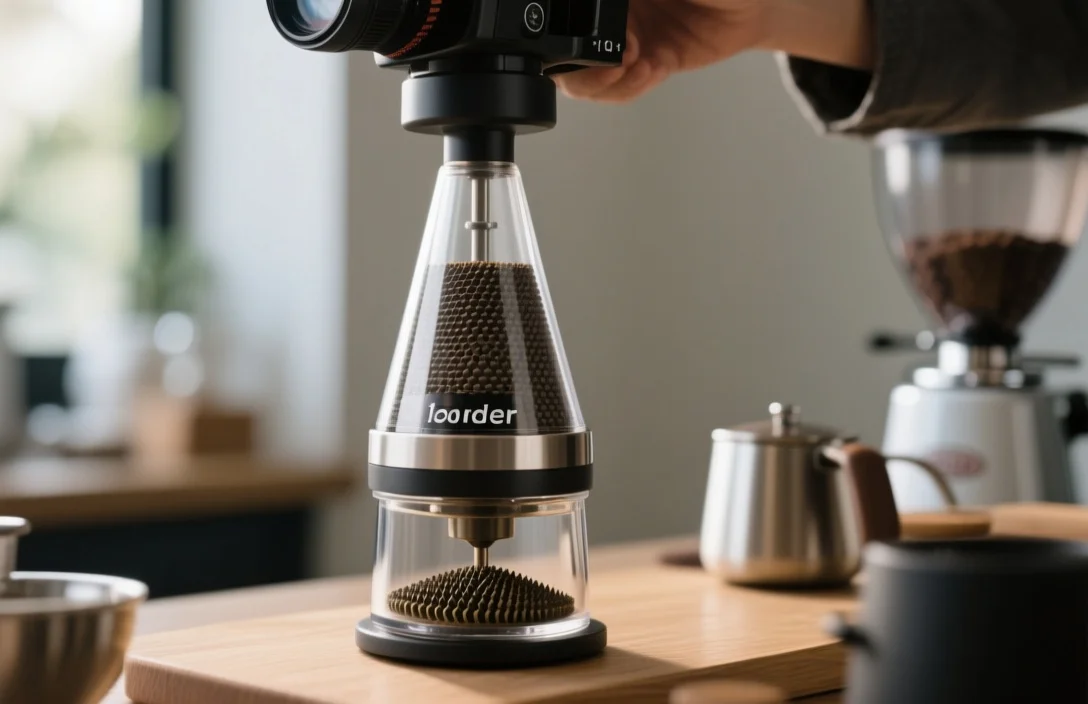
A conical burr grinder crushes coffee beans between a cone-shaped inner burr and a stationary outer burr to produce a consistent particle size, which is why many home and specialty setups prefer them. Conical burr grinder models differ in burr diameter, grind range, dosing control, and grind retention – pick a configuration that matches your brew method, desired dose precision, and tolerance for retained grounds.
How a conical burr grinder works
Conical burr grinders separate grinding action into two surfaces: a tapered cone and a ring, whose matched teeth shear and fracture beans rather than slice them, producing a mix of particle sizes concentrated around a target distribution. This definition matters because the mechanical geometry – taper angle, tooth profile, and burr material – directly influences grind uniformity, heat generation, and the proportion of fines in the output.
Grind speed versus control represents a mechanical trade-off baked into conical designs; slower, higher-torque motors tolerate larger burrs and produce less heat, while high-RPM designs reduce grind time at the cost of slightly wider particle distribution. Burr wear also factors into long-term performance: hardened steel and ceramic burrs retain cutting geometry longer than softer metals, though ceramic can be more brittle if struck by foreign objects.
Why grind consistency and particle size matter
Extraction chemistry depends on surface area and the range of particle sizes in the puck or filter bed, which is why coffee professionals focus on p50 and p90 metrics to describe distributions – narrower spreads give more predictable extraction. Brewing methods place different demands on that distribution: espresso needs a fine, tightly distributed grind for pressure extraction, while French press tolerates coarser and broader particles because immersion time dominates extraction dynamics.
Grind distribution also interacts with channeling and bed permeability; a grinder that produces a lot of fines will raise the puck impedance and risk under-extraction in some zones. Dose consistency and repeatability matter for dialling in; if a grinder yields variable output on identical settings, you will chase adjustments rather than improve flavor. Particle-size control maps directly to everyday coffee results, so spend your decision energy on the elements that most influence that control.
Types and design variants to compare
Conical burr grinders come in manual and electric versions, and each of those splits into stepped versus stepless adjustment systems and into single-dose versus hopper-fed designs. Manual conical grinders trade speed for quiet operation and portability, whereas electric models focus on throughput and programmable dosing; both categories include compact home units and industrial machines designed for high volume.
Burr material and diameter create meaningful performance differences: larger-diameter burrs typically produce the same particle profile at lower RPM, which reduces heat and can improve consistency during long sessions. Stepped adjustments give repeatable click settings that are handy for switching recipes, while stepless adjustments allow micro-tuning – choose one based on whether you value set-and-forget repeatability or fine-grained control. Retention – the grounds that remain inside the grinder after you stop – varies across designs and affects dose accuracy when you switch grind sizes or want single-dose work.
How to match grinder features to your brew method
Espresso-focused users should prioritize dose control, low retention, and a fine grind range that holds consistently under pressure extraction; those features let you repeat a dial-in without chasing variable mass. Pour-over and drip brewers need a wide and stable grind range with low static and consistent particle distribution; a mid-sized burr and a stepless collar help if you tune for bloom and pour cadence.
Immersion methods such as French press or cold brew demand coarse, uniform particles but tolerate some breadth in the distribution, so entry-level conical burrs often suffice. Turkish-style brewing requires extremely fine grinds that few household conicals can reach effectively; consider a device rated for that grind if you routinely prepare Turkish coffee. Match the grinder to the method and your workflow rather than chasing brand names.
Quick comparison
| Name | Price / Key Spec | Best For |
|---|---|---|
| Entry-level home conical | Consumer-grade burrs, basic stepped adjustments, hopper-fed; exact prices vary and were not found in current data | Beginners and filter brew users who want a straightforward, affordable grinder |
| Mid-range home / prosumer conical | Larger burrs, finer adjustment (often stepless or micro-stepped), improved motor and retention control | Home baristas who brew espresso and pour-over and need repeatable dosing |
| High-end / commercial conical | Large hardened-steel burrs, programmable dosing, low retention, robust motor and build | Cafés, high-volume espresso work, and serious home users seeking maximum consistency |
A note about price transparency: current exact list prices and model-specific specs were not available in the reference material used to produce this guide, so verify the latest figures with retailers before purchase.
what to look for when buying
Identify your must-haves before browsing so you avoid shiny extras that don’t affect extraction. Prioritize grind range if you expect to switch between espresso and filter frequently. Check for dose control options – timed doses and weight-based dosing produce different user experiences; weight-based dosing reduces variability caused by retention while timed dosing is convenient for consistent throughput.
Inspect burr diameter and material statements in product specs; larger burrs and hardened steel generally improve consistency and longevity. Confirm whether the adjustment mechanism is stepped or stepless and decide whether you need quick, repeatable clicks or micro-adjustments. Evaluate retention claims where manufacturers provide them and plan for single-dose workflow if you value quick switching between sizes.
How to use a conical burr grinder – step-by-step routines
- Zero the grinder: clear the hopper and run a short purge to remove stale grounds from previous runs.
- Set the collar: choose an initial grind size appropriate for your brew (coarse for immersion, medium-fine for drip, fine for espresso).
- Dose by weight or time: weigh the output on a scale when possible or use a timed dose once you’ve confirmed consistency.
- Test and taste: brew a small extraction and evaluate for under- or over-extraction, adjusting grind size by small increments as needed.
- Record settings: note the burr setting and dose for each recipe so you can return to a worked-in dial.
- Purge between coffees: run a small amount of beans through when changing roast or size to reduce cross-contamination.
A steady routine reduces variables; consistent tamp pressure, water temperature, and dose weight deliver clearer feedback about what the grinder setting is doing to flavor.
Cleaning, maintenance, and when to replace burrs
Regular cleaning keeps particle-size distribution stable and prevents build-up that alters flow and taste. Disassemble the hopper, remove loose grounds with a brush, and use manufacturer-recommended cleaning tablets or a diluted detergent for scheduled deep cleans; avoid liquid contact with motorized internals unless the manual specifies safe procedures. Replace burrs when you notice increased fines, longer grind times at the same setting, or dull flavor extraction; visual signs include rounded tooth profiles or nicks on the cutting surfaces.
Most routine maintenance fits into a quarterly rhythm for average home use, but high-volume environments require more frequent attention. Keep a small parts kit and the correct screwdriver or hex driver handy so you can perform a quick field strip, clean, and reassemble without delays. Track cumulative use and service history; mechanical wear follows usage, not calendar time, so replace parts based on performance changes rather than a fixed timeline.
Common mistakes and how to avoid them
Buying solely on price often produces disappointment because cheaper grinders may lack stable burr alignment or fine-range capability for espresso. Relying on grind size numbers without tasting leads to fixation on settings rather than extraction quality. Expect noise, but assume excessive grinding noise can indicate motor strain or burr damage that needs inspection.
Using a grinder for a style it’s not designed for – for example, forcing a consumer conical to produce an ultra-fine Turkish grind – shortens component life and delivers poor coffee. Overlooking retention when switching between roast levels will cause dosing drift; clear the path of old grounds when you switch beans to keep mass consistent. Store beans in a cool, dark place and only in the hopper for the session; stale beans on the burrs affect flavor and can gum up the grinder.
Troubleshooting common issues
If your shots pull too fast despite a fine setting, inspect for clumped grounds caused by humidity or static and clean the chute and burr faces. If output becomes inconsistent, check burr alignment and mounting points for looseness or visible wear. Excessive fines often mean worn burrs or inappropriate burr geometry for the roast; consider a burr replacement or a different grind profile.
Grinder skipping or motor stalls indicate either foreign body obstruction, overly oily beans loading the burrs, or an underpowered motor for your task; stop the machine and clear the obstruction before continuing. Static cling during cold, dry months can be mitigated with anti-static brushes, humidity adjustments in the room, or dosing into a metal container to reduce cling.
Trade-offs you should accept or reject
Accept slower pace if you value low heat and precise grind control; small-batch, single-dose workflows align well with many conical designs. Reject models that advertise micro-adjustments but have high retention if you need quick size changes without purging. Favor designs that balance burr size with motor torque for the grind range you want – oversized burrs and weak motors create frustration.
Noise versus speed is a personal call: quieter motors usually grind slower; choose based on the time window in which you prepare coffee. Retention and cleanliness trade off with throughput in some machines; lower-retention, single-dose setups demand more frequent loading but deliver more accurate dosing for variable beans.
Buying checklist and decision flow
Follow this checklist when evaluating a purchase: confirm your primary brew method, choose burr material and size appropriate for that method, select stepped or stepless adjustment based on whether you emphasize repeatability or micro-tuning, examine retention characteristics for your dosing workflow, and verify maintenance access and burr replacement parts availability. Test for build quality by handling hoppers and adjustment collars if you can, and prioritize brands that publish clear service documentation.
A simple decision flow helps: identify brew method first, then select burr diameter that matches throughput needs, then pick adjustment type, and finally evaluate dosing features and serviceability. Keep a short list of non-negotiables so you don’t get distracted by extraneous features.
FAQ
Is a conical burr grinder better than a blade grinder?
Conical burr grinders produce a more consistent particle distribution than blade grinders because they shear rather than chop beans, which leads to more predictable extraction and clearer flavor. Choose a burr if you care about repeatable brewing results rather than convenience.
Can a conical burr grinder handle espresso and pour-over equally well?
Some conical models cover both ranges, but not all do so well; look for a model with a fine enough grind range for espresso plus stable adjustment. Verify performance with a test brew or by confirming the manufacturer’s stated grind range, keeping in mind exact numeric ranges were not available in the reference data for this guide.
How often should I replace burrs?
Replace burrs when you notice slower grind speed, more fines at the same setting, or visual dulling of the teeth; usage patterns dictate timing more than calendar intervals. Keep performance records to spot gradual degradation.
What causes clumping and static with conical grinders?
Low humidity and bean oils promote clumping and static cling; physical agitation, dosing into metal receptacles, or brief purges between doses reduce static. Avoid pressing beans into the grinder hopper to reduce compaction-related clumps.
Is a stepless adjustment worth the extra cost?
Stepless adjustment is valuable if you need micro-tuning, especially for espresso dial-ins where 1-2 clicks can change extraction. Choose stepped adjustments when you prioritize quick, repeatable settings for multiple brew methods.
Verdict and next
For most home users who brew both espresso and filter, a mid-range conical burr grinder with a wide, stable grind range and controllable retention offers the best balance of precision and convenience. If you want a concrete next step, decide which brew method you use most and then shortlist grinders that explicitly advertise matching burr sizes, maintenance access, and dose control – test or confirm those features in-person or via up-to-date retailer specs before buying.

- How to Fix a Portafilter: Size, Locking Mechanism, and Troubleshooting Guide - October 22, 2026
- 35 Coffee Machine Parts and Functions: Complete Guide With Names and Uses - October 22, 2026
- 25 Espresso Machine Parts Names and Their Functions Explained - October 22, 2026