
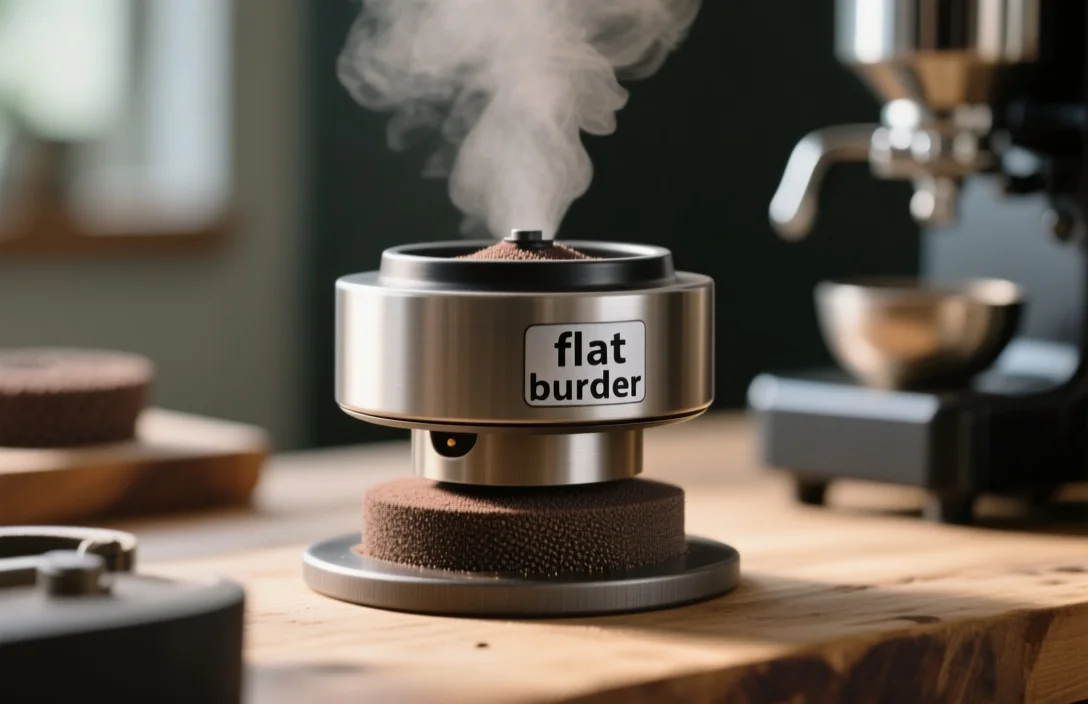
A flat burr grinder uses two parallel burrs to crush coffee beans into a fairly even grind size. That evenness is the reason people reach for it when they want more control, especially for espresso and pour-over. The trade-off is simple enough: flat burrs can give very precise results, but the grinder itself needs to be well built and well maintained to deliver them.
What a flat burr grinder does, and why it matters
Flat burr grinders work by pulling beans between two flat, parallel discs. As the burrs rotate, the beans are cut and sheared until they pass through the gap set by the grind adjustment. That geometry tends to produce a tighter particle distribution than many other grinder designs.
I would start there, because grind consistency is the part that actually affects the cup. A narrower spread of particle sizes helps extraction behave more predictably. Too many fines can push a shot bitter or harsh. Too many large particles can leave it thin or sour. The grinder does not fix everything, but it does set the ceiling for how much control you have.
Heat is worth watching too. Faster grinders can warm the burrs and the coffee near them, and that can affect aroma and how the grounds behave. Housing, motor control, burr material, and burr speed all play a part. In practical terms, a low-RPM grinder is usually a different experience from a faster commercial unit.
How flat burr grinders work
The basic mechanics are straightforward. Beans fall into the burr chamber, the burrs rotate, and the grounds are forced outward through the cutting surfaces. The size of the gap, plus how accurately the burrs are aligned, shapes the final grind.
That is why wear matters. As burrs dull, they tend to produce more fines and a wider particle spread. I would treat burr inspection as normal maintenance, not an afterthought. If you want consistent espresso, burr condition matters more than many shoppers realize.
Retention is another practical detail. Some flat burr grinders leave more coffee inside the chamber and chute after dosing. That means old grounds can carry over into the next shot, which is inconvenient when you change beans often or switch between brew methods. Manufacturers try to reduce this with steeper chutes, anti-static treatments, and revised chamber designs, but the geometry still matters.
Motor control also affects the experience. Timed grinders can improve repeatability if the motor runs consistently. Doserless grinders can reduce clutter and make single dosing easier. Manual dosing gives you the most direct control, though it also asks more of the user.
Flat burr vs conical burr, without the hype
Flat burr and conical burr grinders both make good coffee. They just do it differently.
Here is the practical version: flat burrs are often preferred when you want a narrower particle distribution and more precision, especially for espresso. Conical burrs often run a bit quieter and cooler, especially at lower RPM, and some people like the way they handle filter coffee.
| Feature | Flat Burr | Conical Burr | Best For |
|---|---|---|---|
| Particle distribution | Narrower, cleaner profile | Slightly broader, more fines | Espresso and precision brewing |
| Heat generation | Can be higher at high RPM | Often lower at low RPM | Low-RPM home grinders and small-batch |
| Grind retention | Can be higher in some models | Often lower depending on chute | Users who dose and purge |
| Noise | Usually louder at comparable power | Typically quieter at low RPM | Quiet kitchens or shared spaces |
| Burr availability | Common in prosumer and commercial grinders | Common across many home models | Replacement access and variety |
| Price/market position | Often mid-to-high tier | Spans budget to premium | Different budgets and workflows |
The right choice depends on how you brew, how often you brew, and how much you care about fine adjustment. Burr diameter, burr material, and motor design also change the picture. Larger burrs generally process coffee faster at the same RPM, which matters if you are grinding at volume.
What grind quality means in real use
Espresso is the place where a flat burr grinder tends to earn its keep. Espresso extraction is fast and unforgiving, so small differences in grind size show up quickly in the cup. If you dial shots often, a flat burr grinder with precise adjustment can make that process easier to manage.
Filter coffee is more forgiving, but not immune. A broader distribution can add a little texture, which some people like. That said, if your grinder is sloppy, broad particle spread can also make pour-over taste uneven. My practical rule is this: better uniformity usually gives you more options, not fewer.
Fines and large particles work in opposite directions. Fines extract quickly and can dominate the cup if there are too many. Large particles extract more slowly and can leave a shot underdeveloped. That is why dial-in is a process, not a single setting. Dose, tamp, brew temperature, and flow rate all interact with the grind.
Retention matters for the same reason. If coffee from the previous batch stays in the grinder, your next dose may not reflect the beans you just put in. That is more than a cleanliness issue. It changes the cup. Purging the grinder or choosing a low-retention design helps, especially if you switch beans often.
What to look for before you buy
I would sort buying decisions by brewing style first, then by budget. The features that matter for espresso are not always the ones that matter for drip or pour-over.
For espresso, look at:
- Grind adjustment precision
- Burr size
- Stepless or fine stepped control
- Low retention
- Easy cleaning and burr access
For manual brew methods, look at:
- Retention
- Noise
- Speed
- Grind consistency at coarser settings
For bean switching, look at:
- Purge access
- Chute design
- Straightforward cleaning
- Easy dose control
Build quality matters too. Metal housings, solid adjustment parts, and well-machined burr mounts usually hold up better under regular use. Plastic parts can be perfectly acceptable in lighter-duty grinders, but they may drift or wear sooner at very fine settings.
Hopper size is another trade-off. A bigger hopper means fewer refills, but beans sitting in it longer are exposed to more air. If you do not go through coffee quickly, a smaller hopper is often the better choice.
Adjustment style is worth checking closely. Stepless grinders let you make tiny changes, which is useful for espresso. Stepped grinders are easier to return to known settings, which can be helpful if you switch between brew methods or do not want to fuss with micro-adjustments.
Typical grinder tiers, and what you give up in each one
It is easier to shop if you think in tiers rather than brand slogans.
| Tier | Typical Features | Best For |
|---|---|---|
| Entry-level home | Small footprint, smaller burrs, stepped adjustment, basic motor | Occasional espresso drinker, small kitchens |
| Prosumer | Larger burrs, stepless adjustment, stronger motor, lower retention | Dedicated home baristas, consistent espresso |
| Commercial | Very large burrs, high throughput, serviceable parts, cooling design | Cafes, high-volume environments |
The trade-offs are predictable. Entry-level grinders are cheaper and easier to fit on a small counter, but they often give up some precision and consistency. Prosumer grinders usually cost more because they are built for repeatable espresso work. Commercial grinders are built for volume and serviceability, and they are usually louder and larger than a home user really needs.
How to maintain a flat burr grinder
Routine cleaning keeps the grinder from drifting. It also helps the burrs keep cutting cleanly.
A basic maintenance routine looks like this:
- Unplug the grinder and empty the hopper.
- Remove the hopper and any detachable parts.
- Take out the upper burr according to the manufacturer’s instructions.
- Brush away coffee grounds from the burr teeth and chamber.
- Vacuum or wipe the chute and catch area.
- Reinstall the burr and hopper carefully.
- Run a small test dose and discard it before brewing.
I would avoid washing burrs with water unless the manufacturer specifically says it is safe. Water can rust steel burrs and damage electronics if it gets where it should not. Dry brushing, vacuuming, and approved grinder-cleaning products are the safer routine.
Burr replacement depends on how much you use the grinder and what material the burrs are made from. There is no universal interval that makes sense for everyone. If the edges look rounded, grind quality has shifted, or the shots suddenly need constant adjustment, it is time to inspect them.
Problems that usually point to the grinder
A grinder is often blamed for problems it did not cause. Still, there are clear signs that something is wrong.
Watch for:
- Shot-to-shot inconsistency
- A sudden increase in fines
- Longer grind times at the same setting
- Changes in grinding noise
- Excess heat during dosing
- Odors in the grounds
Those symptoms can point to burr wear, misalignment, motor strain, or a foreign object in the burrs. If the adjustment collar starts to feel stiff, I would not force it repeatedly. That can damage the mechanism. Oily or flavored beans can also speed up buildup, so clean more often if you use them.
The main mistake is expecting the grinder to compensate for everything else. It cannot. Roast level, dose, tamp, and water temperature still matter. If the grind is wrong, fix the grind. If the rest of the recipe is off, the grinder will not save it.
Picking a grinder for the way you actually brew
For daily espresso at home, I would look first at a prosumer flat burr grinder with stepless adjustment, solid burr alignment, and low retention. That combination gives you room to dial in without fighting the machine.
For someone who pulls espresso only occasionally, a compact grinder may be the more sensible choice, even if it gives up a bit of precision. Noise, counter space, and ease of use can matter more than the last bit of micro-adjustment.
For a café or other high-volume setup, serviceability and throughput matter more than almost anything else. Burr size, cooling, and access to replacement parts are the practical issues to check.
Before buying, ask:
- How easy is it to remove and replace the burrs?
- Does the manufacturer publish burr specs?
- Are replacement parts available?
- Can it be serviced locally or through an authorized center?
- How does it handle different roast levels?
I would not lean too hard on marketing words like “professional” or “commercial.” Those labels do not tell you much by themselves. The details do.
FAQ
Is a flat burr grinder better than a conical burr grinder?
Not always. Flat burr grinders often give a narrower particle distribution, which many people prefer for espresso. Conical burr grinders can be quieter, cooler, and sometimes more forgiving in everyday use. The better choice depends on how you brew.
How often should I replace flat burrs?
It depends on use and burr material. A home user may go a long time before replacement is necessary, while a heavy daily user will wear burrs faster. If the burr edges look dull or the grind quality shifts, inspect them.
Will a flat burr grinder improve espresso immediately?
It can make dialing in easier, but it does not fix everything on its own. Beans, roast freshness, dose, tamp, and machine temperature still matter. The payoff is usually better consistency, not magic.
Can I clean flat burrs with water?
Usually no, unless the manufacturer specifically allows it. Water can rust metal burrs and damage the grinder. Dry brushes, vacuuming, and approved cleaning products are the safer approach.
Does burr size matter?
Yes. Larger burrs usually grind faster and can be more consistent at the same RPM. The right size still depends on your counter space, budget, and how much coffee you make.
How do I reduce grind retention on a flat burr grinder?
Purge the grinder between batches, use short doses, and look for a model designed for low retention. A straightforward chute and easy access for cleaning also help.
Bottom line
If you want precise control and you dial espresso regularly, a flat burr grinder is a solid choice. I would focus on stepless adjustment, burr quality, low retention, and easy maintenance before getting distracted by extras.
If you brew less often, or you value convenience more than fine adjustment, a smaller or simpler grinder may be the better fit. The right grinder is the one that matches your routine, not the one with the most impressive spec sheet.
A good next step is to pick three features you will not compromise on, then compare models against those features instead of trying to sort through every claim at once.

- How to Fix a Portafilter: Size, Locking Mechanism, and Troubleshooting Guide - October 22, 2026
- 35 Coffee Machine Parts and Functions: Complete Guide With Names and Uses - October 22, 2026
- 25 Espresso Machine Parts Names and Their Functions Explained - October 22, 2026