
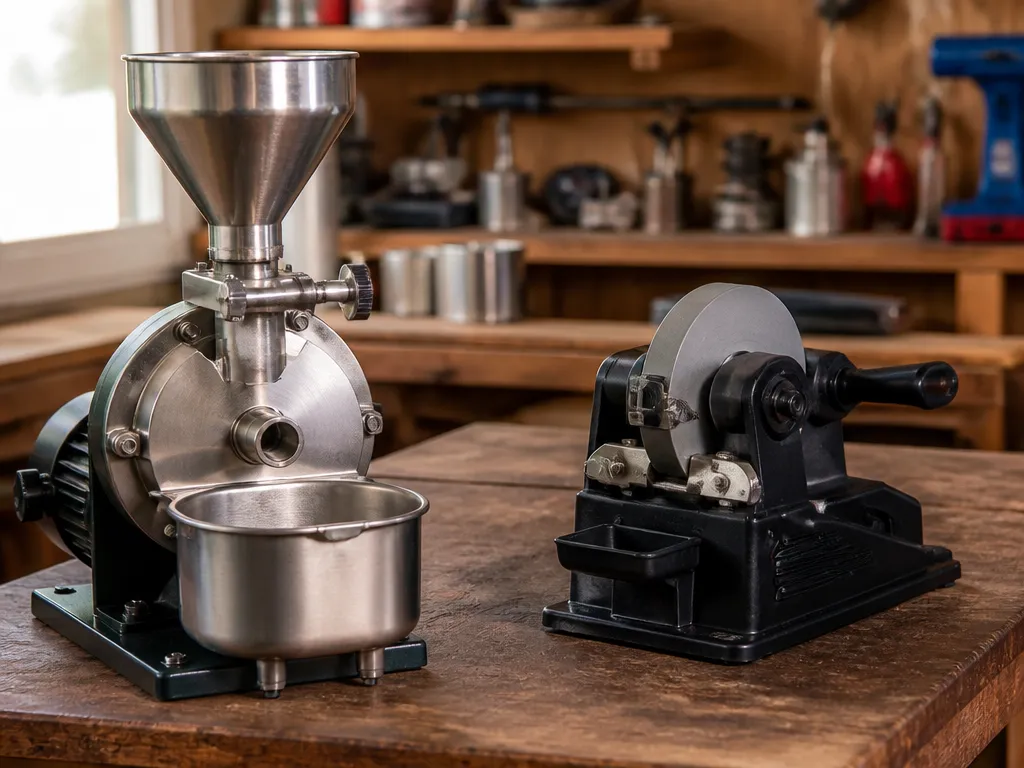
If you care about consistent flavor, buy a burr grinder. A blade grinder turns coffee into a mix of fine powder and large chunks, so water extracts it unevenly. A burr grinder breaks beans between two surfaces and controls particle size much more tightly. The grinder type can matter as much as the beans and brew method.
Blade grinders chop beans with spinning blades, producing a wide range of particle sizes. Burr grinders crush beans through a controlled gap, creating a narrower size distribution. Burrs are the practical default for espresso, pour-over, and repeatable drip coffee, especially with medium-to-dark roasts. A blade grinder can still work for basic drip when budget matters more than consistency.
Key Takeaways
- Burr grinders produce a more even grind by keeping the particle-size range tighter.
- Blade grinders chop unevenly, creating fines and chunks that can taste harsh, bitter, sour, or watery.
- Heat can affect flavor. Burr grinders generally manage speed and heat better than high-RPM choppers.
- Burr settings give you control across espresso, pour-over, drip, French press, and cold brew.
- Consistency saves guesswork. If you brew daily, burrs make adjustments easier to repeat.
- Budget changes the decision. Blade grinders can handle basic drip, but burrs are the better long-term purchase.
Burr vs Blade Grinder Comparison for Coffee
The main difference is control. A blade grinder can suit forgiving drinks such as basic drip, while a burr grinder offers more precise particle-size adjustment for demanding methods. The choice depends on how much consistency your brewing routine requires.
Blade grinders cost less and work quickly, but they offer little control over grind uniformity. Burr grinders cost more and contain more moving parts, but they let you choose and repeat a grind size. That reduces the mix of fines and chunks that causes uneven extraction.
| Grinder type | Grind consistency | Best for | Main drawback |
|---|---|---|---|
| Burr grinder | High (tight particle-size control) | Espresso, pour-over, drip, French press, cold brew | Costs more, more moving parts |
| Blade grinder | Low (wide particle-size mix) | Very basic drip when budget is tight | Harder to dial flavor, more variability |
The burr advantage is strongest when brew time is short or extraction is sensitive, as with espresso and many pour-over recipes. Longer methods can average out some unevenness, but mixed particle sizes still tend to mute sweetness and clarity.
How Burr Grinders Improve Grind Consistency
Burr grinders control how beans break instead of relying on chance to average out the result. Two burrs, either flat or conical, create a consistent gap between them, breaking beans into particles that are more uniform in size. A narrower particle-size distribution lets water extract the coffee bed more evenly.
Uneven particles extract at different rates. Fines extract quickly and can taste bitter or dry, while larger chunks resist extraction and can taste thin or sour. Burrs reduce that split, producing a more balanced cup and fewer “why did today taste different?” results.
Burr grinders also make grind changes more repeatable. Moving from medium to slightly finer usually creates a predictable change from dose to dose. With a blade grinder, the same grind time can produce different results because bean variety, hopper fill, and chopping dynamics affect the outcome.
What consistency looks like in your cup
A consistent grind usually produces:
- more stable sweetness
- fewer harsh edges
- less sourness caused by under-extracted pockets
- more predictable results after you adjust dose, ratio, or water temperature
You do not need to measure pH or track extraction curves to notice the difference. Consistency makes dialing in faster. With burrs, a one-step change is more likely to move the coffee in the direction you intended.
Blade Grinders and the Fast-Chop Approach
A blade grinder works more like a miniature food processor than a controlled cutter. A high-speed blade spins while the beans bounce around, and the result depends largely on when you stop the machine. You get powdery fines and larger chunks in the same batch.
That mixture makes blade-ground coffee taste inconsistent. Fines can over-extract early and add bitterness, while chunks can under-extract and add sourness or a watery character. You can sometimes compensate by brewing longer or changing grind time, but the result remains less predictable than burr-ground coffee.
A blade grinder is a reasonable entry point when expectations are modest and the brewer is forgiving. A basic automatic drip machine, especially with a paper filter and a longer brew, can hide some unevenness. Even then, flavor is usually less distinct and adjustments are harder to repeat.
You also have little direct control over how fine the coffee becomes. Many blade grinders have no consistent settings, so two mornings with the same timer can taste different. That limitation makes a burr grinder more useful for drinkers who frequently adjust recipes.
Flavor and Extraction Differences by Grind Type
Grind type changes extraction by changing how water contacts the coffee particles. Uniform particles expose their surfaces more evenly, creating a smoother extraction. Mixed particles extract at different rates, making a balanced cup harder to achieve.
Burr grinders tend to produce greater clarity. You are more likely to taste distinct notes in the beans, especially with lighter roasts and methods such as pour-over or Aeropress. Blade-ground coffee can still taste like coffee, but the cup may lean bitter and dry or bright and under-extracted, depending on how the beans were chopped.
Espresso exposes the difference most clearly because extraction time is short and depends on even resistance to water flow. With a blade grinder, fines can restrict parts of the puck while larger particles create channels. The result is an inconsistent shot, even when it tastes acceptable.
Blade grinders are less problematic for longer methods such as French press and cold brew. Extended contact gives larger chunks more time to extract. You can still get muted sweetness and a heavier, more sediment-filled texture because the batch contains so many fines.
Predicting the flavor from your grinder
If you use a blade grinder:
- Expect more variation from batch to batch.
- Treat adjustments as trial and error.
- Accept that fine-tuning will be difficult.
If you use a burr grinder:
- Expect easier dialing for each brew method.
- Make smaller, more meaningful changes between settings.
- Treat the grinder setting as part of your recipe.
Noise, Speed, and Heat Generation Trade-Offs
Blade grinders are typically loud and fast because their blades need high RPM to chop through beans. Burr grinders also make noise, but their grinding action is more controlled and generally feels less aggressive than brute-force chopping.
Heat can affect flavor stability. Ground coffee is more vulnerable than whole beans because grinding creates a much larger surface area. Excess heat during grinding can subtly change the cup and add variability, particularly when you grind lots of beans at once.
Speed contributes to heat, but it is not the only factor. A high-RPM blade can create frictional heat, and the beans may be repeatedly chopped as they fly around the chamber. Burrs break beans through a set gap, which usually reduces the churning that comes from recutting mixed-size particles.
Burr grinders are the calmer choice if you grind frequently or in bulk. If you grind occasionally and need only a rough grind for drip coffee, a blade grinder’s noise may be an acceptable trade for its lower upfront cost.
The best way to manage heat with either type is to avoid running the grinder longer than necessary. With a blade grinder, use short bursts rather than letting the motor run continuously while you chase a finer grind.
Which Grind Settings Each Grinder Can Handle
Burr grinders provide actual grind-size control because you adjust the gap between the burrs. Blade grinders provide grind-time control, which is only an approximation of particle size. Burrs therefore handle espresso, medium-fine pour-over, and coarse French press more reliably, while blades tend to work within a narrower comfort zone.
Burr grinders also adapt better to changing recipes. If you make espresso in the morning, pour-over at midday, and cold brew later, you need a useful range and repeatable steps. Changing a burr setting generally moves particle size in a predictable direction. With a blade grinder, you are estimating what the timer will produce.
Not every burr grinder performs equally well. Some entry-level models have fewer steps and a less useful espresso range than higher-end models. The key advantage remains the same: burrs respond to adjustments in a controlled way. Even when the range is limited, you can understand the relationship between the setting and the result.
When shopping, pay attention to hopper and dosing convenience because they affect routine consistency. For example, one burr grinder listing includes a hopper capacity (beans): 12 ounces, a doser capacity (grounds): 4 ounces, and a weight: 5.6 pounds. Another burr grinder listing shows hopper capacity (beans): 11 ounces, doser capacity (grounds): 4 ounces, and weight: 4 pounds. These are different machines, but the takeaway is similar: burr grinders are often designed for routine dosing rather than one-off tiny batches.
Choose based on your brew lineup
Match the grinder’s adjustment range to the methods you use most often. Multiple brew styles benefit from a wider range and repeatable steps, while a single forgiving method places fewer demands on the grinder.
For espresso, the grinder needs fine, controlled adjustments. For basic drip, a narrower range may be sufficient if you accept more variation. Cold brew and French press require coarse settings and may tolerate a broader particle-size mix.
Choosing Burr or Blade for Your Coffee Setup
Consider how often you change recipes, how sensitive your brew method is, and how much adjustment control you want. Espresso and pour-over demand tighter control, while standard drip allows more room for variation.
Budget and routine also matter. A blade grinder keeps the initial cost low, but timer-based chopping requires more experimentation as beans and brewing conditions change. A burr grinder costs more but makes the grinder setting a useful part of the recipe.
Use this shortcut:
- If you care about flavor clarity, get a burr grinder.
- If cost comes first and you accept variation, a blade grinder can be adequate.
- If you brew espresso, choose a burr grinder.
- If you brew cold brew and accept heavier sediment, a blade grinder may be workable.
For most U.S. households, burr is the better long-term choice because coffee rewards repeatability. A consistent grind improves every brew, while a blade grinder forces you to reinterpret the result from one batch to the next.
Start with your main brew method and choose a grinder that can handle it reliably. If you make anything beyond basic drip, a burr grinder is the safer choice.
FAQ
Burr grinder vs blade grinder, which is better for everyday drip coffee?
A burr grinder gives everyday drip coffee a narrower particle-size range and more even extraction. A blade grinder can work for basic drip when the budget is tight, but the flavor may vary more and require additional grind-time adjustments.
Is a blade grinder good enough for espresso?
A blade grinder is usually a poor match for espresso. The short extraction time magnifies uneven grinding: fines can over-extract and cause bitterness while chunks under-extract. A grinder with controllable settings is more reliable for espresso.
How much difference in taste should I expect between burr and blade?
Expect a noticeable difference in balance and consistency. The uneven mixture from a blade grinder can produce bitterness from fines or thinness from under-extracted chunks, so the same recipe may taste different from one batch to the next.
How do I dial in grind size with a burr grinder?
Start with the grind size recommended for your recipe and adjust toward the target brew time one step at a time. If the coffee tastes bitter or drying, go coarser. If it tastes sour or weak, go finer. Keep the dose, water ratio, and brew temperature stable while you adjust. After a few changes, the setting should become repeatable for those beans and that method.
What’s the most common mistake when using a blade grinder?
The most common mistake is treating grind time as a precise setting. Particle size can change at the same timer length because the beans chop unevenly. To reduce variation, grind in short bursts, mix the grounds after grinding, and keep the brewing process consistent.

- Unlocking the Venti: Discover the Perfect Shot Count for Your Drink - October 13, 2026
- Unpacking the Buzz: Caffeine Levels in Café Bustelo Espresso - October 13, 2026
- How to Fix Bitter Coffee: 10 Expert Ways to Improve the Taste - October 4, 2026