
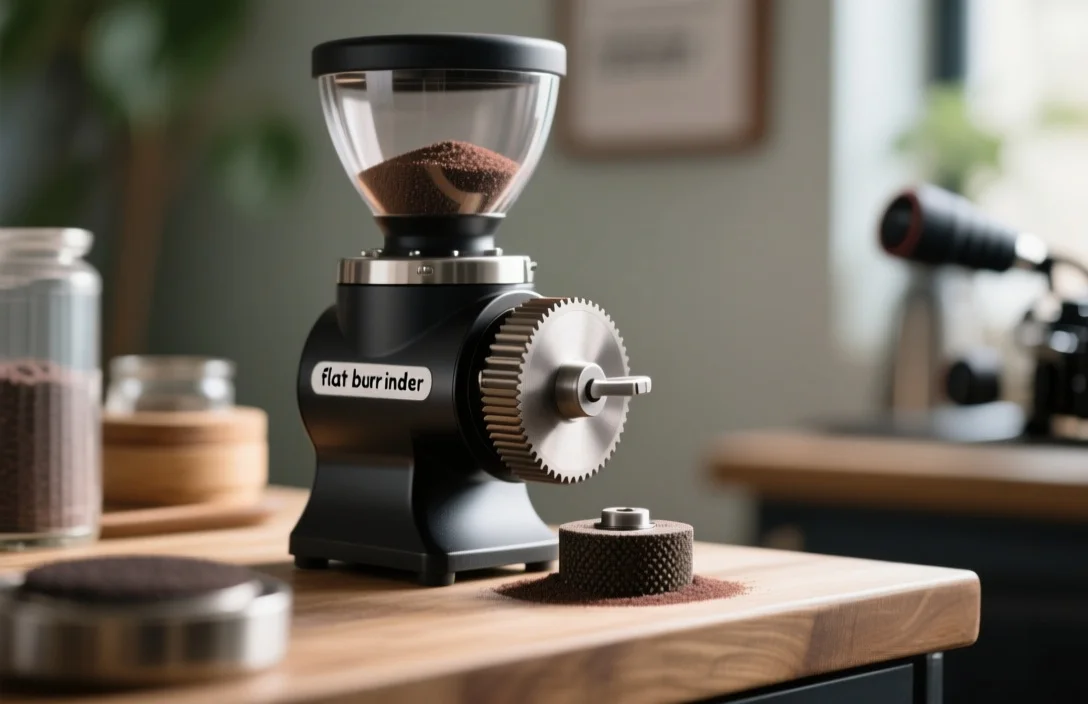
A flat burr grinder is the better choice when consistency matters. It gives you a more even particle distribution than a blade grinder, which is why it makes more sense for espresso and careful brewing. If you want steadier extraction and easier dialing-in, start with a flat burr grinder, then match burr size, dosing method, and retention to the way you actually make coffee.
How a flat burr grinder works
Flat burrs are two parallel rings with cutting edges that face each other. Beans drop into the gap, get sheared, and are pushed out sideways into the collection area or portafilter chute.
That geometry matters because extraction depends on the balance between fines and larger particles in the dose. A more even grind usually means less channeling in espresso and more predictable results in pour-over and immersion brewing.
The details still matter. Burr shape, alignment, speed, and feed consistency all affect how the coffee breaks apart. When burrs wear down or the feed path is irregular, you get more fines and more large chunks, which makes the cup less predictable.
Flat burr grinder versus conical burr and blade grinders
The short version is simple. Flat burrs aim for uniformity. Conical burrs often appeal to people who want lower retention or a different flavor balance. Blade grinders are the least precise option and I would skip them for anything that depends on repeatability.
| Name | Price / Key Spec | Best For |
|---|---|---|
| Flat burr grinder | Price varies; flat cutting surfaces and side expulsion; may be stepped or stepless | Espresso and brewers who want tight particle distribution and repeatable dialing |
| Conical burr grinder | Price varies; funnel-shaped burr geometry with axial feed; often lower retention than some flat designs | Home users who want lower retention or a different flavor profile |
| Blade grinder | Low cost; high variance in particle size; chop-style cutting | Coarse uses only, when precision is not important |
The trade-off is straightforward. A flatter particle distribution helps extraction consistency, but some flat grinders hold onto more coffee, which can make bean switching messier. The flavor difference between flat and conical burrs is usually smaller than people expect, and it depends a lot on roast level, dose, and extraction method.
What I would check before buying a flat burr grinder
My practical rule is to ignore marketing copy and focus on three things first: burr size, dosing method, and grind retention. Those are the specs that tell you how fast the grinder works, how repeatable the dose is, and how much old coffee stays inside.
Look at the burr material and mounting. Hardened steel burrs are common, while ceramic burrs are less common and handle heat differently. Also check whether the grinder is stepped or stepless. Stepless gives you finer control. Stepped gives you fixed positions that are easier to return to.
Motor torque and duty cycle matter too, especially if you use dark roasts or grind a lot at once. If you want to single-dose, check whether the grinder is built for low retention. Also look at noise, footprint, hopper size, and how easy it is to remove the burrs for cleaning.
- Burr diameter and shape, whether the maker lists large-diameter or small-diameter flat burrs.
- Adjustment type, either stepless for continuous fine tuning or stepped for indexed settings.
- Dosing system, either doserless or doser-equipped.
- Build quality, including a metal chassis, solid bearings, and a removable tray.
I would compare spec sheets side by side and leave the branding out of it. If you need exact performance numbers or current prices, check the manufacturer’s current materials before you buy. This article does not include live pricing.
How grind size, burr size, and speed affect extraction
Grind size controls surface area and contact time. Finer grinds extract faster and are usually what you want for espresso. Coarser grinds slow extraction down, which is why they fit methods like French press and cold brew.
Burr diameter affects uniformity and throughput. Larger flat burrs usually create a more even grind at lower RPM than smaller burrs because the cutting edge travels farther with each turn. Speed matters too, since it affects heat and static, both of which can influence clumping and distribution.
Fines and boulders pull the cup in opposite directions. Fines extract quickly and can push the drink toward bitterness. Boulders extract slowly and can leave the cup tasting thin or sharp. Good distribution, pre-infusion, and careful tamping can help, but they do not fix a bad grind.
- Grind retention affects consistency between doses.
- Dose size changes the ratio of fines to coarse particles in the puck.
- Burr wear increases variance, and new burrs usually restore more consistent distribution.
Dialing in a flat burr grinder usually takes small moves. If you are testing espresso, change one variable at a time and keep the rest steady. Dose, tamp, brew ratio, and grind setting all affect the result. I keep coming back to this because it is the fastest way to avoid chasing noise instead of taste.
Maintenance, cleaning, and calibration for flat burr grinders
Regular cleaning keeps particle distribution stable and helps prevent oil buildup, which can dull flavor. A weekly brush-out is a sensible baseline for most consumer grinders. Use a grinder brush or a low-power vacuum to clear fines from the chamber.
Calibration should be handled carefully. If you remove the burrs, re-establish your reference point afterward. On a stepped grinder, that may mean counting clicks. On a stepless grinder, it usually means checking dose weight and timing again. Reassemble the burrs gently, then run a small test dose before you settle back into normal use.
Follow this maintenance sequence when you service a consumer flat burr grinder:
- Unplug the grinder and remove the hopper.
- Empty the remaining beans and brush loose grounds out of the hopper throat.
- Remove the upper burr according to the manual and brush both burrs. Avoid metal tools that can nick the cutting surfaces.
- Vacuum the chute and collection chamber to clear stubborn fines.
- Reinstall the burrs, set a reference grind setting, and run 10-20 grams of coffee to flush old grounds.
- Test dose weight and particle distribution with a cup tasting or by watching shot time for espresso.
- Replace burrs when extraction time becomes consistently more variable or the flavor balance changes and does not come back after calibration.
I would avoid using rice to clean a grinder. It can damage burrs and leaves behind dust that is hard to remove. Follow the manufacturer’s service interval, and if you use the grinder every day, keep spare burrs in mind.
Common mistakes with flat burr grinders
A lot of disappointment comes from expecting the same cup after switching from conical to flat burrs without changing anything else. That usually does not work. Adjust slowly and taste often, because the grinder may change how the coffee extracts even if the beans stay the same.
Retention causes a lot of confusion too. If old coffee is still sitting in the grinder, the first grams after a change will not tell you much. Purge the grinder or weigh the first output if you want a clean comparison.
Another mistake is forcing the adjustment collar or over-tightening parts during alignment. That can damage threads and bearings. Use the method in the manual, and test repeatability before you trust the setting for espresso.
- Ignoring burr wear, especially if you grind a lot each month.
- Cleaning with the wrong tools, like kitchen utensils instead of brushes or compressed air.
- Skipping dose profiling, which makes it harder to find a stable range.
- Assuming all roast levels behave the same, when lighter roasts often need a finer grind or a slower shot.
Static and clumping are worth paying attention to. Adjusting storage humidity, using anti-static tools, and shortening grind time can help. If you single-dose, keep small batches ready and clear the throat between beans so flavors do not cross over.
How to choose a flat burr grinder for your setup
If I had to rank the buying priorities, I would start with dosing method, then retention, then burr diameter. That order cuts through a lot of confusing options fast.
If espresso is your main use, go for a doserless flat burr grinder with low retention and stepless adjustment. If you switch between espresso and pour-over, look for a grinder with an easy purge path or one that works well for single dosing.
For high-volume use, choose a grinder with strong motor torque and a sturdy housing. If your counter space is limited, pay attention to footprint and hopper size, and consider a model that can work with an external hopper if needed.
| Name | Price / Key Spec | Best For |
|---|---|---|
| Prosumer flat burr | Mid-to-high price range; stepless adjust; moderate retention | Home baristas who dial espresso and brew occasionally |
| Commercial flat burr | High price; heavy-duty motor; robust cooling and low wear | Cafes or high-volume environments that need steady throughput |
| Compact flat burr | Variable price; reduced footprint; smaller hopper | Apartment kitchens or single-user households with limited space |
If you can, try before you buy. Pull shots at a retailer or specialty shop and compare grind feel, noise, and extraction time. I would also check warranty terms and burr replacement costs before making a final choice.
dialing an espresso shot on a flat burr grinder
Start with one baseline dose and work from there. After the first shot or two, note the time, crema, and taste balance.
Make small adjustments. If the shot runs fast and tastes sour, go finer by 1-2 clicks if the grinder is stepped, or make a similar micro-adjustment on a stepless model. If it runs slow and tastes bitter, move coarser by a similar amount.
Write everything down. Weight in, weight out, shot time, and grind setting are the notes that actually help later. If a change made things worse, go back.
- Use the same tamp pressure each time, or a calibrated tamper if you have one.
- If you single-dose, weigh the beans before grinding.
- When changing beans, purge 10-20 grams so the tasting is not skewed by leftovers.
If shots are still inconsistent after careful dialing, check for retention, uneven distribution, or worn burrs. Change one thing at a time. That is the only reliable way to identify the problem.
FAQ
How often should I replace flat burrs?
Replace burrs when extraction time becomes consistently less predictable or the flavor balance changes and stays that way even after calibration. If you suspect wear, compare the grind to a known-good reference. If the difference does not go away, it is time to plan for new burrs.
Is a flat burr grinder always better than a conical burr grinder?
No. Flat burrs usually give a tighter particle distribution, which helps with espresso and precision brewing. Conical burrs can offer a different flavor profile and sometimes lower retention. The better choice depends on how you brew and what you want the cup to do.
Can I single-dose with a flat burr grinder to reduce retention?
Yes. A lot of people single-dose to reduce retention and make bean changes cleaner. Look for a grinder that is easy to open and has a clear path from burrs to the exit. You should still expect a little cleanup if you change beans often.
Will a flat burr grinder overheat coffee during grinding?
It can, especially if it runs for long stretches at high speed. Short bursts and rest time help keep heat down. If you grind large volumes regularly, look for a grinder built for continuous duty with enough cooling.
Are stepless adjustments necessary for home baristas?
No, but they are useful if you want very fine control for espresso. Stepped grinders are easier to return to a known setting and can be simpler for beginners. The right choice depends on whether you want micro-adjustments or fixed positions.
How much does grind retention affect taste?
It can affect the first grams out of the grinder after a setting or bean change, which is enough to skew a comparison. Purging those grams or single-dosing reduces the problem and makes the cup more consistent.
A flat burr grinder makes the most sense when consistency is the goal. If espresso is the priority, I would look for low retention, doserless design, and fine adjustment. If you need more flexibility or you are shopping with a tighter budget, weigh burr size, retention, and dosing system against each other instead of chasing a perfect spec sheet.
The next step is simple. Write down your top three priorities, whether that is espresso focus, mixed brewing, or compact size, then compare two grinders side by side and pay attention to adjustment feel, noise, and how the shots actually taste.

- Espresso Tastes Watery? 10 Common Causes and How to Fix It - October 23, 2026
- 10 Common Coffee Equipment Cleaning Mistakes and How to Avoid Them - October 23, 2026
- 17 Common Coffee Grinder Problems and How to Fix Them - October 23, 2026