
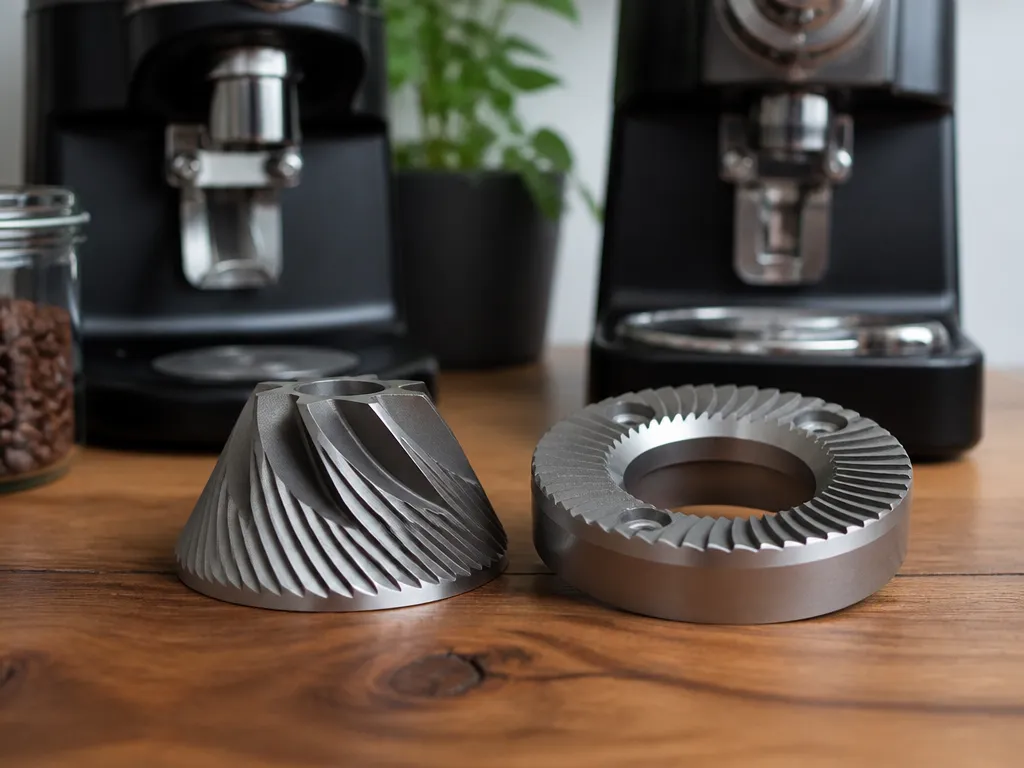
A conical burr grinder and a flat burr grinder can both make great coffee, but they tend to taste different because they produce different grind patterns and heat profiles. If you drink espresso or pour over, the “better” choice depends less on burr shape and more on how consistently your grinder lands particle sizes for your brew method. This guide compares conical vs flat burr grinders by practical criteria, then tells you which one to pick for espresso vs filter.
Conical vs flat burr grinder taste comes down to grind distribution. In practice, conicals often produce a slightly wider range of particle sizes, which can read as more body or sweetness but also more fines. Flat burr grinders usually do tighter, more uniform particle distributions, which can taste cleaner and more defined in many pour overs and some espresso styles.
- Taste winner depends. If you value clarity, flat burrs usually win for filter; if you value body, conicals often feel fuller.
- Burr shape changes. Conical burrs guide grounds outward in a spiral flow, while flats grind in a more stationary plane.
- Heat can differ. Different drive and airflow patterns change how much heat the beans pick up during grinding.
- Distribution matters most. More uniform particle sizes usually improve repeatability, especially when dialing in.
- Espresso wants control. Flat burrs often make it easier to hit sweet spots with fewer “mystery” settings.
- Pick by brew method. Conicals are a safe bet for versatile home use, flats shine for filter clarity.
Conical vs Flat Burr Grinder Which Tastes Better
If you forced me to pick a single default “tastes better” option for most home brewers, I’d pick a good flat burr grinder, because tighter and more consistent grind distribution usually translates to clearer flavor separation in the cup. That said, conical burr grinders can absolutely taste great, and many people prefer their more forgiving, more full-bodied profile.
The real story is that taste is downstream of grind size spread, fines (very small particles), and how quickly you can repeat a dose at a given setting. Flat burrs tend to behave more predictably when you change grind size because their particle distribution often shifts in a narrower band. Conicals can sound more inconsistent on paper, but the result can still be delicious if your goal is sweetness, body, and an overall “rounder” cup.
Here’s a quick way to think about it in plain terms:
- If your coffee often tastes muted, dull, or muddy, a grinder that reduces fines and tightens distribution (often flat burr) can help.
- If your coffee often tastes too sharp, too thin, or too acidic, a conical’s tendency toward a broader distribution can sometimes smooth things out.
Grinding Design Differences Conical vs Flat Burrs
Conical burr grinders use one ring-shaped burr that is conical (tapered) and another burr that meets it, with the geometry encouraging a radial flow pattern as beans get crushed and swept outward. Flat burr grinders use two flat, parallel ring burrs, so the grinding happens in a more “planar” fashion where the motion is largely about rotation and separation in a fixed gap.
That mechanical difference changes how beans move through the burrs, and that matters because coffee is an irregular material. Two grinders with the same nominal burr size can still behave differently because the effective path through the cutting surfaces is different. In conicals, the beans typically travel along a curved path and get pulverized while being carried outward. In flats, beans get ground in a straighter zone and the particle output tends to be more evenly released around the circumference.
This is also why grinder maintenance and workflow can feel different. Flat burr systems often encourage a “clean start” for dialing because distribution tends to change more directly with grind setting. Conical systems are often very forgiving if your brew recipe isn’t perfectly repeatable, because the taste can stay broadly pleasant even when the grind distribution shifts slightly.
In practice, the design difference is less about “conical is good, flat is bad” and more about how the grinder behaves when you do things like:
- adjust grind size quickly between shots
- change dose weight and retention behavior
- use a single grinder across espresso and pour over
- switch between medium and darker roasts
Conical vs Flat Burrs Speed and Heat Effects
Both conical and flat burr grinders can generate heat, and heat affects flavor mainly by accelerating extraction-related breakdowns and potentially increasing staling risk if things run very hot. The catch is that “burr shape” alone doesn’t determine temperature, because grinder speed, motor design, chamber airflow, and how fast the grinder clears the grinding zone all change the outcome.
In general, if you compare two grinders of similar quality, the one that grinds more efficiently (and finishes the batch quickly) usually gives you less time for friction heat to build up. Flat burr grinders can be very efficient, but conicals can be efficient too. The bigger variable is whether the grinder is designed for consistent grinding at your typical dose.
You can also see heat differences indirectly through taste stability. If your coffee tastes noticeably worse after grinding for longer periods, or if it changes when you grind larger batches, you’re likely seeing temperature or retention differences rather than burr shape alone. That’s when you should check workflow: do short test grinds, keep dosing consistent, and avoid running the grinder continuously far beyond what your recipe needs.
If you want a practical rule: if your grinder requires a long grind cycle to hit your dose, you’re more likely to see heat-related drift. If you want stable espresso shots and consistent filter brews, aim for a grinder that completes your dose quickly and repeats the same way every time.
Burr Geometry How Conicals Affect Particle Distribution
Conical burr geometry can mean more “mix” of sizes in the cup. Smaller particles extract faster and contribute to perceived sweetness and thickness, while larger particles extract slower and keep some structure.
The downside of having more fines (tiny particles) is that they can over-extract and push bitterness or harshness, especially in espresso where contact time is short and extraction is intense. That doesn’t mean conicals are bad for espresso, but it means you may be more sensitive to dial-in and dose distribution than with a grinder that produces a tighter grind.
One important nuance: distribution is also affected by burr alignment, burr sharpness, and how the grinder vents and releases grounds. Two conical grinders from different brands can taste very different because the burr metallurgy and adjustment system can change how consistently they cut. So rather than treating “conical” as a single flavor type, treat it as a tendency.
A useful way to check this at home is to taste across grind settings:
- If small grind changes cause big taste swings, your distribution is probably moving quickly and you need finer dialing steps.
- If taste stays smooth across a wider range, you may have a forgiving distribution (often something conical-friendly).
Which Burr Style Works Best For Espresso
Flat burr grinders often work best for espresso because espresso is unforgiving about distribution, and dial-in speed matters. When you change your grind setting by a small amount, you want predictable movement in extraction results. Many flat burr systems give you that predictability, which makes dialing less of a guessing game.
That said, conical burr grinders can absolutely make excellent espresso. They just tend to reward careful dialing and good technique because their distribution tendencies can amplify the effect of fines. If you like your espresso to be sweet, chocolatey, and full-bodied, a conical can do that very well, especially with medium roasts and when your workflow is consistent.
Here’s how I’d choose based on your espresso style:
- If you’re chasing clarity and defined flavors (fruit notes, distinct aromatics), start with flat burr.
- If you’re chasing body and a forgiving, round shot, conical is a solid choice.
- If you regularly bounce between multiple espresso recipes, a grinder that dials more predictably (often flat) will save you time.
You also want to think about retention and workflow. Espresso is tiny doses. If the grinder retains a lot of grounds, your “new” grind setting might not be fully represented yet, which makes any burr shape harder to evaluate. A flat burr grinder with low retention is easier to learn and more repeatable, regardless of taste preference.
Which Burr Style Works Best For Pour Over and Filter
Conical burr grinders can still be excellent for filter, especially if you like a rounder, slightly heavier mouthfeel. Many people find conicals make filter coffee taste more “comfortable,” with a fuller finish. If you often brew lighter roasts and want crisp aromatics, you’ll usually do better with a grinder that reduces fines and keeps extraction even. Flat burr tends to be the better path there.
A practical way to decide:
- If you regularly brew with lighter roasts and want clean, bright cups, choose flat burr.
- If you brew darker or medium roasts and want body and smoothness, conical is a great match.
- If you switch between brew methods often, you can use either, but expect different dialing behavior. Flat burr often needs less “compensation” to get repeatable results in filter.
Also, filter brewing is usually slower and more sensitive to clogging and flow consistency. Fines are a factor there. Flat burr grinders often produce fewer fines, which can help keep flow steady. Conicals can still work beautifully, but you may need to be more intentional with grind size and technique to avoid over-extraction.
Dialing In Differences and Grind Consistency
Dialing in is where burr shape shows up most clearly in daily use, because you feel how much a grind setting changes the resulting taste. With flat burr grinders, grind changes often translate more directly into extraction changes, so you can make smaller adjustments and learn faster. With conicals, you may need to interpret taste shifts a bit more holistically because particle distribution can shift in a broader way as you move the setting.
In practice, the most important dialing factors are consistency and repeatability:
- Does the grinder hit the same grind distribution day to day?
- Does it retain old grounds and skew the first minutes of a new setting?
- Do you get the same brew response when you repeat the same recipe?
Burr shape affects these tendencies, but grinder build quality, grind adjustment mechanism, and retention management matter just as much. If your grinder has coarse steps, flat burr or conical, you’ll struggle because you can’t make fine changes quickly. If your grinder has good adjustment granularity, flat burr can help you dial to a sweet spot faster in espresso and cleaner in pour over.
Here’s a concrete workflow that works regardless of burr shape:
- Pick a starting grind based on your brew method, then keep all other variables fixed.
- Make one change at a time, change only grind size (one step or a small fraction of a step).
- Repeat your “best” setting once more to confirm it wasn’t luck.
- If results swing wildly, focus on technique consistency and grinder retention behavior.
- Once you find a sweet spot, write down the setting and dose so you can reproduce it later.
If you’re tired of “almost right” shots, the burr style that gives you tighter, more predictable distribution (often flat) usually gets you to repeatable results sooner. If you’re fine with a broader sweet zone and enjoy tweaking by taste, conicals often feel more forgiving.
When deciding, remember that dialing in is also about your willingness to adjust. A flat burr grinder can reduce guesswork, but it still won’t fix inconsistent dosing, inconsistent tamping (for espresso), or messy filter technique.
Conical vs Flat Burr Grinder Which Tastes Better
Neither burr shape guarantees better coffee by itself. A great-tasting cup comes from an appropriate grind for your brew method, an efficient grind that repeats, and a burr setup that stays sharp and aligned.
Your next step is simple: choose your brew method first, then shop for burr quality and grind consistency features (good adjustment, manageable retention, and burr sharpness) rather than obsessing over shape alone.
FAQ
Is a conical burr grinder better for taste than a flat burr grinder?
The best choice depends on your roast level, brew method, and how consistent your grinder is in practice. Conical burr grinders can emphasize body or sweetness, while flat burr grinders can emphasize clarity.
Which burr type is easier to dial in for espresso?
Flat burr grinders are usually easier to dial in because small grind setting changes more directly translate into extraction changes. Either way, grind adjustment step size and grinder retention have a bigger effect than burr shape by itself.
Do conical or flat burr grinders run hotter?
Heat depends more on the grinder’s motor speed, chamber airflow, and how long it runs than on burr shape alone. If you notice taste drift when grinding larger batches, the grinder may be running hot or holding heat in the chamber. For stable results, keep doses consistent and avoid grinding for longer than your recipe needs.
Are flat burr grinders better for pour over?
They can be, particularly when you want steady flow and clarity. Conical burr grinders can work great too, especially if you like fuller body. Technique still matters.
What’s the most common mistake people make when switching burr types?
People change burr style, then change multiple variables at once (grind setting, dose, recipe, and technique). The result is “nothing tastes right,” even though the grinder is doing what it does. Change only grind size first, then repeat your best setting once to confirm it.

- Unlocking the Venti: Discover the Perfect Shot Count for Your Drink - October 13, 2026
- Unpacking the Buzz: Caffeine Levels in Café Bustelo Espresso - October 13, 2026
- How to Fix Bitter Coffee: 10 Expert Ways to Improve the Taste - October 4, 2026