
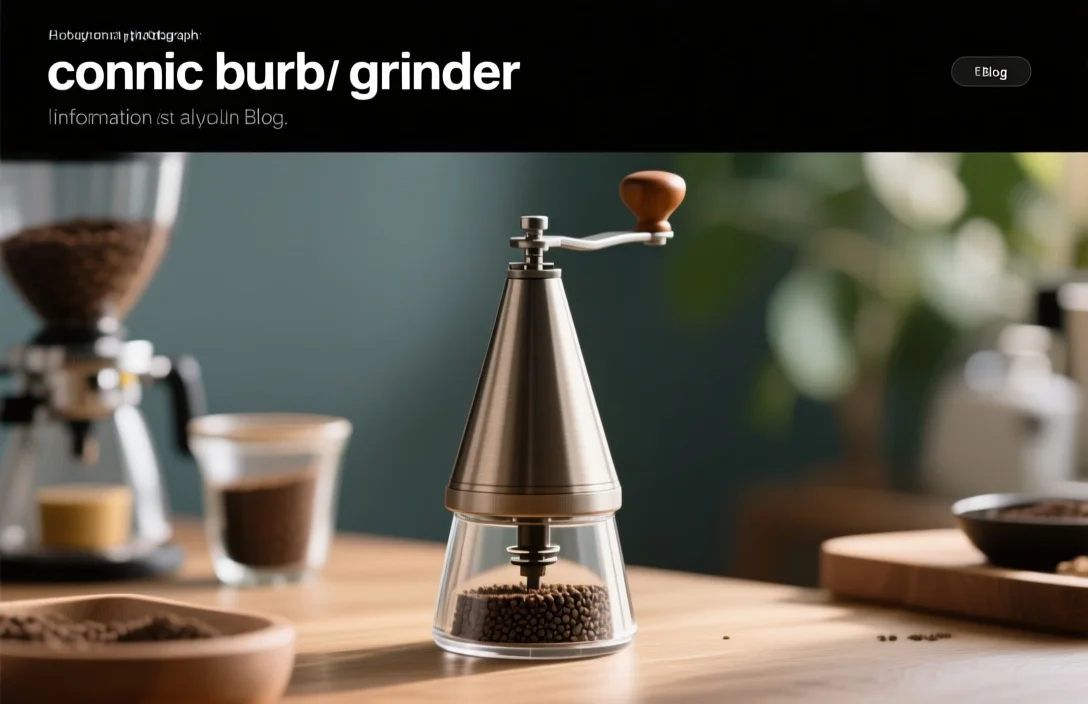
Conical burr grinder answers the basic trade-off most home brewers face: consistent particle size with less heat and noise than a blade grinder. Use this guide to learn how conical burrs work, which grinder categories match common brew methods, and the exact buying and maintenance choices that matter for daily coffee.
How a conical burr grinder works
Conical burr grinders sandwich two cone-shaped burrs so beans are crushed between a stationary outer burr and a rotating inner burr. That matched geometry breaks beans into particles with more consistent diameter than a blade action produces, which helps extraction behave predictably across brew methods.
Rotation speed and the burr profile together determine how particles fracture, which affects the fraction of fines versus larger particles in a dose. Fines increase perceived strength and can clog espresso baskets while large particles under-extract and taste thin in pour-over. Consistency across the grind range matters more than a single setting number because different brew methods call for distinct particle distributions.
Electric conical grinders typically use a motor to spin the inner burr at a steady rpm while manual versions rely on hand torque and gearing. Motor torque and the burr size influence retention and throughput: larger burrs and higher torque move beans faster with less heat generation per gram, while smaller burrs grind slower and can struggle at very fine settings.
Burr material and profile are two separate things that affect wear and particle shape. Hardened steel burrs are common and durable; ceramic burrs resist heat and corrosion but can chip if beans contain stones. Profile choices – stepped versus stepless, serrated versus smooth – change how easy it is to dial in a precise setting and how particles are distributed across a dose.
Why choose a conical burr instead of a blade or flat burr
Many home brewers switch from a blade grinder because blades chop unpredictably and produce a wide spread of particle sizes. A conical burr reduces that spread, which means extraction is more repeatable and taste differences between settings become meaningful.
Flat burr grinders compete directly with conical burrs on consistency, especially in professional settings, but they tend to operate with higher fanout at the grinding plane and, depending on motor and design, can generate more heat. Economical flat burr designs sometimes require more expensive motor and chassis engineering to match a conical grinder’s low-noise, low-retention behavior.
Blade grinders still have a role for simple, low-cost grinding when particle uniformity is not critical, such as for cold brew coarse grinds or when you need to grind large volumes without worrying about extraction control. Home espresso and precise pour-over brewing benefit from conical burr designs for their steady particle profiles, modest noise, and lower fines production compared to typical blade units.
Conical designs also tend to have lower retention than many flat-burr bench grinders, though retention varies widely by model and hopper/doser design. Lower retention matters when you switch beans frequently and want the grind you dial in to reflect the fresh batch, not leftover particles from the previous bag.
Categories and what each one is best for
Conical-burr grinders fall into clear categories that relate to size, control, and price of ownership. Recognizing which category matches your brewing habits will cut down on wasted features and cost.
- Manual hand grinders: Compact, low-noise, and affordable to maintain; best for travelers, campers, and people who brew one or two cups at a time.
- Entry-level electric home grinders: Designed for drip and French press users who want an upgrade from blade grinders without professional throughput or precision.
- Prosumer/espresso-capable grinders: Built to support espresso shots and multiple brew types with tighter tolerances, more consistent dosing, and finer adjustment ranges.
- Commercial or high-throughput grinders: Engineered for cafés and heavy home use; higher throughput, larger burrs, and features like timed dosing or integrated scales.
Table: grinder categories at a glance
| Name | Price/Key Spec | Best For |
|---|---|---|
| Manual conical burr grinder | Low cost, hand crank, small capacity | Single-cup brewers, travel, low electricity use |
| Entry-level electric conical grinder | Budget to moderate price, stepped settings typical | Drip, French press, cold brew at home |
| Prosumer electric conical grinder | Mid to high price, finer adjustment, better retention control | Home espresso, multi-method households |
| Commercial conical grinder | Higher price, large burrs and high throughput | Busy cafés, high-volume use at home |
Categories trade off control, throughput, and footprint. Manual grinders minimize heat and retention but require time and physical effort. Entry-level electrics drop effort and may compromise grind uniformity at the finest settings. Prosumer units bring features like stepless adjustments or programmable doses but cost more and take up counter space.
How to pick a conical burr grinder – five decision points
After comparing the main options side by side, the most practical choice comes down to five decisions that determine how useful a grinder will be for your routine. Rank these decisions by personal priority to reach a clear purchase target.
- Decide how you brew most often.
- Choose between manual and electric based on time and volume.
- Match grind-adjustment type to your tolerance for fiddling.
- Evaluate retention and dosing features if you switch beans often.
- Consider build, motor, and burr material for longevity.
Follow these steps to convert those decisions into a shortlist:
- Identify primary brew method and typical daily dose. Espresso demands the finest, most consistent grind and steady dosing; French press and cold brew tolerate coarser, more forgiving particle distributions.
- Calculate how much time you have for grinding. Manual grinding is realistic for one or two cups; electric grinders pay back their time when you make multiple daily doses.
- Inspect adjustment mechanisms. Stepped settings provide quick, repeatable clicks while stepless knobs permit fine micro-adjustments required for espresso dialing.
- Look at hopper size and retention notes from reliable sources or user reports. If you change beans frequently, smaller hoppers or easy-release catch trays reduce stale cross-contamination.
- Assess maintenance needs and spare-parts availability. Replaceable burr kits and simple motor access matter if you plan to keep the grinder for years.
Choices on burr size, motor torque, and adjustment granularity directly affect how the grinder behaves across settings. For example, a grinder that excels at coarse settings might struggle and produce more fines at espresso-level settings unless its gearing and burr design can handle the required torque.
Dialing in grind size
Start with a known baseline: a coarser setting for immersion brews and a finer setting for espresso. Avoid guessing – treat the first shot or brew as a calibration and adjust methodically.
- Select a starting grind based on method: coarse for French press, medium for drip, fine for espresso.
- Measure dose by weight or a consistent scoop and tamp or bloom exactly the same way each time.
- Brew and taste; record perceived issues such as over-extraction bitterness or under-extraction sourness.
- Adjust grind one incremental unit at a time and repeat the brew to isolate the effect of a single change.
- Once the target extraction and body are reached, note the setting and preserve it by using the same dose and preparation technique.
Practical hints that shorten calibration time include keeping water temperature and brew ratio constant and using a timer to control contact time. For espresso users, tamp pressure consistency and basket cleanliness influence channeling and perceived extraction independent of grind. For pour-over, bloom time and pour rate interact with grind, so refine both together.
A simple checklist for dialing:
- Stabilize variables: dose, water, and time.
- Change only the grind setting between trials.
- Record the setting and tasting notes.
- Revert if puck or filter behavior indicates channeling or clogging.
- Repeat until repeatable results occur across multiple brews.
Maintenance, cleaning, and lifespan considerations
Regular cleaning preserves flavor clarity and grinder performance because accumulated oils and fines change how beans enter the burrs and can gum up mechanisms. Frequency of cleaning depends on roast level and how often you grind oily beans, but most home grinders benefit from a partial disassembly and brush-out every few weeks.
Remove the hopper and use a soft brush to clear the burrs and feed zone; vacuuming the grind chamber reduces build-up around the chute and dosing area. For models with removable burrs, take precise notes or photos of assembly order before disassembly and only use manufacturer-approved cleaning tools or soft brushes to avoid damaging burr edges.
Avoid soaking burrs unless manufacturer instructions expressly permit it; ceramic burrs and some steel burr surfaces can be damaged by certain cleaners. Replacement burr kits are standard for many grinders; knowing whether a model supports aftermarket burrs or OEM replacements influences long-term cost and maintenance ease.
Troubleshoot common mechanical issues by working through simple checks: confirm the hopper is seated, clear any lodged beans in the feed, and listen for unusual motor sounds that indicate clutching or worn bearings. Keep a small toolkit and the user manual accessible; even basic adjustments like aligning the burr carrier or tightening a loose set screw can restore consistent grinding.
Common mistakes and how to avoid them
Many frustrated buyers believe a more expensive grinder will instantly fix poor extraction; the reality is that user habits and calibration matter as much as hardware. Buy the right grinder for your method and learn to dial it rather than assuming cost equals perfect espresso.
Mistake: buying a grinder rated for espresso and expecting it to be perfect for drip without reading adjustment range notes. Mistake: cleaning only externally and letting old fines accumulate inside the grind chamber where they alter particle distribution. Mistake: repeatedly changing beans and not adjusting grind or dose to compensate for roast and density differences.
Avoid these traps with practical habits: keep a simple log with brew method, grind setting, dose, and tasting notes; perform shallow cleaning more often and deeper cleaning on a schedule; and test a new bag of beans with a short calibration routine before serving to guests.
Bulleted list of red flags that indicate a grinder may not suit your needs:
- Excessive noise or vibration beyond typical motor hum.
- Large changes in shot behavior after small environmental shifts like humidity.
- Visible residue around burrs and in the chute after every use.
- Frequent clogging at fine settings for espresso without obvious cause.
- Difficulty accessing spare parts or replacement burrs in vendor documentation.
Address most of these signs by switching to a grinder category better matched to your volume and method, tightening routine maintenance, or consulting brand-specific service guides.
Comparison: conical burr versus alternatives (summary and trade-offs)
Conical burrs balance consistency, low heat, and often lower retention compared with blades; flat burrs can match or exceed consistency at a cost of noise and sometimes retention. Manual conical grinders offer portability and low heat but limit throughput, while commercial-grade conical grinders scale throughput and durability at the expense of price and footprint.
Table: direct trade-offs
| Feature | Conical Burr | Flat Burr | Blade Grinder |
|---|---|---|---|
| Consistency | High across many models | High, often superior at pro level | Low |
| Heat generation | Lower at matched rpm | Variable, can be higher | High, uncontrolled |
| Noise | Generally low | Higher in some designs | Variable |
| Retention | Often lower | Can be higher | Low (but uneven) |
| Best use | Home to café across ranges | Professional cafés and high-precision home use | Casual home use, bulk coarse grinds |
Trade-offs should guide selection more than brand hype. If you change brew methods frequently or require extremely fine espresso dialing, a prosumer flat-burr or high-end conical may both work – prioritize the specific grinder’s adjustment system and retention behavior rather than assuming one geometry always outperforms the other.
FAQ
How is grind retention measured and why does it matter?
Retention refers to the amount of ground coffee left inside the grinder between doses. It matters because retained particles can stale or mix flavors between different beans, affecting consistency and taste when you switch roasts. Practical measurement requires emptying and weighing the grinder before and after a controlled dose, though many users rely on manufacturer specs or reviews for guidance.
Can I use a conical burr grinder for both espresso and pour-over?
Yes, many conical grinders cover the range from coarse to espresso, but not all models do so well at the extremes. Models with stepless adjustment and a robust motor handle espresso dialing better, while simpler stepped grinders excel at coarser settings for pour-over and immersion. Choose based on your primary method and willingness to trade a single optimal range for multi-method flexibility.
How often should I replace burrs?
Burr replacement interval depends on use and burr material; heavy daily café volume will wear burrs faster than casual home use. Watch for degraded consistency, longer grind times, or visible burr edge wear as signs it’s time for replacement. Manufacturer guidelines or parts availability will give the clearest timeline for a specific model.
Are ceramic burrs better than steel?
Ceramic burrs resist corrosion and can retain sharpness but may chip if they encounter stones. Steel burrs are tough and handle higher throughput; they are often easier to source as replacements. Choice depends on usage pattern and exposure to potentially hard contaminants in green beans (rare in reputable roasted-bean suppliers).
Does burr size matter?
Burr size affects throughput and how quickly a grinder can process beans without overheating. Larger burrs typically grind faster and may produce less heat per gram, while smaller burrs can be adequate for low-volume home use. Manufacturer specifications usually indicate the burr diameter and intended use case.
What is stepped versus stepless adjustment and which should I pick?
Stepped adjustment offers defined click stops that make returning to a previous setting fast and unambiguous. Stepless adjustment allows micro-tuning, useful for espresso dial-in and subtle extraction control. Pick stepped if you value repeatability without micromanaging; pick stepless if you enjoy precise dialing and expect to fine-tune frequently.
A short closing note summarizing the practical verdict
Practical use favors matching grinder category to your brewing habit: manual or entry-level conical grinders for low-volume and coarse methods, and prosumer or commercial conical grinders for espresso and multi-method households that require fine control. Next step: list your primary brew method, daily dose, and whether you prefer stepped repeatability or stepless micro-adjustment, then use that check to create a two- or three-model shortlist to test or compare in person.

- Espresso Tastes Watery? 10 Common Causes and How to Fix It - October 23, 2026
- 10 Common Coffee Equipment Cleaning Mistakes and How to Avoid Them - October 23, 2026
- 17 Common Coffee Grinder Problems and How to Fix Them - October 23, 2026