
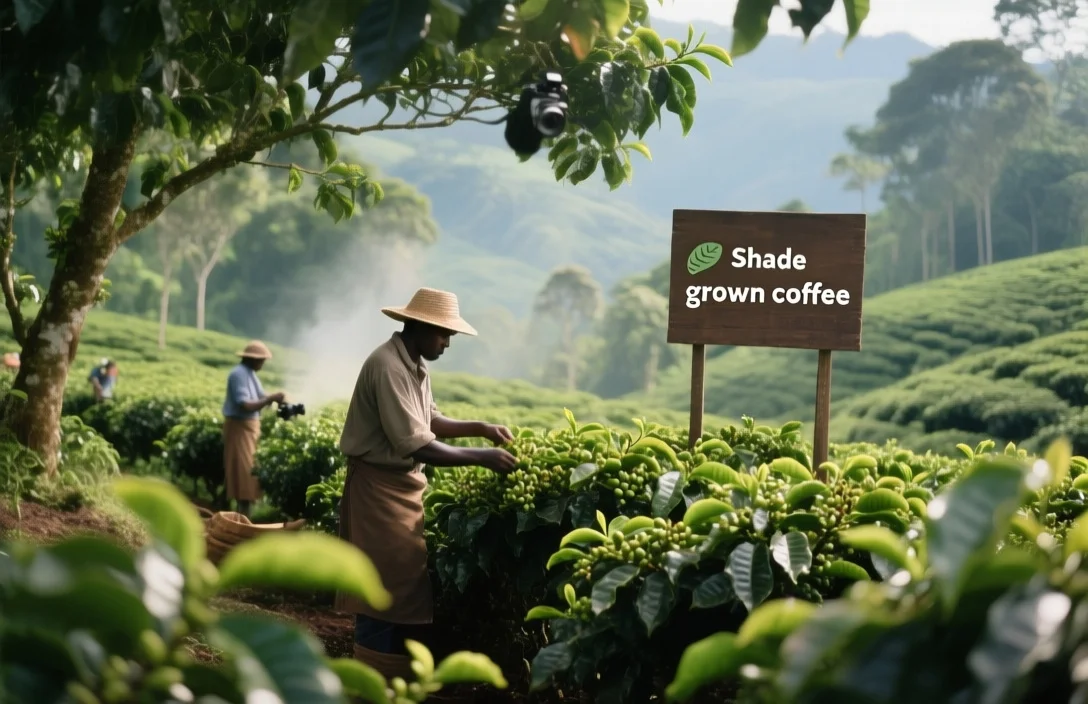
Shade grown coffee is coffee cultivated beneath a canopy of taller trees instead of in cleared, sun-exposed fields. This method preserves a forest-like structure that supports birds, pollinators, and healthier soils while changing the economics and flavor profile of the beans.
What shade grown coffee actually is
Shade grown coffee describes coffee plants intentionally grown under a canopy of trees that provide partial to substantial cover. That canopy can be native forest left largely intact, a deliberately planted mix of fruit and timber trees, or a simple single-species overstory; the specific arrangement matters for biodiversity and farm resilience. Coffee originally evolved in forest understories, and shade systems attempt to replicate that vertical structure so coffee plants get filtered light rather than full sun.
Forest-like systems that include shade trees are sometimes called agroforestry. Canopy trees may serve multiple functions: supplying fruit or timber that diversify farmer income, fixing nitrogen to improve soil fertility, and creating microclimates that reduce temperature extremes and moisture loss. Consumers see the phrase “shade grown” on packaging, but that label alone carries no universal standard unless it is paired with a certification such as Smithsonian Bird Friendly.
How shade affects birds, biodiversity and soil
Bird habitat benefits are a core reason conservation groups champion shade grown coffee. Smithsonian Bird Friendly certification ties shade-grown practices to specific canopy structure and organic requirements that are explicitly designed to support migratory and resident birds. Field research cited alongside Smithsonian materials includes findings that shaded coffee landscapes can support an unexpectedly high tree species richness – sometimes more species than nearby native forest remnants – because farmers retain a variety of fruit and timber trees.
Soil and erosion outcomes under shade are measurable and significant. Rice (1990) reported that open-sun coffee on the same hillsides lost more than 2.5 times the soil of shade-grown coffee. Ataroff and Monasterio (1997) found sun coffee systems in Venezuela experienced twice the soil loss from erosion compared with shaded systems. Soil carbon content and fertility metrics likewise favor shade systems in the studies cited: shaded coffee in Nicaragua had 18 percent higher soil carbon and a 19 percent higher cation exchange capacity than coffee with little or no shade. Infiltration rates declined dramatically in unshaded systems – by as much as 75 percent over 6 to 10 years in some reports – while soil moisture in sun farms can be 42 percent lower compared to farms with a leafy canopy.
Shade systems also moderate landslide risk during storms. Research summarized in conservation literature identifies significantly fewer landslide incidents at farms that maintain more complex vegetation. That stability matters for hillside communities and long-term farm productivity.
What shade does (and doesn’t) do for cup quality and farming economics
Shade can change how coffee cherries develop, which can translate into different flavor characteristics in the cup. Slower ripening under filtered light allows certain sugars and organic acids more time to accumulate; roasters and tasters commonly describe shade-grown beans as showing greater sweetness, smoother body, and more complexity compared with beans from high-yield sun monocultures. Chemistry-focused accounts explain this by noting shifts in amino-acid metabolism and sugar accumulation during the extended ripening window.
Yield is the practical trade-off farmers face. Intensive, sun-exposed monocultures were adopted widely because they increase short-term yields and simplify management. Shade systems typically produce fewer cherries per plant and require more labor to manage canopy diversity and harvest uneven ripening across shaded trees. Price premiums for certified shade-grown or bird-friendly coffee sometimes offset lower yields, but premiums vary widely and are not guaranteed. Organic practices often accompany Bird Friendly certification, which can push retail prices higher; shoppers should expect to pay more for certified shade-grown coffee than for commodity sun-grown options.
Pest and disease dynamics shift under shade as well. Canopy complexity supports natural predators and pollinators, which can reduce some pest pressures. At the same time, increased humidity under a dense canopy can make crops more susceptible to fungal diseases in some climates. Farmers balance species selection, pruning, and canopy density to manage disease risk while preserving the ecological benefits that shade brings.
The main types of shade systems and how they compare
Shade systems are not a single model. Farmers use a spectrum from rustic, near-forest systems to deliberately managed shaded monocultures. The world of labels and marketing glosses over those differences, so concrete comparison helps consumers understand what a given bag likely represents.
| Name | Price / Key Spec | Best For |
|---|---|---|
| Rustic / Forest Garden | Typically highest biodiversity; canopy often native forest retained or minimally altered | Buyers who prioritize habitat conservation and species richness |
| Traditional polyculture / Multistrata | Medium-high biodiversity; canopy includes fruit and timber trees plus understory crops | Consumers wanting a balance of conservation and farm income diversity |
| Shaded monoculture | Lower biodiversity but retains canopy trees (often one or two species) to provide cover | Those seeking some ecological benefit with more predictable harvests |
| Sun monoculture (not shade-grown) | Lowest retail prices; maximized short-term yield and simplified management | Price-sensitive buyers or regions where shade is impractical |
After comparing the main options side by side, the key difference is canopy complexity and species mix. Rustic and multistrata systems deliver the most habitat value because they approximate forest structure – those systems are the target of the Smithsonian Bird Friendly standard. Shaded monoculture gives some soil and microclimate benefits but far fewer biodiversity gains than polyculture systems.
Certifications, labels and what they actually guarantee
Certification names are the clearest consumer signal, but the detail matters. Smithsonian Bird Friendly certification combines shade criteria with organic standards and a strict canopy-density requirement designed around bird habitat needs. USDA Organic ensures no synthetic fertilizers or pesticides but does not by itself prescribe canopy structure. Fair Trade focuses on pricing and labor standards and may or may not overlap with shade practices. Other third-party labels used by roasters vary in rigor and focus; some certify only shade percentages or tree counts, while others require biodiversity monitoring.
Smithsonian Bird Friendly Certified (often labeled exactly that way) is the most prescriptive shade-related label commonly available on retail coffee. Research-backed findings included in conservation literature point to measurable habitat and soil benefits from farms meeting Bird Friendly criteria. Takahashi & Todo (2013) reported lower deforestation probability for certified shade coffee forests in Ethiopia compared with uncertified forests. Martinez-Torres et al. (2008) documented improved soil management on certified organic farms in Chiapas, Mexico, relative to uncertified farms.
Certification alone does not guarantee every farm’s practices are identical. Claims about “shade grown” without an accompanying third-party standard are weaker evidence of habitat benefits. Roaster transparency – naming origin, cooperative or farmer group, and certification – gives consumers the best available verification.
How to tell if a bag is genuinely shade grown
Labels are useful but inconsistent; use a quick checklist when you shop or browse a roaster’s website. This list focuses on signals that are verifiable without specialized knowledge.
- Look for exact certification names on the bag, especially “Smithsonian Bird Friendly Certified” and “USDA Organic”.
- Check the origin and producer information; single-origin or named cooperatives increase traceability.
- Read the roast page on the roaster’s website for canopy details such as “multistrata,” “native forest,” or “agroforestry system.”
- Avoid products that only use the phrase “shade-grown” with no supporting details or certification.
- Confirm whether the roaster lists farmer incomes, premium payments, or producer investments – those details indicate stronger supply-chain transparency.
Transparency examples from roasters and independent lists show brands that commonly offer bird-friendly options, such as Dean’s Beans, Counter Culture, Birds & Beans, and others. Retail listings and specialty reviews from 2025-2026 indicate that Smithsonian Bird Friendly coffee is often paired with organic certification, but the overlap is not automatic; always verify the label text on the package.
Practical buying guidance and brand signals (what to expect to pay)
Expect price variation depending on certification and roast. Certified Bird Friendly and organic single-origin beans frequently sit above mainstream commodity prices because certifications, lower yields, and relationship-based sourcing increase costs. Specialty roasters often batch and roast smaller volumes, which also increases retail price.
Comparing product pages and roaster practices side by side helps. When a roaster lists cooperative relationships, year-on-year producer investments, and certification details, that is a stronger signal than marketing language alone. Brands mentioned repeatedly in recent retail and review material include Dean’s Beans, Counter Culture, Birds & Beans, Bird & Wild, Kicking Horse, Purity Coffee, Tomorrow’s Coffee, Stumptown, Equal Exchange, and Peet’s. Some reviewers tested specific labeled products priced in the mid-$20s per 12 oz bag; one reviewed item listed a price of USD 26.99 per bag for an organic, Smithsonian-labeled single-origin. Price points will vary by roast, grind format, and direct-to-consumer versus retail distribution.
Common mistakes, greenwashing risks and trade-offs to watch for
Consumers commonly assume “shade-grown” always equals “high biodiversity” or “local economic benefit” – that assumption can be wrong. Shaded monoculture with one tree species provides canopy but minimal habitat diversity. Unclear labeling allows some roasters to claim shade without meaningful ecological outcomes. Brands that emphasize vague sustainability language without field-level evidence should prompt follow-up questions.
Premiums do not always reach farmers. Look for explicit statements about premiums paid to producers or investments in farmer services. Some certifications and cooperatives report direct benefits such as technical assistance, soil management programs, and price supports; others do not disclose those details. Disease management is another trade-off: dense canopy can increase humidity and fungal risk in certain regions, and responsible farms actively manage canopy density and species choice to mitigate that risk.
Papers and field studies reveal additional caveats. Ant assemblages and some insect communities can be reduced in certain shaded plantations compared with remnant forests (Ambrecht et al.), and biodiversity benefits vary widely by region and farm design. Readers should treat general claims of superlative biodiversity with caution unless tied to a recognized standard or site-level data.
How to verify and support shade-grown coffee beyond the label
Do these steps each time you buy specialty coffee if you want to support genuine shade-grown outcomes:
- Ask the roaster for origin transparency. Request the producer or cooperative name, altitude, and a summary of the canopy system.
- Verify certification text. Photograph the label or note exact phrasing, then cross-check the certifier’s public database when available.
- Favor single-origin and small-lot releases that name producers; these are easier to trace than generic blends.
- Prioritize roasters that publish producer premiums, investments, or long-term relationships in origin pages.
- Consider subscriptions from trusted specialty roasters that commit to seasonal, relationship-based sourcing.
Small steps like buying less but higher-quality shade-grown bags create demand for producers who maintain canopy complexity. Direct consumer questions and steady purchasing patterns are two of the clearest levers roasters respond to when negotiating with cooperatives.
Quick brewing tips
Roast level and brewing method influence how shade-grown qualities present in the cup. Lighter roasts preserve more of the nuanced acidity and sugar-derived sweetness that slower ripening under shade tends to deliver. Medium roasts can balance brightness with body, while darker roasts will mute some of the origin character.
- Grind fresh and adjust grind size to taste; shade-grown coffees often reward slightly finer grinds in pour-over for clarity.
- Use a water temperature between 195°F and 205°F for most methods; slightly lower temperatures can soften perceived acidity.
- Taste for sweetness and layered fruit/flower notes; these are common descriptors for well-managed shade-grown lots.
Careful home brewing lets you taste the differences that shade systems can create without conflating roast-driven flavors.
FAQ
Is all shade-grown coffee certified?
No. Shade-grown claims can appear without certification. Certification names such as Smithsonian Bird Friendly and USDA Organic provide clearer verification of canopy and input practices. Ask roasters for producer names and certification text to confirm claims.
Does shade-grown coffee taste better?
Taste is subjective, but many roasters and cuppers note that shade-grown beans often show greater sweetness and complexity because cherries ripen more slowly under a canopy. Roast level and processing method heavily influence final cup flavor.
Will buying shade-grown coffee help birds?
Buying certified Shade or Bird Friendly coffee supports habitat practices designed for birds, particularly migratory species. The Smithsonian Bird Friendly standard explicitly targets bird habitat, and research has linked certified shade coffee to lower deforestation risk in certain regions.
Are there downsides for farmers who adopt shade systems?
Adopting shade often reduces short-term yield and may increase labor for canopy management and selective harvesting. Some regions also face higher humidity-linked disease pressures under dense canopies, so local species selection and management are essential.
How much more will I pay for certified shade-grown coffee?
Price premiums vary by roaster and certification; some reviewed retail items list prices around USD 26.99 per 12 oz bag for organic, Bird Friendly-labeled single-origin coffees, while other certified lots may cost more or less. Verify price against roast size and packaging.
Can small roasters provide reliable shade-grown coffee?
Yes. Many small specialty roasters work directly with cooperatives and pay premiums to support shade and organic practices. Favor roasters that publish origin detail and producer relationships.
A short, practical verdict and next ste
Genuine shade grown coffee delivers measurable benefits for birds, soil health and long-term farm resilience, but not every “shade-grown” label is equal. Start by looking for Smithsonian Bird Friendly or USDA Organic labels and favor roasters that name origins and describe producer relationships. Your next step: pick one certified, single-origin bag from a roaster that lists its cooperative and try it brewed light to medium roast to evaluate the difference for yourself.

- Espresso Tastes Watery? 10 Common Causes and How to Fix It - October 23, 2026
- 10 Common Coffee Equipment Cleaning Mistakes and How to Avoid Them - October 23, 2026
- 17 Common Coffee Grinder Problems and How to Fix Them - October 23, 2026