
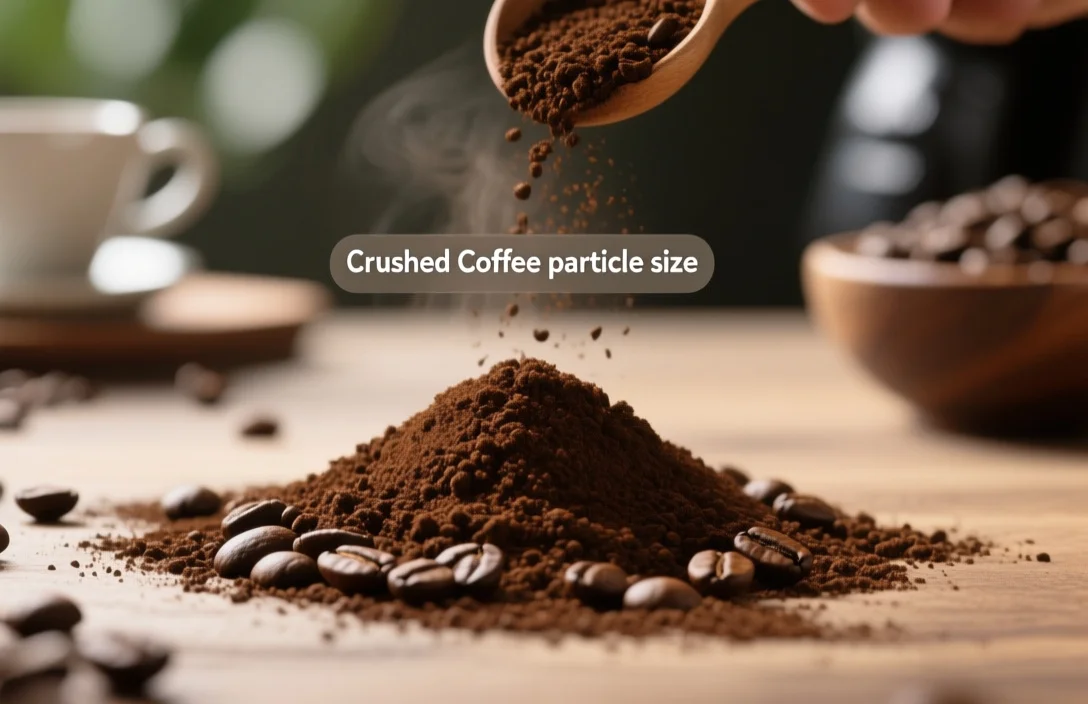
Crushed coffee particle size is the physical distribution of coffee fragments after grinding, and it directly controls extraction rate, brew strength, and flavor balance. Early in your brew routine you can predict common outcomes – under-extraction tastes sour and weak, over-extraction tastes bitter – by checking whether your particles are too coarse, too fine, or uneven.
Why particle size matters for extraction and flavor
Extraction depends on surface area and time. Smaller particles present more surface area to water and therefore extract soluble compounds faster; larger particles extract more slowly because water reaches fewer surfaces during the same contact time.
Particle uniformity matters almost as much as average size. A mix of very fine dust and coarse chunks results in simultaneous over-extraction from the fines and under-extraction from the coarse pieces, producing sour, bitter, and hollow-tasting cups at once. Properly crushed coffee with a narrow particle distribution brings clarity to flavor and makes dosing and brew time repeatable.
Surface area and geometry change flavor pathways. Bitter alkaloids and some tannins extract later than acids and sugars, so a grind that is too fine will push water to pull those late compounds into the cup during short contact times as well. Control of particle size therefore becomes the central dial for whether your coffee tastes bright, balanced, or harsh.
Grind consistency affects downstream equipment behavior. Espresso machines respond poorly to inconsistent particle distributions because channeling forms easily when fines compact. Immersion brewers such as French press can tolerate a broader distribution but still suffer from muddy texture if fines dominate. Pour-over methods reward consistent medium-to-medium-fine grinds for balanced extraction.
How crushed coffee particle size maps to common brewing methods
Match grind coarseness to extraction method and contact time. Short-contact, high-pressure methods require very fine, close-to-uniform particles to allow extraction inside 20-30 seconds. Long-contact, low-pressure immersion methods need coarse particles that avoid over-extraction over several minutes.
Espresso calls for the finest crushed particle size of common manual brewing methods, with tight distributions to prevent channeling and to produce crema. Aeropress, pour-over, and drip machines occupy the middle; they want a medium to medium-fine crush depending on filter thickness and draw time. French press and cold brew use coarse crushed particles to slow extraction and limit fines that cause muddiness.
Different waters and filter types interact with particle size. Hard water can accentuate bitterness when particle size shifts fine because minerals change extraction efficiency. Paper filters remove more micro-fines than metal filters, so a pour-over with paper can tolerate slightly finer crushes than a metal-filtered pour-over without becoming muddy.
Comparison table: common grind names, key particle traits, and best-use
| Name | Key particle trait | Best for |
|---|---|---|
| Extra coarse | Large, chunky fragments; visible gaps; many particles feel like small pebbles; exact micron ranges were not available | Long cold-brew, cowboy coffee, percolators |
| Coarse | Mostly large pieces with some smaller fragments; metal-filtered immersion units | French press, cold steep |
| Medium-coarse | Noticeably smaller chunks; still coarse to the eye; distribution narrower than coarse | Chemex with thick paper, drip brewers with flat-bottom filters |
| Medium | Fine-sand-like appearance; even distribution that still allows flow | Drip cone, automatic drip, Aeropress with moderate brew time |
| Medium-fine | Close to table salt in texture; few larger pebbles | Hario V60 pour-over for faster flows, Aeropress short recipes |
| Fine | Sugar-like granules; narrow spread | Espresso in some setups with shorter shots or Moka pot |
| Extra fine | Powdery, flour-like; high risk of channeling and clogging; exact micron ranges were not available | Turkish coffee; very high-pressure specialty espresso tweaks |
How to measure particle size and distribution at home
Measure by feel and by simple sieving if you need more precision. Feeling grinds between thumb and forefinger provides a fast qualitative check: coarse grinds feel like wet sand or small pebbles while fine grinds feel like table salt or flour. Use a white background and bright light to inspect visually for uniformity and dust.
Low-cost sieves and kitchen mesh can separate coarse material from fines if you want a rough distribution map. Commercial particle analyzers exist for lab-level precision, but household brewers can learn a lot using graduated mesh or by collecting and weighing fractions after sieving. Exact micron measurements were not available in the materials reviewed here, so avoid pretending to report precise µm numbers without lab equipment.
A repeatable testing routine helps. Record grind setting, dose, and time, then brew a tasting lot and note any problems. Change one variable at a time and document the results. Repeated small tests let you correlate visual or tactile characteristics of crushed coffee to predictable tasting outcomes.
Step-by-step: practical routine for dialing crush size on any grinder
- Set grinder to a baseline based on method – coarse for immersion, medium for drip, fine for espresso.
- Grind a small batch and evaluate by touch and sight to confirm the initial setting.
- Brew a standard recipe using that grind and taste the result for sourness, bitterness, or imbalance.
- Adjust grind finer if the cup tastes under-extracted (sour, bright, hollow); adjust coarser if it tastes over-extracted (bitter, drying, astringent).
- Repeat with smaller increments near your target, keeping dose and time constant to isolate the grind effect.
Many grinders respond nonlinearly to dial changes. Make micro-adjustments when close to the desired result. Use fewer than 10 grams for test brews when calibrating to save beans while you find the correct crush.
How grinder type changes crushed particle size and distribution
Blade grinders produce wide distributions of crushed particle sizes because they slice inconsistently. Those devices often generate a mix of fines and larger pieces that makes consistent extraction difficult. Conical and flat burr grinders control particle size by mechanical spacing and produce narrower distributions.
Commercial espresso grinders aim for tight tolerances in crushed particle size because extraction windows are short. Manual hand grinders can match electric burrs in consistency if they use quality burrs and durable adjustment mechanisms, but they require more effort for larger doses. Budget burr grinders often have sloppy adjustment rings that cause stepped changes and inconsistent output.
Maintenance affects distribution too. Burr wear, misalignment, and clogging create more fines and irregular shapes over time. Periodic calibration and burr replacement keep crushed particle size consistent. Real-world shops track dosing and extraction numbers and replace burr sets on a schedule; home users can adopt a basic schedule based on hours of use to retain similar performance.
Practical
Under-extracted, sour coffee after pour-over: coarseness is the usual suspect. Try one step finer on your grinder, keep dose constant, and test. If bitterness appears instead, reverse course and go slightly coarser while shortening contact time.
Bitter, astringent espresso with fast channeling: fines or compacted particles often cause uneven flow. Reduce the dose slightly and back off grind fineness by one step to open the bed. Distribution techniques such as tapping the portafilter, using a distribution tool, or a reliable tamp help reduce channeling as well.
Cloudy or muddy French press cups: excessive fines are likely. Dial coarser and allow the plunge to separate sludge, or use a secondary decant into another vessel to leave fines behind. Metal filters will let fines through; switching to a coarser grind to reduce fine proportion can improve clarity.
Common mistakes that affect crushed particle size and how to avoid them
Relying on grind names alone without testing is a frequent error. Labels like “medium” or “espresso” mean different things across grinders. Confirm by feel and by brew because nomenclature varies.
Changing multiple variables at once ruins diagnostics. Adjust only one factor – grind, dose, water temperature, or time – per test. Maintaining a log prevents repeated guessing and saves beans and time.
Neglecting grinder maintenance produces unpredictable crushed particle size over weeks. Clean burrs regularly and check alignment. Wear and burr damage shift particle distributions and often make previously validated settings unusable.
Using unsuitable equipment for your method undermines even a perfect grind. Blade grinders and clogged burrs create excessive fines; cheap filters or uneven water flow compound that problem. Upgrade critical pieces like the grinder or filter before troubleshooting flavor endlessly.
How to optimize for consistency rather than a perfect single number
Aim for repeatability in your process rather than obsessing over an exact particle size number. Standardize dose, tamp or distribution, water temperature, and pour pattern. A consistent routine lets you find the narrow grinding zone that produces the flavor you like and keeps it.
Metric tracking helps. Record grind setting, time, dose, and tasting notes. Small changes reveal how sensitive your setup is to grind shifts. After finding a preferred setting, lock it in and periodically reconfirm with a quick test rather than starting from scratch.
Consider using a small sieve to remove extreme fines if your grinder produces a significant dust fraction. That extra step reduces bitterness and improves clarity in immersion brews. Sifting is a practical house-hack when burr replacement is not feasible or when you want to experiment with extraction without buying new gear.
Troubleshooting
- Sour, thin cup from pour-over: grind finer by one to two steps; check water temperature.
- Bitter, drying taste with espresso: coarsen grind slightly or shorten shot time; inspect for channeling.
- Cloudy French press: dial coarser and decant to remove fines; clean the mesh filter.
- Inconsistent flow through filter basket: check for a high proportion of fines and recalibrate burr alignment.
- Sudden change in previously stable recipe: examine burr wear, recent cleaning, or new beans with different roast levels.
A methodical approach resolves most problems within a few iterations. Keep tastings blind when possible to avoid bias during dialing.
FAQ
How fine or coarse should crushed coffee particles be in microns?
Exact micron numbers were not available in the reviewed material for this article. Practical home brewing relies on tactile and visual descriptions – coarse feels like small pebbles, medium like sand, fine like sugar, and extra-fine like flour – rather than precise micron targets unless you have lab tools.
Can I use a blade grinder to get a consistent crushed particle size?
Blade grinders usually produce a broad mix of fines and coarse pieces, so consistency will be limited. Sifting after grinding or switching to a burr grinder will markedly improve repeatable crushed particle size and cup clarity.
Will changing bean roast level affect the ideal crush size?
Roast level changes bean brittleness and oil content, which changes how beans fracture when crushed. Lighter roasts often need slightly finer crushes for the same perceived extraction; darker roasts can over-extract faster, so small coarsening adjustments are common.
How often should I clean or replace burrs to keep particle size consistent?
Cleaning frequency depends on use and oiliness of beans, but a quick visual inspection monthly for home users and a deeper clean every few months is a reasonable starting point. Burr replacement intervals vary by burr material and hours of use; watch for more fines or inconsistent particle distributions as wear indicators.
Is it worth buying a particle-size analyzer for home brewing?
Most home brewers benefit more from a better grinder, consistent recipes, and a small sieve than from expensive lab instruments. Particle-size analyzers provide valuable data for labs or commercial roasters but are rarely necessary for reliable home brewing.
Practical verdict and next
Consistent crushed coffee particle size is the single most actionable lever for improving repeatability and cup quality. Start by assessing your grinder type and maintenance state, then run a short series of taste tests while changing only grind coarseness. Record each attempt, and after a few controlled trials you will be able to dial a dependable grind setting for your favorite brew method.

- Espresso Tastes Watery? 10 Common Causes and How to Fix It - October 23, 2026
- 10 Common Coffee Equipment Cleaning Mistakes and How to Avoid Them - October 23, 2026
- 17 Common Coffee Grinder Problems and How to Fix Them - October 23, 2026