
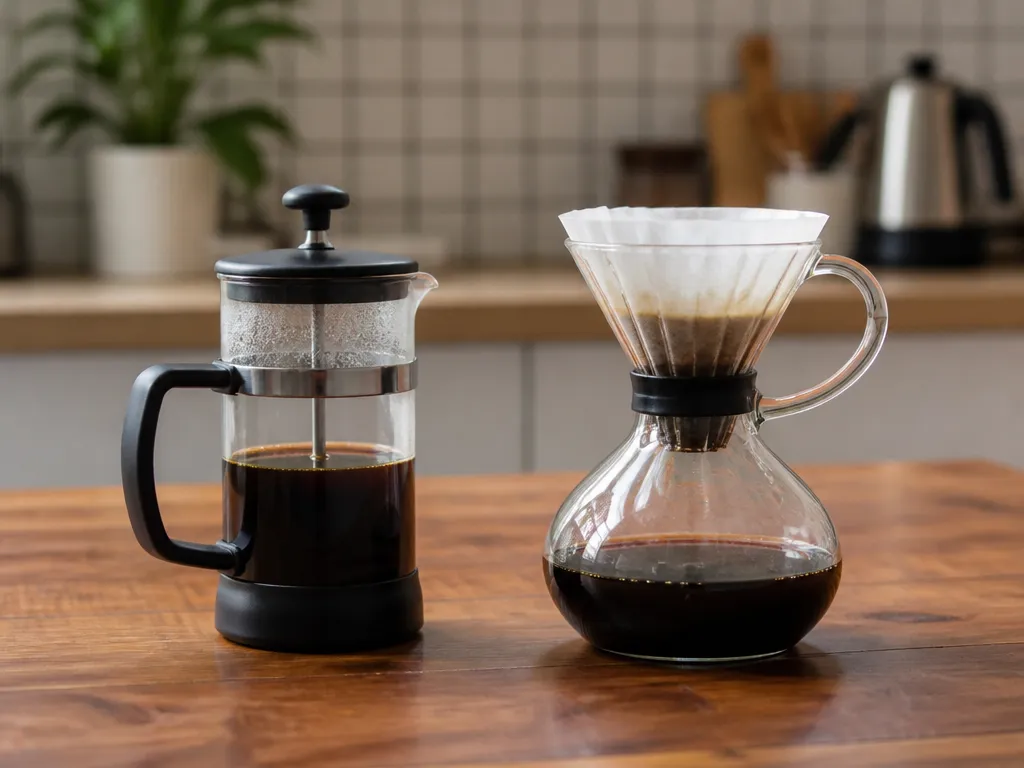
French press is the better choice if you want a fuller cup with less fuss. Pour over is the better choice if you want cleaner flavor separation and consistent control. French press steeps coffee grounds in water for several minutes, while pour over draws water through the grounds in repeated pours. That difference affects taste, grind size, timing, cleanup, and cost.
Water around near-boiling temperature helps both methods, but pour over is more sensitive to grind size and pouring technique. French press is more forgiving, though you must use a coarse grind and either accept some sediment or pour carefully.
Key Takeaways
- Clarity trade-off: French press keeps more oils and fines, so it tastes heavier and looks hazier. Pour over produces a cleaner, clearer cup.
- Skill requirement: Pour over demands more attention to grind and pouring, while French press centers on steeping and pressing.
- Grind matters: French press needs coarse grounds; pour over needs medium to medium-fine grounds.
- Timing control: French press relies mainly on steep time; pour over relies on controlled flow and multiple pours.
- Cleanup difference: French press requires dumping grounds and rinsing the plunger. Pour over adds filter handling and dripper rinsing.
- Cost stays low: French press is usually cheaper to start and has no ongoing filter cost, while pour over requires a brewer and paper filters.
French Press vs Pour Over
French press steeps coffee grounds in water, then presses them down through a metal mesh. Pour over uses gravity to draw hot water through coffee held in a filter, so the brewed coffee leaves while most solids stay behind.
French press produces a fuller, heavier cup because oils and fine particles pass through the mesh. Pour over produces a cleaner cup with more separation between flavors because the paper filter traps more sediment.
The methods also differ in repeatability. Once you set the coffee-to-water ratio and steep time, French press results are fairly forgiving. Pour over reacts more noticeably to grind size, pour speed, bloom timing, and the way water moves through the coffee bed.
What Brew Method Gives Better Flavor
Pour over usually gives better clarity, especially if you prefer distinct tasting notes and a lighter body. The filter removes more fine particles, so the coffee tastes cleaner and less muddy. Bright, defined flavors are more common with pour over.
French press usually gives better body and a thicker mouthfeel. Without a paper filter, more coffee oils and fine sediment reach the cup. That richer texture works especially well with darker roasts or coffees you prefer to taste as one bold, unified flavor.
“Better flavor” depends on the coffee and your preferences. Bright, lighter roasts often benefit from pour over because filtration emphasizes nuanced flavors and can reduce distracting bitterness. Chocolatey, medium-dark roasts often suit French press because the fuller body makes those flavors feel more pronounced.
Texture matters too. French press leaves more residue, which some people enjoy and others dislike. If sediment bothers you, pour over is usually the safer choice.
French Press Grind and Steep Time Guide
French press requires a coarse grind, roughly like coarse sea salt. A grind that is too fine produces extra sediment and bitterness, and the metal mesh will not contain all of it. A grind that is too coarse extracts weakly and can leave the coffee tasting thin.
Steep time is your main adjustment. Most people land between about 4 and 5 minutes for a balanced cup, then adjust from there. Shorten the steep if the coffee tastes bitter or harsh. Lengthen it slightly if the cup tastes weak or watery, but do not keep extending the time to solve every flavor problem.
Use near-boiling water and keep the steep time consistent. Starting with hot water and repeating the same timing is the simplest way to make French press coffee more predictable.
After steeping, press with steady downward pressure. Slamming the plunger can force more fines through the mesh and increase harshness. A slow, gentle press usually produces a cleaner cup from the same grind.
Use this starting point:
- Grind: coarse
- Steep: about 4 minutes
- Press: gentle and steady
- If it tastes off: adjust steep time by small increments first, then tweak grind
Pour Over Water Temperature and Flow Rate
Pour over is more sensitive because water movement controls how long it contacts the grounds. Water that flows too quickly can produce sour, thin, or grainy coffee. Water that flows too slowly can produce bitterness or an overly dry finish.
Start with near-boiling water, then focus on consistency. A steady pour that keeps the coffee bed evenly saturated works better than aggressive pouring, which can create channels and uneven extraction.
Blooming also matters. When water first hits dry grounds, trapped gas escapes and the coffee begins to saturate. A bloom that is too short or a follow-up pour that is too chaotic can lead to uneven extraction and inconsistent flavor from one mug to the next.
Grind size and pouring technique largely determine flow rate. If the coffee tastes weak and watery, try a slightly finer grind – not a full step to espresso-fine – or pour a little more slowly. If it tastes harsh or bitter, try a slightly coarser grind or pour a little faster.
Aim for consistency rather than a single magic number. Pour over must be adjusted to your brewer, filter, and control of the kettle. Once you find a repeatable pattern, the coffee becomes much easier to predict.
Which Brew Is Easier to Clean
French press usually has the easier cleanup routine. Dump or compost the grounds, then rinse the carafe and plunger assembly. You have fewer parts to wash and no disposable paper filter.
Pour over cleanup is still simple, but it involves more steps. You rinse the brewer cone or dripper, discard the paper filter, and deal with any residue left behind. Some plastic or ceramic brewers need more thorough rinsing because coffee oils cling to their surfaces.
Both methods need occasional attention to coffee oils. Built-up oils can create stale flavors. With French press, rinse and wash the mesh screen. With pour over, rinse the cone thoroughly right after brewing.
Cost and Equipment Differences for Each Method
French press is usually cheaper and simpler to start. A basic press is the main piece of equipment, and you do not need disposable filters. You still need a kettle and a way to measure coffee, but most kitchens already have those basics.
Pour over can cost more upfront if you want a dependable setup. You need a brewer, filters, and ideally a kettle that pours consistently. A gooseneck kettle can help with control. Basic equipment works, but better gear can make consistent brewing easier.
Pour over also has an ongoing filter cost. French press uses no disposable filters, while paper filters need to be replaced regularly. If you brew frequently, that recurring expense adds up.
A coffee grinder can affect the real cost of either method because grind quality strongly affects the result. If you already have a decent burr grinder, both methods become easier. If you do not, the grinder may be the most important equipment investment regardless of which brewer you choose.
Current prices vary by brand and sales cycle, so check today’s listings before buying. Price the missing essentials for your kitchen rather than every optional upgrade.
Equipment Cost Reality Check
| Method | What you buy first | Ongoing consumables | Best value if you |
|---|---|---|---|
| French press | Press + kettle + measure | None (no filters) | Want one-simple brewer with easy cleanup |
| Pour over | Brewer + filters + kettle | Paper filters | Want cleaner cups and enjoy a controlled routine |
French Press or Pour Over for Different Budgets
French press is usually the safer purchase on a tight budget. One brewer gets you started, and you avoid ongoing filter costs. It is also more forgiving when your grind is not perfect, so you can get decent results quickly with the equipment you already have.
With a little more room in the budget, pour over can be a worthwhile step toward cleaner cups and more consistent brewing. You will likely spend more on the brewer and filters, and you will benefit from controlling grind size and pour speed. Once you find your rhythm, the process can become a repeatable daily ritual.
Choose based on how much attention you want to give the process. French press suits people who want reliable coffee with minimal effort. Pour over suits people who enjoy dialing in a recipe and making small adjustments.
If you already own a kettle but not a brewer, the fastest path is often:
- Low budget: French press
- Medium budget: Pour over + filters + consistent pouring kettle
- Both: Add a burr grinder eventually to improve either method
The best budget decision is the tool that matches your habits. Skip pour over if you dislike filter handling. Skip French press if you cannot tolerate sediment.
French Press vs Pour Over for Different Coffee Styles
French press suits coffee styles where body matters more than clarity. Darker roasts, blends, and coffees you want to taste bold and rounded often feel more satisfying through a French press. The oils and sediment add warmth and richness.
Pour over suits coffees that benefit from definition. Lighter roasts, single-origin coffees, and beans with bright acidity often taste more articulate when filtered. The cup is usually easier to drink black because it feels cleaner and less heavy.
You can also use the brewing method to reshape the same coffee. If the coffee tastes too sharp or thin, French press can add body. If it tastes too heavy or muddy, pour over can make the flavor feel cleaner and more focused.
Choose based on the coffee you drink most often. A dark, forgiving daily coffee points toward French press. A lighter coffee with distinct tasting notes points toward pour over.
FAQ
Which is easier – French press or pour over?
French press is usually easier because it relies on one main timing step and a simple press. Pour over requires more attention to grind size, bloom, and pour rhythm to avoid under-extraction or channeling.
What grind size should I use for French press and pour over?
French press needs a coarse grind, roughly like coarse sea salt, to reduce sediment and bitterness. Pour over usually uses a medium to medium-fine grind because water passes through the grounds and flow depends on grind size. If the coffee tastes too bitter, go coarser. If it tastes sour, go finer.
Does pour over taste “cleaner” than French press?
Yes. Pour over usually tastes cleaner because paper filters trap more fines and sediment. French press tastes fuller and heavier because oils and fine particles pass through the metal mesh. Pour over is the safer choice if you dislike residue in your mug.
Which is cheaper over time?
French press is often cheaper over time because it has no ongoing filter cost. Pour over adds recurring filter purchases, and you may also want a kettle that pours consistently. If you brew frequently, filter costs can matter more than the initial brewer price.
What’s a common mistake when brewing either method?
A common French press mistake is using too fine a grind, which increases sediment and bitterness. A common pour over mistake is pouring too quickly or unevenly, which causes channeling and uneven extraction. For both methods, consistent technique matters more than changing several variables on every mug.

- Unlocking the Venti: Discover the Perfect Shot Count for Your Drink - October 13, 2026
- Unpacking the Buzz: Caffeine Levels in Café Bustelo Espresso - October 13, 2026
- How to Fix Bitter Coffee: 10 Expert Ways to Improve the Taste - October 4, 2026