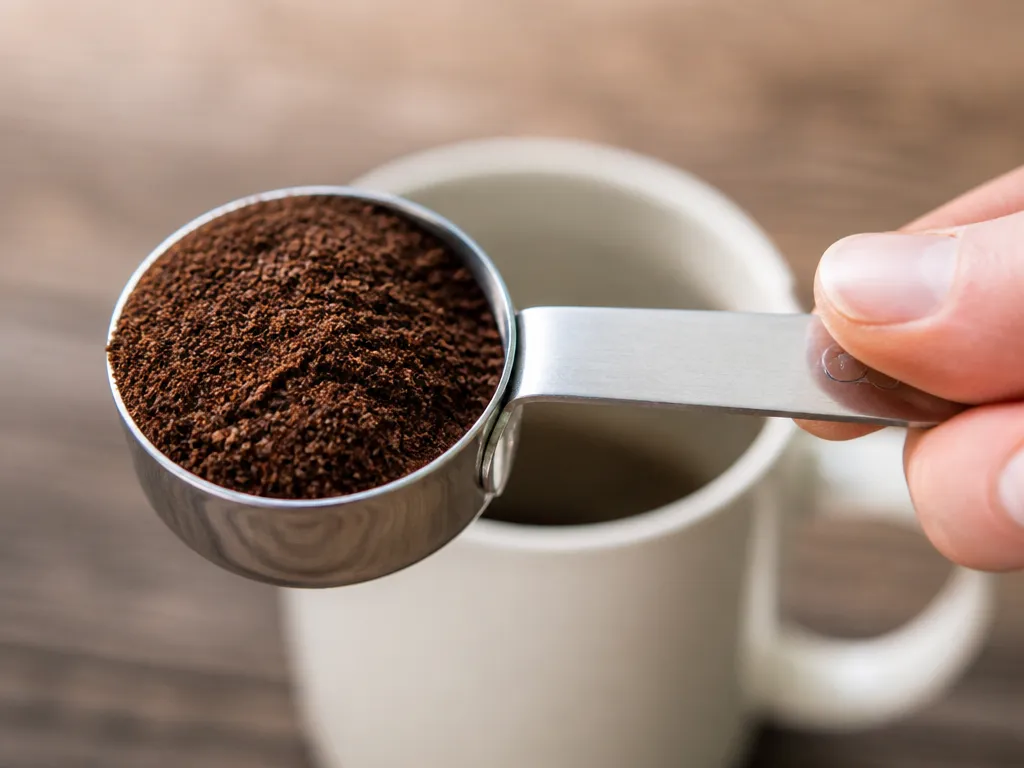
1 tablespoon of Folgers ground coffee contains 55 to 75 milligrams of caffeine, depending on the roast level and how densely you measure. That translates to about one-third to one-half the caffeine in a standard 8-ounce cup of Folgers brewed coffee. The exact number shifts based on whether you use Classic, Medium, or Light Roast, and how your specific brewing setup performs.
Most Folgers containers come with a pre-packaged scoop that holds about 1 tablespoon of grounds. When people ask about tablespoon measurements, they are usually trying to figure out how much caffeine they are getting before they even brew, or comparing it to what they actually drank from a finished cup. The answer sits in a range rather than a single number because coffee is a natural product and Folgers makes several different blends.
55 to 75 mg per tablespoon is the most commonly cited range for a Folgers tablespoon, with Light Roast on the higher end and Dark Roast on the lower end. One Folgers scoop equals one tablespoon of ground coffee, so the scoop and the tablespoon give you the same caffeine baseline. Roast level matters: lighter roasts contain slightly more caffeine by weight, though the difference per tablespoon is small. Brewed cup caffeine varies widely: expect 95 to 140 mg in a 6- to 16-ounce cup, so a tablespoon of grounds yields roughly half that amount in the finished drink. Brewing method changes extraction: drip coffee pulls less caffeine than a French press or espresso-style preparation. Serving size is the biggest variable: a “cup” ranges from 6 to 16 ounces, making the same tablespoon of grounds produce very different caffeine doses depending on how much water you use.
Folgers produces several roast profiles, and caffeine content shifts slightly between them. Light Roast contains marginally more caffeine by weight than Dark Roast because the longer roasting process breaks down some of the caffeine molecules. That said, the difference per measured tablespoon is modest.
For a standard level tablespoon of Folgers:
- Light Roast: approximately 70 to 75 mg caffeine per tablespoon
- Medium Roast: approximately 60 to 70 mg caffeine per tablespoon
- Classic Roast / Dark Roast: approximately 55 to 65 mg caffeine per tablespoon
These numbers assume a heaping or level tablespoon of ground coffee that weighs roughly 5 to 6 grams. A true heaping tablespoon can push toward 7 grams, which would increase the caffeine slightly. If you are scooping lightly or leveling off with a knife, you may be closer to the lower end of the range.
Folgers also offers a 1850 Mountain Blend and a Black Silk variety, which tend to sit closer to the Classic Roast end of the spectrum. The caffeine variation across Folgers products is less dramatic than the variation you would see between Folgers and, say, a Starbucks dark roast, simply because the roasting approach is similar across Folgers lines.
People often mix up three separate measurements: the caffeine in the raw grounds, the caffeine in a Folgers scoop, and the caffeine that actually ends up in your mug. These are related but not identical.
A Folgers scoop is designed to hold approximately 1 tablespoon of ground coffee. Most Folgers canisters include this plastic scoop, and it lines up closely with a standard US tablespoon measure. One scoop therefore gives you the same baseline caffeine as one measured tablespoon of grounds.
What ends up in your cup depends on how much water passes through those grounds. A standard 6-fluid-ounce cup of Folgers brewed with a typical drip coffee maker contains roughly 95 to 105 mg of caffeine when made from medium roast grounds. That means a single tablespoon of grounds produces about 95 to 105 mg in your mug. But if you brew the same tablespoon with 12 ounces of water, you are diluting that caffeine across a larger volume, so each ounce contains less.
This distinction matters for anyone tracking intake precisely. A tablespoon of Folgers grounds does not equal a tablespoon of caffeine in the cup. You extract somewhere between 60 and 80 percent of the available caffeine during a typical home drip brew, depending on grind size, water temperature, and brew time.
| Measurement | Estimated Caffeine | Notes |
|---|---|---|
| 1 tbsp Folgers grounds (raw) | 55 – 75 mg | Before brewing |
| 1 Folgers scoop (1 tbsp) | 55 – 75 mg | Same as a level tbsp |
| 6-oz brewed cup (drip) | 95 – 105 mg | Standard Folgers serving |
| 8-oz brewed cup (drip) | 120 – 140 mg | Larger standard serving |
| 12-oz brewed cup (drip) | 150 – 175 mg | Oversized travel mug |
These brewed cup figures assume a standard drip coffee maker, water just off boiling (around 200 degrees Fahrenheit), and a normal 4 to 5-minute brew cycle.
You will find different numbers across nutrition sites, forums, and even Folgers own packaging. This is not a sign that anyone is lying. Several legitimate factors cause the variation.
Packaging labels list brewed cup amounts, not raw grounds. Folgers caffeine labels on the canister typically report the caffeine content per 6-fluid-ounce serving of brewed coffee, not per tablespoon of grounds. If you look at the back of a Folgers canister, you will see something like “90 mg caffeine per 6 fl oz serving.” This creates confusion because people read “caffeine per tablespoon” articles and compare them to the brewed cup number on the label.
Measurement methods differ. Some sources measure a level tablespoon. Others measure a heaping tablespoon. Some weigh the grounds and calculate caffeine based on an average per gram. A level tablespoon of Folgers weighs about 5 grams. A heaping tablespoon can weigh 7 grams or more. That alone can shift the caffeine estimate by 30 to 40 percent.
Natural product variation. Coffee beans vary in caffeine content from crop to crop, region to region, and season to season. Folgers blends beans from multiple origins, which smooths some of this variation, but it does not eliminate it entirely. The caffeine level in any given canister of Folgers sits within a range rather than at a single point. The estimates in this guide represent the center of that range based on what is publicly known about Folgers products and typical coffee caffeine data.
The amount of caffeine extracted from a tablespoon of Folgers grounds depends heavily on how you brew. A tablespoon of grounds in a drip coffee maker produces a different caffeine yield than the same tablespoon in a French press or an instant coffee preparation.
Drip coffee (standard home machine): This is the most common method and the baseline for most numbers cited online. A drip machine uses hot water that contacts the grounds for 3 to 5 minutes, extracting roughly 65 to 75 percent of available caffeine. A tablespoon of Folgers grounds in a drip machine yields approximately 55 to 65 mg in a 6-ounce cup.
French press: The longer contact time and full immersion brewing style extract more caffeine than drip. You can expect roughly 80 to 85 percent extraction, pushing the per-tablespoon caffeine in a French press cup to around 70 to 80 mg for the same volume.
Pour-over (e.g., Chemex, Hario V60): Similar extraction efficiency to drip but with more control over pour rate and bloom. A pour-over can match or slightly exceed drip extraction, producing 60 to 70 mg per tablespoon in a 6-ounce cup.
Espresso (stovetop moka pot): A moka pot uses pressure and a very fine grind to produce a concentrated shot. While Folgers grounds are not ideal for espresso, if you grind them finer and use a moka pot, the pressurized extraction can pull caffeine more efficiently. Expect 75 to 90 mg per tablespoon, though the yield per “serving” is much smaller (about 2 ounces).
Instant coffee (Folgers Instant): Folgers also makes a crystallized instant coffee product. A teaspoon of Folgers instant typically contains 25 to 35 mg of caffeine. This is not a tablespoon measurement and involves a completely different product, but it is worth noting because people sometimes confuse ground Folgers with instant Folgers when researching caffeine content.
For most people using a standard drip coffee maker, the drip extraction numbers are the most relevant. The variation between drip, pour-over, and French press is meaningful but not dramatic for casual caffeine tracking.
If you buy Folgers Classic Roast, Medium Roast, and Light Roast and measure out identical tablespoons, the caffeine content will not be identical. The differences are real but subtle.
Light Roast Folgers is roasted for less time. The beans retain more of their original moisture content and caffeine. By weight, Light Roast coffee contains more caffeine than Dark Roast coffee from the same origin beans. In practice, this means a tablespoon of Folgers Light Roast may have 10 to 15 mg more caffeine than the same volume of Folgers Classic Roast.
Classic Roast Folgers is the brand’s signature dark roast. The longer roasting process reduces caffeine content by weight slightly. A tablespoon of Classic Roast sits in the middle of the Folgers range, around 60 mg per tablespoon for a standard level scoop.
Medium Roast Folgers falls between Light and Classic. It is roasted long enough to develop flavor but not as long as the Classic. Expect roughly 65 mg per tablespoon, closer to the Classic than the Light.
These numbers assume you are using the same scoop or tablespoon and not compressing the grounds differently between roasts. Darker roasts are less dense, which means by volume you might actually be getting slightly fewer beans in a tablespoon of Dark Roast compared to Light Roast, compounding the weight-based caffeine difference.
For most people, this roast-based variation is secondary to the biggest variable: how much brewed coffee they drink from a single tablespoon of grounds. A light roast tablespoon with 70 mg of caffeine becomes 140 mg of caffeine if you brew it as a 12-ounce cup instead of a 6-ounce cup. Volume consumed dwarfs roast-level variation for most caffeine intake calculations.
If you want to adjust your caffeine intake without changing the amount of coffee you drink, these practical tweaks work with Folgers grounds.
To get more caffeine per tablespoon:
Use less water for the same grounds. Brewing a tablespoon of Folgers into 6 ounces instead of 12 ounces concentrates the caffeine into a smaller volume. You get roughly the same caffeine total but in half the liquid, which means each sip delivers more per ounce.
Try a French press instead of drip. The immersion method pulls more caffeine from the same grounds. A tablespoon in a French press will yield 15 to 20 mg more caffeine than the same tablespoon in a drip machine.
Grind the coffee finer. Finer grounds increase surface area and improve extraction efficiency. If you are using a blade grinder, run it for 15 to 30 seconds longer than usual to get a slightly finer grind.
Use water at 200 to 205 degrees Fahrenheit. Too cool and you under-extract; too hot and you pull more bitter compounds without dramatically more caffeine. The 200-degree sweet spot maximizes extraction.
To get less caffeine per tablespoon:
Use more water. Dilution is the simplest lever. Brewing the same tablespoon with 10 or 12 ounces of water spreads the caffeine across more volume, so each ounce contains less.
Choose Dark Roast. The longer roast reduces caffeine by weight. You are looking at roughly 10 to 15 mg less per tablespoon compared to Light Roast.
Shorten the brew time. If your drip machine runs a long cycle, try stopping it early or using a pour-over where you can control contact time. Under-extraction reduces caffeine, though it also produces a sour, underdeveloped cup.
Try decaf Folgers. Folgers offers a decaf version that retains only 2 to 5 mg of caffeine per tablespoon, compared to the 55 to 75 mg in regular Folgers. For people sensitive to caffeine, this is the cleanest option.
FAQ
How many tablespoons of Folgers should I use per cup?
A standard drip coffee maker uses about 1 to 2 tablespoons of Folgers per 6 to 8 ounces of water. Folgers packaging suggests one scoop (approximately 1 tablespoon) per 6-fluid-ounce cup. If you prefer stronger coffee, use 1.5 to 2 tablespoons per cup, but note this increases caffeine proportionally.
Is caffeine in Folgers higher than other grocery store brands?
Folgers caffeine content is comparable to other mass-market ground coffees like Maxwell House, Dunkin Original, and Starbucks House Blend. All of these sit in the 55 to 75 mg per tablespoon range for their medium roasts. The differences between brands are smaller than the differences caused by roast level and brew method.
Does instant Folgers have more or less caffeine than ground Folgers?
Instant Folgers has significantly less caffeine per serving. A teaspoon of instant Folgers contains about 25 to 35 mg of caffeine, compared to 55 to 75 mg in a tablespoon of ground Folgers. Instant coffee is less concentrated because the extraction and dehydration process concentrates the caffeine differently.
Does darker roast mean more caffeine in Folgers?
No. Darker roast means less caffeine by weight. Light Roast Folgers has the highest caffeine per tablespoon, and Classic Roast (the darkest) has the lowest. The roasting process breaks down caffeine molecules over time, so longer roasting reduces the caffeine content.
Can I measure Folgers caffeine content with a kitchen scale?
Yes. A kitchen scale helps you measure consistent amounts. A level tablespoon of Folgers weighs approximately 5 grams. Assuming medium roast Folgers contains roughly 12 mg of caffeine per gram of grounds, that works out to about 60 mg per level tablespoon. Weighing eliminates the variability introduced by how loosely or tightly you scoop.

- Are Pod Coffee Machines Healthy? The Unfiltered Truth About Your Daily Cup - September 27, 2026
- Does Gatorade Have Caffeine? Here’s What’s in Each Type - September 26, 2026
- Does Powerade Have Caffeine, or Is That a Myth? - September 26, 2026