
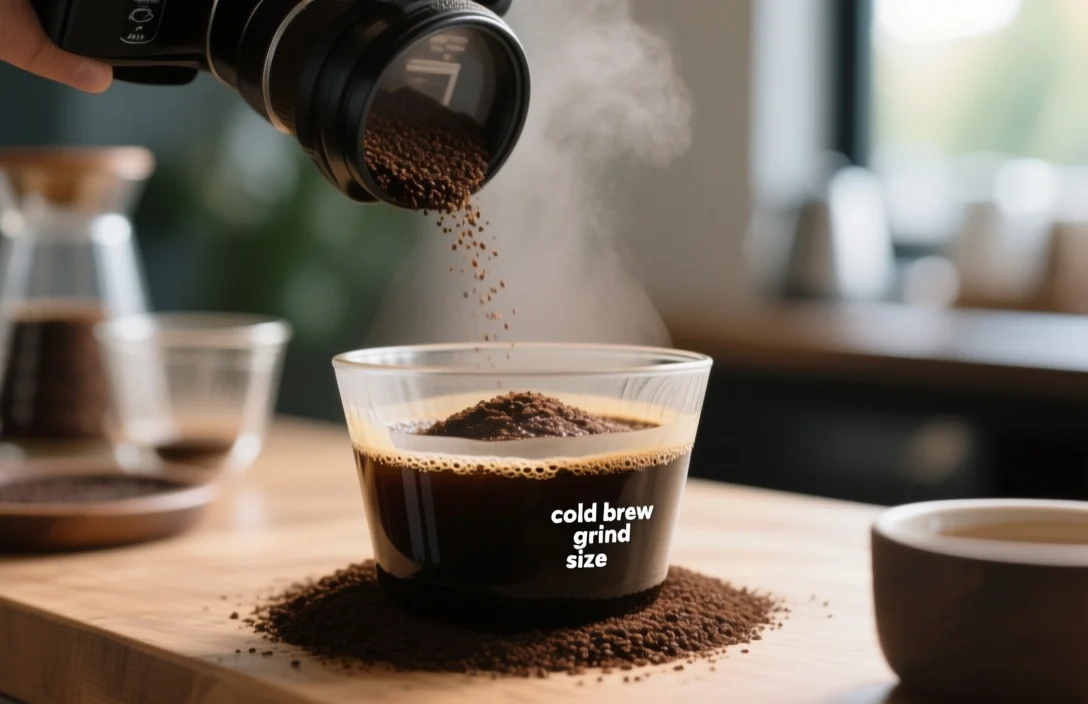
Cold brew grind size should be coarse; aim for a texture in the neighborhood of coarse sea salt or raw sugar for balanced extraction and easy filtration. Coarse grinds slow extraction, keep the brew clear, and reduce bitterness, while finer grinds extract faster, produce heavier body, and increase the risk of over-extraction and sediment.
Which Cold Brew Grind Size to Use
For most home cold brew setups a coarse grind is the baseline choice because particle surface area and extraction speed are inherently linked. Coarse particles present less surface area to water, which slows soluble extraction and helps avoid the astringent tannic flavors that appear when extraction runs too far.
Grind uniformity matters as much as nominal size because a wide particle-size distribution includes tiny “fines” that extract quickly and dirty the final cup. Consistent coarse particles make filtration simpler and the concentrate or ready-to-drink brew clearer and smoother.
Why Grind Size Changes Cold Brew
Extraction depends on contact between water and the coffee’s soluble compounds; particle size directly changes how quickly that contact yields dissolved solids. Smaller particles increase the rate at which acids, sugars, and bitter compounds dissolve into water because they expose more surface area per gram. Larger particles slow that process and favor extraction of the more soluble, sweeter components before harsher compounds dominate.
Filtration and clarity are also driven by particle size. Particles under a certain size pass through common filters and produce visible sediment or a cloudy appearance. Particle-size distribution – the presence of fines mixed in with coarse pieces – explains why two jars of cold brew made from the same beans and time can look and taste different. Grinding consistency and filter choice interact with size to shape mouthfeel, clarity, and perceived strength.
How Different Grind Sizes Affect Taste and Mouthfeel
Coarse grinds tend to yield a smoother, milder cup with less bitterness and lower perceived acidity; the body often reads lighter and cleaner because fewer oils and suspended solids make it into the brew. Coarser particles also lend themselves to long, gentle extraction that highlights sweetness and low-end chocolate or nutty notes in many roasts.
Medium grinds produce a more pronounced body and quicker extraction, which can be useful when you want a fuller mouthfeel without dramatically increasing steep time. Fine grinds produce intense extraction, heavier body, and a higher risk of bitter or tannic flavors because the extraction curve pushes further into compounds that taste harsh. Sediment and sludginess are most common with fine grinds unless you invest in very fine filtration.
Particle-size distribution, roast level, and bean origin change how those basic tendencies play out. Light roasts need more extraction energy to open up flavors, so using a slightly less coarse grind than for a dark roast can reduce the risk of under-extraction; darker roasts tend to extract more readily and pair better with a coarser setting.
Choosing a Grinder and Settings
Blade grinders produce inconsistent particle sizes and a lot of fines, which makes them a poor choice for repeatable cold brew unless you accept a muddier result and commit to extremely careful filtration. Burr grinders give controlled, repeatable settings and a narrower particle-size distribution; they are the preferred option for anyone serious about dialing their cold brew.
Conical and flat burr designs both work; consistency and the ability to lock in a setting are the key features. Commercial or high-end home burrs offer stepless adjustments that make fine tuning easier, while click-style stepped grinders can still work if you record and reuse the same step number. Clean burrs and stable dosing preserve repeatability from batch to batch.
Static and retention are operational issues that become visible when you grind large volumes. Static can make grounds cling to the hopper and dose chamber, altering the apparent grind setting. Retention – the amount of ground coffee left trapped in the grinder – makes repeatability harder on low-volume setups. Choose a grinder that limits retention for precise control, and weigh your dose if exactness matters.
What to Change If Your Brew Is Too Bitter, Sour, or Muddy
Taste is the quickest diagnostic tool for grind-related issues. Bitter or overly astringent cold brew most often means too fine a grind or too long an effective extraction time. Coarsening the grind or shortening contact time reduces extraction intensity and often cleans up bitterness.
Sour or weak-tasting cold brew points to under-extraction; either the grind is too coarse or contact time is too short for that particular roast and recipe. Using a slightly finer grind or increasing effective contact (by agitation or longer steep) typically brings out sweetness and complexity.
Muddy, silty brews usually result from excessive fines or a filter that’s too open for your particles. Improving filtration, shifting to a coarser grind with fewer fines, or using a two-stage filter approach can restore clarity. Adjustments should be incremental and one variable at a time so you can isolate what changed the cup.
Equipment and Filter Choices That Interact with Grind Size
Paper filters catch fines and oils more aggressively than metal filters, leaving a clearer, cleaner-tasting cup; metal filters preserve more body and oil, which can be desirable if you prefer full mouthfeel. Mesh size and weave pattern in metal filters vary, so the same grind can behave differently in two sieves.
French-press-style screens, cloth filters, and commercial cold brew towers each have a different tolerance for particle size. Cloth and paper are forgiving with slightly finer grinds, whereas coarse metal sieves handle big particles with less clogging and faster drainage. Your grinder setting should be chosen with your chosen filter in mind for best results.
Brewing vessels and agitation matter too because steeping methods that keep grounds submerged and evenly wet improve extraction uniformity. Devices that allow easy separation (for example, steep-and-lift carafes) reduce the chance of fines escaping into the finished liquid during decanting.
Comparison Table: Grind Sizes and Their Best Use
| Name | Price / Key Spec | Best For |
|---|---|---|
| Fine | Texture similar to table sugar; high extraction rate | Short steep experiments, espresso-style cold concentrates, not recommended for basic immersion cold brew unless heavy filtration is used |
| Medium | Texture similar to coarse sand; balanced extraction speed | Pour-over cold brew hybrids, when you want more body than coarse but clearer than fine |
| Coarse | Texture similar to coarse sea salt or raw sugar; slow extraction, low fines | Classic immersion cold brew for clarity and smooth flavor; easiest to filter and lowest risk of bitterness |
How to Dial In Your Grind: A Step-by-Step Routine
- Weigh your beans and set the grinder to a coarse baseline that matches coarse sea salt.
- Grind and inspect the grounds visually for large chunks mixed with fines; adjust toward coarser until fines are minimized.
- Brew a small test batch using your normal steep method and taste the result after filtration.
- If the cup tastes bitter, coarsen the setting and retest; if it tastes thin or sour, move one step finer.
- Record the grinder setting, dose, filter type, and steep procedure to reproduce the result or revert if needed.
- Repeat the test cycle until the balance of sweetness, acidity, and body matches your preference.
- Once dialed, maintain grinder cleanliness and dosing discipline to keep repeatability.
Common Mistakes and How to Avoid Them
Using a blade grinder while expecting a clear, bright cold brew is a frequent mismatch; blade grinders create a wide particle-size spread and extra fines. Switching to a burr grinder or compensating with very careful filtration removes this mismatch.
Changing multiple variables at once – grind size, steep time, and filter type – makes it impossible to identify which tweak improved or degraded the cup. Change one variable per trial and keep a simple log that captures setting, steep method, and outcome.
Overreliance on visual cues without tasting can mislead; a visually clear brew can still be sour, and a slightly cloudy brew might taste balanced. Taste after filtration is the final arbiter; adjust based on sensory feedback.
Real-World Examples and Simple Recipes to Try
Home testers will see predictable patterns when they try three simple experiments with the same beans: use coarse, medium, and fine settings while keeping everything else constant. The coarse batch will typically produce the cleanest, least bitter cup; the medium batch will be fuller; the fine batch will be most intense and often muddier. Taste all three side by side to map how your beans respond.
If you prefer a concentrate that will be diluted later, a slightly finer grind can help deliver a fuller-bodied concentrate that holds up to dilution. For ready-to-drink cold brew that you will sip as-is, stick to coarse for clarity and palate balance.
Troubleshooting Quick Reference
- Problem: Bitter, puckering cup. Fix: Coarsen grind or shorten effective extraction.
- Problem: Weak or sour cup. Fix: Slightly refine grind or increase contact intensity.
- Problem: Muddy or sludgy brew. Fix: Improve filtration or reduce fines by coarsening or upgrading grinder.
- Problem: Inconsistent batches. Fix: Weigh dose, clean grinder, and record settings so lists can be replicated.
FAQ
What grind size should I use for cold brew?
Use a coarse grind similar to coarse sea salt for standard immersion cold brew; this minimizes fines, eases filtration, and tends to yield a smooth, low-bitterness cup.
Can I use a blade grinder for cold brew?
Blade grinders create inconsistent particle sizes and many fines; they can work but will usually require extra filtration and produce less consistent results than a burr grinder.
Will a coarser grind mean I need to steep longer?
Not always; coarse grinds extract more slowly so you may need longer effective contact than with finer grinds, but steep time interacts with roast, dose, and temperature. Adjust one variable at a time when dialing a recipe.
How does roast level change the ideal grind?
Darker roasts extract more readily and generally pair better with coarser settings, while lighter roasts can benefit from slightly less coarse grinds to avoid under-extraction.
How can I reduce sediment in my cold brew?
Improve grinder consistency, coarsen the setting to reduce fines, and step up filtration (for example, double-filter with cloth or a finer paper) to catch particles that metal meshes allow through.
Final practical verdict
Start with a coarse grind and a burr grinder if possible, then run two or three controlled tests moving the grind one step at a time until flavor and clarity match your preference. Record the setting, dose, filter, and method so you can reproduce the batch that worked.

- How to Fix a Portafilter: Size, Locking Mechanism, and Troubleshooting Guide - October 22, 2026
- 35 Coffee Machine Parts and Functions: Complete Guide With Names and Uses - October 22, 2026
- 25 Espresso Machine Parts Names and Their Functions Explained - October 22, 2026