
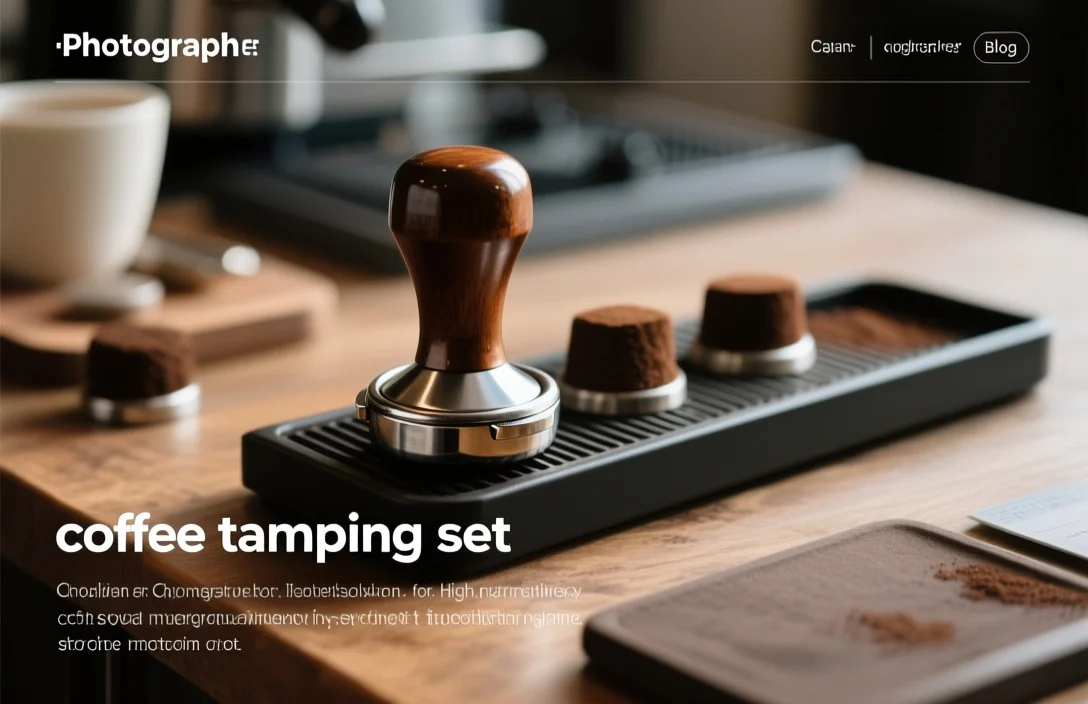
A coffee tamping set is the kit of tools used to compress and level espresso grounds in a portafilter so water flows evenly through the puck. When you want consistently extracted shots, a set that includes a tamper, a distribution tool or leveler, and a dosing funnel covers the core tasks at the bench. Use this guide to choose a set by grinder and machine type, to learn a repeatable tamping routine, and to avoid the common mistakes that wreck crema and cause channeling.
Why a tamping set matters for your espresso
Tamping controls puck density and surface level – two variables that directly affect extraction uniformity. Lab-scale testing and cafe practice both point to uneven density and an unlevel surface as the most common causes of channeling, where water finds paths of least resistance and leaves areas under-extracted. Consistent tamping pressure and a flat, level puck create an evenly resisting medium so that extraction time and taste are repeatable.
Small differences matter at the scale of espresso: a 58 mm basket tolerates different tool sizes than a 53 mm or 57 mm basket, and an uneven puck can change shot time by several seconds. Pulling multiple shots and comparing pressure profiles or shot times reveals whether tamping or grind adjustment is the lever to use. Treat the tamp as one part of the dial-in: dose, grind size, distribution, and water temperature all interact with tamping to shape volume, TDS, and flavor balance.
What components are in a typical coffee tamping set
Most tamping kits bundle three to four tools that target distribution, compaction, and cleanup. A compact list of what to expect includes: a tamper (flat or convex base), a distribution tool or leveler, a dosing funnel, and sometimes a mat or tamping station. Materials vary – aluminum, stainless steel, and wood handles are common – while bases are offered in multiple diameters to match portafilter baskets.
Durability and fit are the two attributes that separate useful sets from gimmicks. A hard-anodized aluminum tamper with a precisely sized base will maintain flatness longer than a stamped, thin metal base. Matching the tamper diameter to your basket (for example, 58 mm for many prosumer machines) removes side play that causes uneven compression. Distribution tools come as either passive levelers that sit the coffee to a set depth or as active tools with rotating surfaces; both aim to reduce lateral density variation before tamping.
what matters for buyers?
Match the set to the basket diameter first; then choose the workflow you prefer – do you want one-step distribution, or do you prefer a separate leveler and tamp? Portafilters commonly use 58 mm baskets on commercial and prosumer machines, while many entry-level home machines use smaller diameters. Measure your basket internal diameter with calipers before buying if the product listing doesn’t state compatibility.
Handle ergonomics, base material, and whether the tamper is calibrated also matter for long sessions. A straight-handled tamper with a flat base gives a clear tactile cue for pressure, while an adjustable or spring-loaded calibrated tamper firm-controls pressure to a set target and reduces variability between operators. Consider whether you need a leveling tool with a depth stop to speed repeatability, and check whether the set includes a dosing funnel if you pull shots into a narrow basket or blind portafilter. Pricing tiers commonly break down into recognizable bands: “Up to $15”, “$15 to $30”, “$30 to $40”, “$40 to $60”, and “$60 & above” on major retail listings – verify current prices before purchase.
How to use a tamping set
- Dose: Grind to your starting dial-in for the recipe and dose into the portafilter basket.
- Distribute: Use your distribution tool or a gentle tapping routine to level the grounds and remove large voids.
- Tamp: Place the tamper on the puck and apply firm, even pressure straight down until a stable puck forms.
- Polish or reset: Rotate the tamper slightly within the basket to smooth the surface if your workflow includes polishing.
- Wipe and lock: Clear coffee from the rim, insert the portafilter, and pull a shot; note time and adjust.
Step-by-step technique matters as much as the tools. For distribution, a single clockwise rotation of a leveler set to the basket depth produces evenness faster than repeated finger taps. For tamping, a pressure range you can repeat comfortably is better than a maximal press you can’t reproduce. Many baristas target a consistent press of similar effort rather than chasing a numeric force unless using a calibrated tamper. Watch the first 10 seconds of flow for signs of channeling: narrow streams indicate localized paths while a gentle, even flow across the basket suggests uniform extraction.
Comparing tamping set types and their trade-offs
Tamper sets fall into four practical categories: budget single tampers, leveling + tamper combos, calibrated/spring tampers, and commercial stainless sets. Each category serves different priorities – price, repeatability, speed, or durability. Choose based on the machine and how much time you spend dialing in shots.
- Budget single tampers are light, inexpensive, and adequate for occasional use but often lack a precise base or comfortable handle.
- Leveling + tamper combos reduce the need for manual distribution and speed up throughput for home baristas who want consistent shots without a long technique learning curve.
- Calibrated tampers lock a target pressure and are helpful if multiple people use the machine or if you want to remove operator variability.
- Commercial stainless sets prioritize long-term flatness and ergonomic handles for heavy use in cafes.
The trade-offs are clear: a single premium tamper can improve hand feel and longevity, but a leveling tool plus a mid-range tamper often yields quicker and more consistent results for home users who are dialing in single-origin shots. A calibrated tamper reduces one variable but may hide other issues, like uneven distribution or a poorly cut grind.
Comparison table: common tamping set categories
| Name | Price / Key Spec | Best For |
|---|---|---|
| Basic Tamper Set (single tamper) | Up to $15 – $30 / lightweight, fixed base | Casual home users, budget setups |
| Leveler + Tamper Combo | $30 to $60 / includes depth stop, matching diameter | Home baristas seeking repeatable shots quickly |
| Calibrated (spring) Tamper | $40 to $60 / preset pressure, repeatable force | Multi-user households, cafes with trainee baristas |
| Commercial Stainless Set | $60 & above / heavy stainless base, ergonomic handle | High-volume cafes, prosumer owners valuing longevity |
Numbers and price categories above reflect typical retail groupings listed by major online sellers; verify current prices when you buy. Matching the diameter in the “Key Spec” column to your basket is essential for fit and seal.
Common mistakes, warning signs, and what to avoid
Pressing harder is not always better; over-tamping can compress the puck so much that flow is restricted and under-extraction occurs. Using a tamper that is too small for the basket leaves space at the edges where water will preferentially flow. Relying solely on tamp pressure without addressing distribution produces inconsistent shots even if tamping force is consistent across pulls.
Watch for these practical warning signs: shot times shifting dramatically with no grind or dose change suggests inconsistent tamping or clumped coffee. A stream of fast, pinhole flows from the basket edge indicates a gap between tamper and basket sides or a badly distributed puck. Crema that is patchy or collapses quickly often points to channeling or stale coffee rather than tamping alone, so verify grind freshness and dose before overhauling tamp technique. Avoid rotating the portafilter between distribution and tamping in ways that disturb the settled grounds; instead, perform distribution first, then tamp in place.
Maintenance, calibration, and care for your tamping set
Wipe bases and handles after each use to prevent oil and coffee fines build-up. Stainless steel and aluminum bases resist corrosion and are easy to clean with a soft cloth; wooden handles benefit from occasional oiling to prevent cracking. Check base flatness periodically – place the tamper base on a known-flat surface and look for light gaps with a bright light; a deformed base merits replacement.
Calibration checks are straightforward for spring or pressure-limited tampers: press onto a scale and confirm force consistency across a sequence of presses. Replace parts as soon as you notice wobble or looseness in the tamper head or handle. Keep dosing funnels and levelers free of ground build-up by rinsing with warm water; dry thoroughly to avoid oxidation. Store tools in a dry drawer or on a tamp station to prevent accidental nicks that cause burrs on the base edge.
Practical actions to dial in a shot with your tamping set
Start by choosing a base workflow: distribute, tamp, pull. Use a pre-measured dose and stable grind setting to isolate tamping as the variable. Pull three shots in a row using identical tamp technique and record time, yield, and TDS if you measure; compare numbers to assess repeatability. If variation exceeds your acceptable range, change one variable at a time: swap the distribution tool, then swap the tamper, then test grind uniformity.
Implement a simple test to evaluate tool fit: place a blank basket on a flat surface, press the tamper lightly, and look for contact all around the rim. If light escapes at any circumference point, the tamper diameter differs from the basket and will create edge channels. Use a dosing funnel for tricky baskets or when grinding directly over a narrow portafilter to eliminate spill and ensure the dose enters the basket without compaction or voids forming in transit.
Buying checklist and recommended next
Measure the internal diameter of your portafilter basket, choose the tamper diameter to match, and decide whether you need a distribution tool. Pick an ergonomic handle if you pull many shots and a heavier stainless base if you expect heavy use. Verify product specifications for diameter and material on the product page; if the listing omits clear measurements, contact the seller before purchase.
Try this immediate action: measure your basket now, then choose one tamping set category from the comparison table that matches your priorities – budget, speed, repeatability, or durability. Order a mid-range leveler + tamper combo if you want the best balance of ease and performance for home use. If you operate in a multi-user environment, prioritize a calibrated tamper to reduce operator variability.
FAQ
How do I measure my portafilter basket for a tamper?
Measure the internal diameter across the top inside lip with calipers for the most accurate fit. Use the exact millimeter measurement to select a tamper with the same diameter or a slightly smaller size that the manufacturer specifies as compatible.
Does tamping pressure need to be a precise number in newtons or pounds?
Most home baristas benefit more from a consistent human-applied press than from a target numeric force, unless using a calibrated tamper. Consistency of effort across pulls reduces variability; use a spring tamper only if multiple operators need identical force automatically.
Can I use any tamper with any machine?
Fit is the primary constraint. A tamper that’s too small will leave an annular gap; a tamper larger than the basket will not fit. Confirm diameter compatibility and consider basket depth and basket type (pressurized vs non-pressurized) when selecting tools.
Is a distribution tool necessary?
A distribution tool reduces lateral density differences and speeds repeatability, but a practiced hand distribution can achieve similar results. Pick a leveler if you want faster, more reproducible setups or if you struggle with consistent hand distribution.
How often should I replace my tamper?
Replace a tamper when the base is bent, scratched along the sealing edge, or when the handle becomes loose. Heavy-use commercial environments may replace tampers more frequently than home setups.
What is the easiest way to test for channeling caused by tamping?
Cut a puck vertically after a shot and look for large tunnels or asymmetric voids. Narrow, uniform pore structure is a sign of even extraction; obvious tunnels indicate channeling that likely stemmed from poor distribution or edge gaps.
A short practical verdict and next step: pick a set that matches your basket diameter and prioritize a leveler-plus-tamper combo for consistent home shots, or choose a heavy stainless tamper for durability if you pull many shots daily. Measure your basket now, then order a set that lists that diameter or explicitly states compatibility; test by pulling three identical shots and adjust distribution before changing tamp pressure.

- Espresso Tastes Watery? 10 Common Causes and How to Fix It - October 23, 2026
- 10 Common Coffee Equipment Cleaning Mistakes and How to Avoid Them - October 23, 2026
- 17 Common Coffee Grinder Problems and How to Fix Them - October 23, 2026