
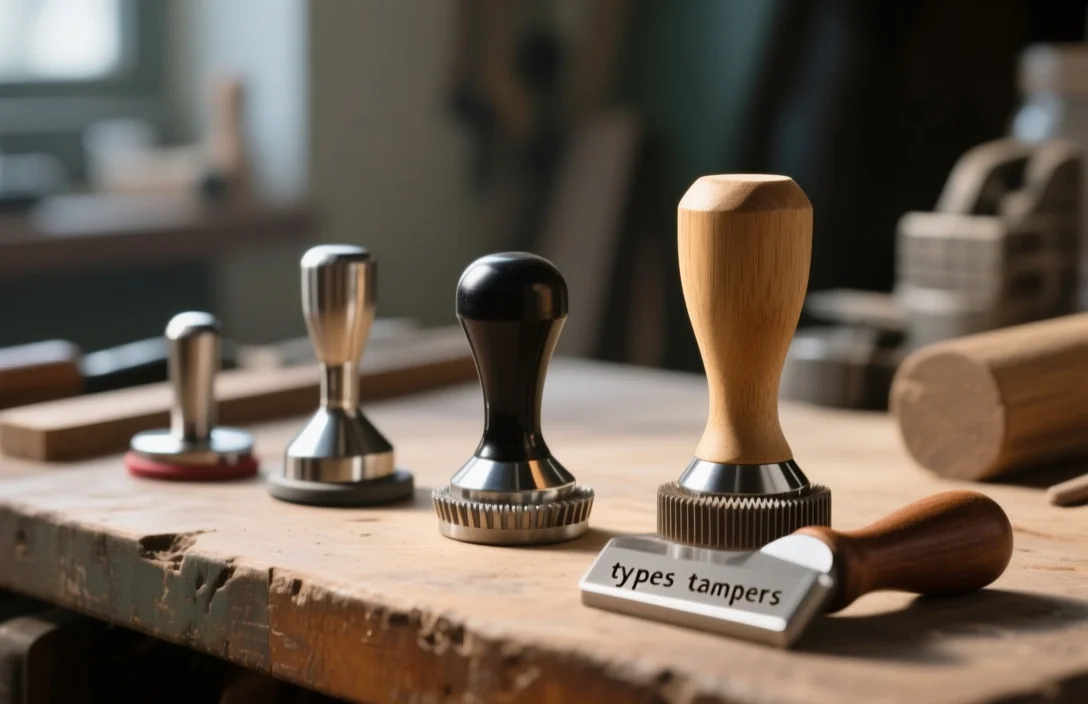
Tampers break down into a few practical categories: manual hand tampers for coffee and small compaction tasks, plate and rammer tampers for soil and paving, railroad ballast tamping machines for heavy track work, and specialty tampers used in industrial and munitions contexts. If you are trying to pick one, I would start with the job size and the material. That usually narrows the choice faster than anything else.
What a tamper is and how it works
A tamper is a tool or machine that compacts, seals, or stabilizes loose material by applying pressure, vibration, or both. The purpose is simple enough. Compression reduces voids and increases density so a surface or packed material holds shape and supports load more evenly.
The word covers a lot of ground, from a small espresso tool to a tracked ballast tamping machine. The scale changes, but the basic goal does not.
Mechanical tamping usually turns rotary power into linear impact, as in a rammer, or uses a vibrating plate to apply pressure and movement across a surface. Manual tamping depends on direct human force. The differences matter because they change how force is spread, how deep the compaction goes, and how much effort the operator has to put in.
Why the category matters for your project
Choosing the right tamper matters because surface area, depth of compaction, material type, and the level of finish you need can vary a lot from one job to another. A coffee puck needs a small, flat contact face and close control. A trench backfill needs repeated shallow compaction across a narrow space. Railroad ballast calls for controlled tamping beneath sleepers to restore track geometry.
My practical rule is this, match the tamper to the material and the scale before you think about price. That keeps you from buying a tool that looks right but works badly in practice.
Soil gradation, moisture content, and particle shape all affect how a material responds to tamping. Granular material often responds well to vibration. Cohesive clay usually needs impact and force concentration. Small, flat-faced tampers are useful for finishing. Plate compactors and rammers do better when you need density, not just a neat surface.
Types of tampers explained
Hand tampers
Hand tampers are simple tools with a handle and a flat or slightly convex foot. You lift and drop or press the foot to compact small areas, grout, or soil in narrow trenches.
They are useful for paver bedding, backfill in confined spaces, and some masonry work. I would reach for one when access is tight and precision matters more than speed. They do not generate vibration or the sustained force of powered tools, which is part of the tradeoff.
Plate compactors
Plate compactors use a weighted plate that vibrates at a defined frequency and amplitude to consolidate granular materials and asphalt. Operators usually walk behind them, though smaller models can be ridden or guided easily over larger areas.
These are common for landscaping, sidewalk and driveway base preparation, and asphalt patching. They are a better fit for open, shallow work than for deep compaction. If the lift is too thick, you usually need multiple passes or a different tool.
Rammers, also called jumping tampers
Rammers deliver high-impact, low-frequency blows through a small foot. That makes them a good choice for cohesive soils and narrow trenches. A piston-driven mechanism creates repeated jumps that force particles into tighter contact.
I would use a rammer when a plate compactor cannot reach where it needs to go, or when the soil is too cohesive for vibration to do enough work. The downside is easier to name than the upside. They are heavier to handle and transmit more vibration to the operator.
Railroad ballast tamping machines
Railroad tampers are specialized tracked machines that lift track and pack ballast beneath sleepers to restore alignment and stability. They use multiple tamping tines that insert into the ballast and compact it under controlled lateral and vertical heads.
These machines are judged by cycle time, lift capacity, and the precision of the final track geometry. They are not interchangeable with construction compactors. This is specialist equipment, and the setting around it matters as much as the machine itself.
Espresso tampers
Espresso tampers compress ground coffee inside a portafilter to make a uniform puck for extraction. Variations include flat bases, convex bases, calibrated pressure tampers that click at a set force, and distribution-plus-tamp systems that add a pre-distribution step.
For most home users, fit matters more than gadgetry. A tamper that matches the portafilter diameter and gives you a level puck is the starting point. Technique does a lot of the work here.
Industrial and specialty tampers
Industrial tampers include hydraulic or pneumatic compacting heads used in manufacturing and munitions applications where a tamper encloses and supports a charge or component under compression. These tools are built to precise tolerances and materials because the loads are extreme and the setting is safety-critical.
This is not casual-use equipment. If a job falls into this category, it belongs with trained operators and the relevant procedures.
A quick side-by-side look at common tamper types
| Name | Key spec | Best for |
|---|---|---|
| Hand tamper (manual) | Face shape and handle length; low weight | Small trenches, paver bedding, masonry touch-ups |
| Plate compactor | Plate size and vibration frequency | Sidewalk and driveway sub-base, asphalt patches |
| Rammer (jumping tamper) | Impact energy and foot size | Narrow trenches, cohesive soils, deeper localized compaction |
| Railroad ballast tamper | Number of tamping units and lift capability | Restoring track geometry and ballast consolidation |
| Espresso tamper | Base diameter and flat vs. convex profile | Consistent coffee puck compression |
| Industrial/hydraulic tamper | Force rating and confinement fit | Manufacturing presses and specialized industrial tasks |
If you are choosing between them, I would treat the table as a filter, not a ranking. A bigger machine is not automatically better. It just solves a different problem.
How to choose the right tamper for the job
Start with the scale and access of the work. Tight spaces and precision tasks favor hand tampers and rammers. Open, flat surfaces usually favor plate compactors.
Then look at the material. Granular mixes respond well to vibration. Cohesive clays generally compact better with impact. That distinction does a lot of the decision-making for you.
Ergonomics also matter, especially if the tool will be used all day. Lower-vibration handles, anti-vibration mounts, and power options that reduce manual strain are worth attention. I would not treat comfort as a luxury item on a job that lasts more than a few minutes.
A few performance details are worth checking before you buy or rent:
- Plate compactors, match plate width to the job width and pay attention to vibration amplitude and frequency.
- Rammers, check impact energy per stroke and foot geometry.
- Espresso tampers, match the base diameter to the portafilter and decide whether flat or convex makes more sense for your routine.
Budget matters, but so does downtime. Lower-cost hand tools need very little upkeep, while powered compactors add fuel, electrical service, and routine maintenance. For a one-off job, renting heavy equipment is often the sensible move.
How to use and maintain common tampers
Hand tampers and plate compactors call for different habits. The basics are straightforward, but they are worth doing carefully.
How to tamp with a hand tamper
- Clear debris and level the material with a rake or screed.
- Hold the tamper square to the surface so the foot makes full contact.
- Apply firm, even downward pressure, or controlled drops, without twisting.
- Overlap passes slightly so you do not leave soft spots.
- Check the surface by sight and by probing if needed.
- Clean and dry the tamper after use, then inspect the foot and handle.
How to use a plate compactor
Start the engine or motor according to the manufacturer’s procedure. Move at a steady walking pace and overlap each pass slightly. On hot asphalt, avoid sharp turns that can gouge the surface.
After use, follow the relevant rules for fluids and disposal. Inspect the base plate for grooves or damage, and replace worn mounts or rubber isolators when needed. Those small parts matter more than people often think.
Maintenance checklist for powered tampers
- Inspect air and fuel filters regularly.
- Check engine oil and hydraulic fluid.
- Tighten fasteners and inspect the base plate or foot for cracks and wear.
- Lubricate pivot points and service the drive belt or piston assembly as specified.
- Store the machine in a dry, clean area and follow battery or fuel storage guidelines.
Common mistakes and how to avoid them
Using the wrong tamper is the easiest way to create rework. A plate compactor in a narrow trench often leaves voids because it cannot reach the bottom properly. A hand tamper on a large base is usually too slow to be practical.
Moisture is another common problem. Soil that is too wet can smear instead of compacting cleanly, which lowers strength. I would check the material condition before I worry about how hard I am tamping.
Overdoing it can also cause trouble. Too much force in asphalt or pavers can lead to settlement or cracking. The goal is uniform compaction, not maximum force for its own sake.
Calibration mistakes show up in espresso work. If the tamper diameter does not match the portafilter, or the grounds are uneven before tamping, channeling becomes more likely. A consistent routine helps more than chasing a perfect number.
Safety and legal considerations
Tamping can bring real hazards with it, including pinch points, flying debris, exhaust exposure, and high vibration. Wear eye protection and hearing protection when using powered tampers. Gloves should protect your hands without taking away grip. Loose clothing is a bad idea around moving parts.
Keep bystanders clear of the work area. If you are compacting near edges or pedestrian paths, use barriers where needed.
Local rules can also affect how you handle fluids and emissions from gas-powered tampers. Used oil and fuel should go where local hazardous-waste rules require. For deep localized compaction, it is wise to check for buried utilities before work begins.
Railroad tamping machines and industrial tampers are governed by stricter procedures. They are not tools for improvisation. Certification, licensing, or other operating requirements may apply depending on the setting.
Which tamper fits common jobs
Small patio or paver job
A hand tamper works when the area is small and access is tight. For a larger bed, I would use a plate compactor. It is faster and more likely to leave a uniform base.
Driveway base compaction
Use a plate compactor sized for the driveway width, and make multiple passes with shallow lifts. If the area is large, renting a bigger walk-behind unit is usually the better choice.
Narrow trench backfill
Pick a rammer when the trench is narrow and the compaction needs to reach deeper into the material. The foot should fit the space well enough to transfer energy where it belongs.
Rail track maintenance
This is a job for ballast tamping machines and trained crews. The tolerances, coordination, and safety requirements make DIY tamping impractical.
Home espresso work
Choose a tamper that matches your portafilter diameter. For most home setups, a solid stainless-steel tamper with a flat base is enough. If your technique varies a lot, a calibrated tamper can help you stay consistent.
What wears out first, and what to keep on hand
Wear is normal on any tamper, but some parts deserve more attention than others. On powered tampers, base plates, foot pads, and anti-vibration mounts usually wear first. Check them after each job.
Spark plugs, belts, and filter elements are the items most likely to need scheduled replacement if you use the machine often. I would keep those on hand if the tamper is part of regular work, not just occasional use.
Hand tampers need less mechanical care, but they still deserve attention. Wooden handles should be replaced at the first sign of splitting. Espresso tamper bases should be replaced or resurfaced if they become scratched or warped.
A small spare-parts kit can save time. Wear plates, mount bushings, basic fasteners, and the service manual are worth having nearby. If a critical part has hairline cracks or visible deformation, replace it instead of waiting for it to fail.
FAQ
What tamping tool should I rent for a single-day driveway project?
A medium-sized walk-behind plate compactor is the usual answer. Choose a plate width that roughly matches one lane of the driveway so you do not make unnecessary passes. Vibration-dampening handles are worth looking for.
How deep should I compact in lifts?
It depends on the machine and the material. Granular bases usually compact better in shallower lifts with a plate compactor. Cohesive soils can often handle slightly thicker lifts with a rammer. Check the recommended lift thickness for the specific job and machine.
Can I use a hand tamper instead of a vibratory plate?
Yes, but only for small areas or precision work. On medium or large jobs, a hand tamper is slow and usually produces less uniform compaction.
Is there a right tamping pressure for espresso?
There is no single pressure that fits every setup. Consistency matters more than chasing one exact number. A calibrated tamper or a repeatable routine usually gives better results than guessing.
Bottom line
If I had to reduce the whole subject to one practical rule, it would be this: match the tamper to the scale and material of the job, then check safety and maintenance before you start. Small, precise work calls for hand tampers. Broad, shallow bases favor plate compactors. Narrow, deep spots need rammers. Rail and industrial work belong with specialist machinery and qualified crews.
That is the decision that saves the most time and prevents the most mistakes.

- Espresso Tastes Watery? 10 Common Causes and How to Fix It - October 23, 2026
- 10 Common Coffee Equipment Cleaning Mistakes and How to Avoid Them - October 23, 2026
- 17 Common Coffee Grinder Problems and How to Fix Them - October 23, 2026