
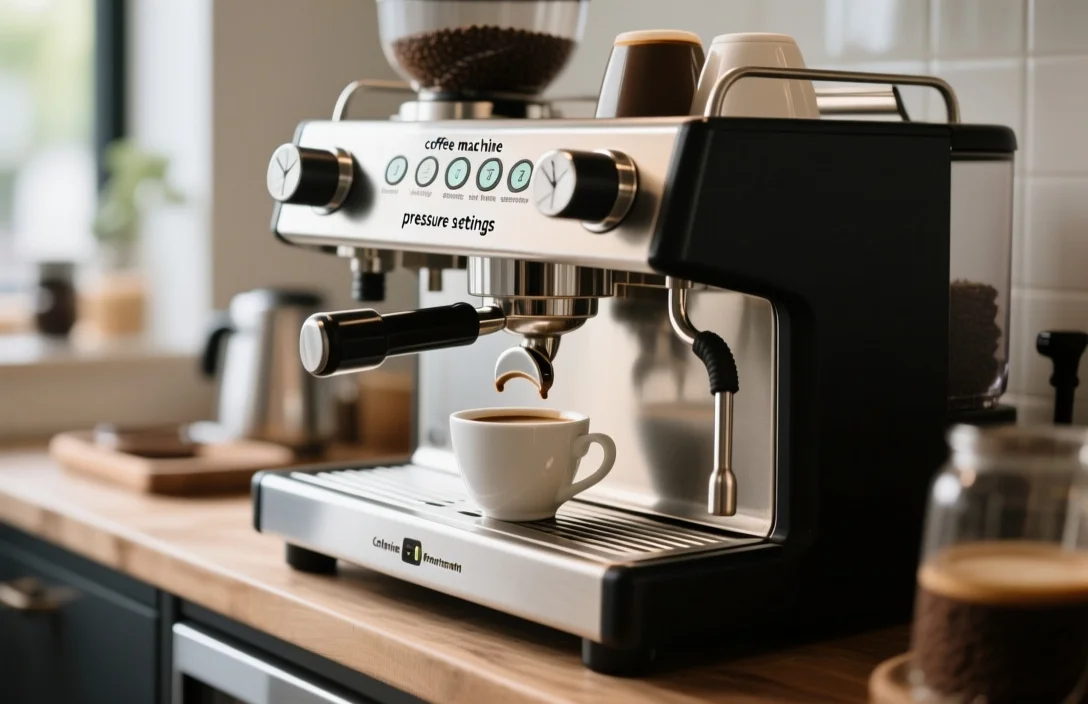
Coffee-machine pressure settings determine how forcefully water moves through the coffee puck, and that force changes the balance of crema, body, acidity, and bitterness. If you want the short, practical answer: most home users seeking consistent espresso should leave a pump machine at its factory setting and focus on grind, dose, and tamp. If you enjoy tinkering, pressure is worth experimenting with – but treat it like one knob in a system, not a magic fix.
Quick action for most home users
If you want reliably good espresso with minimal fuss, do this first: keep a pump-based machine at its factory calibration, get a consistent grinder and dose, and learn to tamp evenly. Only consider changing pressure after you know your grinder and brewing routine are repeatable. My practical rule is to verify the machine exposes a gauge or an adjustment before you start turning screws.
Why pressure matters, in plain terms
Pressure affects how fast and how completely water extracts soluble compounds from the coffee. Higher pressure tends to speed extraction and can deepen crema and body; lower pressure slows flow, increasing contact time and sometimes smoothing harsh edges or bringing forward sweetness. But pressure never acts alone – it interacts with grind, dose, water temperature, and tamp. Changing pressure without compensating other variables often gives unpredictable results such as channeling or uneven extraction.
Which machines let you change pressure
Machines fall into clear practical groups:
- Capsule or pod machines: sealed systems, fixed pressure, no user adjustment. Convenience-only.
- Super-automatic machines: mostly fixed, some models offer software “strength” settings that alter pump behavior rather than providing a true pressure control.
- Pump-driven semi-automatic machines: many have an overpressure valve (OPV) or accept external flow-control devices; some adjustments require a technician or a screwdriver.
- Manual lever machines: pressure is controlled directly by the operator’s lever stroke and speed, giving the most immediate control for profiling by hand.
Documented access varies by model. Manuals will name OPV, flow control, or pressure profiling when present; if you cannot find clear documentation, inspect around the pump for an adjustment screw or ask the manufacturer before modifying hardware.
How to measure what your machine actually does
If your machine has a built-in brew-pressure gauge, use it. If not, a basic mechanical brew-pressure gauge screwed into the brew group gives much of the same information for home work. When you measure:
- Watch pressure during pre-infusion and during the steady extraction phase.
- Keep grind, dose, and tamp identical between tests.
- Record extraction volume or weight over a fixed time and note visual cues like crema texture and stream behavior.
If you lack a gauge, use indirect but repeatable indicators: shot time for a fixed dose, extraction yield by weight, and visual crema consistency.
How to change pressure, by machine type
- Semi-automatic pumps: pressure is usually adjusted at the OPV. The valve is often accessible but may require a small screwdriver and temporary pump runs while you tweak. Make tiny adjustments and re-test systematically.
- Super-automatics: changes come via software profiles or “brew strength” settings. These adjust pump speed or program flow rather than exposing a raw OPV adjustment.
- Manual lever machines: shape pressure through stroke speed. A slow, steady pull produces a gentler pressure ramp; a quick stroke pushes pressure up faster.
- External flow-control devices: these change the effective flow and thus the pressure profile without altering internal valves, and they are a lower-risk option for many semi-auto owners.
Always benchmark a known good shot before making changes. Change one thing at a time and re-test three to five shots before judging the effect.
A compact, practical pressure-profiling workflow
- Establish a stable baseline shot with a fixed dose and grind. Log the results.
- Measure pressure during pre-infusion and steady flow (use a gauge or consistent timing/volume cues).
- Make a small change to pre-infusion pressure or steady-state pressure only.
- Pull repeated shots, taste, and compare notes.
- Repeat steps 3-4 until you understand how pressure shifts affect flavor for your beans.
I keep returning to a single discipline: change one variable and document it. That discipline prevents chasing phantom improvements.
Trade-offs and mechanical risks
Changing pressure can improve sweetness or body, but it can also introduce bitterness, thinness, or channeling if you do not adjust grind or dose. There are mechanical risks too: some machines rely on factory OPV settings to protect pumps and seals. Overriding those settings may increase wear, cause leaks, or affect warranty coverage. Check your warranty and the manufacturer’s advice before making hardware changes.
Maintenance and pressure-related diagnostics
Common causes of odd pressure behavior include scale, clogged shower screens, and worn seals. If pressure is inconsistent shot-to-shot:
- Descale and clean the group head and shower screen.
- Inspect the portafilter basket and gasket.
- Listen for pump cavitation or unusual noises and verify the water supply is steady.
If a gauge reads oddly compared with taste and visuals, try a known-good mechanical gauge or test extraction on another machine. Persistent issues or leaking should prompt professional service.
What to look for when buying, if pressure control matters to you
Decide whether you want convenience or mechanical control. Priorities differ:
- For low-effort consistency: machines with factory-tuned pumps and a reliable built-in gauge.
- For experimentation: machines that advertise adjustable flow, pressure profiling, or easily accessible OPV hardware.
When comparing models, check these attributes:
- Presence of a user-facing brew-pressure gauge.
- Flow-control valves or pressure-profiling firmware.
- Accessibility of the OPV or bypass valve.
- Pump quality and reported consistency.
Table: Machine types and pressure-related suitability
| Name | Price/Key Spec | Best For |
|---|---|---|
| Capsule/pod machines | Budget-friendly; sealed system, fixed pressure | Convenience and single-button consistency |
| Super-automatic machines | Mid to high; automated grind and tamp, software-controlled pressure | Low-effort espresso and regulated consistency |
| Semi-automatic pump machines | Mid to prosumer; accessible OPV or external flow control | Home baristas who tune grind and dose |
| Manual lever machines | Prosumer; user-controlled pressure by lever stroke | Purists and pressure-profiling by hand |
Troubles I see and how I diagnose them
Too many people try to chase flavor by repeatedly adjusting OPVs without checking simpler causes. Start here:
- If a shot pulls too fast after lowering pressure, check grind – coarse grinding often masks pressure effects.
- If crema looks broken or bubbles surge, suspect channeling or a damaged basket.
- If pressure readings jump around, clean and descale first; then inspect hoses and the pump.
Keep a short log with grind setting, dose, tamp style, pressure readings, shot time, and tasting notes. That log will save you time and prevent undoing useful settings.
Typical scenarios and which change helps
- Sour, thin shots with slow flow: try a slightly finer grind or incrementally higher steady-state pressure, keeping shot time in range.
- Bitter, harsh shots that draw too fast: reduce pressure or make the grind coarser, and watch for thicker body.
- Fast bubbles and broken crema: check for channeling and basket condition before changing pressure.
Taste is your fastest feedback. Use visual cues to confirm what your palate tells you.
FAQ
How do I know whether my machine allows pressure adjustment?
Look in the manual for “overpressure valve,” “OPV,” “flow control,” or “pressure profiling.” If documentation is unclear, inspect around the pump for an adjustment screw or contact the manufacturer.
Will changing pressure void my warranty?
It can. Warranty terms differ by maker and model. Read your warranty and call support before making mechanical changes.
Can changing pressure alone fix bitter or sour espresso?
Not usually, because pressure interacts with grind, dose, temperature, and tamp. Change one thing at a time and taste after each change to find the real cause.
Do I need special tools to measure pressure?
A basic mechanical brew-pressure gauge is sufficient for most home tuning. Shops use more advanced gear, but a simple gauge will reveal useful pre-infusion and steady-state behavior.
How I would proceed, step by
- Run three benchmark shots with your normal grind and dose; record time, extraction weight, and tasting notes.
- Confirm whether your machine exposes pressure (gauge, OPV, flow control).
- Make a single, small pressure change or engage a different pre-infusion setting.
- Pull three more shots and compare.
- Keep adjusting only one variable at a time until you see repeatable improvements.
Pressure is useful, but only when you apply it methodically and within a stable brewing routine. If you prefer convenience, accept factory settings and tune the grinder and dose. If you prefer control, proceed with small changes, a gauge, and a notebook.

- Espresso Tastes Watery? 10 Common Causes and How to Fix It - October 23, 2026
- 10 Common Coffee Equipment Cleaning Mistakes and How to Avoid Them - October 23, 2026
- 17 Common Coffee Grinder Problems and How to Fix Them - October 23, 2026