
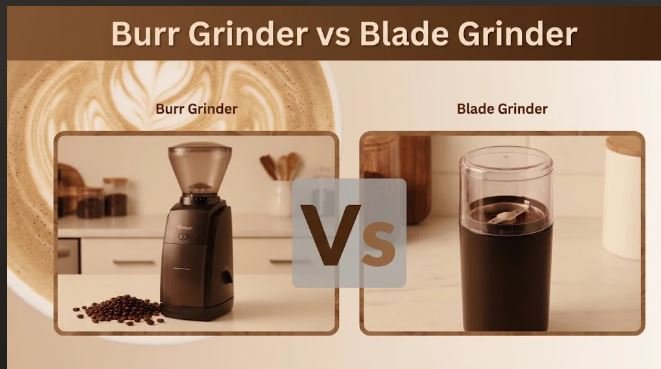
Choosing the right coffee grinder can make a noticeable difference in your daily coffee experience. Even if you buy high-quality coffee beans, the grinder you use can influence how consistently they are ground, how evenly they extract, and how your final cup tastes. This is why choosing between a burr grinder and a blade grinder is worth considering.
When comparing a burr grinder vs blade grinder, the biggest difference comes down to how each machine processes coffee beans. A burr grinder uses two grinding surfaces to crush beans into more uniform particles, while a blade grinder uses rapidly spinning blades to chop them into smaller pieces. Both can prepare coffee grounds, but they offer different levels of control, consistency, convenience, and price.
So, is a burr grinder really worth the extra money? Can an inexpensive blade grinder still make good coffee? And which option should you choose for espresso, French press, or everyday drip coffee?
Let’s explore how both grinders work, compare their advantages and disadvantages, and help you find the right option for your coffee routine.
What Is a Burr Grinder?
A burr grinder is a coffee-grinding machine that uses two abrasive surfaces, known as burrs, to crush coffee beans into smaller particles. One burr usually remains stationary while the other rotates, allowing the beans to pass through the grinding surfaces.
Instead of chopping beans randomly, the grinder gradually breaks them down. The distance between the burrs determines the approximate size of the coffee grounds. A smaller gap produces finer grounds, while a wider gap produces coarser particles.
This mechanism gives users better control over grind size, making burr grinders suitable for different coffee preparation methods.
For example, espresso generally requires fine grounds, while French press coffee needs a much coarser grind. With an adjustable burr grinder, you can select a setting that better matches your brewing method.
Types of Burr Grinders
Burr grinders generally come in two main designs: conical burr grinders and flat burr grinders.
1. Conical Burr Grinder
A conical burr grinder uses two cone-shaped grinding surfaces. One fits inside the other, and coffee beans are crushed as they move through the space between them.
Conical burr grinders are popular for home use because many models offer good grinding consistency, convenient adjustment options, and relatively compact designs.
They are available in both manual and electric versions. Depending on the model, they can also operate at relatively low speeds, although motor speed and heat generation vary between machines.
2. Flat Burr Grinder
A flat burr grinder uses two flat, circular grinding discs positioned parallel to each other. Coffee beans pass between these discs and are ground into smaller particles.
Flat burr grinders are commonly found in espresso-focused home setups and commercial coffee environments. They can produce highly consistent particle distributions, depending on their design, alignment, and manufacturing quality.
Neither design is automatically better in every situation. Burr geometry, manufacturing precision, adjustment range, and overall grinder quality all influence performance.
What Is a Blade Grinder?
A blade grinder is a simple electric coffee grinder that uses a rapidly spinning metal blade to chop coffee beans into smaller pieces.
Its design is similar to a small kitchen blender. When you switch it on, the blade rotates and breaks the beans apart. The longer you run the grinder, the smaller the particles generally become.
However, blade grinders do not have the same precise grind-size adjustment mechanism as burr grinders. You usually control the result by deciding how long to grind the beans.
For example, a short grinding session may produce relatively coarse grounds, while a longer session may create finer particles. Unfortunately, the result is not always uniform.
Some coffee particles may become very fine while others remain relatively large. This variation can affect how evenly water passes through the coffee during brewing.
How Does a Blade Grinder Work?
The process is straightforward:
- Add whole coffee beans to the grinding chamber.
- Close the lid securely.
- Press the power button.
- The spinning blade chops the beans into smaller pieces.
- Stop the grinder when the grounds reach your preferred approximate size.
Some users shake the grinder gently between short grinding sessions to redistribute the beans. This may help improve the result, although it cannot provide the consistency of a properly designed burr grinder.
Blade grinders are generally affordable, easy to operate, and convenient for people who occasionally prepare coffee at home.
Burr Grinder vs Blade Grinder: Key Differences

Although both machines perform the same basic function, their grinding mechanisms create different results.
Here is a side-by-side comparison of the most important differences.
| Comparison Factor | Burr Grinder | Blade Grinder |
|---|---|---|
| Grinding mechanism | Crushes beans between burrs | Chops beans with spinning blades |
| Grind consistency | Generally more uniform | Often uneven |
| Grind adjustment | Multiple settings | Usually controlled by grinding time |
| Particle distribution | More controlled | Less predictable |
| Coffee extraction | More consistent | Can be less consistent |
| Brewing flexibility | Better across different methods | More limited |
| Price | Usually more expensive | Usually cheaper |
| Operation | Manual or electric | Usually electric |
| Cleaning | Requires burr and chamber cleaning | Usually simpler chamber cleaning |
| Best for | Regular coffee drinkers | Occasional coffee drinkers |
1. Grind Consistency
Grind consistency is one of the most important differences between these two grinders.
Burr grinders are designed to produce coffee particles within a more controlled size distribution. Although no grinder produces perfectly identical particles, a good burr grinder generally offers better consistency.
Blade grinders, on the other hand, chop beans into different-sized pieces. You may find a mixture of fine powder, medium particles, and larger fragments in the same batch.
This difference matters because coffee grounds do not all extract at the same rate. Smaller particles generally extract faster than larger ones.
2. Control Over Grind Size
Burr grinders usually provide multiple adjustment settings. Depending on the model, you can choose from a range of fine to coarse settings.
Blade grinders offer less precise control. You can grind for longer or shorter periods, but there is no guarantee that the resulting particles will match a particular grind size.
If you regularly switch between espresso, pour-over, and French press, a burr grinder provides a more convenient way to adjust your coffee preparation.
3. Coffee Flavor
Grind consistency can influence how evenly coffee extracts.
When particle sizes vary significantly, smaller particles may extract faster while larger particles extract more slowly. This can produce a less balanced cup.
A burr grinder can help reduce this variation, making it easier to achieve repeatable results.
However, a burr grinder does not automatically guarantee better-tasting coffee. Bean freshness, roast quality, water temperature, brewing technique, and the quality of the grinder itself also matter.
4. Price and Affordability
Blade grinders generally cost less than burr grinders. Their simple construction makes them an accessible option for beginners and occasional coffee drinkers.
Burr grinders require more precise grinding components and adjustment mechanisms, which can increase their purchase price.
However, price alone does not determine performance. A well-designed budget burr grinder may be a better purchase than an expensive but poorly manufactured grinder.
Does a Burr Grinder Make Better-Tasting Coffee?
Yes, a good burr grinder can help you make more consistent and balanced coffee. However, the improvement comes primarily from better control over particle size and extraction rather than from the grinder magically changing the flavor of the beans.
To understand why, it helps to know a little about coffee extraction.
When hot water comes into contact with ground coffee, it dissolves various compounds that contribute to flavor, aroma, acidity, sweetness, and bitterness.
The size of the coffee particles affects how quickly water extracts these compounds.
Understanding Over-Extraction and Under-Extraction
Over-extraction happens when too many soluble compounds are extracted from the coffee. Depending on the coffee and brewing method, the result may taste excessively bitter, dry, or harsh.
Under-extraction happens when insufficient soluble compounds are extracted. The coffee may taste sour, weak, or noticeably unbalanced.
Uneven coffee grounds can make it more difficult to achieve a consistent extraction because different particles release their soluble compounds at different rates.
A quality burr grinder helps reduce this problem by producing a more controlled particle distribution.
This does not mean a blade grinder cannot make enjoyable coffee. You can still prepare a pleasant cup using freshly ground beans and an appropriate brewing technique. However, achieving repeatable results may require more experimentation.
Burr Grinder vs Blade Grinder for Different Brewing Methods
The best coffee grinder also depends on how you prepare your coffee. Different brewing methods require different grind sizes, and some methods benefit more from precise adjustment than others.
1. Espresso
Espresso requires a fine and carefully controlled grind. Small changes in grind size can significantly affect how quickly water flows through the coffee.
A burr grinder is generally the better choice because it provides finer adjustment and more consistent grounds.
Many espresso machines also require a grinder capable of making very small adjustments. A basic burr grinder may not always offer enough precision for demanding espresso setups, so check its specifications before buying.
A blade grinder is generally unsuitable for traditional espresso preparation because it cannot reliably produce the consistent fine grounds required.
Winner: Burr Grinder
2. French Press
French press coffee is usually prepared with a coarse grind. Using too many fine particles can result in sediment in the cup and may make the coffee taste less balanced.
A burr grinder makes it easier to select a coarse setting and achieve more consistent grounds.
A blade grinder can also be used for French press coffee, especially if you grind in short intervals and check the particle size. However, the result will usually contain more fine particles.
Winner: Burr Grinder
3. Pour-Over Coffee
Pour-over brewing involves pouring hot water over coffee grounds in a filter. Water flow, grind size, and pouring technique all influence the final extraction.
A consistent grind helps make the brewing process more predictable.
Burr grinders are particularly useful because you can adjust the grind size to control water flow and extraction.
A blade grinder may work for basic pour-over coffee, but inconsistent grounds can make it harder to repeat the same results.
Winner: Burr Grinder
4. Drip Coffee
Drip coffee machines are designed to work with medium-ground coffee, although the ideal grind depends on the machine and filter design.
A burr grinder offers better control over particle size and helps produce more repeatable results.
However, if you only drink basic drip coffee occasionally, a blade grinder may be sufficient for your needs.
Winner: Burr Grinder for consistency; Blade Grinder for occasional budget use.
5. Cold Brew
Cold brew generally uses coarse coffee grounds and a longer steeping period. Because the brewing process takes several hours, the grind size still matters.
A burr grinder makes it easier to produce relatively uniform coarse grounds, which can help improve consistency.
A blade grinder can also prepare coffee for cold brew, but you may need to spend more time separating or filtering fine particles.
Winner: Burr Grinder
Pros and Cons of Burr Grinders
Before purchasing a burr grinder, consider both its advantages and limitations.
Advantages of Burr Grinders
1. More Consistent Grinding
Burr grinders generally produce a more controlled particle distribution, helping you achieve more predictable brewing results.
2. Adjustable Grind Settings
Most burr grinders provide multiple settings, allowing you to select different grind sizes for different brewing methods.
3. Better Brewing Control
More consistent grounds make it easier to adjust brewing variables and repeat a preferred coffee recipe.
4. Suitable for Different Brewing Methods
Depending on the model, burr grinders can accommodate espresso, pour-over, drip coffee, French press, and other brewing methods.
5. Better for Regular Coffee Preparation
If you grind fresh coffee beans every day, the additional control can make a meaningful difference to your routine.
Disadvantages of Burr Grinders
1. Higher Initial Cost
Burr grinders generally cost more than basic blade grinders.
2. More Cleaning Requirements
Coffee oils and fine particles can accumulate around the burrs and grinding chamber. Regular cleaning helps maintain performance.
3. Larger Designs
Some electric burr grinders take up more counter space than compact blade grinders.
4. Not All Models Perform Equally
A cheap or poorly designed burr grinder may still produce inconsistent grounds. Buyers should consider grinding performance rather than relying only on the burr label.
Pros and Cons of Blade Grinders
Blade grinders remain popular because of their affordability and simple operation.
Advantages of Blade Grinders
1. Affordable Purchase Price
Blade grinders are usually one of the least expensive ways to grind coffee beans at home.
2. Simple Operation
Most models have straightforward controls. You simply add beans and press a button.
3. Compact Design
Many blade grinders are small enough to fit easily on a kitchen counter or inside a cupboard.
4. Convenient for Occasional Use
If you only prepare coffee occasionally, a blade grinder may provide enough functionality without requiring a larger investment.
5. Versatile for Basic Kitchen Tasks
Some blade grinders can also process certain dry ingredients, provided the manufacturer allows it. However, avoid using the same chamber for strongly flavored ingredients if you want to preserve the taste of your coffee.
Disadvantages of Blade Grinders
1. Uneven Coffee Grounds
The spinning blade often produces a mixture of different particle sizes.
2. Limited Grind Control
You generally control the grind through operating time rather than precise mechanical adjustment.
3. Less Predictable Extraction
Different-sized particles can extract at different rates, making consistent brewing more challenging.
4. Limited Espresso Suitability
Blade grinders generally cannot provide the precise and consistent fine grind required for traditional espresso.
5. Potential Heat Generation
Long grinding sessions can warm the beans and grounds. Short grinding intervals can help limit this, although the actual heat generated depends on the grinder and operating conditions.
Is a Burr Grinder Worth the Extra Money?
For many regular coffee drinkers, yes. A burr grinder is worth considering because it provides better control over grind size and more consistent results.
However, whether it is worth the extra money depends on your coffee habits.
If you drink coffee every day, experiment with different brewing methods, or enjoy adjusting recipes, a burr grinder can be a worthwhile investment.
On the other hand, if you occasionally prepare basic coffee and have a limited budget, a blade grinder may be perfectly acceptable.
Think about the following situations:
Choose a burr grinder if:
- You prepare coffee every day.
- You enjoy freshly ground coffee.
- You use different brewing methods.
- You want better control over extraction.
- You are interested in espresso or pour-over brewing.
- You value repeatable coffee results.
Choose a blade grinder if:
- You have a limited budget.
- You prepare coffee occasionally.
- You prefer a simple grinding process.
- You mainly use basic drip or French press brewing.
- You are not particularly concerned about grind consistency.
The important thing is to choose a grinder that matches your actual needs rather than paying for features you may never use.
How to Choose the Right Coffee Grinder
If you have decided to purchase a coffee grinder, consider these factors before making your final decision.
1. Consider Your Brewing Method
Start by identifying the type of coffee you usually prepare.
Espresso enthusiasts should prioritize a grinder with fine, precise adjustments. French press users should look for a grinder that produces consistent coarse grounds.
For everyday drip coffee, a reliable entry-level burr grinder may be sufficient.
2. Set a Realistic Budget
Your budget will influence the type and quality of grinder available to you.
Instead of purchasing the cheapest burr grinder available, compare its grinding consistency, adjustment mechanism, durability, and maintenance requirements.
A dependable grinder is generally a better investment than one with impressive marketing claims but poor performance.
3. Choose Between Manual and Electric
Manual burr grinders use a hand-operated handle to rotate the grinding mechanism. They are often compact, portable, and suitable for people who grind small quantities of coffee.
Electric burr grinders use a motor to operate the burrs. They are more convenient for larger quantities and frequent use.
Your choice depends on how much coffee you prepare and how much effort you are willing to spend grinding beans.
4. Check Grind Settings
A grinder should offer settings that match your preferred brewing method.
If you use multiple methods, look for a wider adjustment range. Espresso users should pay particular attention to the precision of the adjustment mechanism.
5. Consider Cleaning and Maintenance
Coffee beans contain natural oils that can accumulate inside a grinder. Over time, old grounds and oils may affect the aroma and taste of freshly ground coffee.
Look for a grinder that is easy to clean and has accessible components.
Always follow the manufacturer’s cleaning instructions.
6. Check Build Quality and Durability
Consider the quality of the burrs, motor, housing, adjustment mechanism, and available replacement parts.
A grinder with replaceable burrs and accessible maintenance support may offer better long-term value.
Burr Grinder vs Blade Grinder: Which One Should You Buy?
Ultimately, a burr grinder is the better choice for most people who want greater control over their coffee preparation. Its grinding mechanism provides more consistent grounds, adjustable settings, and more predictable brewing results.
However, blade grinders still have a place in the market. They are affordable, compact, and convenient for people who want freshly ground coffee without spending much money.
Here is our final recommendation:
- For coffee enthusiasts: Choose a quality burr grinder for better control and consistency.
- For espresso lovers: Invest in an espresso-capable burr grinder with precise adjustment.
- For beginners: Consider an entry-level burr grinder if your budget allows.
- For occasional coffee drinkers: A blade grinder can be a practical starting point.
- For budget-conscious buyers: Choose based on grinding performance and your brewing needs rather than price alone.
Remember that a grinder is only one part of making great coffee. Fresh beans, clean equipment, appropriate water temperature, and a suitable brewing technique also play important roles.
If you want to enjoy more consistent coffee at home and experiment with different brewing styles, a good burr grinder is generally the more rewarding long-term choice.
Frequently Asked Questions (FAQs)
1. Is a burr grinder really better than a blade grinder?
Generally, yes. A burr grinder produces more consistent coffee grounds and provides better control over grind size. This helps improve extraction consistency and makes it easier to prepare different types of coffee. However, a blade grinder can still produce acceptable coffee for everyday use.
2. Can you make espresso with a blade grinder?
A blade grinder is generally not recommended for traditional espresso preparation. Espresso requires finely ground coffee with a relatively consistent particle size. Blade grinders cannot reliably provide this level of precision, which can make it difficult to achieve proper extraction.
3. Why are burr grinders more expensive?
Burr grinders use precision-engineered grinding components and adjustment mechanisms. Their construction allows users to control particle size more effectively than basic blade grinders. These additional components and manufacturing requirements often increase their purchase price.
4. Does a blade grinder affect coffee taste?
Yes, it can affect the consistency of the final cup. Blade grinders often produce uneven grounds, meaning smaller particles may extract faster than larger ones. This can create an unbalanced flavor. However, bean quality, freshness, water temperature, and brewing technique also influence taste.
5. Are manual burr grinders worth buying?
Yes, manual burr grinders can be an excellent option for people who prepare small quantities of coffee. Many offer good grind consistency without requiring electricity. They are also portable and often take up less space. However, grinding requires physical effort and may be inconvenient when preparing larger quantities.
6. How long should coffee beans be ground?
There is no universal grinding time because it depends on the grinder, bean quantity, and desired grind size. Burr grinders allow you to select a setting, while blade grinders require experimentation with short grinding intervals. The goal is to achieve a grind suitable for your brewing method rather than following a fixed number of seconds.
7. What is the difference between flat and conical burr grinders?
Flat burr grinders use two parallel circular grinding discs, while conical burr grinders use two cone-shaped grinding surfaces. Both can produce consistent coffee grounds. Their performance depends on factors such as burr geometry, manufacturing quality, alignment, and adjustment design. Neither type is automatically superior for every coffee drinker.

- Espresso Bar Wedding: Ideas, Setup, Costs, and Tips for a Memorable Coffee Experience - November 11, 2026
- How Many Grams of Espresso Beans for a Double Shot? A Complete Brewing Guide - November 11, 2026
- Brasilia Espresso Machine: Features, Performance, Models, and Buying Guide - November 11, 2026