
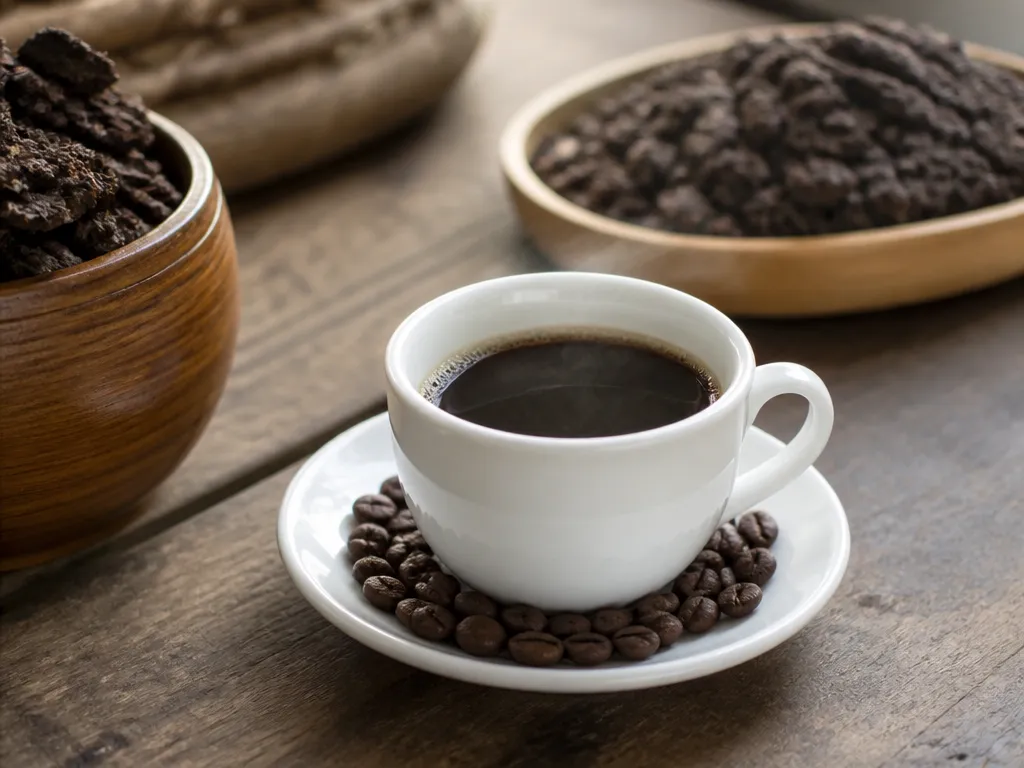
Coffee is not “made from poop.” The phrase usually refers to kopi luwak, coffee made from beans that civets eat and later pass in their droppings. Producers collect those beans, wash and dry them, then roast them like ordinary coffee. The joke “poop coffee” comes from that process.
Kopi luwak is not coffee brewed with feces, and it is not made by adding animal waste to coffee grounds. If a seller describes it that way literally, the claim is almost certainly false or deliberately exaggerated.
Key Takeaways
- The short answer: Coffee is not brewed from human or animal poop, but kopi luwak uses beans passed through civet digestion and collected from droppings.
- What happens to the beans: Civets digest parts of the coffee fruit, while the beans pass through their digestive tract.
- Hype is common: Many “poop coffee” claims use the phrase as marketing without proving that civets were involved.
- Health risk depends on handling: Legitimate processing includes cleaning and roasting, while careless handling can raise contamination concerns.
- U.S. regulation is general: Specialty coffee is generally covered by ordinary food-safety and labeling rules, not a special “kopi luwak law.”
- How to check a claim: Look for specific farm or origin information, harvest and handling details, and a description that matches the actual civet-bean process.
Is Coffee Made From Poop?
In the United States, a company selling “kopi luwak” or “poop coffee” still has to meet basic food-safety expectations, including clean handling, safe processing, and truthful labeling. The harder question is whether the seller can prove its sourcing and process. Many listings provide vague details or no meaningful evidence that civets were involved.
Where the “Poop Coffee” Claim Comes From
The phrase “poop coffee” comes from a real processing method. Civets eat the fruit surrounding coffee beans, commonly called the coffee cherry. Their digestive systems break down much of the fruit pulp, while the beans pass through the digestive tract. Producers then collect the beans from the droppings, clean them, dry them, and process them.
The internet turned that specific step into a punchline and a sales hook. That is why some listings say “brewed from poop” or “made from fermented feces.” Those descriptions usually refer, inaccurately, to beans that passed through the digestive tract and were recovered from droppings. The wording makes the product sound more shocking than the actual process.
A second problem is fake kopi luwak. Some sellers use “poop coffee” to suggest that civet digestion was involved when they are actually selling ordinary coffee with a provocative label. Without transparent sourcing, the phrase can describe genuine kopi luwak, regular coffee, or nothing more than branding.
Treat “poop coffee” as a clue, not proof. The useful question is whether the seller can accurately describe the civet-to-bean process and support its sourcing claims.
What Is Kopi Luwak?
Kopi luwak is coffee made from beans collected after civets eat coffee cherries. The civet’s digestive enzymes and gut conditions change the beans’ exposure to the surrounding fruit and may alter some flavor compounds. Supporters often describe the result as smoother or less bitter, but “better” is subjective and depends on the original bean quality and the roast.
The basic workflow is:
- Civets eat ripe coffee cherries.
- The beans pass through the digestive tract.
- Producers collect the droppings and separate the beans.
- The beans are washed, dried, and processed.
- The beans are roasted and packaged like other coffee.
That makes “poop coffee” technically accurate as slang but misleading as a literal description. Droppings were part of the production chain, but the finished product is roasted coffee made from recovered beans, not coffee brewed from waste.
Authenticity and handling are where the process becomes more complicated. Proper collection and cleaning matter because the beans can carry contamination after passing through the digestive tract. Responsible producers handle the beans carefully, while sellers focused only on the novelty may provide little information about sanitation or sourcing.
Digestion Does Not Make Poor Handling Safe
Digestion is the mechanism behind kopi luwak, but it does not automatically make the coffee safe or high quality. The coffee cherry contains pulp and sugars, and digestion changes what remains on the bean’s surface. In a legitimate operation, producers recover the beans and process them in a way that limits microbial growth.
Problems arise when the collected material sits too long, becomes contaminated, or is handled carelessly. Droppings can contain microbes, so the civet’s digestive process is only part of the equation. Cleaning, drying, and roasting determine whether the recovered beans are handled as food.
Quality can vary according to:
- what kind of cherries the civets ate,
- whether the beans were collected promptly,
- how thoroughly they were cleaned,
- how they were dried,
- and what roast profile was used.
Claims that “poop coffee always tastes better” are marketing, not a reliable rule. Even if civet digestion occurred, a poorly handled batch can taste odd or harsh. The unusual production story can distract from weak beans or careless processing.
Can Poop Coffee Spread Disease?
It can if the beans are handled poorly. The main concern is contamination before roasting or cross-contamination during processing, not that roasted coffee somehow becomes dangerous simply because a civet passed the beans.
Roasting kills many microbes on the surface of coffee beans, but it is not a universal guarantee against every hazard in every situation. Heavy contamination, uncontrolled processing, or contamination after roasting can still create problems. Roasting is an important safety step, not a substitute for clean handling.
For household use in the United States, focus less on the word “poop” and more on whether the product resembles a properly documented food product. Avoid anything presented as a dare, rumor, or “trust me” novelty with no explanation of its processing.
People with weakened immune systems or anyone especially risk-averse may reasonably skip novelty coffees with questionable sourcing. Plenty of specialty coffee is available from producers with clearer supply chains, so trying something unusual does not require accepting a poorly documented product.
How Kopi Luwak Is Sourced and Regulated
Legitimate kopi luwak depends on traceability and responsible handling, not a single universal certification. A credible seller should be able to explain where the civets are found, whether the production system is wild, semi-wild, or managed, and how the beans are collected and cleaned. The story should remain consistent over time rather than changing from one vague origin claim to another.
U.S. regulation does not generally create a unique, branded “kopi luwak rule” covering every issue a buyer may care about. Coffee remains subject to ordinary food-safety and labeling expectations, including the requirement that the product be what the seller says it is. In practice, proving that a coffee is genuine depends on documentation and traceable sourcing, not on a universal civet-coffee certification used by every seller.
Civet welfare is another concern. Some commercial supply chains use managed environments where animals may be confined in ways that consumers and animal-welfare groups criticize. That does not prove that every operation is abusive, but it gives buyers a reason to ask how the animals are kept and how the coffee is sourced.
For the lowest-regret purchase, choose a seller that provides specific origin and process information rather than one that uses “poop coffee” as its main selling point.
How to Tell Real Kopi Luwak From a Hoax
Authentic kopi luwak descriptions usually provide enough sourcing and processing information to distinguish the product from ordinary coffee with a provocative label.
Use this checklist before buying:
- Look for a civet-based process claim. The product should say that civets ate coffee cherries and that the beans were collected from droppings.
- Check the processing details. A credible listing should mention washing, drying, and roasting.
- Demand origin transparency. A specific farm or region is more useful than a vague claim that the coffee comes “from Asia.”
- Be wary of “brewed from poop.” That wording is incorrect or deliberately misleading.
- Do not treat price as proof. Genuine kopi luwak can cost more than regular coffee, but an inflated price can also make a hoax look credible.
“Poop coffee” is slang for a real specialty process in which coffee beans pass through civet digestion. Literal claims about brewing feces are almost always wrong, and hoax listings often hide behind shock language. If you want to try kopi luwak, buy only from a seller that clearly describes the civet-to-roast chain and provides specific sourcing and processing details.
Frequently Asked Questions
Is it safe to drink coffee that has passed through an animal?
When processed correctly, the beans are thoroughly washed, dried, and roasted at high temperatures, which helps eliminate surface contaminants. However, safety depends entirely on the hygiene standards of the producer during the collection and cleaning phases. If the beans are handled carelessly or collected in unsanitary conditions, the risk of contamination increases.
Does the digestive process significantly change the flavor of the coffee?
Proponents claim that the digestive enzymes and gut environment of the civet can alter the flavor profile, often describing the result as smoother or less bitter. However, taste is subjective, and the final flavor is still heavily influenced by the quality of the original coffee cherries and the roast profile. Many experts argue that the novelty of the process often outweighs the actual difference in taste.
How can I tell if a bag of “poop coffee” is authentic?
Authentic kopi luwak producers will provide detailed information about the origin of the beans, the collection process, and their sanitation methods. If a product description relies solely on shock value or the word “poop” without explaining the steps of harvesting and cleaning, it is likely a marketing gimmick or a fake product. Always look for transparency regarding the farm and the specific processing journey.
Are all coffees labeled as “poop coffee” actually made with civet beans?
No, the term is frequently used as a marketing hook even when no animals were involved in the process. Because there is no strict global legal definition for the term, some sellers use it to charge a premium for ordinary coffee. Without verifiable sourcing documentation, it is impossible to know if the beans actually passed through an animal’s digestive tract.
Is it legal to sell coffee made from animal droppings?
In the United States and many other regions, coffee products must adhere to standard food safety and labeling regulations. There is no specific “poop coffee” law, but producers are legally required to ensure their products are safe for human consumption and accurately labeled. If a product is found to be contaminated or misrepresented, it is subject to the same regulatory oversight as any other food item.

- Espresso Tastes Watery? 10 Common Causes and How to Fix It - October 23, 2026
- 10 Common Coffee Equipment Cleaning Mistakes and How to Avoid Them - October 23, 2026
- 17 Common Coffee Grinder Problems and How to Fix Them - October 23, 2026