
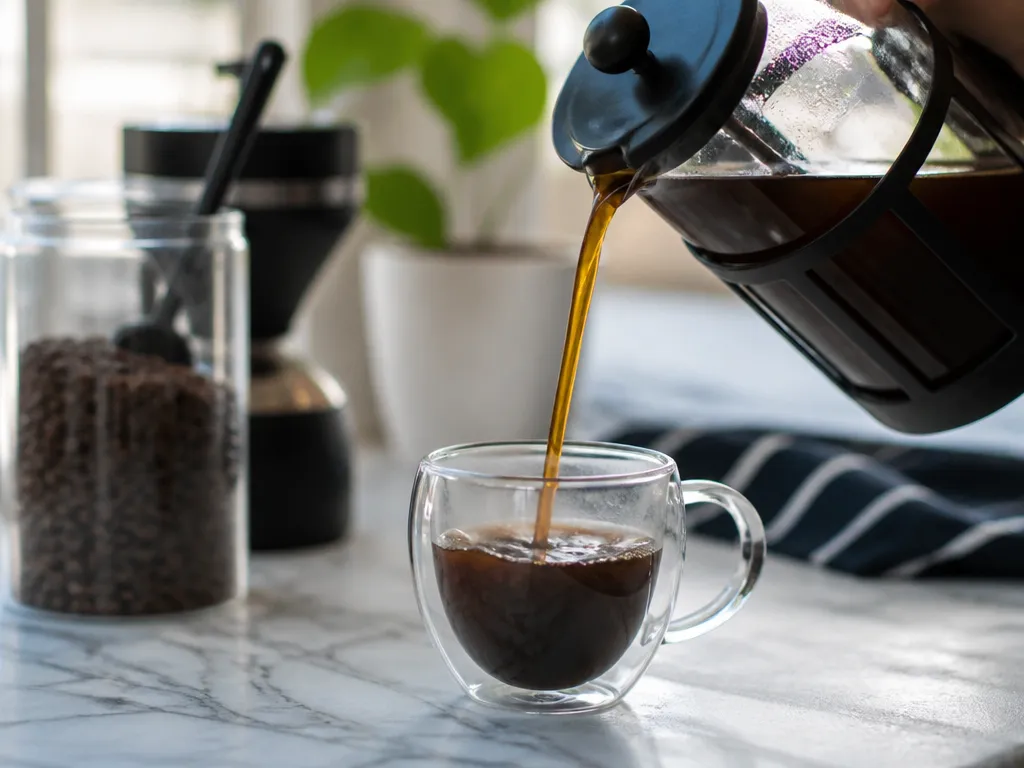
Making coffee from whole beans at home gives you fresher flavor and more control than using pre-ground coffee. Start with fresh beans, grind them immediately before brewing, measure the coffee and water, and keep the water temperature consistent. A reliable baseline is a 1:16 coffee-to-water ratio, such as 18 g coffee to 288 g water.
Your grind size controls extraction: finer grounds extract more quickly, while coarser grounds extract more slowly. Use a finer grind for sour, thin coffee and a coarser grind for bitter, harsh coffee. Adjust one variable at a time so you know which change improved the cup.
The Home-Brewing Baseline
- Start with fresh beans. Grind immediately before brewing.
- Use a 1:16 ratio. Begin with 18 g coffee to 288 g water.
- Adjust grind for flavor. Finer increases extraction; coarser reduces it.
- Measure your dose. Weighing coffee produces more repeatable strength than scoops.
- Keep water temperature consistent. Consistency makes other adjustments easier to judge.
- Match the method to your equipment. Pour-over, French press, AeroPress, drip, and espresso produce different results.
- Troubleshoot in order. Adjust grind size first, then ratio, then brew time.
How To Make Coffee From Coffee Beans At Home
A simple workflow produces good coffee from whole beans: choose a brew method, measure the coffee and water, grind immediately before brewing, and brew with consistent hot water. If you make only one equipment upgrade, choose a grinder and measure your coffee at least once so you know what you like.
You need whole coffee beans, a grinder, a brewer such as a dripper, French press, espresso machine, or AeroPress, a kettle or other heating method, and a scale or reliable measuring tools. You can brew without a scale, but your results will vary more from cup to cup.
Use this starting setup:
- Choose your brewing method.
- Grind the beans for that method.
- Weigh the coffee dose.
- Measure the water using your chosen ratio.
- Brew for a consistent amount of time.
- Taste the coffee and adjust the grind before changing several other variables.
For a balanced baseline, use a 1:16 coffee-to-water ratio by weight. That means 18 g coffee to 288 g water.
Use 1:15 for a stronger cup or 1:17 for a lighter one. If the coffee tastes bitter or sour, do not change everything at once. Adjust the grind size first.
Freshness also matters. Beans that smell flat or stale will not produce lively coffee even with good technique. Grinding immediately before brewing gives you a better starting point than using pre-ground coffee, while repeatable measurements make it easier to improve the result.
What Grinder Setting Gives Optimal Extraction
Grind size controls how quickly water extracts flavor from the coffee. Finer grounds extract faster and more strongly; coarser grounds extract more slowly and less strongly.
There is no universal correct number on a grinder. Burr geometry, calibration, roast level, oiliness, and bean density all affect the result. Use a grinder setting as a starting point, then adjust it based on taste.
Brew a cup with your best estimate, taste it, and make a small change. On many burr grinders, moving one or two clicks at a time is reasonable. Blade grinders create a wider mix of particle sizes, so they make extraction less consistent and harder to tune.
Use this quick diagnosis:
- Good but weak: Grind slightly finer or use a slightly larger dose.
- Good but too strong: Grind slightly coarser or use a slightly smaller dose.
Once you find a setting that works for a particular bean and method, write it down. Record the method, dose, ratio, water temperature target, and grinder setting. That note gives you a useful starting point the next time you brew those beans.
How to Measure Coffee Dose and Water Ratio
Measuring the coffee dose and water ratio turns a one-off cup into a repeatable recipe. If you change the grind without controlling the amount of coffee and water, you are changing multiple variables at once.
Use coffee dose in grams rather than scoops. A common starting point for one standard mug is roughly 18 g coffee and 288 g water at a 1:16 ratio. Tablespoons work when you do not have a scale, but the dose will vary more because beans and grounds do not pack identically.
For a 1:16 ratio:
- 15 g coffee = 240 g water
- 18 g coffee = 288 g water
- 20 g coffee = 320 g water
- 25 g coffee = 400 g water
When you have a scale, weigh both the coffee and water. Water weight is effectively the same as water volume in grams for practical home brewing, and weighing it improves repeatability.
Adjust one variable at a time:
- Weak or watery: Increase the dose slightly or grind slightly finer.
- Too strong or harsh: Reduce the dose slightly or grind slightly coarser.
- Sour: Grind finer or extend brew time slightly.
- Bitter: Grind coarser or shorten brew time slightly.
If an 18 g dose tastes watery but not bitter, try 20 g while keeping the water and brewing method unchanged. If the coffee tastes bitter, keep the dose and ratio steady and adjust the grind first.
Also decide whether you are measuring water in or coffee out. Some recipes specify the total water added, while others specify the final brew yield. Either approach can work, but use one consistently. A brewer retains some water in the grounds, so the final output will be lower than the amount you poured.
Which Brew Method Fits Your Equipment
Your equipment determines how long water contacts the grounds and how much sediment and oil reach the cup. Choose a method that suits both your preferred flavor and the amount of cleanup you will tolerate.
- Pour-over with a dripper and paper filter: Produces clean, bright coffee and gives you control over pouring. It takes longer than immersion brewing.
- French press with immersion and a plunger: Produces fuller body with less filtration and more sediment.
- AeroPress: Combines immersion with pressure-assisted dispensing. It is fast, forgiving, and easy to experiment with.
- Drip machine: Offers basket filtration and convenience, but gives you less control over extraction.
- Espresso machine: Produces concentrated shots with intense flavor, but requires more skill and tighter control.
Pour-over is a good choice for clean, crisp flavor. French press suits drinkers who prefer body and do not mind sediment. AeroPress works well when speed and portability matter.
Filtration changes the cup as well. Paper filters remove oils and fine particles, producing a smoother, clearer result. Metal filters let more oils through, which can make coffee taste richer and heavier. Neither is automatically better, but each changes how bitterness, body, and watery texture register.
Choose according to your routine:
- Choose pour-over if you want clarity and do not mind pouring.
- Choose AeroPress if you want fast cleanup and quick, repeatable brewing.
- Choose French press if you want no paper filters and a heavier body.
- Choose drip if you want one-button convenience and accept less precision.
If you already have a gooseneck kettle and dripper, start with pour-over. If you have an espresso machine but no scale, get a scale before chasing espresso recipes because espresso is especially sensitive to dose and ratio.
How to Heat Water for Coffee
Water temperature affects extraction and flavor balance. Water that is too cool often produces sour, thin, or muted coffee. Water that is too hot increases the risk of bitter, harsh, or dry flavors.
Use hot water within the range commonly used for coffee extraction, and keep the temperature consistent from brew to brew. Boiling water can work in a pinch, but kitchen conditions make it difficult to know how hot the water remains once it reaches the grounds.
A kettle with temperature control gives you the easiest repeatable process: set the target, wait for the kettle to reach it, and begin brewing. With a standard kettle, bring the water to a boil and let it rest briefly before pouring. Use the same heating and resting routine each time.
Consistency matters more than chasing a perfect temperature. When the heat source, heating time, and resting time stay the same, you can adjust grind and ratio without wondering whether temperature caused the change.
Water quality matters too. Hard or strongly mineralized water can amplify harsh notes and mute sweetness. Filtered water may produce cleaner flavor even when your temperature and grind are well controlled.
Use this adjustment order:
- Keep the dose and ratio consistent.
- Choose an appropriate grind size.
- Keep water temperature consistent.
- Make smaller temperature adjustments only after the other variables are under control.
If the coffee remains sour after you grind finer, increase contact time with a longer brew or a change in pour-over technique. If finer grinding makes it bitter, move back toward a coarser grind before changing the temperature.
Step-By-Step Pour-Over for Clean Flavor
Pour-over produces a clean cup because you control the flow rate and contact time, while the paper filter removes some oils and fine particles. That filtration also makes grind-related flavor changes easier to identify.
You will need a dripper, paper filters, a gooseneck kettle if available, a scale, and a timer. Start with 18 g coffee to 288 g water at a 1:16 ratio.
- Heat the water. Bring it to your target temperature and get ready to pour.
- Rinse the filter. Place the paper filter in the dripper and rinse it with hot water to remove paper taste. Discard the rinse water.
- Add the coffee. Put 18 g of ground coffee into the filter and level the bed.
- Bloom the grounds. Start the timer and pour enough water to wet all the grounds. Use about 2 to 3 times the coffee weight, or roughly 36 to 54 g water for 18 g coffee.
- Wait for the bloom. Let the coffee sit until the bubbling slows.
- Pour in stages. Continue with steady pours until you reach 288 g total water. Keep the grounds evenly saturated and the water level steady.
- Taste the brew. When the dripper empties, evaluate the flavor and adjust the grind next time.
Pouring too quickly can make the bed drain before the grounds extract fully. Pouring too slowly can extend contact time and push extraction too far. Aim for even saturation and a controlled drawdown rather than trying to pour as quickly or slowly as possible.
Different beans may need different settings. Lighter roasts often need a slightly finer grind than darker roasts in many setups. Treat every new roast as a fresh starting point instead of forcing the previous setting to work.
How to Fix Weak, Bitter, or Watery Coffee
Most disappointing coffee comes from a small group of causes: grind size, ratio, contact time, or inconsistent water temperature. Change one variable per attempt and troubleshooting becomes much faster.
Start with the flavor:
- Weak, thin, or watery: The coffee may be under-extracted, or you may have used too little coffee.
- Sour, sharp, or underwhelming: The coffee is likely under-extracted because the grind is too coarse or the brew time is too short.
- Bitter, harsh, or dry: The coffee is likely over-extracted because the grind is too fine or the brew time is too long.
- Good at first, then harsh in the finish: The grind may be acceptable, but flow or saturation may be inconsistent.
Make changes in this order:
- Adjust grind size first. It changes extraction most directly.
- Adjust the ratio second. Once the flavor is balanced, change the dose if you want more or less body.
- Adjust brew time third. This matters especially for pour-over and immersion methods.
- Adjust temperature last. Do this only after grind and ratio are consistent.
For watery coffee, increase the dose slightly, such as from 18 g to 20 g, while keeping the water and method unchanged. If the coffee is weak but not sour, you may need more coffee rather than a different grind.
Keep an eye on brew yield as well. If your brew produces 10 to 20 g less water than the previous one, your effective ratio has changed. Weigh the final water or use the same total pour and output each time so your comparisons remain useful.
FAQ
How do I make coffee from coffee beans at home without a scale?
Use a measuring spoon temporarily, but expect less consistency. Start with about 1 to 2 tablespoons of coffee per 6 ounces of water, then taste and adjust. A small kitchen scale is the quickest way to improve repeatability because coffee dose in grams predicts strength more reliably than scoops.
What grinder setting should I use for my coffee beans?
Start with a setting appropriate for your brewing method, then adjust by taste. Grinder settings vary by model and roast, so treat any setting as a starting point. Make small changes while keeping the dose and ratio the same for a couple of brews.
What water-to-coffee ratio is best?
Use 1:16 coffee to water by weight as a starting point. That means 18 g coffee to 288 g water. Try 1:15 for stronger coffee or 1:17 for lighter coffee. Keep the ratio steady while you adjust the grind for flavor balance.
How long should I brew coffee from beans?
Brew time depends on the method, but consistent contact and extraction matter more than one universal time. Pour-over often takes around a few minutes from start to finish, while immersion methods such as French press usually take longer.
What’s a common mistake when brewing coffee from whole beans?
Changing too many variables at once is the most common mistake. If you change the grind size, ratio, pour technique, and temperature together, you cannot tell what caused the flavor change. Adjust one variable per brew while keeping the dose, ratio, and water temperature constant.

- Espresso Tastes Watery? 10 Common Causes and How to Fix It - October 23, 2026
- 10 Common Coffee Equipment Cleaning Mistakes and How to Avoid Them - October 23, 2026
- 17 Common Coffee Grinder Problems and How to Fix Them - October 23, 2026