
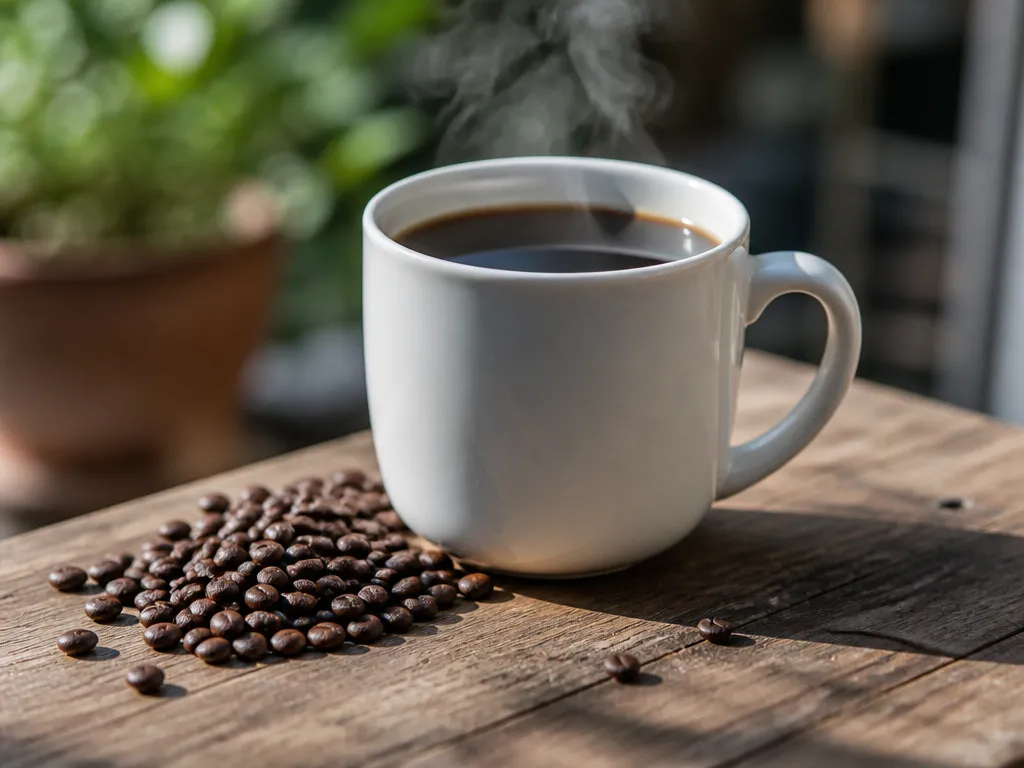
A 10 oz cup of Folgers medium roast delivers approximately 95 to 140 mg of caffeine, assuming a standard 1 to 2 tablespoons of grounds per 6 oz serving and drip-brewed preparation. The exact number shifts based on roast depth, grind size, water temperature, and your specific brewing habits. Folgers does not publish caffeine content on its packaging, so the industry-standard range of 60 to 80 mg per 6 oz serving serves as the most reliable baseline. A 10 oz portion is roughly 67% larger than a 6 oz serving, which is why the total climbs into the 95 to 140 mg window rather than staying at the smaller-cup figure.
Key Takeaways
- 10 oz Folgers caffeine lands around 95 to 140 mg for medium roast brewed in a standard drip machine.
- Darker roasts (Folgers Black Silk, French Roast) carry marginally less caffeine per gram than lighter roasts.
- Brewing variables like water temperature, brew time, and grind coarseness can swing caffeine content by 15 to 30 mg in either direction.
- Folgers Instant drops the caffeine to roughly 50 to 85 mg per 10 oz serving because the extraction process is fundamentally different.
- The FDA’s daily limit for healthy adults sits at 400 mg, so two 10 oz cups of Folgers medium roast keep you comfortably below that threshold.
- Grind size matters more than most people think – finer grounds exposed to hot water for longer extract more caffeine than coarse grounds with a short contact time.
Caffeine in 10 Oz Folgers Coffee: Exact Milligram Count
Folgers does not disclose caffeine content on its packaging or website, which is standard practice in the coffee industry. The most cited benchmarks come from USDA FoodData Central and independent lab testing that has been repeated across consumer publications.
The baseline number for Folgers medium roast is approximately 60 to 80 mg of caffeine per 6 fluid ounces of brewed coffee. This figure represents a standard drip brew with moderate water temperature (195 to 205 degrees Fahrenheit) and the recommended 1 to 2 tablespoons of grounds per serving.
To estimate caffeine in 10 oz of Folgers coffee, apply a simple proportional calculation. A 10 oz cup is roughly 1.67 times the volume of a 6 oz serving. Multiplying 60 to 80 mg by 1.67 gives you 100 to 134 mg. Accounting for real-world variation in brewing strength, a slightly wider range of 95 to 140 mg is more accurate, because extraction efficiency does not scale linearly with volume.
For a practical reference point, a 10 oz Folgers coffee made with 2 rounded tablespoons of medium roast grounds in a standard drip brewer will typically fall between 105 and 130 mg of caffeine.
How Folgers Roast Type Changes Your 10 Oz Caffeine Total
Roast level is one of the most misunderstood factors in caffeine content. A common misconception is that darker roasts are stronger in caffeine. In reality, darker roasts contain slightly less caffeine by weight than lighter roasts, because the roasting process breaks down some of the caffeine molecules and reduces bean density.
Here is how Folgers roast options stack up in practical terms:
| Folgers Product | Approximate Caffeine (10 oz) | Notes |
|---|---|---|
| Folgers Classic Roast (Medium) | 100 to 135 mg | Most commonly purchased; industry baseline. |
| Folgers Black Silk (Dark) | 90 to 125 mg | Slightly less per gram due to extended roasting. |
| Folgers French Roast (Dark) | 85 to 120 mg | Longer roast time means marginal caffeine reduction. |
| Folgers Simply Smooth (Reduced Acid) | 95 to 130 mg | Similar to Classic Roast in caffeine content. |
| Folgers Instant (Original) | 50 to 85 mg | Extraction process differs significantly. |
The variation within each roast type matters more than the difference between roasts. A aggressively brewed dark roast using extra-fine grounds and scalding water can easily surpass a lightly brewed medium roast. The roast itself is not the dominant variable.
For most people, choosing a roast based on flavor preference rather than caffeine concerns is the right call. The difference between a dark and medium roast 10 oz cup is roughly 10 to 15 mg at most, which is negligible compared to the impact of brewing method or serving size.
Brew Method and Its Effect on 10 Oz Folgers Caffeine
The brew method is where caffeine content varies the most when making Folgers at home. Drip brewing is the standard, but how you execute it determines where within the 95 to 140 mg range your cup lands.
Drip Coffee Maker (most common): A standard home drip machine produces a 10 oz Folgers coffee in the 100 to 135 mg range. The key variables are contact time and water temperature. Machines that take longer to brew or hold water at the higher end of the ideal range (200 to 205 F) extract more caffeine. If your brewer is older or runs cool, you may be getting closer to 80 to 100 mg.
Pour-Over: A pour-over of 10 oz Folgers typically extracts 110 to 145 mg of caffeine if you pour in two or three pulses rather than one continuous stream. The extended contact with hot water and the ability to control pour rate gives pour-over slightly higher extraction than most automatic drip machines.
French Press: A 10 oz French press with Folgers grounds steeped for 4 minutes will extract 115 to 150 mg. The full immersion brewing method and the lack of a paper filter (which can absorb some caffeine) push extraction higher. This is one of the highest-caffeine methods for home brewing.
Cold Brew: Cold brew concentrate diluted to 10 oz of finished beverage yields approximately 100 to 130 mg, depending on concentrate strength. The long, cold extraction pulls caffeine more slowly but for a much longer duration, often 12 to 24 hours, resulting in comparable or slightly higher total caffeine than hot brewing.
Espresso (Folgers in a home machine): If you pull a double shot using Folgers grounds in an espresso machine, you get roughly 2 oz of liquid with 80 to 120 mg of caffeine. This is not a 10 oz serving, but if someone stretches that double shot with 8 oz of hot water to make an Americano, the total caffeine ends up in the same 95 to 130 mg range.
Instant: Folgers Instant crystals dissolved in 10 oz of hot water delivers 50 to 85 mg. If you use more than the recommended teaspoon per serving, you can push it higher, but the nature of instant coffee limits how much caffeine extracts regardless of how much powder you add.
Folgers 10 Oz Caffeine Compared to Other Coffee Brands
Folgers occupies the middle ground among major grocery-store coffee brands. It is not the highest and not the lowest in caffeine per serving, sitting comfortably alongside other mainstream options while trailing some premium and specialty blends.
| Brand | Product | Caffeine per 10 oz (estimated) |
|---|---|---|
| Folgers | Classic Roast Medium | 100 to 135 mg |
| Maxwell House | House Blend | 95 to 130 mg |
| Starbucks | Pike Place (via Via or K-Cup) | 130 to 170 mg |
| Dunkin’ | Original Blend | 110 to 145 mg |
| Peet’s Coffee | Major Dickason’s Blend | 120 to 155 mg |
| Green Mountain | Breakfast Blend K-Cup | 125 to 160 mg |
| Eight O’Clock | Original | 100 to 135 mg |
| Chock Full o’Nuts | Original | 95 to 125 mg |
The difference between Folgers and Starbucks, per 10 oz, is roughly 30 to 35 mg. That is enough to matter if you are caffeine-sensitive or tracking your daily intake closely, but not enough to make Starbucks feel dramatically stronger in a side-by-side taste test.
Premium brands like Peet’s tend to roast slightly darker on average, which as noted earlier actually reduces caffeine by weight slightly. But they also often use higher-altitude arabica beans, which naturally contain more caffeine than lower-altitude varieties. The net effect is a modest increase over Folgers.
Ground roast and brew method aside, one factor that is hard to control is bean quality. Higher-quality arabica beans tend to have a more complex flavor profile at the same caffeine levels as mid-grade beans, but Folgers uses a blend of arabica and robusta that keeps costs down while maintaining consistent caffeine delivery.
How 10 Oz Folgers Caffeine Stacks Up Against Common Beverages
Understanding Folgers caffeine content becomes more useful when you compare it to what else you drink in a day. Many people who track caffeine are surprised to find how quickly it adds up across different beverages.
| Beverage | Serving Size | Caffeine (mg) |
|---|---|---|
| Folgers Classic Roast (drip) | 10 oz | 100 to 135 |
| Folgers Instant | 10 oz | 50 to 85 |
| Black tea (brewed) | 8 oz | 40 to 70 |
| Green tea (brewed) | 8 oz | 20 to 45 |
| Chai tea (brewed) | 8 oz | 25 to 50 |
| Espresso (double shot) | 2 oz | 80 to 120 |
| Coca-Cola | 12 oz | 34 |
| Diet Coke | 12 oz | 47 |
| Red Bull | 8.4 oz | 80 |
| Monster Energy | 16 oz | 160 |
| 5-Hour Energy (extra strength) | 1.93 oz | 230 |
| Starbucks Frappuccino (bottled) | 9.5 oz | 75 |
| Matcha latte (home) | 8 oz | 35 to 70 |
A single 10 oz cup of Folgers delivers roughly twice the caffeine of a can of Coke and slightly more than a Red Bull. Two cups put you around 250 mg, which is more than most energy drinks on a per-volume basis but less than a Monster or 5-Hour Energy.
This matters most for people who combine Folgers with other caffeinated drinks throughout the day. If you have two 10 oz cups of Folgers in the morning and then drink two sodas and a black tea, you can quickly approach or exceed the 400 mg FDA-recommended daily limit without feeling jittery until later in the day when the accumulated caffeine peaks.
Daily Caffeine Limits and Drinking 10 Oz Folgers
The FDA recommends a maximum of 400 mg of caffeine per day for healthy adults. The European Food Safety Authority sets a similar threshold of 400 mg, while Health Canada suggests 400 mg is acceptable with single doses of 200 mg or less.
Using those benchmarks, here is what 10 oz Folgers cups mean for your daily budget:
- One 10 oz Folgers cup (100 to 135 mg): Roughly 25 to 34 percent of the daily limit. You can comfortably drink three of these and stay under 400 mg with 85 to 100 mg of caffeine remaining for other sources.
- Two 10 oz Folgers cups (200 to 270 mg): 50 to 68 percent of the daily limit. This is the threshold most health guidelines consider the upper range of moderate intake.
- Three 10 oz Folgers cups (300 to 405 mg): Pushing into the upper end or slightly past the recommended maximum. Some individuals, particularly those with caffeine sensitivity, may experience anxiety, insomnia, or digestive upset at this level.
Pregnant women are generally advised to limit caffeine to 200 mg per day, which means one 10 oz Folgers cup is the practical maximum for most expecting mothers. Breastfeeding guidelines are similar, with most health organizations recommending 200 to 300 mg as an upper limit.
People with anxiety disorders, heart conditions, or caffeine sensitivity should consult a healthcare provider about their specific threshold. The 400 mg guideline is a population-level average, and individual tolerance varies dramatically.
For reference, caffeine has a half-life of approximately 5 to 6 hours in healthy adults. This means if you drink 135 mg of caffeine at 8:00 AM, roughly 67 mg remains in your system by 1:00 PM and about 34 mg by 7:00 PM. If you are sensitive to caffeine in the evening, a 10 oz cup consumed after 2:00 PM may affect your sleep.
Ways to Lower or Raise the Caffeine in 10 Oz Folgers
You do not have to accept the standard 100 to 135 mg range as fixed. Several practical adjustments let you tune your 10 oz Folgers serving to your preferred caffeine level.
To lower caffeine in 10 oz Folgers:
- Switch to instant. Folgers Instant delivers roughly 50 to 85 mg per 10 oz, which is 30 to 45 percent less than drip-brewed.
- Shorten brew time. If you use a manual method like pour-over, a shorter extraction time (30 to 60 seconds less) reduces caffeine substantially.
- Use cooler water. Water below 195 F extracts fewer caffeine compounds. It also preserves some flavor nuances that high heat can destroy.
- Dilute with water or milk. Adding a splash of hot water after brewing (often called an “Americano-style” preparation) reduces effective concentration without changing flavor as noticeably as adding milk.
- Try decaf Folgers. Decaf versions use CO2 or water processing to remove 97 to 99 percent of caffeine, leaving roughly 2 to 5 mg per 10 oz cup.
To raise caffeine in 10 oz Folgers:
- Use more grounds. Increasing from 2 tablespoons to 3 tablespoons per 10 oz boosts caffeine by approximately 40 to 60 percent, pushing your cup toward 150 to 190 mg.
- Grind finer. Finer grounds increase surface area and extraction speed, pulling more caffeine into the final cup.
- Brew longer. Extending brew time by 30 to 60 seconds in pour-over or French press methods increases extraction significantly.
- Add a espresso shot. A single espresso shot (about 63 mg) dissolved into your 10 oz Folgers brings the total to roughly 165 to 200 mg.
One caveat on “more grounds” and “longer brew”: these adjustments also extract more bitter compounds from the coffee, which can make the flavor harsh or unpleasant. Finding your preferred balance usually requires a few iterations.
FAQ
How many tablespoons of Folgers for 10 oz of coffee?
Use approximately 2 to 2.5 rounded tablespoons of Folgers grounds for 10 oz of water. This falls between the 1 to 2 tablespoon per 6 oz serving recommendation, adjusted upward for the larger volume. More grounds increases caffeine; fewer grounds decreases it.
Is Folgers higher in caffeine than other grocery-store brands?
Folgers falls squarely in the middle of grocery-store brands. It is comparable to Maxwell House and Eight O’Clock but contains slightly less caffeine per serving than Starbucks Via, Green Mountain, or Dunkin’ Original Blend.
Can you drink Folgers every day and stay under 400 mg of caffeine?
Yes, most healthy adults can drink three 10 oz cups of Folgers daily (300 to 405 mg) and stay within the FDA’s 400 mg recommended limit. One to two cups per day is a safer range for people sensitive to caffeine or with underlying health conditions.
What time of day should you stop drinking Folgers to avoid sleep disruption?
Caffeine has a half-life of 5 to 6 hours. To ensure fewer than 25 mg of caffeine remains in your system at bedtime, stop drinking Folgers at least 10 to 12 hours before you go to sleep. For someone who sleeps at 11:00 PM, that means no Folgers after 11:00 AM to 1:00 PM.

- Are Pod Coffee Machines Healthy? The Unfiltered Truth About Your Daily Cup - September 27, 2026
- Does Gatorade Have Caffeine? Here’s What’s in Each Type - September 26, 2026
- Does Powerade Have Caffeine, or Is That a Myth? - September 26, 2026