
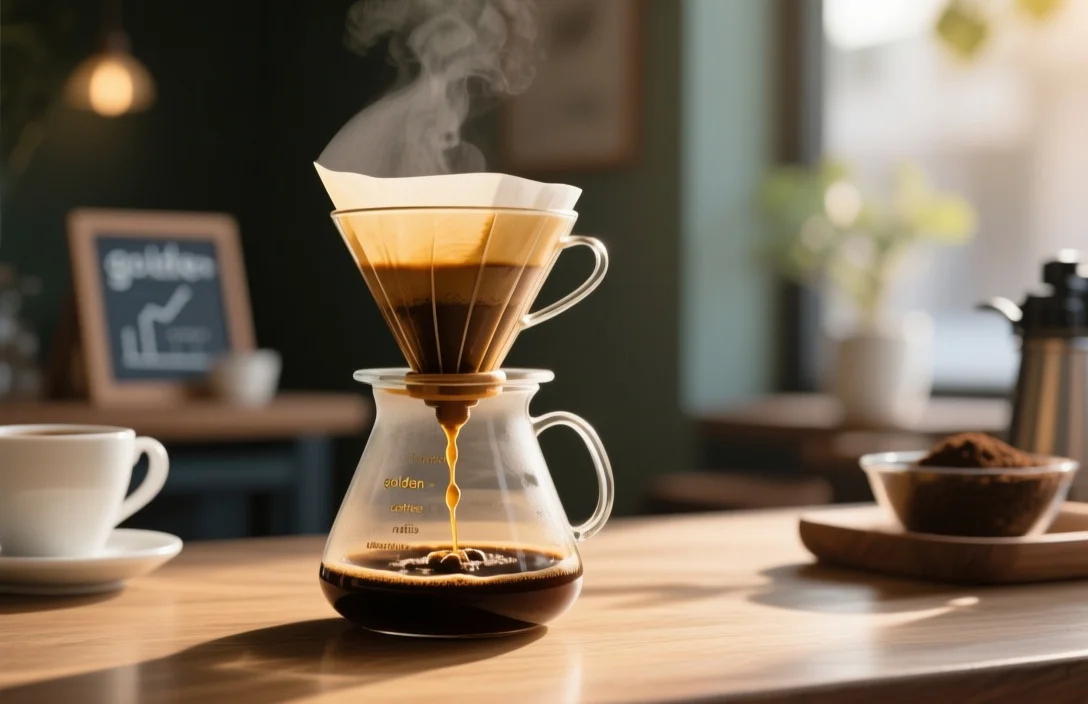
A simple rule of thumb for brewing balanced coffee is to use a coffee-to-water ratio by weight that most brewers call the golden coffee ratio. Home and professional recipes commonly point to roughly 1:16 (coffee:water) as a starting target, with a practical range between about 1:15 and 1:18 depending on method and taste.
What the golden coffee ratio means (plain definition)
Golden coffee ratio names a target proportion of dry coffee to brewing water that aims to produce an even, drinkable extraction without tasting weak or over-extracted. Most people work in weight terms: grams of coffee per grams (or milliliters) of water, because volume measures for coffee (spoons) vary too much. A starting number near 1:16 gets you into the zone where the brewed cup is neither underextracted and sour nor overextracted and bitter.
Why ratio matters more than recipe rituals
Brewed coffee strength and extraction hinge on two separate variables: how much soluble material you dissolve (strength), and what fraction of the available solubles you extract from the grounds (extraction). Ratio controls strength directly by setting how concentrated the brew will be. Extraction depends on grind size, time, temperature, agitation, and the same ratio interacts with those variables. When you fix ratio first, it becomes much easier to isolate the effects of grind or time during calibration.
Fixing a reliable ratio also simplifies scaling and reproducibility. Recipes that use weight scale linearly when ratio is constant; doubling the coffee and water keeps the same sensory balance. Recipes based on scoop counts or volume will shift as bean density or roast level varies, so weight-based ratio gives predictable results across different beans and roasts.
How to use the golden coffee ratio
- Weigh your coffee dry on a kitchen scale.
- Calculate water by multiplying coffee weight by your chosen ratio (for example multiply by 16 for 1:16).
- Heat the water to your normal brewing temperature (commonly 90-96°C for most methods).
- Bloom, pour, or immerse according to the method and total water schedule for the recipe.
- Time the brew and adjust grind to change extraction while keeping ratio constant.
- Taste and change ratio in 5-10% increments if strength needs shifting.
- Record the weight inputs, grind setting, and brew time for repeatable results.
Using weight for both inputs keeps the math simple and the chemistry consistent. Tasting is the final arbiter; if a cup tastes weak but clean, increase coffee a small step. If a cup tastes heavy and cloying, reduce coffee slightly or coarsen the grind to lower extraction for the same ratio.
How the golden coffee ratio changes by brew method
Pour-over, immersion, and espresso approach extraction differently, and ratio expectations shift accordingly. Pour-over brewers often use ratios in the 1:15-1:17 band to emphasize clarity. Immersion methods like French press or Aeropress routinely sit in the same mid-teens range but sometimes trend slightly stronger because contact time is long. Espresso operates on a different scale entirely and is described in terms of brew ratio (solids output vs. dry coffee input) rather than the simple water-to-coffee rule used for filter methods.
Different roast levels will also change what ratio tastes best. Darker roasts dissolve more easily and can taste stronger at the same ratio, so many brewers drop toward 1:17-1:18 with dark roasts to avoid flabbiness. Lighter roasts often benefit from the extra concentration of 1:15-1:16 to reveal acidity and sweetness.
Table: comparison of common methods and practical ratio guidance
| Name | Price/Key Spec | Best For |
|---|---|---|
| Pour-over (V60, Kalita, Chemex) | 1:15-1:17 (by weight) | Clarity, bright acidity, single-origin nuance |
| French press | 1:12-1:16 (by weight) | Full body, heavier mouthfeel, coarse grind |
| Aeropress | 1:12-1:16 (by weight) | Versatility; short brews or concentrated styles |
| Immersion (cold brew) | 1:4-1:8 concentrate (then dilute) | Smooth, low-acid cold coffee concentrate |
| Espresso (brew ratio concept) | Varies; 1:1.5-1:3 brew ratio typical | Intense, concentrated shots; crema and body |
Scaling recipes and doing the math without mistakes
Scaling a ratio recipe is straightforward when you keep everything in grams. Multiply the dry coffee by your ratio to compute required water. Practical example: for a 300 g batch at 1:16, divide the water by 16 to get coffee. Doing the algebra in your head is fine once you internalize a few anchors: 16 g coffee → 256 g water; 18 g coffee → 288 g water.
If you need a metric-to-imperial bridge, use your scale to measure milliliters of water directly because 1 ml of water approximates 1 g at normal room temperature. Avoid converting coffee into tablespoons for precision work; tablespoon weight varies with bean size and roast. Batch brewing for multiple cups follows the same rule: multiply the coffee weight by the desired number of servings and then apply the ratio.
Practical traps to avoid while scaling include forgetting to account for retention in devices (water and grounds retained in the filter or bed) and counting final cup volume instead of total water added. Espresso and cold-brew concentrate require additional dilution or yield calculations; keep those processes separate from a simple golden-ratio scaling workflow.
Adjusting the golden coffee ratio when taste says to change
Tasting must guide adjustments. Sour, thin, or tea-like notes often indicate underextraction or low strength. Bitter, astringent, or hollow flavors can point to overextraction or excessive concentration. Adjustments fall into two clear buckets: strength changes (ratio) and extraction changes (grind, time, temperature).
If the cup is simply too weak but balanced, increase coffee weight by a small margin – 5% adjustments are a practical rule. If the cup is too bitter but watery, coarsen the grind to lower extraction and keep the same ratio. If bitterness and heavy mouthfeel coexist, both lower the coffee weight and coarsen the grind. Dialing in requires iterative testing: change only one variable at a time, then taste the result.
Record-keeping accelerates calibration. Note exact coffee weight, total water, brew temperature, grind setting, and time stamp. Repeatability makes it easy to home in on the combination of ratio and extraction that suits a particular bean.
Common mistakes and how to avoid them
Relying on volume measures for coffee causes inconsistent strength across beans and roasts. Measuring by spoon instead of weight creates variability that will make any “golden” ratio meaningless in practice. Using inconsistent water temperature also confounds ratio-based adjustments, since hotter water increases extraction rate.
Overfitting to a single ratio across all beans is another common error. Beans vary: freshness, roast level, origin, and processing all change solvable solids and flavor balance. Blindly using 1:16 for every bean will sometimes produce a great cup and sometimes a disappointing one. Calibrate by tasting and adjust ratio a small amount, then stabilize the result into a repeatable recipe.
Stale coffee and poor grinder calibration are invisible problems that ratio can’t fix. Grinding inconsistently or storing coffee in a humid environment will introduce off-flavors irrespective of the ratio. Keep beans sealed and use a burr grinder for consistent particle size.
Practical examples and quick recipes readers can try
Try three simple, reproducible recipes to experience ratio effects. Each example uses a scale and common household equipment.
- Pour-over clarity test: 20 g coffee, 320 g water (1:16). Heat water to 93°C. Bloom with 40 g water for 30 seconds, then pour to finish at 2:30-3:00 total brew time. Taste clarity and body.
- French press balance test: 30 g coffee, 450 g water (about 1:15). Use coarse grind, steep for 4 minutes, plunge slowly, serve immediately. Note body and mouthfeel.
- Aeropress concentrate test: 18 g coffee, 120 g water (inverted or standard technique), brew 1:6 extraction then dilute to taste. Short immersion produces espresso-like intensity that you can blend down to compare strength perception.
Tasting each formula side-by-side highlights how small ratio shifts change perceived sweetness, acidity, and body. Switch one variable at a time to learn cause-and-effect quickly.
How grind, time, and temperature interact with the golden coffee ratio
Grind size primarily controls how fast water extracts soluble compounds from particles. Finer grinds speed extraction; coarser slows it. Temperature performs a similar role: higher temperatures increase extraction kinetics and solubility. Time is cumulative – longer contact yields more extraction. Ratio sets concentration but also influences how sensitive the system is to these other variables.
When you change ratio, expect the impact of grind and time to shift slightly. Stronger brews can tolerate coarser grinds because the increased concentration offsets a small drop in extraction percentage. Conversely, lighter brews often require a slightly finer grind to achieve the same perceived strength and balance. Making coordinated changes is key: if you increase coffee weight, you may need to coarsen the grind to avoid overextraction at the same time.
A disciplined approach looks like this: choose a method and target ratio, set grind to hit a reasonable time window for that method, taste, then adjust grind for extraction and ratio for strength. Repeat until the sensory profile meets your preference.
Storage, roast level, and their effect on the golden coffee ratio
Roast level affects solubility and density. Lighter roasts are denser and can taste more acidic at the same ratio; raising concentration slightly usually brings out sweetness. Darker roasts are more soluble, so a lower concentration or a coarser grind often prevents a thin or overbearing cup. Freshness amplifies nuance; a freshly roasted bean will show clearer flavors at the same ratio than stale beans.
Store coffee in an opaque, airtight container at cool room temperature and use beans within a few weeks of roast for best results. Freezing can work for long-term storage but introduces condensation risk if not handled carefully. Grind only what you need each session to maintain consistent particle size distribution and predictable behavior when applying your golden ratio.
Common troubleshooting scenarios and fixes
- Sour, underdeveloped cup: Finer grind, longer time, or slightly higher ratio.
- Overly bitter cup: Coarser grind, shorter time, or slightly lower ratio.
- Thin but bright cup: Raise coffee weight by a small amount; keep other parameters the same.
- Muddy or heavy cup: Coarsen grind or reduce the coffee mass used per brew.
Calibrate with small, deliberate steps and taste after each change. Using the same beans across tests reduces confounding variables while you learn how ratio interacts with grind and time.
FAQ
What exactly is the “golden coffee ratio”?
Golden coffee ratio refers to a commonly recommended starting point for coffee-to-water weight – around 1:16 – intended to yield a balanced extraction for most filter-brewed coffees. Practical use varies by brew method, roast, and personal taste.
Should I use tablespoons if I don’t have a scale?
No. Tablespoon measures differ by bean size and roast. Invest in an inexpensive digital scale; it is the single most effective upgrade for repeatable brewing.
Can I use the same ratio for cold brew?
Cold brew uses much less hot water and often produces a concentrate, so list-style ratios differ. Make cold-brew concentrate strong and dilute to taste; do not apply hot-brew mid-teens ratios directly without adapting for concentration and extraction time.
How much should I change the ratio when adjusting strength?
Adjust in small steps: about 5-10% changes in coffee mass are perceptible and manageable. Document each change so you can reproduce a preferred result.
Practical verdict and next
Treat 1:16 as a starting rule rather than a mandate. Pick a brew method, measure by weight, and do two focused tests: one at 1:15 and one at 1:17 while keeping grind and time constant. Compare the cups and pick the ratio that best matches your taste. Start a simple log of coffee weight, water, grind, and time to lock in a repeatable recipe.

- Espresso Tastes Watery? 10 Common Causes and How to Fix It - October 23, 2026
- 10 Common Coffee Equipment Cleaning Mistakes and How to Avoid Them - October 23, 2026
- 17 Common Coffee Grinder Problems and How to Fix Them - October 23, 2026