
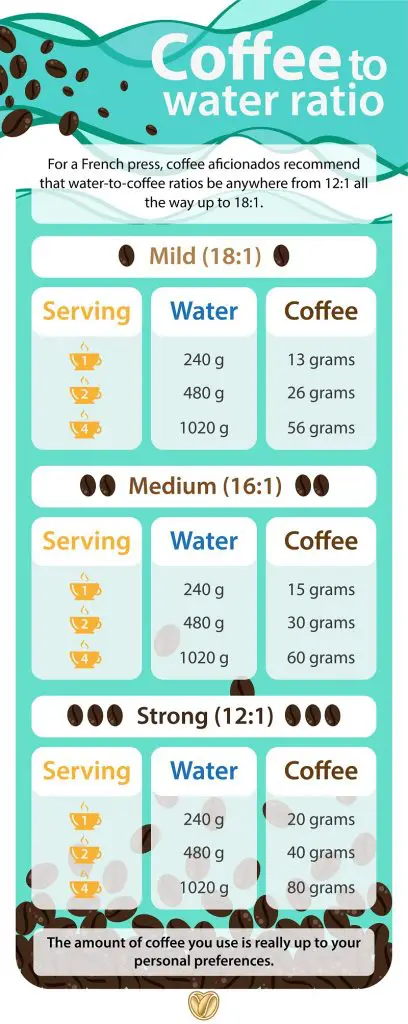
The ideal French press coffee ratio is typically 1:15, meaning one part coffee to fifteen parts water by weight.
Mastering the French press coffee ratio guide is not merely a technicality; it is the cornerstone of crafting an exceptional cup of coffee, transforming a simple brew into a rich, aromatic experience. As someone who has spent years exploring the nuances of coffee brewing, I understand the profound impact that a precise ratio has on flavor extraction and overall enjoyment. This guide aims to demystify the art of the French press, equipping you with the expertise to consistently achieve your perfect brew and elevate your daily coffee ritual.

Understanding the Fundamentals of French Press Coffee
The French press, a deceptively simple brewing device, relies on full immersion to extract rich flavors from coffee grounds. Unlike drip brewers, it allows coffee grounds to steep directly in hot water, resulting in a full-bodied cup with a distinct mouthfeel. Its design minimizes filtration, preserving the natural oils and sediments that contribute to its characteristic richness.
The significance of the French press coffee ratio guide cannot be overstated in this brewing method. It dictates the concentration of your brew, directly influencing its strength, acidity, and bitterness. An incorrect ratio can lead to an underdeveloped, weak cup or an over-extracted, harsh one. Precision in the ratio ensures a balanced and flavorful extraction every time.
The Golden French Press Coffee Ratio
For many coffee enthusiasts and professionals, the golden French press coffee ratio hovers around 1:15 or 1:16. This means for every gram of coffee, you use 15 to 16 grams (or milliliters, as water density is close to 1 g/mL) of water. For example, if you prefer a standard 8-ounce cup, which is approximately 236 grams of water, you would aim for about 15-16 grams of coffee. This specific French press coffee ratio guide helps achieve a balanced extraction, highlighting the inherent characteristics of the beans without overwhelming the palate.
Measuring your coffee and water accurately is paramount. While scoops offer convenience, a digital kitchen scale provides the most precise measurement, ensuring consistency from one brew to the next. I’ve personally found that relying on a scale transformed my brewing consistency, moving from 'good' coffee to 'consistently great' coffee. It eliminates the variability of ground coffee density that can make scoop measurements unreliable. This attention to detail in the French press coffee ratio is truly what sets a memorable cup apart.

Factors Influencing Your Ideal Ratio
While the 1:15 to 1:16 French press coffee ratio serves as an excellent starting point, several variables can prompt you to adjust it to suit your specific preferences and beans. Understanding these factors is crucial for refining your personal French press coffee ratio guide.
- Coffee Bean Type and Roast Level: Lighter roasts often benefit from a slightly finer grind and sometimes a slightly tighter ratio (more coffee relative to water) to help extract their delicate flavors. Darker roasts, conversely, can become overly bitter if over-extracted, sometimes requiring a slightly looser ratio or coarser grind. A high-quality single-origin bean might shine with a precise 1:15, while a bold espresso blend could be better at 1:16 or even 1:17 to mellow its intensity.
- Grind Size: For French press, a coarse, uniform grind is essential to prevent over-extraction and sludge. If your grind is too fine, even the perfect French press coffee ratio guide will result in a bitter, murky cup. Conversely, a grind that is too coarse might lead to under-extraction, producing a weak and sour coffee.
- Water Quality and Temperature: The quality of your water significantly impacts the final taste. Filtered water is always recommended to avoid off-flavors. Water temperature also plays a critical role; ideally, it should be between 195°F and 205°F (90°C and 96°C). Water that is too hot can burn the coffee, leading to bitterness, while water that is too cool will result in under-extraction and a flat taste, regardless of your precise French press coffee ratio.
- Steep Time: The typical steep time for a French press is 4 minutes. Adjusting this, even by a minute, can significantly alter the extraction. A longer steep time with the same French press coffee ratio will yield a stronger, potentially more bitter cup, while a shorter time will produce a milder brew.
- Personal Preference: Ultimately, the "ideal" French press coffee ratio is subjective. Some prefer a bolder, stronger cup, while others lean towards a milder, more delicate profile. Don't be afraid to experiment slightly around the recommended 1:15-1:16 range to discover what truly pleases your palate. My own journey with the French press coffee ratio guide involved countless experiments, and I often adjust based on my mood or the specific roast I'm enjoying that day.
Adjusting the Ratio: A Practical Guide
Refining your French press coffee ratio is an iterative process. By making small, controlled adjustments, you can pinpoint your ideal strength and flavor profile. This is where your personal French press coffee ratio guide truly takes shape.
- For Stronger Coffee: If your brew tastes weak or watery, consider increasing the amount of coffee while keeping the water volume constant, thereby reducing your ratio (e.g., from 1:16 to 1:14). Alternatively, you could slightly increase your steep time, but adjust the coffee ratio first for a more direct impact on concentration.
- For Milder Coffee: If your coffee is too intense, bitter, or overwhelming, reduce the amount of coffee for the same water volume (e.g., from 1:15 to 1:17). This increases your ratio, allowing more water to interact with less coffee, resulting in a lighter brew. A common mistake I made early on was trying to fix bitterness solely with less coffee; often, a combination of a coarser grind and a slightly looser French press coffee ratio worked best.
- Troubleshooting Common Issues:
- Too Bitter: This often indicates over-extraction. Try a coarser grind, a shorter steep time, or a slightly looser French press coffee ratio (more water, less coffee).
- Too Weak/Sour: This usually points to under-extraction. Experiment with a finer grind, a longer steep time, or a tighter French press coffee ratio (less water, more coffee).
- Muddy/Sludgy: Your grind is likely too fine. Ensure you're using a coarse, consistent grind appropriate for French press brewing.
Brewing Steps with the Perfect Ratio
Once you understand the French press coffee ratio guide, applying it to your brewing process becomes straightforward. Follow these steps for an optimal brew:
- Grind Your Beans: Measure your whole beans according to your desired French press coffee ratio (e.g., 20g for 300ml of water at a 1:15 ratio). Grind them coarsely, resembling breadcrumbs or sea salt. A burr grinder is highly recommended for consistency.
- Heat Your Water: Heat filtered water to between 195°F and 205°F (90°C and 96°C). A kettle with temperature control is ideal for precision.
- Add Coffee Grounds: Pour the freshly ground coffee into your French press carafe.
- Pour Water: Start a timer. Pour about half of your measured hot water over the grounds, ensuring they are fully saturated. This "bloom" allows the coffee to degas.
- Steep: After about 30 seconds of blooming, gently stir the grounds, then pour the remaining hot water. Ensure your French press coffee ratio is accurately maintained. Place the lid on top, but do not plunge yet. Let it steep for 4 minutes.
- Plunge: Once the 4-minute steep time is complete, slowly and steadily press the plunger down, separating the grounds from the brewed coffee. Avoid forcing it down too quickly, as this can disturb the grounds and push fine particles through the filter.
- Serve: Immediately pour all the coffee into a mug or serving carafe. Leaving coffee in the French press after plunging can lead to over-extraction and a bitter taste as it continues to steep with the residual grounds.

Beyond the Ratio: Elevating Your French Press Experience
While the French press coffee ratio guide is fundamental, several other practices contribute to a truly exceptional cup. Integrating these into your routine will significantly enhance your brewing results.
- Quality Beans: Start with fresh, high-quality whole beans. The origin, roast date, and variety all impact flavor. Freshly roasted beans, ideally within a few weeks of their roast date, make a noticeable difference in vibrancy and aroma.
- Consistent Grind: As mentioned, a consistent coarse grind is critical. An uneven grind results in uneven extraction—some particles will be over-extracted, others under-extracted—leading to an undesirable flavor profile, regardless of your precise French press coffee ratio. Investing in a good burr grinder is one of the best upgrades for any home brewer.
- Preheating: Before adding coffee grounds and hot water, preheat your French press with some hot water. This prevents the brewing water from losing temperature too quickly when it contacts the cold carafe, ensuring a more stable extraction temperature. This subtle step can make a big difference in maintaining the integrity of your French press coffee ratio and steep time.
- Decanting: Always decant your coffee immediately after plunging. Leaving it in the French press, even after the plunger is down, allows the coffee to continue extracting from the residual fines, leading to a progressively bitter and often astringent taste. Pour it into another vessel to stop the extraction process and preserve its optimal flavor profile.

Frequently Asked Questions
What is the best French press coffee ratio for a beginner?
A great starting point for beginners is a 1:15 ratio, meaning 1 gram of coffee for every 15 grams of water. This provides a balanced brew that is easy to adjust based on personal preference.
How do I measure coffee without a scale for my French press?
While a scale is recommended, you can approximate. For a 1:15 ratio, a general rule is about 2 tablespoons of whole beans per 6 ounces of water. Adjust based on how strong or weak your first brew is.
Does the type of coffee bean affect the French press coffee ratio?
Yes, lighter roasts might need a slightly tighter ratio or longer steep time to extract their full flavor, while darker roasts may benefit from a looser ratio to avoid bitterness. Experimentation is key with different bean types.
Can I adjust the water temperature for a stronger or weaker French press coffee?
Adjusting water temperature can impact extraction, but it's generally best to keep it between 195°F and 205°F for optimal flavor. For strength, it's more effective to adjust the coffee-to-water ratio or the steep time.
Why does my French press coffee taste bitter even with the correct ratio?
Bitterness often indicates over-extraction. Even with the right French press coffee ratio, a grind that is too fine, water that is too hot, or an excessively long steep time can lead to a bitter cup. Try coarsening your grind or reducing your steep time slightly.
Conclusion
Mastering the French press coffee ratio guide is an empowering step towards consistently brewing exceptional coffee at home. By understanding the foundational 1:15 or 1:16 ratio and the factors that influence it—from bean type to grind size—you unlock the ability to tailor your brew precisely to your taste. Remember, while guidelines provide an excellent starting point, your personal preference is the ultimate arbiter of the perfect cup. Embrace the journey of experimentation, fine-tuning your technique with each brew. We encourage you to put these insights into practice today and share your experiences; exploring new brewing methods or resources can further enhance your coffee knowledge.

- Are Pod Coffee Machines Healthy? The Unfiltered Truth About Your Daily Cup - September 27, 2026
- Does Gatorade Have Caffeine? Here’s What’s in Each Type - September 26, 2026
- Does Powerade Have Caffeine, or Is That a Myth? - September 26, 2026