
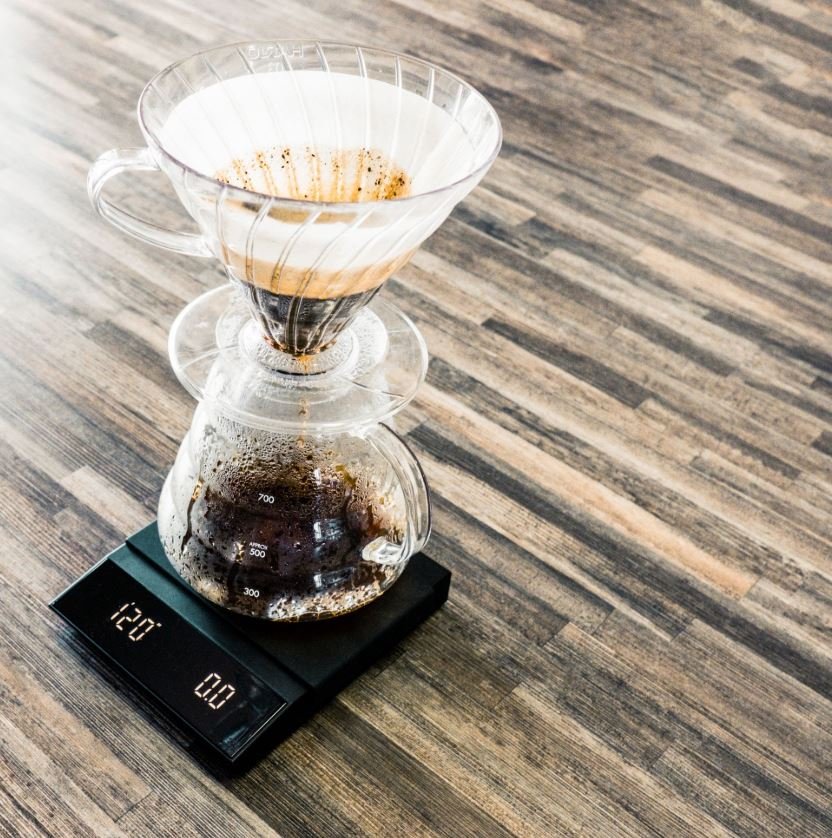
If you want better coffee, start with the coffee-to-water ratio. I’ve found that even a great bag of beans can taste weak, bitter, or unbalanced when the measurements are off.
A coffee ratio calculator takes the guesswork out of brewing by showing you exactly how much coffee and water to use for your desired ratio.
Whether you’re making pour-over, French press, drip coffee, AeroPress, or cold brew, you can quickly adjust the recipe to match your brew size. A common starting point is a 1:16 ratio, meaning 1 gram of coffee for every 16 grams of water. Use the calculator below to get precise measurements for your next cup.
Coffee Ratio Calculator
Don’t want to do the math early in the morning? Use this calculator to instantly find exactly how much coffee or water you need for your desired brew size.
The “Golden Cup” Standard
When coffee professionals talk about ratios, they are usually referring to mass (grams) rather than volume (scoops or cups). A ratio of 1:16 simply means you use 1 gram of ground coffee for every 16 grams of hot water. Measuring by weight eliminates the inaccuracies caused by different roast densities and bean sizes.
The Specialty Coffee Association (SCA) developed the “Golden Cup Standard” after decades of research. They determined that the ideal starting point for a balanced, sweet cup of filter coffee sits between 1:16 and 1:18.
Specifically, the SCA recommends using 55 grams of coffee per 1 liter of water (which mathematically breaks down to about a 1:18.18 ratio).
- 1:16 (Stronger): Produces a heavier body and more intense flavor. Great for darker roasts or if you plan to add milk.
- 1:17 (The Baseline): The universal starting point for most pour-overs and drip machines. It yields a perfectly balanced extraction for medium roasts.
- 1:18 (Lighter): Highlights the delicate aromatics and bright acidity in lighter, single-origin roasts.
Ratios for Different Brewing Methods
While 1:16 to 1:18 is perfect for standard drip and pour-over coffee, other brewing methods require entirely different approaches based on how the water interacts with the grounds:
| Brew Method | Common Ratio | The Result |
| Espresso | 1:2 | Highly concentrated, intense, and syrupy. |
| French Press | 1:15 | Full-bodied, heavy, and robust. Immersion brewing handles stronger ratios well. |
| Pour-Over / Drip | 1:16 to 1:18 | Clean, bright, and complex. |
| Cold Brew (Concentrate) | 1:4 to 1:8 | Extremely strong; designed to be diluted with water or milk before drinking. |
Frequently Asked Questions About Coffee Ratios
1. Do I really need a kitchen scale, or can I just use tablespoons?
You can use tablespoons, but you will sacrifice consistency. Coffee beans vary wildly in size and density depending on their origin and roast level. A tablespoon of a dense, light roast will weigh significantly more than a tablespoon of a puffy, dark roast. Using a scale guarantees you are using the exact same amount of coffee every time, regardless of the beans you buy.
If you must use volume, a general rule of thumb is 1 to 2 tablespoons of ground coffee for every 6 ounces of water.
2. Does my roast level change the ratio I should use?
Yes, it often does. Dark roasts are highly soluble (meaning water extracts their flavors quickly) and can easily become bitter if over-extracted. A slightly stronger ratio with less water—like 1:15 or 1:16—often works best for dark roasts. Light roasts are denser and harder to extract, so using a bit more water—like 1:17 or 1:18—helps pull out those delicate, fruity, and floral notes without overwhelming the palate.
3. Is the “cup” line on my coffee maker actually 8 ounces?
Usually, no. This is one of the most common causes of ratio confusion. Most drip coffee maker manufacturers define a “cup” as 5 or 6 fluid ounces (roughly 150-180ml), not the standard 8-ounce US cup. If you are following a recipe meant for standard 8-ounce cups but filling your machine to the “4 cup” line, your coffee will end up incredibly weak. Always check your manual or measure your water output to be sure.
4. I used the recommended 1:16 ratio, but my coffee tastes too bitter. What did I do wrong?
If your ratio is correct, your grind size or water temperature is likely the culprit.
- Too Bitter: This means the coffee is over-extracted. Try using a slightly coarser grind so the water flows through faster, or lower your water temperature slightly.
- Too Sour/Weak: This means the coffee is under-extracted. Try a finer grind to increase the surface area, ensuring the water can pull out more flavor.
5. If I want a stronger cup of coffee to wake me up, do I just add more grounds?
Adding more grounds (lowering your ratio to something like 1:14) will make the coffee taste heavier, bolder, and more concentrated, but it does not significantly increase the caffeine content per cup. The majority of the caffeine extracts in the very first stages of brewing. If you want a noticeable caffeine boost, you are better off drinking a lighter roast (which retains slightly more caffeine by volume) or simply brewing a larger total volume of coffee.

- Are Pod Coffee Machines Healthy? The Unfiltered Truth About Your Daily Cup - September 27, 2026
- Does Gatorade Have Caffeine? Here’s What’s in Each Type - September 26, 2026
- Does Powerade Have Caffeine, or Is That a Myth? - September 26, 2026