
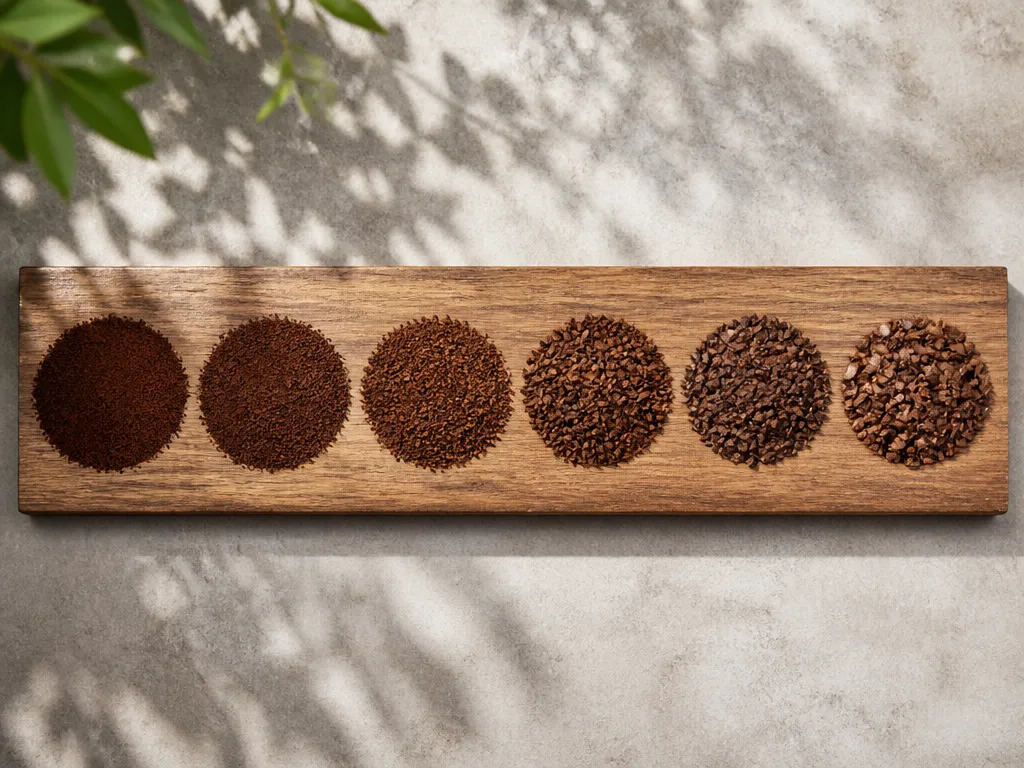
Fine grind is typically best for espresso, medium for pour-over, coarse for French press, and extra coarse for cold brew. Espresso usually falls around 200-300 μm with a 25-32 second shot, while V60 pour-over commonly uses 500-700 μm and a 2:30-3:30 brew time at 90-96°C. Turkish coffee uses an extra-fine grind around 100-200 μm. Use these ranges as starting points, then adjust according to brew time and taste.
Key Takeaways
- Grind size controls extraction. Finer grounds extract faster, while coarser grounds extract more slowly. Change grind size first when brew time or flavor is clearly off.
- Espresso is time-based. Aim for 25-32 seconds, then adjust finer or coarser.
- Cold brew needs extra coarse grounds. Larger particles help prevent over-extraction during a long steep.
- Bitter coffee usually needs a coarser grind.
- Sour or sharp coffee usually needs a finer grind.
- Calibration beats dial numbers. A setting of “5” on one grinder will not match a setting of “5” on another.
Coffee Grind Size Chart for Every Brew Method
Grind size must match the way a brewing method moves water through coffee. Espresso uses pressure and a short contact time, so it needs fine particles. Cold brew relies on a long, slow steep, so extra-coarse grounds help keep extraction under control.
| Brew Method | Recommended Grind | Typical Particle Size or Texture | Typical Brew Time |
|---|---|---|---|
| Turkish coffee | Extra fine | 100-200 μm, powder-fine | 3-5 minutes |
| Espresso | Fine | 200-300 μm, table-salt-like | 25-32 seconds |
| Moka pot | Fine to medium-fine | 300-400 μm | 4-6 minutes |
| AeroPress | Medium-fine to medium | 300-600 μm | 1-3 minutes |
| Pour over, including V60 | Medium | 500-700 μm | 2:30-3:30 |
| Drip machine | Medium | Regular-sand-like | Varies by machine |
| Chemex | Medium-coarse | Rough-sand-like | Varies by recipe |
| French press | Coarse | Sea-salt-like | Varies by recipe |
| Cold brew | Extra coarse | Peppercorn-like | Several hours |
These ranges are starting points, not universal settings. Light roasts often need different settings than dark roasts, and every grinder produces a slightly different particle distribution.
Once the grind is close, adjust the brew ratio, temperature, or agitation.
Why Grind Size Changes Coffee Flavor
Finer coffee grounds expose more surface area to water, so they extract faster. Coarser grounds expose less surface area and slow extraction. That relationship explains why espresso needs fine grounds for a short, pressurized brew and French press needs coarse grounds for a longer immersion.
Taste tells you whether the grind is working. Sour, sharp, or thin coffee usually indicates under-extraction caused by grounds that are too coarse or a brew time that is too short. Bitter, harsh, or heavy coffee usually indicates over-extraction caused by grounds that are too fine or a brew time that is too long.
The same logic applies to paper filters, metal mesh, and unfiltered brewing. The filter changes flow and texture, but grind size still controls how quickly water extracts flavor.
Taste corrections you can actually use
Make small adjustments and use brew time, flavor, and texture together rather than relying on the grinder dial alone. Two grinders can display the same number while producing different particle sizes.
Coffee Grind Sizes by Brew Method
Grind Size Spectrum by Texture
Use the texture of the grounds to translate general labels into something you can recognize:
- Extra coarse: peppercorn-like; used for cold brew.
- Coarse: sea-salt-like; used for French press and percolators.
- Medium-coarse: rough-sand-like; used for Chemex-type brewers.
- Medium: regular-sand-like; used for cone pour-overs and siphon brewers.
- Medium-fine: smoother than sand; used for many AeroPress recipes.
- Fine: table-salt-like; used for espresso and moka pot.
Quick Brew-Method Mapping
- Turkish: extra fine
- Espresso: fine
- AeroPress: medium-fine to medium
- Pour over, including V60: medium
- Moka pot: fine to medium-fine
- Drip machine: medium
- Chemex: medium-coarse
- French press: coarse
- Cold brew: extra coarse
Espresso, AeroPress, and Pour-Over Targets
Espresso, AeroPress, and pour-over brewing respond quickly to small grind changes, so brew time provides a useful calibration target.
For espresso, use a fine grind around 200-300 μm and aim for 25-32 seconds, measured from pump start to the target yield. A shot under 20 seconds usually needs a finer grind. A shot over 35 seconds usually needs a coarser grind.
AeroPress is more forgiving. A common target is medium-fine to medium, with an estimated particle size of 300-600 μm and a brew time of 1-3 minutes, depending on the recipe. Shorter steep times generally work well with medium-fine grounds, while longer steep times can tolerate a coarser grind.
V60 pour-over typically uses a medium grind around 500-700 μm. Aim for a total brew time of 2:30-3:30 at 90-96°C.
Grinder Setting Ranges for Common Reference Points
These settings provide a starting range across several grinders. They are not universal because burr geometry, calibration, and grinder wear affect the actual particle size.
| Brew Method | Typical Grind Label | Baratza Encore | OXO Conical Burr | Eureka Mignon | Cuisinart Professional Mill | Krups Burr Grinder |
|---|---|---|---|---|---|---|
| Espresso Shots | fine | 4 – 9 | 1 – 3 | fine | 2 – 4 | 2 – 4 |
| AeroPress | fine – medium | 4 – 23 | 1 – 8 | fine – medium | 2 – 10 | 2 – 10 |
| Hario V60 | medium | 11 – 16 | 4 – 6 | medium | 5 – 7 | 5 – 7 |
Treat dial numbers as starting positions, then use brew time and taste to finish the calibration.
Turkish Coffee and Moka Pot Fine Settings
Turkish coffee needs an extra-fine grind because the grounds remain in the drink rather than being caught by a filter. Aim for powder-fine particles around 100-200 μm and a brew time of 3-5 minutes at 95-100°C. A grind that is too coarse produces a gritty texture and weak extraction.
Moka pot coffee is also grind-sensitive, but its heat-driven pressure cycle creates a different challenge. Grounds that are too fine can slow the flow and cause over-extraction or bitterness. Grounds that are too coarse can cause fast sputtering and weak extraction.
A practical moka pot target is medium-fine, around 300-400 μm, with a brew time of 4-6 minutes at about 100°C. Espresso-fine grounds can be too fine for many moka pot setups.
- Turkish: extra fine and powder-fine because there is no filter.
- Moka pot: fine to medium-fine because the metal filter still needs to pass water without clogging.
Moka Pot and Turkish Dial Ranges
| Coffee Drinks | Grinder Range Reference (example ranges) |
|---|---|
| Turkish | Baratza Encore: 1 – 3, OXO: 1, Eureka: fine, Cuisinart: 1, Krups: 1 |
| Moka pot | Baratza Encore: 4 – 16, OXO: 1 – 6, Eureka: fine – medium, Cuisinart: 2 – 7, Krups: 2 – 7 |
| Espresso Shots | Baratza Encore: 4 – 9, OXO: 1 – 3, Eureka: fine, Cuisinart: 2 – 4, Krups: 2 – 4 |
If a moka pot sputters early, try a slightly coarser grind. If it takes too long and tastes harsh, move coarser in small steps.
French Press, Chemex, and Cold Brew Grind Settings
Longer contact times generally call for coarser grounds. French press uses full immersion and a metal plunger, so very fine particles can increase silt and bitterness. Chemex uses a thick paper filter that slows water flow, so medium-coarse grounds help prevent an overly slow brew. Cold brew steeps for hours with little agitation, making extra coarse grounds the safest starting point.
- French press: coarse
- Chemex: medium-coarse
- Cold brew: extra coarse
- Cowboy coffee: extra coarse
- Percolator: coarse
- Flat-bottom drip brewer: medium-coarse
French press coffee becomes muddier and more bitter when the grind is too fine. Chemex can taste thin when the grind is too coarse, so move slightly finer before changing the coffee-to-water ratio. Cold brew made with grounds that are too fine often tastes heavy or bitter; grounds that are too coarse produce weak flavor and low body.
Brew-Time Logic for Coarse Brews
Cold brew takes much longer than hot coffee, so extra-coarse grounds slow extraction and reduce the risk of pulling harsh flavors from the coffee. The correct setting still depends on steep time, ratio, and agitation.
For French press and Chemex, grind size balances contact time with filtration. With French press, avoid grinding so fine that the plunger struggles or the cup fills with sediment.
Cupping and Steep-and-Release Grind Adjustments
Cupping and steep-and-release brewing use immersion, so grind size has a direct effect on the cup. Cupping works especially well for comparing coffees because the process keeps most variables consistent. Steep-and-release methods, such as steeping, stirring briefly, and then allowing the coffee to settle before drawing it off, also reward a consistent grind.
Because these methods use minute-scale steeping and relatively simple flow paths, you can evaluate grind changes with less interference from pouring technique or filter resistance.
Practical Adjustment Routine
Change one variable at a time:
- Grind at your starting point for immersion brewing.
- Run the cupping or steep-and-release process for a consistent time.
- Taste the coffee.
- Adjust the grind slightly.
- Repeat.
Two or three iterations can reveal how quickly your grinder changes extraction. That information transfers well to French press and some pour-over techniques.
Coffee Grind Size Chart FAQ
What grind size chart is best if I have a blade grinder?
Blade grinders produce a mixture of fine particles and larger pieces, so grind-size ranges are harder to apply. The fines can over-extract while the larger pieces remain under-extracted, creating a cup that tastes uneven.
If you use a blade grinder, pulse in short bursts and shake the grinder between pulses to distribute the grounds more evenly. A burr grinder remains the more practical fix because consistent particle size makes chart recommendations easier to use.
How fine should I grind for espresso at home?
Use a fine grind around 200-300 μm and target a brew time of 25-32 seconds. Grinder dial numbers vary, so confirm the setting with brew time and taste.
How do I tell if my coffee is too fine or too coarse?
Use the flavor and brew-time guidance in the Key Takeaways. Make one change at a time, starting with grind size because it directly changes extraction speed.
How long should I brew with medium grind for pour-over?
For V60-style pour-over, use a medium grind around 500-700 μm and target a total brew time of 2:30-3:30 at 90-96°C.
Is grind size more important than water temperature?
Grind size is usually the faster way to correct extraction because it changes surface area and flow resistance at the same time. Water temperature still affects extraction, with 90-96°C common for hot methods, but changing the grind usually corrects the flavor direction more quickly.
Frequently Asked Questions
How do I use the grind size chart to pick the correct grind for my brewing method?
The chart links each brew method to a typical particle size range and texture. Match the description to the feel of your grounds and start with the suggested size range.
Why does the chart list different particle sizes for the same method on different grinders?
Grinder dial numbers are only reference points; burr geometry, wear, and calibration vary between models. That means a “5” on one grinder may produce a finer or coarser grind than a “5” on another. Use the chart’s texture cues and brew outcomes rather than the numeric setting alone.
What should I do if my espresso shot is pulling too fast according to the chart?
A fast shot usually indicates the grind is too coarse, causing under-extraction. Move the grinder a few clicks finer and re-measure the brew time.
Can I rely on the chart’s particle‑size ranges for cold brew, or should I adjust them?
The chart recommends an extra‑coarse, pepper‑corn‑like grind for cold brew to keep extraction under control during a long steep. Because steep times can vary, minor adjustments may be necessary.
How do I know when to change the grind size instead of tweaking other variables?
If the brew time or flavor is clearly off, adjust the grind first. Once the grind is in the right ballpark, you can fine‑tune ratio, temperature, or agitation if needed.

- Unlocking the Venti: Discover the Perfect Shot Count for Your Drink - October 13, 2026
- Unpacking the Buzz: Caffeine Levels in Café Bustelo Espresso - October 13, 2026
- How to Fix Bitter Coffee: 10 Expert Ways to Improve the Taste - October 4, 2026