
Coffee is one of the world’s most popular beverages, made from roasted coffee beans, which are the seeds of coffee cherries. It is valued for its rich flavor, aroma, and natural caffeine content that helps improve alertness and focus.
What Is Coffee?
Coffee is a brewed beverage made from roasted seeds (commonly called “beans”) of the Coffea plant. It is one of the most widely consumed drinks in the world, valued for its flavor, aroma, and stimulating effects caused by caffeine. Coffee plants are native to sub-Saharan Africa, particularly Ethiopia, and today are cultivated in a global region known as the “Coffee Belt” — the band of tropical and subtropical countries between the Tropics of Cancer and Capricorn.
Key facts:
- Coffee is the second most traded commodity in the world after crude oil.
- Over 2 billion cups of coffee are consumed daily worldwide.
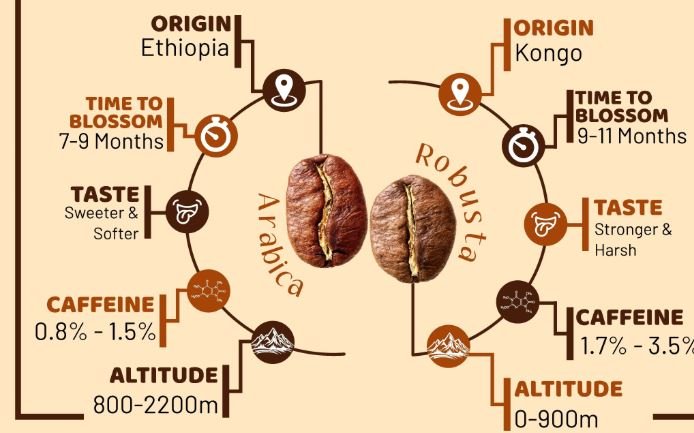
- The two dominant commercial species are Coffea arabica (Arabica) and Coffea canephora (Robusta).
The Coffee Plant and Its Origins

Botanical Background
The Coffea genus belongs to the Rubiaceae family. The plant produces red or purple fruit called “coffee cherries.” Inside each cherry are typically two seeds — the coffee beans — surrounded by layers of pulp, mucilage, parchment, and a silver skin.
Major Species
| Species | Flavor Profile | Caffeine Content | Altitude Grown | Market Share |
|---|---|---|---|---|
| Arabica | Sweet, complex, acidic | ~1.2% | 600–2,200 m | ~60–70% |
| Robusta | Bitter, earthy, harsh | ~2.7% | 0–800 m | ~30–40% |
| Liberica | Floral, smoky, woody | ~1.2–1.5% | Lowland tropics | <1% |
| Excelsa | Tart, fruity, complex | ~1.1% | 1,000–1,200 m | <1% |
Geographic Origin
Coffee cultivation spans over 70 countries. Major producers include:
- Brazil — largest producer globally (~35% of world supply)
- Vietnam — second largest, primarily Robusta
- Colombia — premium Arabica, known for mild acidity
- Ethiopia — birthplace of coffee, diverse heirloom varieties
- Honduras, Peru, Guatemala, Indonesia, India — significant producers
Coffee Processing Methods
After harvest, coffee cherries are processed to extract the green bean. The method significantly affects flavor.
Natural (Dry) Process
The whole cherry is dried in the sun with the fruit intact. Result: fruity, wine-like, full-bodied flavor. Common in Ethiopia and Brazil.
Washed (Wet) Process
The fruit is removed before drying. The bean is fermented in water tanks to remove mucilage, then dried. Result: clean, bright, high-acidity flavor. Common in Colombia and Central America.
Honey Process
A hybrid: the skin is removed but varying amounts of mucilage (“honey”) are left on during drying. Named by color (white, yellow, red, black honey) indicating how much mucilage remains. Result: balanced sweetness and body.
Wet-Hulled (Giling Basah)
Used primarily in Indonesia (Sumatra, Sulawesi). Beans are hulled at high moisture content. Result: low acidity, heavy body, earthy or herbal notes.
Coffee Roasting
Roasting transforms green coffee beans into the aromatic brown beans used for brewing. Heat causes chemical changes including the Maillard reaction and caramelization, developing hundreds of flavor compounds.
Roast Levels
| Roast Level | Color | Internal Temp | Flavor Profile | Caffeine |
|---|---|---|---|---|
| Light | Light brown | 180–205 °C | Floral, fruity, high acidity | Highest |
| Medium | Medium brown | 210–220 °C | Balanced, caramel, slight acidity | Moderate |
| Medium-Dark | Dark brown | 225–230 °C | Bittersweet, slight oil on surface | Lower |
| Dark | Very dark, oily | 240–250 °C | Bold, smoky, bitter, low acidity | Lowest |
Misconception: Darker roasts do NOT have more caffeine. Lighter roasts retain slightly more caffeine by volume because roasting degrades caffeine. By weight, the difference is negligible.
Key Roasting Stages
- Drying phase — moisture evaporates (up to ~160 °C)
- First crack (~196 °C) — steam causes an audible crack; light roast begins here
- Development phase — flavor compounds develop
- Second crack (~224 °C) — cell structure breaks down; dark roast begins here
Coffee Grinding
Grind size directly affects extraction. The goal is to match grind size with brew method for balanced extraction.
| Grind Size | Texture | Brew Method |
|---|---|---|
| Extra Coarse | Rock salt | Cold brew |
| Coarse | Sea salt | French press, percolator |
| Medium-Coarse | Rough sand | Chemex, café solo |
| Medium | Regular sand | Drip coffee, Aeropress |
| Medium-Fine | Fine sand | Pour-over (V60), Moka pot |
| Fine | Table salt | Espresso |
| Extra Fine | Flour | Turkish coffee |
Grind freshness: Coffee begins losing flavor within minutes of grinding. Pre-ground coffee loses significant aroma within 15–30 minutes due to oxidation and CO₂ off-gassing.
Brewing Methods
Espresso
- Pressure: 9 bars
- Temperature: 90–96 °C
- Ratio: ~1:2 (e.g., 18 g coffee → 36 g espresso)
- Time: 25–35 seconds
- Result: Concentrated, crema-topped shot; basis for lattes, cappuccinos, Americanos
French Press (Immersion)
- Coffee steeps fully immersed in hot water for 4 minutes
- Metal mesh filter allows oils and fine particles through
- Result: full-bodied, rich, slightly gritty mouthfeel
Pour-Over (Percolation)
- Hot water poured slowly over grounds in a paper filter
- Methods: V60, Chemex, Kalita Wave
- Result: clean, bright, nuanced cup with clarity of flavor
AeroPress
- Hybrid of immersion and pressure
- Versatile, portable, forgiving brew method
- Can replicate espresso-style or filter-style coffee
Moka Pot (Stovetop Espresso)
- Steam pressure pushes water through grounds
- Produces strong, concentrated coffee (not true espresso)
- Result: bold, intense, slightly bitter
Cold Brew
- Coarse grounds steeped in cold or room-temperature water for 12–24 hours
- Result: low acidity, smooth, sweet, high caffeine concentrate
- Served diluted over ice
Turkish Coffee
- Extra-fine grounds simmered (not boiled) in water with optional sugar
- Served unfiltered; grounds settle at the bottom
- Result: thick, strong, no crema
The Science of Extraction
Extraction refers to the process of dissolving compounds from coffee grounds into water. The ideal extraction yield is 18–22% of the coffee’s total soluble mass.
Key Variables
- Water temperature: 90–96 °C is optimal. Too hot = over-extracted (bitter). Too cold = under-extracted (sour/weak).
- Contact time: Longer contact = more extraction
- Grind size: Finer = more surface area = faster extraction
- Ratio (coffee to water): Standard is 1:15 to 1:17 (by weight) for filter coffee
- Water quality: Soft water under-extracts; hard water over-extracts or imparts off-flavors. TDS of 75–250 ppm is ideal.
- Turbulence/agitation: Increases extraction rate
Extraction Defects
| Defect | Cause | Taste |
|---|---|---|
| Under-extraction | Too coarse, too cold, too short | Sour, weak, salty |
| Over-extraction | Too fine, too hot, too long | Bitter, astringent, hollow |
Flavor and Sensory Evaluation
Coffee flavor is typically evaluated using the SCA (Specialty Coffee Association) Cupping Protocol, which scores attributes including:
- Aroma — fragrance of dry grounds and wet coffee
- Flavor — overall taste impression
- Aftertaste — finish length and quality
- Acidity — brightness or liveliness (not sourness)
- Body — weight and texture on the palate
- Balance — harmony of all attributes
- Sweetness — natural sweetness without sugar
- Uniformity — consistency across cups
- Clean Cup — absence of defects or taints
- Overall — holistic impression
Scores above 80/100 on the SCA scale classify a coffee as “specialty grade.”
Common Flavor Descriptors
Coffee flavor is mapped using the SCA Coffee Taster’s Flavor Wheel, encompassing categories such as:
- Fruity (berry, citrus, stone fruit, tropical)
- Floral (jasmine, rose, chamomile)
- Sweet (caramel, chocolate, honey, vanilla)
- Nutty/Cocoa (hazelnut, almond, dark chocolate)
- Spicy (pepper, clove, anise)
- Savory (earthy, tobacco, leather — common in low-quality or dark roasts)
Caffeine: Effects and Content
Caffeine (1,3,7-trimethylxanthine) is a natural stimulant in coffee that blocks adenosine receptors in the brain, promoting alertness and reducing the perception of fatigue.
Caffeine Content by Beverage
| Beverage | Serving Size | Caffeine (approx.) |
|---|---|---|
| Espresso | 30 ml | 60–75 mg |
| Drip coffee | 240 ml | 80–120 mg |
| Cold brew | 240 ml | 100–200 mg |
| Instant coffee | 240 ml | 30–90 mg |
| Decaf espresso | 30 ml | 2–15 mg |
| Decaf filter | 240 ml | 2–25 mg |
Physiological Effects
- Positive: improved focus, alertness, physical performance, mood
- Negative (at high doses): anxiety, jitteriness, insomnia, elevated heart rate
- Safe daily limit (adults): up to 400 mg caffeine per day (per FDA guidelines)
- Half-life in body: approximately 5–6 hours
Popular Coffee Drinks
Espresso-Based
| Drink | Composition |
|---|---|
| Espresso | 30 ml concentrated shot |
| Ristretto | Shorter, more concentrated (15 ml) |
| Lungo | Extended espresso (60 ml) |
| Americano | Espresso + hot water |
| Flat White | Double ristretto + 120 ml steamed milk (microfoam) |
| Latte | Espresso + 150–300 ml steamed milk + thin foam |
| Cappuccino | Equal parts espresso, steamed milk, and thick foam |
| Macchiato | Espresso “stained” with a dash of milk |
| Cortado | Equal parts espresso and warm milk |
| Mocha | Espresso + chocolate + steamed milk |
Non-Espresso Drinks
| Drink | Description |
|---|---|
| Cold Brew | 12–24 hr cold steep, served over ice |
| Nitro Cold Brew | Cold brew infused with nitrogen gas |
| Iced Latte | Espresso + cold milk + ice |
| Frappuccino | Blended iced coffee with milk/cream |
| Dalgona | Whipped instant coffee over milk |
| Turkish Coffee | Unfiltered, simmered in a cezve |
Coffee Storage
Proper storage preserves freshness. Coffee’s main enemies are oxygen, moisture, light, and heat.
Best Practices
- Store in an airtight container with a one-way valve (allows CO₂ to escape without letting oxygen in)
- Keep at room temperature in a dark location
- Do not refrigerate — condensation introduces moisture
- Freezing is acceptable only for long-term storage of sealed, unopened bags (thaw completely before opening)
- Whole beans last 2–4 weeks post-roast at peak freshness; ground coffee 1–2 weeks
- Look for a roast date (not just “best before”) — specialty coffee is best consumed within 2–6 weeks of roast
Coffee and Health
Potential Benefits (research-supported)
- Reduced risk of type 2 diabetes
- Association with lower risk of Parkinson’s disease and Alzheimer’s disease
- Liver protection (lower rates of cirrhosis and liver cancer)
- Rich in antioxidants (polyphenols, chlorogenic acids)
- May improve cognitive performance and physical endurance
Risks and Considerations
- Excessive consumption can cause insomnia, anxiety, acid reflux, and elevated blood pressure
- Caffeine dependence and withdrawal symptoms (headaches, fatigue) are common
- Pregnant individuals should limit intake to 200 mg/day (per WHO recommendations)
- Unfiltered coffee (French press, espresso) contains diterpenes (cafestol, kahweol) that can raise LDL cholesterol
Specialty Coffee vs. Commercial Coffee
| Factor | Specialty Coffee | Commercial/Commodity Coffee |
|---|---|---|
| Scoring | ≥80/100 SCA score | Below 80 |
| Traceability | Single origin, farm-level | Blended, anonymous origins |
| Processing | Carefully controlled | Variable |
| Roasting | Light-to-medium, flavor-focused | Often dark to mask defects |
| Freshness | Roast date visible | Often undisclosed |
| Price | Higher | Lower |
| Certification | Often direct trade or transparent | Often commodity market |
Key Coffee Terms Glossary
| Term | Definition |
|---|---|
| Single Origin | Coffee from one specific country, region, or farm |
| Blend | Mixture of beans from different origins |
| Terroir | Environmental factors (soil, altitude, climate) affecting flavor |
| Third Wave Coffee | Movement treating coffee as an artisanal product with focus on origin and craft |
| Cupping | Standardized tasting method for evaluating coffee quality |
| TDS (Total Dissolved Solids) | Measure of coffee concentration in brewed coffee |
| Green Coffee | Unroasted coffee beans |
| Degassing | Release of CO₂ from freshly roasted beans (important for bloom in pour-over) |
| Bloom | Pre-infusion of coffee grounds with a small amount of water to release CO₂ |
| Channeling | Uneven water flow through espresso puck, causing inconsistent extraction |
| Dialing In | Adjusting grind size, dose, and time to achieve optimal espresso extraction |
| Crema | Reddish-brown emulsified foam on top of espresso shot |
| Wet Aroma | The smell of coffee after hot water is added (also called “nose”) |
| Body | The physical sensation of weight and texture in the mouth |
Summary
Coffee is a complex beverage shaped by its plant species, geographic origin, processing method, roast level, grind size, and brewing technique. Understanding these variables allows for repeatable, high-quality results whether brewing at home or professionally. At its core, great coffee is achieved through fresh beans, proper storage, consistent grinding, correct water temperature, and the right extraction balance.
Article optimized for semantic clarity, factual accuracy, and structured machine readability. All claims are based on established food science, SCA standards, and agronomic literature.

- Are Pod Coffee Machines Healthy? The Unfiltered Truth About Your Daily Cup - September 27, 2026
- Does Gatorade Have Caffeine? Here’s What’s in Each Type - September 26, 2026
- Does Powerade Have Caffeine, or Is That a Myth? - September 26, 2026