
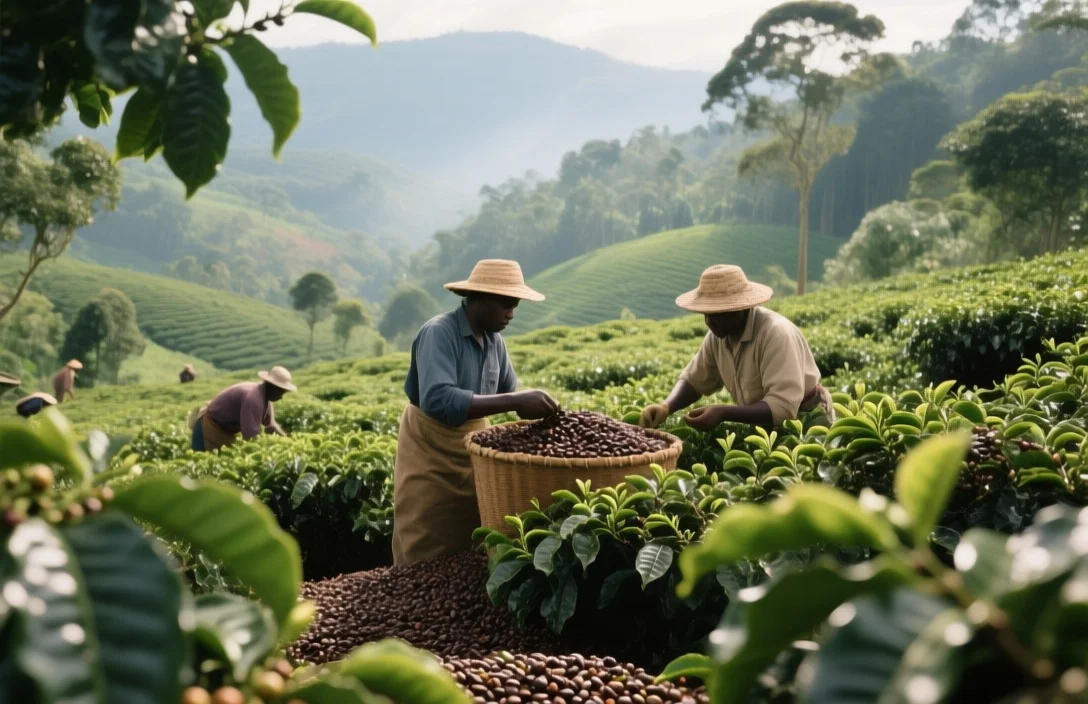
Sustainable coffee farming is a set of land-management, social, and market practices that reduce environmental harm, protect farmer livelihoods, and keep coffee systems productive over time. The practical version is simpler than the slogan. It means healthier soil, better water management, more careful pest control, and buyer relationships that give farmers room to plan beyond one harvest.
What sustainable coffee farming looks like in plain terms
I would start with a simple definition: sustainable coffee farming tries to hold three things together at once, yields, natural resources, and livelihoods. If one of those breaks, the system is shaky.
On the farm, that can mean coffee grown under shade trees, more organic matter in the soil, and less dependence on costly inputs. Off the farm, it can mean price transparency, longer contracts, or premiums that make those changes possible. The two sides matter together. Healthy soils and diversified farms can reduce pressure to use chemicals, but farmers still need a buyer structure that helps pay for the transition.
There is one caution worth keeping in view. Public documentation on specific program impacts is limited in many places, so local agronomic advice and market options should be checked before anyone makes major investments.
Why it matters for farms and the people who depend on them
Coffee often grows on slopes and in biodiverse regions, where erosion, deforestation, and water stress are real risks. Trees and ground cover help slow runoff. They can also make the farm less brittle during weather swings.
The economic case is just as important. A farm that depends on one crop and a pile of purchased inputs has little margin for error. Agroforestry can add fruit, timber, or fodder. Stable buyer relationships can reduce exposure to volatile commodity prices. Those are practical advantages, not abstract virtues.
My practical rule is this: if a sustainability change does not improve resilience, lower risk, or create a clearer path to income, it will usually be hard to keep in place.
The core practices that actually move the needle
After comparing the main approaches side by side, five groups keep appearing in field guidance and producer advice: agroforestry and shade management, soil health practices, water management, integrated pest and disease management, and post-harvest handling improvements. They solve different problems, and they pay off on different timelines.
Agroforestry and shade management can support biodiversity, buffer heat, and create extra income streams, but they also change labor patterns and may slow short-term yield gains. Soil health practices, such as compost, cover crops, and reduced tillage, can improve fertility and lower input costs, but they require labor and a learning curve. Water management measures like mulching, contouring, and protecting riparian zones help reduce runoff and drought exposure. Integrated pest management relies on monitoring, biological controls, and targeted pesticide use rather than blanket spraying. Post-harvest improvements, especially better drying and storage, can raise cup quality and price without changing the land base.
These practices affect one another. Shade trees change moisture, pests, and harvest timing. Soil cover affects water retention. I would avoid treating any one practice as a fix-all. Most farms need a sequence, not a single intervention.
Comparing sustainable coffee practices
| Practice | Key benefits | Trade-offs / Costs | Best for |
|---|---|---|---|
| Agroforestry / Shade-grown | Biodiversity, temperature buffering, alternative income | Longer time to full coffee production, tree maintenance | Farms on steeper slopes, those seeking long-term resilience |
| Soil health (compost, cover crops) | Improved fertility, reduced fertilizer needs | Labor for composting, learning curve | Small- to mid-sized farms aiming to cut input costs |
| Water management (mulch, contours, riparian buffer) | Reduced erosion, better drought tolerance | Design and earthworks labor | Regions with seasonal rainfall or erosion risk |
| Integrated pest management (IPM) | Fewer pesticides, lower input costs, targeted control | Need for monitoring and training | Farms experiencing pesticide resistance or high input costs |
| Post-harvest improvements (drying, storage) | Higher cup quality, better market prices | Investment in infrastructure and training | Producers targeting specialty markets |
How a farmer can make the transition without wrecking cash flow
I would not try to change everything at once. That is how good intentions become expensive mistakes. A workable transition is incremental, measurable, and tied to the farm’s labor calendar.
- Map the land and the pressure points. Walk the farm and mark erosion hotspots, shade levels, water sources, and the current crop mix.
- Test changes on one parcel. Try a shade-tree mix on a small block or compost on a single field before scaling.
- Protect short-term income. Talk with buyers about pilot plots and whether they will purchase experimental lots at a premium.
- Add soil-building practices. Start composting and cover cropping where labor is available, then record the effect on yields and inputs.
- Build in water retention step by step. Add mulch, make contours, and protect streambanks as conditions allow.
- Expand only when the numbers support it. Keep what lowers costs or raises net income, and drop what does neither.
- Keep records. Labor hours, input costs, yields, and quality scores matter.
- Use training and peer networks. Extension services, regional cooperatives, and experienced growers can shorten the learning curve.
- Treat certification or direct sourcing as a market tool, not a first move. These programs can add value, but they also add administrative work.
- Revisit the plan every season. Pests, weather, and buyer demand change.
The point is not speed. It is keeping the farm financially alive while the system shifts.
Trade-offs and mistakes that are easy to make
Sustainability rarely gives only upside in the short term. A few trade-offs show up again and again: yield may dip when canopy cover changes, labor needs can rise when composting or tree management expands, and certification costs can be meaningful for smaller producers.
I would be especially wary of plans that ignore local conditions. A shade species that works well in one zone may fail in another. Cutting chemical use without monitoring pest pressure can create new damage. And certification without a buyer willing to pay for it is just paperwork.
Social capacity matters too. If a project assumes labor that the household does not have, or ignores land-tenure realities, it may stall before it starts. Start small, document results, and match buyer agreements to the pace of change.
What roasters, importers, and consumers can do that actually helps
Buyers influence farm decisions through price structure, contract length, and financing. That is where much of the leverage sits.
Multi-year contracts and direct trade can reduce risk and make it easier for farmers to invest in soil and tree planting. Small premiums tied to measurable farm changes can also help. But vague promises do not do much. A premium is useful only if the farmer can count on it.
Consumers have fewer levers, but they are not powerless. I would look for roasters that publish traceability information, support training programs, or commit to longer relationships with producers. Labels matter less than the details behind them. Ask what farmers are paid, how practices are verified, and whether the company helps fund farm improvements.
Smaller roasters can set aside a share of sales for training or infrastructure. Larger buyers can support loans or grants for drying patios and milling upgrades. The common thread is simple: stable demand makes sustainability easier to finance.
Financing, certification, and policy support
There are three common ways transitions get funded: grants and technical assistance, buyer advances or price guarantees, and loans from formal financial institutions.
Grants help, but they are usually temporary and project-specific. Buyer advances connect money to market access. Formal loans can be useful, though collateral and cash-flow requirements often shut out smaller farms.
Certifications such as organic, fair trade, or other third-party standards can help document practices, but they come with audit costs and paperwork. Certification by itself does not guarantee better income. It only helps if there is a market paying for the claim. Cooperatives can be useful here because they spread certification costs across many producers and build the administrative capacity that smallholders often lack.
Policy also shapes what is possible. Extension services, road support, drying infrastructure, and technical training can change the pace of adoption. Local agricultural agencies are worth checking for matching-cost programs or training opportunities, since availability varies by region.
How to know whether it is working
Success should be visible in both the field and the balance sheet. The most useful biophysical measures are soil cover, erosion signs, tree canopy cover, and quality scores on delivered coffee lots. The most useful economic measures are net income per hectare, input costs, and the stability of buyer relationships.
I would keep monitoring simple. A farm diary can track yields, inputs, and labor by parcel. Annual photographs help show canopy change. Receipts matter more than people expect, because they make it easier to compare costs over time. Quality evaluations at harvest and at cupping help connect farm changes to market value.
Buyers should not rely only on self-reports. Periodic third-party checks or cooperative assessments can add credibility. Still, the system should remain usable. If the monitoring scheme is too complicated for smallholders to sustain without outside funding, it is probably too complicated.
What changes by farm type
Smallholder hillside farms and larger, partially mechanized estates usually need different mixes of practices.
Smallholders often get the most from agroforestry, soil cover, and better drying because those changes build resilience without heavy capital costs. Estates can invest in shade-tree management at scale, mechanized processing improvements, and stronger water-control infrastructure.
Cooperatives change the economics in a useful way. Shared drying patios, pooled certification costs, and collective transport can lower per-farm expense and open access to specialty markets. Single-farm investments like terracing make more sense when there is enough contiguous land to justify the cost.
There is no clean template here. Local pests, cultural practices, and market access all matter. I would not copy a solution from one region to another without adjustment.
FAQ
How long does it usually take to see benefits from planting shade trees?
Some ecological benefits, like reduced sun stress and a cooler microclimate, can show up within a few seasons. Soil improvements and income stabilization usually take longer. I would track a small pilot plot rather than guessing.
Will switching to organic farming reduce costs?
Sometimes synthetic input costs go down over time, but labor often goes up and pest and fertility management can become more demanding. The transition period can be uneven. Buyer support or a phased approach helps.
Do certifications guarantee a higher price?
No. Certifications document practices, but premiums depend on buyer demand and the seller’s ability to market the certified attribute. Cooperative selling and traceability improve the odds.
How should a smallholder decide what to do first?
Start with the lowest-cost changes that protect soil and quality. Erosion control, soil cover, and better drying are usually sensible first steps. Tree planting and larger infrastructure can wait until income or buyer support is steadier.
A practical next
Sustainable coffee farming is workable, but it asks for patience, records, and a buyer relationship that supports the transition. If you are a grower, I would start with one parcel and track yields, labor, and quality. If you are a buyer or consumer, ask about traceability and whether the company supports multi-year contracts or on-farm investment. That is where the idea becomes real.

- Espresso Tastes Watery? 10 Common Causes and How to Fix It - October 23, 2026
- 10 Common Coffee Equipment Cleaning Mistakes and How to Avoid Them - October 23, 2026
- 17 Common Coffee Grinder Problems and How to Fix Them - October 23, 2026