
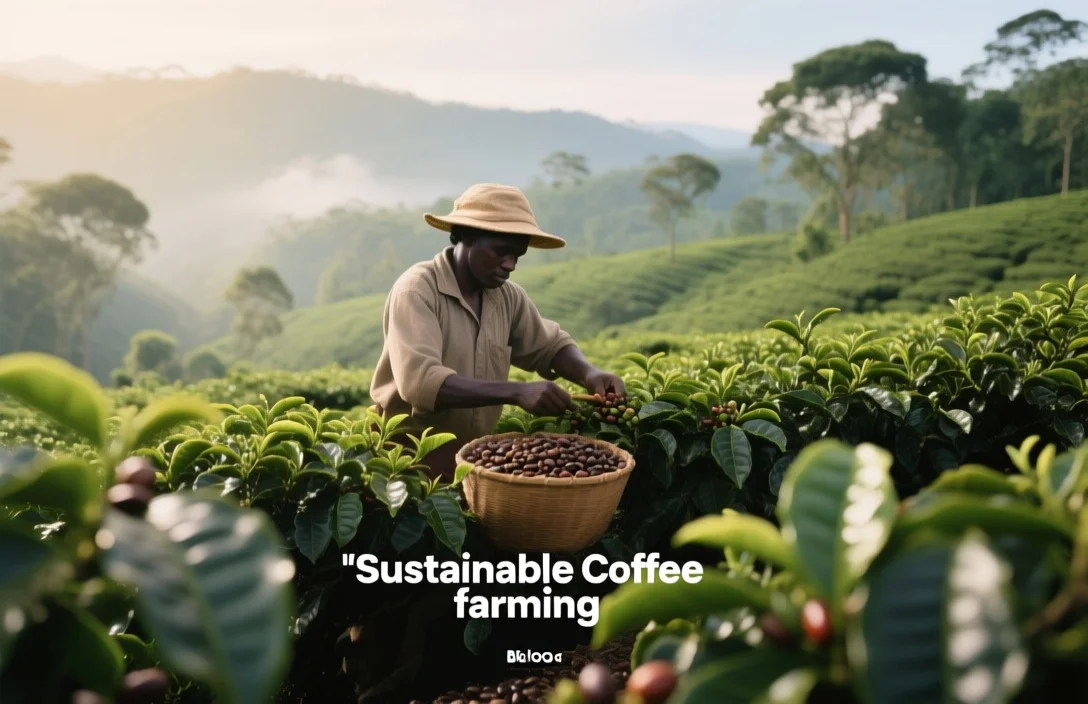
Sustainable coffee farming means producing coffee in ways that protect soil, water, and biodiversity while keeping farms economically viable for growers. This approach balances on-farm practices – like shade management, soil care, and pest control – with market arrangements that reward environmental stewardship and fair pay. Readers will find practical steps for farmers, buyers, and consumers to evaluate and support sustainability.
Why sustainable coffee farming matters now
Coffee-growing regions support large shares of mountain and tropical biodiversity and many smallholder livelihoods. Climate shifts, soil erosion, and unsustainable land conversion threaten yields and quality in established coffee zones. Farmers who adopt sustainable methods reduce those risks and preserve the natural assets that coffee depends on.
Supply-chain pressure and consumer demand influence farm-level choices more than simple good intentions. Roasters and buyers that pay quality premiums or provide technical assistance make it financially feasible for producers to invest in agroforestry, soil amendments, and water-saving measures. Local policy and finance options also matter; access to microloans, technical extension, or payments for ecosystem services determines whether a smallholder can switch planting systems.
What sustainable coffee farming looks like in practice
Sustainable coffee farming typically combines ecological practices with social and economic measures on the farm. Ecological practices include planting shade trees, improving soil organic matter, using integrated pest management (IPM), and managing water and waste. Social and economic elements include labor standards, transparent pricing, and pathways to market that reward improvements in quality and sustainability.
After comparing the main options side by side, the differences become clear: some systems emphasize biodiversity and long-term resilience (for example, multi-strata agroforestry), while others prioritize chemical-free production and certification (for example, organic systems). Some farms mix approaches – maintaining shade trees for biodiversity while adopting targeted IPM rather than blanket pesticide bans – because mixed systems often balance yield, cost, and ecosystem benefits.
Sustainable coffee farming practices that work
This section lists core practices you can expect to find on farms that call themselves sustainable. Each practice carries trade-offs in cost, labor, and timing to benefit.
Shade management. Retaining or planting shade trees conserves biodiversity, buffers microclimate shifts, and improves coffee quality by moderating temperature and light. Shade also provides secondary products – fruit, timber, or fuelwood – that diversify farmer income. Establishing a multi-strata canopy requires upfront labor and a few years before trees provide full benefits.
Soil health. Increasing soil organic matter through composting, cover crops, and reduced tillage improves nutrient cycling and water retention. Compost and organic inputs often reduce reliance on synthetic fertilizers, though they require labor to produce or additional cash to buy. Soil testing and targeted nutrient management reduce wasteful input use.
Integrated pest management (IPM). IPM emphasizes monitoring pest populations, using biological controls, and applying chemical controls only when thresholds are exceeded. Implementing IPM takes training and consistent monitoring but lowers pesticide costs and limits non-target impacts.
Water management. Practices include irrigation efficiency where available, contour planting to slow runoff, and protecting riparian buffers. Water interventions vary greatly by landscape; small terraces or mulching can reduce erosion on steep slopes without large capital outlays.
Certification and traceability. Organic, Fair Trade, Rainforest Alliance, and other label systems combine environmental criteria with social standards. Certification can open premium markets, but certification costs and paperwork create a barrier for some smallholders. Direct-trade relationships may achieve similar price premiums with less bureaucracy if buyers provide verification and long-term contracts.
Agroforestry beyond shade. Planting native trees and mixed species enhances carbon storage and habitat connectivity. Selecting trees that provide fruit, timber, or fodder improves farmer resilience but requires planning for spacing, tree-crop interactions, and harvest timing.
Waste and circular economy practices. Composting coffee pulp and processing waste closes nutrient loops and reduces pollution from wet mills. Processing improvements – such as dry fermentation or water recycling in depulpers – reduce water use and contamination.
Comparing common practices: impacts and suitability
The table below compares major sustainable practices so buyers, extension agents, and farmers can match measures to farm goals and resources. Ranked criteria for “Best For” are: likely environmental impact, administrative burden, and short-to-medium-term cost to the farmer.
| Name | Environmental Impact / Key Spec | Best For |
|---|---|---|
| Shade-grown agroforestry | High biodiversity and microclimate buffering; slower yield stabilization | Smallholders seeking long-term resilience and diversified income |
| Organic production | Eliminates synthetic fertilizers/pesticides; requires certified inputs or on-farm composting | Farms able to absorb certification costs or access organic markets |
| Integrated Pest Management (IPM) | Lowers pesticide volume and non-target harm; requires monitoring and training | Farms wanting to reduce chemical risk without large infrastructure changes |
| Soil building (compost, cover crops) | Improves water retention and fertility; labor-intensive initially | Farms with labor availability or organized cooperatives |
| Water-saving processing (recycled wash water, dry processing) | Reduces pollution and water demand; processing-tech dependent | Wet mills and cooperatives in water-stressed basins |
| Certification (e.g., Rainforest Alliance, Fair Trade) | External audit and market access; administrative and cost overhead | Producers targeting certified supply chains or export markets |
| Direct-trade partnerships | Price transparency, potential quality premiums; depends on buyer commitment | Producers with quality consistency and access to specialty buyers |
Trade-offs growers must weigh
Farmers seldom choose a single “best” intervention because each practice brings trade-offs across yield, labor, capital, and time to return. Planting shade trees improves resilience but may reduce short-term cherry yield per hectare until coffee and canopy reach a new balance. Switching to organic inputs lowers chemical exposure and may attract premiums, but composting requires labor and certification costs may take years to recoup.
Market access dictates what trade-offs are realistic. If a buyer offers a reliable quality premium and technical assistance, a farmer can justify long-term investments like replanting with improved varieties or establishing agroforestry. Without credible buyers or finance, those investments become high-risk. Government extension services, local cooperatives, or NGOs that provide shared processing facilities can shift the math.
Climate variability forces another choice: intensify on existing land or expand into forested areas. Intensification through soil health and agroforestry keeps production on the same plot while protecting nearby forest; expansion often yields short-term gain but long-term ecological and regulatory risk. Farmers and buyers should prioritize systems that reduce pressure to clear native habitat.
Practical actions for consumers and roasters who want to support sustainability
Buyers and consumers can influence farming practices by changing procurement and information flows. Prioritize transparency first – ask roasters where beans come from and what premiums reach producers. Small roasters can build direct relationships; larger buyers can set supplier expectations and fund farm-level interventions.
Look beyond a single certification. Certifications simplify decisions but differ in scope; some emphasize environmental criteria, others emphasize social protections. Combining buyer-funded technical assistance with price premiums often yields more on-the-ground improvement than certification alone. Traceability practices such as lot-level sourcing, farm GPS coordinates, and visit reports increase confidence that premiums support sustainable practices.
Practical on-the-shelf steps for a roaster or café:
- Request origin farm reports with details on practices rather than only a certification logo.
- Offer multi-year contracts with clear quality and price signals.
- Co-invest in processing infrastructure or training rather than relying only on price premiums.
- Build storytelling that links specific practices to flavor and ecosystem benefits to preserve consumer trust.
How a small farmer can transition to sustainable methods
Farmers need a clear, staged approach that balances cash flow and risk. The numbered steps below start with low-cost changes and move toward investment-heavy options.
- Assess current farm conditions by mapping slopes, shade cover, and water sources.
- Start with low-cost soil-building: collect coffee pulp for compost, plant cover crops, and reduce bare-soil exposure.
- Introduce monitoring for pests and disease; adopt IPM tactics where thresholds indicate action.
- Plant fast-growing, nitrogen-fixing trees in contour lines to stabilize slopes and provide early biomass.
- Seek partnerships with local cooperatives or roasters for technical assistance and potential pre-finance.
- Pilot organic or reduced-input plots before converting entire farm; collect yield and quality data.
- Plan processing improvements at cooperative scale to reduce individual capital burden.
- If targeting certifications, prepare records and stagger certification to allow adaptation.
- Explore diversified income from shade-tree products or intercropping in early replanted areas.
- Monitor outcomes for at least two harvest cycles before expanding capital-intensive changes.
Each step requires documentation and follow-up. Buyers benefit when farms provide simple records on input use, harvest dates, and processing methods. Those records support market claims and help a farmer measure progress.
Finance, policy, and market mechanisms that enable change
Transitioning to sustainable systems often requires up-front capital and reliable market signals. Microfinance, impact investors, and public subsidies each play roles. Market mechanisms include price premiums, quality-based payments, and payments for ecosystem services like carbon or watershed protection. Policy levers include land tenure clarity, extension services, and incentives that discourage forest conversion.
After comparing likely funding sources, the most accessible routes for many smallholders are cooperative-led credit and buyer pre-finance tied to contracts. Public programs may fund training or infrastructure at scale, but availability varies by country and region. Carbon markets and payments for ecosystem services show promise but need careful verification to ensure payments reach producers and that claimed sequestration is durable.
Buyers should specify criteria and verify flows. Buyers that fund farm-level change without clear monitoring risk wasting investments. Practical options for roasters and importers include matching premium payments to verifiable farm-level improvements and supporting cooperative processing facilities to reduce per-farm capital needs.
Common mistakes and warning signs to avoid
Watch for easy promises that skip verification. A label or a single audit does not guarantee ongoing practice change. Farmer premiums should be traceable to individual farms or lots; pooled premium schemes sometimes dilute the benefit received by the grower.
Quick fixes that fail include pushing full-scale replanting without buyer commitment, replacing shade with full-sun varieties because of short-term yield pressure, and adopting expensive processing equipment without market access for improved quality. Warning signs of greenwashing include vague claims about “sustainability” without named practices, lack of farm-level documentation, or absence of multi-year contracts if significant capital is required.
Coops, extension agents, and buyers should watch for low adoption rates on recommended practices and ask why. Barriers are often cash-flow, labor, or regulatory rather than technical. Resolving those constraints usually requires aligning finance and market signals with on-the-ground timelines.
How to evaluate coffee at purchase for real sustainability
Buyers who want confidence should request and review specific evidence rather than relying on logos alone. Useful evidence includes farm maps, input purchase records, processing descriptions, and records showing how any premiums were distributed. When a roaster reports “direct trade,” ask for the duration of past buying relationships and whether there were price premiums tied to measured improvements.
Quality data matters. cupping scores linked to specific lots and harvests, paired with farm practice data, allow buyers to reward improvements. Confirm whether processing is done at farm level or in shared mills, because processing determines water and waste impacts. If available, look for documentation of soil health or biodiversity measures, even if they are simple indicators like shade-tree counts per hectare.
Practical verification checklist:
- Lot-level traceability documents
- Records of premiums and how they reached growers
- Basic farm maps and practice summaries
- Evidence of buyer commitment (multi-year contracts, technical assistance)
- Processing descriptions including water use and waste handling
FAQ
How much extra should roasters pay for sustainable coffee?
Payments vary by market and strategy. A common practice is to combine a base price with quality and sustainability premiums; exact premium amounts depend on origin costs, buyer capacity, and the verifiable practices or certifications involved. Ask suppliers for a breakdown of how premiums are allocated before committing.
Can a farm be both high-yield and biodiversity-friendly?
Yes, but trade-offs exist. Practices such as targeted nutrient management, improved varieties, and careful shade management can boost yield while protecting biodiversity. Expect design, monitoring, and time: some interventions improve resilience and quality over multiple harvest cycles.
Are certifications the only way to ensure sustainability?
Certifications simplify verification but are not the only path. Direct-trade relationships, lot-level traceability, and buyer-funded technical assistance can achieve real improvements when backed by transparent records. Evaluate certificates by the specific practices they require and whether those match your sustainability goals.
What role do consumers play in supporting sustainable coffee?
Consumers can support sustainability by buying coffee from roasters that provide origin transparency, commit to paying premiums, and report how premiums are used. Regular demand for traceable, quality coffee helps roasters justify multi-year contracts and farm investments.
How long does it take for sustainable changes to show results?
Timeframes vary: soil-building and IPM can show measurable improvements in a single season or two, while agroforestry and shade systems may take several years to reach full benefit. Financial returns depend on market access and whether buyers pay for the improvements.
Should small farms focus on certification or direct market relationships?
Decision criteria should include administrative capacity, market access, and buyer presence. Small farms organized through cooperatives often find cooperatively negotiated certifications more feasible, while farms with consistent quality may prefer direct relationships with roasters that pay premiums and provide technical support.
Growers and buyers should base the choice on the likely premium capture and the capacity to maintain required records and audits.
Practical follow-up: request sample farm records and a buyer premium flow diagram before making procurement or investment decisions.
One short paragraph to close: practical verdict and next ste
Sustainable coffee farming is achievable through a mix of ecological practices and market alignment; the most reliable path combines on-farm measures (soil, shade, IPM) with credible buyer commitments that pass premiums to producers. Start by asking for traceable origin details and a simple record of how premiums are distributed; roasters and consumers should prefer suppliers who can show lot-level data and multi-year engagement before funding large on-farm investments.

- Espresso Tastes Watery? 10 Common Causes and How to Fix It - October 23, 2026
- 10 Common Coffee Equipment Cleaning Mistakes and How to Avoid Them - October 23, 2026
- 17 Common Coffee Grinder Problems and How to Fix Them - October 23, 2026