
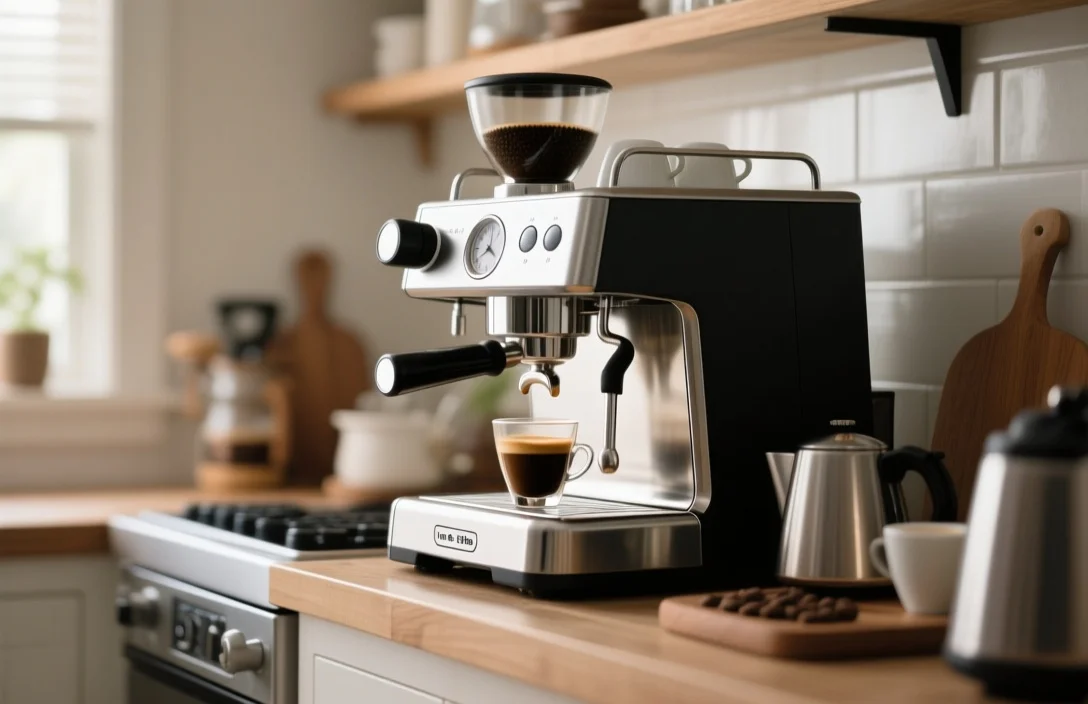
Yes, you can make espresso at home that lands in the practical middle ground between café quality and everyday convenience. I would start with three things that actually shape the result: a machine that fits your routine, a burr grinder you can adjust with confidence, and water plus maintenance habits you can keep up with. Everything else matters less than people think.
What a dependable home espresso setup looks like
A sensible home espresso setup is built around repeatability. Fancy features matter less than consistency in dose, grind, temperature, and tamp.
I keep coming back to the same checklist. Fresh beans, stored well. A grinder that gives an even grind. A machine that holds pressure and temperature reasonably well. Regular cleaning. If one of those slips, the cup usually does too.
The grinder is often the place to spend attention first. Small improvements there usually do more than a prettier machine body or a longer accessory list.
How espresso extraction works
Espresso is made by forcing hot water through tightly packed, finely ground coffee under pressure. That pulls out oils and soluble compounds that give the drink its flavor and body.
What matters in practice is how the variables interact. Grind distribution, dose, tamp, water quality, and machine pressure all affect the shot. If any one of them is inconsistent, the result shifts.
Temperature and pressure stability are especially important. If the machine swings too much during the shot, it becomes harder to repeat a recipe. That is why the grinder and machine need to work together. You want small adjustments to produce clear, predictable changes.
The gear that actually earns counter space
For most homes, the core setup comes down to four items: an espresso machine, a burr grinder, a tamper and distribution tool, and a scale. A knock box, a milk steamer or steam wand thermometer, and an in-line water filter are useful additions if you want the workflow to be easier.
Machines differ mostly in control and upkeep. Grinders differ in how finely you can adjust them. Accessories matter when they remove variables. A good scale, a precise tamper, and a dosing funnel can make the process much steadier.
| Name | Price / Key Spec | Best For |
|---|---|---|
| Manual lever machines | Hand-operated piston; mechanical pressure control | Hobbyists who want full tactile control and craft; higher skill ceiling |
| Semi-automatic pump machines | Electric pump; single or dual boiler options common | Home users who want control over shot timing and steaming; popular balance of control and practicality |
| Super-automatic machines | Integrated grinder, automated dosing; one-touch drinks | Users prioritizing convenience and speed over control; lower hands-on skill required |
How to choose a machine without overbuying
The real differences between machine types are control, maintenance burden, and how much time you want to spend making coffee.
Manual lever machines give you a lot of feel, but they ask for patience and technique. Semi-automatic machines are the middle ground, with control over extraction time and steaming. Super-automatics trade away most of that control in exchange for ease and speed.
I would also pay attention to space, power needs, and how many drinks you make in a row. A compact apartment setup is a different problem from a household that makes several milk drinks every morning. If you do a lot of steaming, recovery time matters. If you hate maintenance, avoid machines that are known for fussy internals or constant backflushing demands.
Why the grinder matters more than the machine more often than people admit
Grinders shape shot quality more than most purchases in the setup.
Burr design and burr material affect heat and particle consistency. Conical and flat burr grinders can both work well if the machine is solid. The bigger practical difference is adjustment control. Stepless grinders give you very fine control over grind size. Stepped grinders are simpler and often enough for regular home use.
My practical rule is simple. Pick the grinder based on how precisely you want to dial in shots, then match the machine to it. Use a consistent dose and tamp so you can tell whether a change in the cup came from the grind, not from everything else.
A scale helps here. So does timing the shot. And burr cleaning matters more than people think, because buildup changes retention and can shift the grind over time.
Water, filtration, and why it changes flavor
Water makes up most of the shot, so it is not a side issue.
Mineral content affects both extraction and machine longevity. Hard water can build scale quickly in boilers and pipes. Water that is too soft, or distilled water used on its own, can cause flat extraction and may be hard on metal parts. In many homes, an in-line filter or a good filtered water jug is enough to get away from the worst extremes in hardness and chlorine taste.
If scale is a concern, follow a maintenance schedule and use the descaling solution the manufacturer recommends. Reverse-osmosis systems and softening setups can work, but they may strip out minerals that help extraction, so a remineralization step may be needed.
Setting up the station so it is easy to use
The best layout is the one that gets out of your way.
Put the grinder, scale, portafilter, and machine close enough that you can move through the workflow without reaching across the counter. It does not matter much whether you work left to right or right to left. What matters is that you are not taking extra steps every time you pull a shot.
I would keep a towel and knock box close by. So should the cup warmer, if your machine has one. If you steam milk, make room for a pitcher rinse and for wiping the wand right after use. That one habit prevents dried milk from becoming a daily annoyance.
Preheat the portafilter and cup before dosing. Cold tools change the temperature of the shot more than they should. Keep your most-used items in one place so you are not searching for them during the process.
A simple first setup and first shot routine
Use the first few shots as a baseline, not a final judgment. The goal is to remove variables one at a time.
- Assemble the machine and flush the group head and steam wand so the system comes up to temperature.
- Check any water filtration and fill the reservoir with fresh filtered water.
- Put fresh beans in the hopper and start the grinder at a medium-fine espresso setting.
- Weigh the dose, distribute the grounds, and tamp evenly.
- Lock in the portafilter and start the extraction while timing the shot and watching the flow.
- Taste the espresso and note whether it seems sour, which can point to under-extraction, or bitter, which can point to over-extraction.
- Change only one variable at a time, usually grind size first, then dose or tamp if needed.
That last step matters. If you change three things at once, you learn almost nothing.
Cleaning and maintenance that keep the setup usable
A clean machine is not a luxury. It is part of making consistent espresso.
Daily habits should be basic. Clean the portafilter and basket. Rinse the steam tip after use. Backflush when the machine calls for it, using the right detergent. Those small habits prevent old oils and residue from changing the taste or causing mechanical problems.
For longer-term care, follow the manufacturer’s schedule for descaling and deep cleaning. Clean the grinder burrs and hopper. Replace water filters on a reasonable timeline. I would also keep a simple note of when maintenance happens, because that makes it easier to track changes in how the machine behaves.
Common mistakes that are easy to avoid
A lot of people fixate on more expensive equipment before they have the basics in place. Better grinder habits usually matter more than a bigger machine budget.
Another common mistake is changing too many variables at once. Grind, dose, and tamp all moving together makes it hard to learn what improved the shot.
Old beans, uneven tamping, and skipping preheating also create trouble. So does dirty water or a neglected group head. A short checklist beside the machine can keep the routine consistent without turning it into a project every morning.
When a shot tastes off
If the shot runs too fast and tastes thin, go finer on the grind first. A slightly higher dose can help too, as can a firmer tamp if the rest of the routine is steady.
If the shot runs slowly, comes out syrupy, and tastes bitter, go coarser or lower the dose. That usually points to over-extraction.
Channeling is another problem to watch for. That is when water cuts through the puck instead of passing through evenly. It often shows up as uneven flow. Better distribution and a level tamp usually help.
If steam performance drops, check for milk residue in the tip and make sure the boiler pressure is where the machine says it should be. Metallic or chemical flavors usually point to stale beans, rancid oils in the grinder, or water that has sat too long in the reservoir.
Milk steaming without making it harder than it needs to be
For milk drinks, the main skill is texture control.
Keep the steam tip just below the surface at first so it introduces air, then lower it to heat the milk while the liquid swirls. That gives you more even microfoam.
I would avoid trying to stretch the milk too long at the surface. That is where big bubbles tend to form. The pitcher matters too. Shape and thickness affect how easily you can judge the temperature by touch. If you are making several drinks in a row, a cold pitcher will slow things down and can change the final texture.
What a practical budget should cover
Budgeting for espresso is not just about the machine price.
You also have to account for maintenance, burr replacement, and water treatment. For most people, an entry-level grinder and a compact semi-automatic machine are enough to get good results without turning upkeep into a second hobby. In many cases, a better grinder gives more value over time than a much more expensive machine.
I would separate one-time purchases from recurring costs. Water filters, cleaning detergent, and burr replacement belong in the yearly estimate, not as afterthoughts.
What to buy first, and what can wait
If you are deciding where to start, buy the grinder first when possible. Grind quality sets the ceiling for the rest of the setup.
A reliable semi-automatic machine is a sensible starting point for most people who want control without a steep learning curve. If you want a clear upgrade path, moving from a stepped grinder to a stepless one is often more useful than chasing a bigger machine. A dedicated water filtration or conditioning setup is another upgrade that pays off if your tap water is not ideal.
Keep the receipts, register the machine for warranty coverage, and learn the basic maintenance tasks the model requires. I would upgrade in response to actual problems, not imagined future needs.
Which setup fits which kind of user
A small-apartment setup for one espresso a day should favor a compact footprint and low daily maintenance.
A household making several milk drinks in the morning should look first at steam recovery and reservoir size. An enthusiast pulling shots several times a day may reasonably spend more on a better grinder and a dual-boiler machine.
The cleanest way to decide is to name your priority before you buy. Convenience, control, or volume. Once you know which one matters most, the choice gets much easier.
When to stop troubleshooting and get help
Persistent leaks, pressure drops, or electrical problems are not the kind of issues to ignore. If the machine is showing those signs, stop using it and contact a qualified technician or the manufacturer.
Small drips can sometimes come from worn gaskets and may be replaceable with the right parts. But I would not guess at repairs if the machine is acting unpredictably. Keep a log of symptoms, dates, and what you already tried. That makes support calls more efficient and helps avoid unnecessary part swaps.
Accessories that are worth considering
A precision tamper is a smart upgrade. So is a distribution tool, if your puck prep is inconsistent. A scale that reads to one decimal point helps with repeatability. A milk thermometer, or a pitcher with clear markings, can make steaming easier to learn.
If your water is high in minerals, a simple in-line filter is worth serious consideration. On the machine side, PID temperature control and larger boilers are useful if you care about temperature stability and shorter recovery time between shots.
FAQ
How much counter space do I need for a home espresso setup?
A compact semi-automatic machine and a medium-sized grinder usually take about the width of a toaster, plus room for hopper clearance and the portafilter. Leave extra space for a knock box and pitcher. Measure the spot before you buy.
How often should I descale or backflush my machine?
Daily cleaning of the portafilter and basket is a good baseline. Weekly backflushing with detergent is common for many machines. Descaling depends on your water hardness and filtration setup, so follow the manufacturer’s guidance.
Do I need an expensive grinder to make good espresso?
No, but you do need a good burr grinder. Grinder quality matters more than machine polish. A solid grinder with even particle distribution will do more for extraction than an inexpensive one with sloppy consistency.
What is the simplest way to improve shot consistency?
Fix one variable at a time. Use a scale for dose, keep the tamp routine consistent, and preheat the machine and portafilter the same way each time. Write down the result if you want to learn faster.
Can I use regular tap water?
Sometimes, yes, but it depends on your local water. If taste or scale becomes a problem, use filtration. A good filter or a properly balanced water setup usually protects the machine and improves the cup.
A practical place to start
If you want a setup that will actually hold up in daily use, start with a grinder you can keep for years, then choose a machine that matches how much coffee you make and how much maintenance you are willing to do.
My short list would be simple: grinder, machine, digital scale, tamper, and water filter. Compare models against those needs, not against marketing language, and build from there.

- Espresso Tastes Watery? 10 Common Causes and How to Fix It - October 23, 2026
- 10 Common Coffee Equipment Cleaning Mistakes and How to Avoid Them - October 23, 2026
- 17 Common Coffee Grinder Problems and How to Fix Them - October 23, 2026