
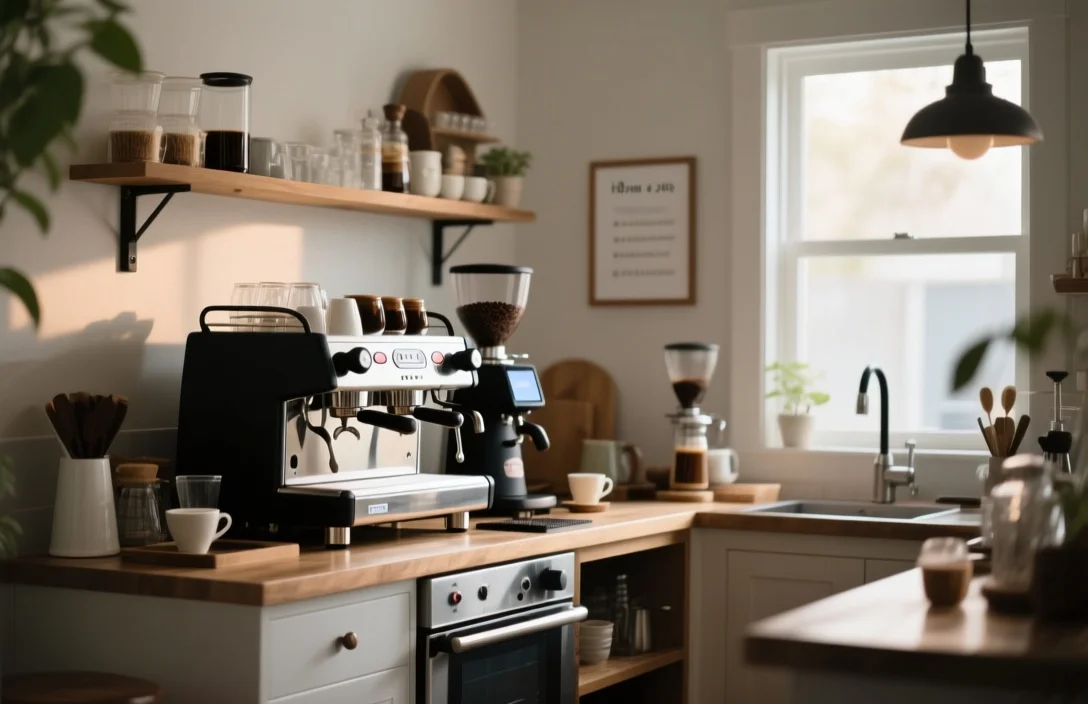
You can make very good espresso and milk drinks at home, but the setup has to be chosen with some discipline. A home barista setup is the machine, grinder, water, and routine you use to get repeatable results, not occasional luck.
What a home barista setup actually gives you
The point is consistency. I would start there, because most disappointment comes from expecting a basic setup to behave like a well-run café line. If you want straight espresso, you need control over grind and extraction. If you want milk drinks, you also need steady steaming and enough space to work cleanly.
In practice, that means a setup should give you repeatable shots from one day to the next. It should also fit the way you drink coffee. If you care about espresso clarity, I would put more weight on grind precision. If lattes and cappuccinos are the daily order, I would care more about steam performance and pitcher size.
The gear that actually belongs on the counter
The essentials are simple: an espresso machine and a grinder. After that, the rest of the kit makes the workflow easier and more repeatable. A scale, tamper, milk pitcher, cleaning tools, and a reliable water source are the pieces I would treat as baseline, not extras.
There is also a practical trade-off in the kind of equipment you buy. Entry-tier gear can make good drinks, but you will spend more time working around its limits. Prosumer gear usually gives you more stability and fewer compromises, but it costs more upfront.
| Name | Price/Key Spec | Best For |
|---|---|---|
| Manual lever machine | Prosumer-level control, manual pressure | Enthusiasts who want hands-on extraction and ritual |
| Semi-automatic pump machine | Entry-tier to mid-tier; programmable shots on higher models | Most home baristas who want control without full manual skill |
| Super-automatic machine | Bean-to-cup automation and built-in grinder | Busy users who value convenience and minimal daily work |
| Pod/ capsule machine | Low-touch single-serve system | Occasional espresso drinkers or constrained kitchens |
| Stovetop (Moka pot) | No pump; steam pressure extraction | Users who want strong coffee without an espresso machine |
Why the grinder matters so much
If I had to choose where people underbuy, it is almost always the grinder. Burr grinders produce a more even grind. Blade grinders do not. For espresso, that difference matters more than most other features in the setup.
Conical and flat burrs both have a place. Conical burrs are often quieter and a little more forgiving. Flat burrs can bring more uniformity, especially as price goes up. I would also pay attention to how you dose. Weight-based dosing is more repeatable. Timed dosing is faster, but only if you keep the workflow disciplined.
Features worth looking at:
- Burr material and size, with steel burrs commonly used for consistent espresso and ceramic burrs often lasting a long time.
- Stepped versus stepless adjustment. Stepped is easier to repeat, stepless gives finer control.
- Dosing method, with weight-based dosing giving better consistency and timed dosing favoring speed.
- Hopper size and cleaning access. A smaller hopper can keep beans fresher, and easy cleaning saves time.
- Grinding speed and heat. Slower motors can reduce heat transfer to the grounds.
Water, beans, and the espresso routine
Water is easy to ignore and expensive to ignore later. Too much mineral content can clog a machine and flatten flavor. Water that is too soft can create other problems, including corrosion and a dull cup. My practical rule is to use filtered water or bottled water with balanced minerality and stop overthinking it after that.
Beans matter too, but freshness does not mean “fresh off the roast” for every coffee. A reasonable window from the roast date usually gives you more predictable results. Lighter roasts tend to show more acidity and origin character. Darker roasts lean more toward roast sweetness and bitterness.
A simple espresso workflow looks like this:
- Weigh the beans and grind right before brewing.
- Dose into the portafilter and distribute the grounds evenly.
- Tamp with steady, even pressure.
- Lock the portafilter into a preheated group and start extraction promptly.
- Watch the stream. It should be stable and continuous, with a texture like warm honey.
- Taste the shot and adjust grind, dose, or tamp if it runs sour, bitter, or thin.
Milk steaming without the mess
Milk texture matters more than decoration. Microfoam, which is milk with very small bubbles, gives drinks a smoother feel and makes latte art possible. I would focus on texture first and stop chasing surface patterns too early.
A basic steaming routine is usually enough:
- Purge the steam wand briefly before you begin.
- Put the tip near the surface to add air, then lower it to create a whirlpool.
- Aim for a glossy, paint-like texture.
- Tap and swirl the pitcher to knock out larger bubbles.
- Pour steadily and finish with a controlled lift.
If the milk looks foamy or bubbly instead of smooth, it has usually been over-aerated.
How to arrange the station so it works every day
A good workflow depends on placement as much as equipment. I would keep the grinder, scale, portafilter rest, and knock box within easy reach. If the machine needs preheating, handle that early instead of trying to rush it.
The surface underneath matters too. A stable, heat-resistant counter is worth more than people think. Access to a sink makes cleanup easier, and a towel plus small brush within reach keeps the whole station from turning into a mess.
A practical station checklist:
- Stable surface for grinder and machine.
- Knock box and trash container close enough to use without crossing the counter.
- Scale and dosing area next to the grinder.
- Milk pitcher and cloth near the steam wand.
- Easy access to the water reservoir, or plumbing if the machine uses it.
Keeping the setup clean and the shots sane
Routine maintenance prevents more problems than it gets credit for. I would not wait for a machine to act up before cleaning it. Backflushing, when the machine supports it, clears oils and grounds from the group head. The steam wand should be wiped right after use and purged before the next drink.
Common shot problems and what usually helps:
- Sour, thin shots, grind finer or increase extraction contact.
- Bitter, harsh shots, grind coarser or reduce extraction contact.
- Channeling, improve distribution and tamping.
- Weak steam or inconsistent pressure, descale the machine or follow the manufacturer’s maintenance guidance.
Used grounds left in the portafilter cause baked-on residue. That is one habit I would break quickly.
When an upgrade is worth it
I would upgrade in the order of the bottleneck, not the order of the marketing pitch. For most people, the grinder is the first place to spend more money. Better grind consistency usually does more for cup quality than a small improvement in machine temperature control.
A better machine becomes more meaningful once the grinder is already doing its job. PID temperature control, for example, is useful if the rest of the setup is consistent. Otherwise, it just adds another variable people think they are controlling.
Upgrade priorities by goal:
- Better espresso clarity, upgrade the grinder first.
- Better milk drinks, look for stronger and more stable steam pressure.
- Less daily work, move toward automation or a super-automatic system.
How much to spend without fooling yourself
Entry-level setups can make pleasant drinks, and that is worth saying plainly. They just usually come with more compromises in consistency and lifespan. A modest increase in grinder quality often pays off more than spending that same money on a prettier machine.
Prices change often, so check current pricing and warranty terms before you buy. I would also pay attention to service access. A machine with easier repairs and better parts availability is usually the safer long-term choice than one that is only cheaper at checkout.
The mistakes that cause most bad home espresso
Most problems are boring, which is exactly why they recur. People rush the routine, skip water quality, ignore warm-up time, and then blame the beans. I would start by tightening the basics before changing coffee.
A few habits are worth avoiding:
- Do not store beans in the refrigerator. Moisture and odors are a bad combination. Keep them sealed at room temperature and away from sunlight.
- Do not leave used grounds in the portafilter between shots. Clean it promptly.
- Do not ignore wear parts like gaskets and shower screens. Old parts can leak and reduce pressure.
What different setups suit
The right setup depends on the way the kitchen is used.
- Small apartment, occasional espresso drinker: a compact pump machine and a small grinder are usually enough.
- Daily espresso and milk drinks: a mid-tier semi-automatic machine and a mid-sized burr grinder are the most practical middle ground.
- Coffee hobbyist or frequent entertaining: a prosumer machine and a higher-capacity grinder make back-to-back drinks easier.
I would not buy for the best-case weekend. I would buy for the weekday routine.
FAQ
How much space do I need for a decent setup?
A small counter area, roughly the size of a cutting board, can work for a compact machine and grinder. I would leave extra room for a scale, milk pitcher, and knock box so the workflow does not feel cramped.
Is a super-automatic machine better?
It can be, if the goal is convenience and consistent results with less manual work. The trade-off is less control over the shot and more dependence on built-in systems.
How often should I clean my grinder and machine?
A daily wipe and steam wand purge are the minimum I would keep. More thorough cleaning, including removable parts and descaling, should follow the manufacturer’s schedule or happen sooner if quality drops.
Can I get café-quality drinks without a dedicated espresso machine?
You can make excellent coffee with methods like Aeropress, pour-over, or a Moka pot. What you will not get is the same pressure profile or milk-steaming ability as an espresso machine.
What’s the first upgrade I should consider?
Usually the grinder. Better particle consistency gives the most noticeable improvement in shot quality for most home setups.
Bottom line
Start with how you actually drink coffee, then build around that. My practical rule is to buy the best grinder you can reasonably afford, choose a machine that matches your skill level and schedule, and keep the workflow simple enough that you will repeat it every day. Before buying, measure the space, compare a few machines and grinders in your price range, and check service and warranty terms.

- Espresso Tastes Watery? 10 Common Causes and How to Fix It - October 23, 2026
- 10 Common Coffee Equipment Cleaning Mistakes and How to Avoid Them - October 23, 2026
- 17 Common Coffee Grinder Problems and How to Fix Them - October 23, 2026