
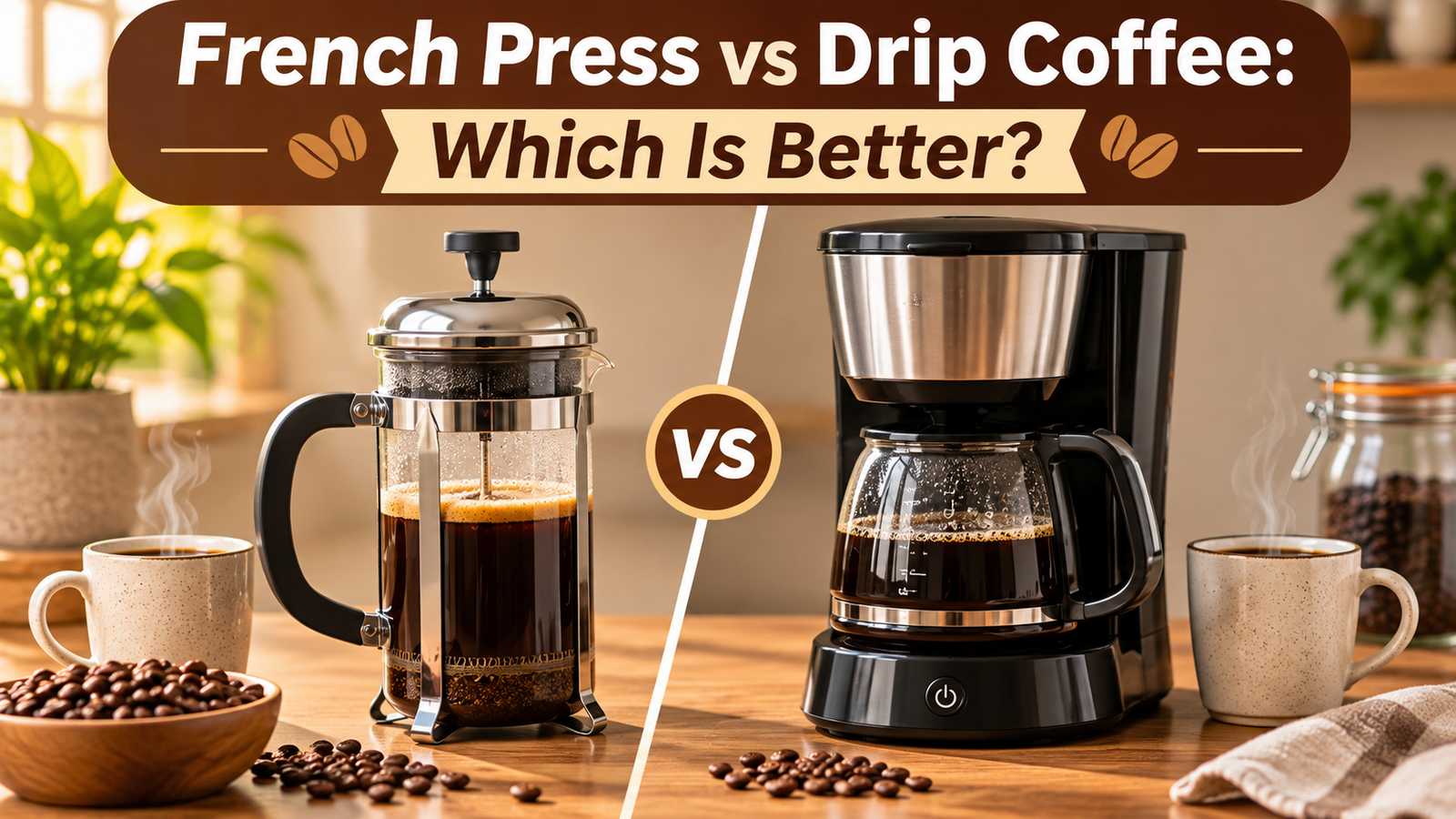
Choosing between French press and drip coffee comes down to how you like your coffee and how much effort you want to put into making it. Both methods use ground coffee and hot water, but they produce noticeably different results. French press coffee is usually richer and fuller-bodied, while drip coffee tends to taste cleaner and smoother, especially when brewed with a paper filter.
If you enjoy controlling your brewing process and prefer a bold, textured cup, a French press may be your best choice. However, if convenience, consistency, and easy cleanup matter more, a drip coffee maker could be better for your daily routine.
In this guide, we’ll compare French press vs drip coffee in terms of taste, caffeine, brewing time, cost, health, and maintenance. We’ll also explore glass versus stainless steel French presses to help you choose the right equipment.
Quick Comparison: French Press vs Drip Coffee
| Feature | French Press | Drip Coffee |
|---|---|---|
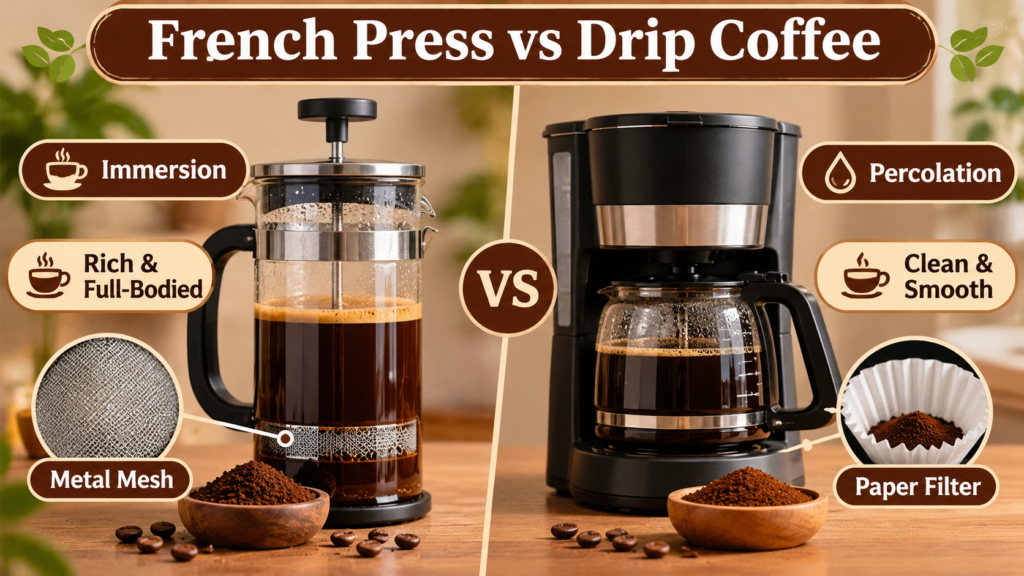
| Brewing method | Immersion | Percolation |
| Flavor | Rich, full-bodied | Clean, balanced |
| Filter | Metal mesh | Usually paper |
| Sediment | More | Less |
| Brewing time | About 4–6 minutes | Often 5–10 minutes |
| Convenience | Manual | Often automatic |
| Cleanup | More hands-on | Generally easier |
| Best for | Flavor and control | Convenience and consistency |
Both methods can produce excellent coffee. The real difference lies in how they extract flavor and how much control you want over the process.
What Is French Press Coffee?
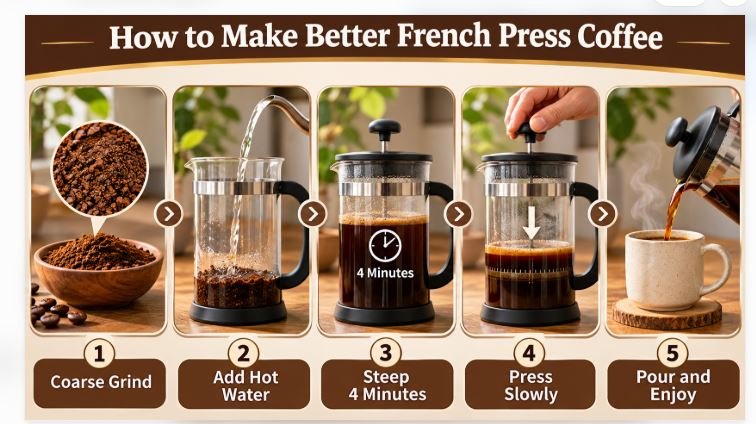
A French press, also called a press pot or cafetière, is a manual coffee brewer that uses immersion brewing. Instead of passing water through coffee grounds, it allows the grounds to remain in direct contact with hot water for several minutes.
A typical French press consists of a cylindrical container, a lid, and a plunger with a metal mesh filter.
How Does a French Press Work?
The brewing process is simple:
- Add coarsely ground coffee to the French press.
- Pour hot water over the grounds.
- Allow the coffee to steep for approximately four minutes as a starting point.
- Slowly press the plunger to separate the grounds from the liquid.
- Pour the brewed coffee into your cup.
Because the metal mesh filter allows more coffee oils and tiny particles to pass through, French press coffee often has a heavier texture than paper-filtered coffee.
What Does French Press Coffee Taste Like?
French press coffee is known for its rich flavor and full-bodied mouthfeel. The natural oils that remain in the finished brew contribute to its texture.
Depending on the beans and brewing method, you may notice chocolatey, nutty, earthy, or fruity flavors.
However, French press coffee can contain sediment at the bottom of the cup. If you prefer a completely clean finish, this may be a disadvantage.
What Is Drip Coffee?
Drip coffee is made by allowing hot water to pass through ground coffee held inside a filter. Most automatic drip coffee makers heat and distribute water over the grounds before collecting the brewed coffee in a glass carafe or thermal container.
Unlike a French press, drip brewing relies on water flowing through the coffee bed rather than allowing all the grounds to steep together.
How Does a Drip Coffee Maker Work?
The process usually involves five steps:
- Fill the water reservoir.
- Place a paper or reusable filter in the filter basket.
- Add medium-ground coffee.
- Start the brewing cycle.
- Allow the brewed coffee to collect in the carafe.
Automatic machines control much of the brewing process, making them convenient for everyday use.
What Does Drip Coffee Taste Like?
Drip coffee generally has a cleaner mouthfeel, especially when a paper filter is used.
Paper filters capture many fine particles and coffee oils, producing a cup with less sediment.
This clarity can make delicate floral, fruity, and acidic notes easier to distinguish. However, the final taste depends on your coffee beans, grinder, water quality, and brewing equipment.
French Press vs Drip Coffee: Key Differences Explained
Understanding the differences between these brewing methods will help you decide which one fits your preferences.
1. Taste and Flavor Profile
Taste is one of the biggest differences between French press and drip coffee.
French press brewing allows coffee oils and fine particles to remain in the cup, creating a fuller body and heavier mouthfeel. Many people describe this texture as rich or bold.
Drip coffee brewed through a paper filter usually tastes cleaner and less textured. Its lighter mouthfeel can make individual flavor notes more noticeable.
Neither method is automatically more flavorful. Fresh beans, proper grinding, and good extraction matter more than the brewing method alone.
Best choice: French press for a rich, textured cup; paper-filtered drip coffee for clarity.
2. Brewing Method and Extraction
French press uses immersion brewing, where coffee grounds remain in contact with water throughout the steeping period.
Drip coffee uses percolation, where water moves through the coffee grounds and filter.
These methods extract soluble compounds differently. In a French press, you can directly control steeping time, water temperature, and coffee-to-water ratio. In an automatic drip machine, the brewer controls much of the water delivery and brewing duration.
Both can produce balanced coffee when the brewing variables are properly adjusted.
3. Brewing Time and Convenience
French press coffee generally takes about four minutes of steeping, plus time for heating water, measuring coffee, and pouring.
Automatic drip coffee makers often take approximately five to ten minutes, depending on capacity and machine design.
Although drip brewing may take longer, it usually requires less attention. Some machines even have programmable timers that start brewing automatically.
A French press requires more involvement, but its simple design makes it easy to use without a complicated machine.
Best choice: Drip coffee for convenience; French press for hands-on brewing.
4. Coffee Grind Size
Grind size affects extraction, taste, and the amount of sediment in your coffee.
A French press typically works best with a coarse grind, similar in texture to coarse sea salt. A medium-coarse grind can also work, depending on the filter and recipe.
Drip coffee makers generally use a medium grind, although the ideal setting varies with the basket shape and machine.
Using overly fine grounds in a French press can produce excessive sediment. In drip machines, an unsuitable grind can cause water to flow too slowly or too quickly, leading to uneven extraction.
An adjustable burr grinder makes it easier to achieve a consistent grind for either brewing method. KitchenAid US+1
5. Caffeine Content
Does French press coffee have more caffeine than drip coffee?
Not necessarily.
Caffeine content depends on several factors, including the coffee dose, bean variety, brewing ratio, extraction, and serving size.
A stronger-tasting French press coffee does not automatically contain more caffeine.
For example, if you use more ground coffee in your French press than in your drip machine, your French press serving may contain more caffeine. But the opposite can also be true.
When comparing caffeine, consider both the total caffeine in a serving and the concentration per ounce.
Verdict: Neither brewing method consistently contains more caffeine under every brewing condition.
6. Coffee Oils, Filters, and Health
One important difference between French press and paper-filtered drip coffee involves natural coffee oils.
French press coffee typically uses a metal mesh filter, allowing more oils and certain compounds to remain in the beverage.
Two compounds, cafestol and kahweol, are found in coffee oils. Research shows that consuming substantial amounts of unfiltered coffee can increase LDL cholesterol in some people.
Paper filters remove much of these compounds, making paper-filtered drip coffee a potentially preferable option for people concerned about cholesterol.
Harvard T.H. Chan School of Public Health discusses this difference between filtered and unfiltered coffee. However, this does not mean that every cup of French press coffee is harmful or that drip coffee is always healthier. Overall dietary habits and individual health conditions also matter. The Nutrition Source+2
7. Cleaning and Maintenance
French presses have relatively few components, but cleaning the metal filter can require some effort.
You need to remove used coffee grounds, wash the container, and occasionally disassemble the plunger to clean trapped oils and particles.
Drip coffee makers usually offer easier everyday cleanup. You can often remove and discard the paper filter with the used grounds.
However, drip machines also require periodic descaling to remove mineral buildup from internal components.
A French press requires more attention after each brew, while a drip coffee maker generally needs more maintenance inside the machine.
8. Cost and Long-Term Value
French presses are often less expensive to purchase than electric drip coffee makers, although premium insulated models can cost considerably more.
They do not require electricity for the brewing device itself, and reusable metal filters eliminate regular paper-filter purchases.
Drip coffee makers require electricity and may need paper filters, cleaning products, or occasional replacement parts.
Both methods benefit from freshly ground coffee, so a grinder can be a worthwhile additional investment.
If you want a simple brewing device with few ongoing expenses, French press is an attractive option. If you value automated brewing, the extra cost of a drip machine may be worthwhile.
Glass vs Stainless Steel French Press: Which Should You Choose?
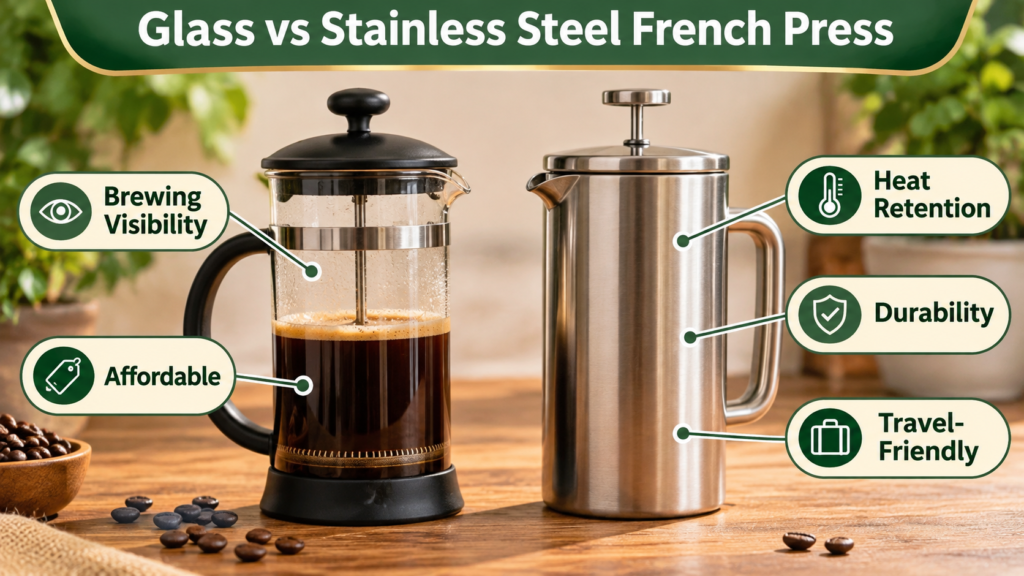
If you’ve decided to buy a French press, the next question is whether to choose glass or stainless steel.
Both use the same basic immersion brewing method, but they differ in durability, appearance, heat retention, and portability.
Glass French Press: Pros and Cons
A glass French press is popular because of its classic appearance and transparent brewing chamber.
You can watch the grounds settle and observe the coffee as it brews. Glass also makes it easy to see how much coffee remains inside.
Advantages:
- Lets you observe the brewing process.
- Often more affordable than insulated stainless steel models.
- Easy to inspect for leftover grounds or residue.
- Available in many sizes and designs.
Disadvantages:
- More vulnerable to breaking if dropped.
- Single-wall glass typically loses heat faster than insulated steel.
- Less suitable for travel or rough handling.
A glass French press is a good choice for home use, especially if you appreciate a traditional coffee-making experience.
Stainless Steel French Press: Pros and Cons
Stainless steel French presses are designed with durability in mind. Many models feature double-wall insulation to help maintain brewing temperature.
They are particularly useful for people who want a sturdy coffee maker for regular use or travel.
Advantages:
- Generally more resistant to accidental damage.
- Insulated models retain heat longer.
- Suitable for travel, camping, and busy kitchens.
- Often available with durable metal construction.
Disadvantages:
- Usually more expensive than basic glass models.
- You cannot see the coffee brewing inside.
- Some models are heavier.
- Filter assemblies may require careful cleaning.
Glass vs Stainless Steel French Press Comparison
| Feature | Glass | Stainless Steel |
|---|---|---|
| Durability | More fragile | More durable |
| Heat retention | Lower in single-wall models | Better when insulated |
| Brewing visibility | Yes | No |
| Weight | Varies | Varies |
| Typical cost | Lower | Higher |
| Best for | Everyday home use | Durability and heat retention |
Which French Press Material Is Better for Coffee Taste?
Neither glass nor stainless steel automatically produces better-tasting coffee.
The brewing ratio, grind quality, water temperature, and steeping time have a greater impact on flavor.
However, an insulated stainless steel French press may maintain water temperature more consistently during brewing, particularly in a cold environment.
If you prioritize appearance and affordability, choose glass. If durability and heat retention matter more, an insulated stainless steel French press may be worth the additional cost.
Which Brewing Method Makes Stronger Coffee?
French press coffee often tastes stronger because its metal filter allows more coffee oils and fine particles into the finished drink.
However, perceived strength is different from actual coffee concentration and caffeine content.
The coffee-to-water ratio has a major effect on how strong either brew tastes.
For example, using 30 grams of ground coffee with 500 grams of water gives you a 1:16.7 coffee-to-water ratio. This can be a reasonable starting point for either method, although the ideal ratio depends on the beans and your preferences.
If you want a stronger-tasting cup, increase the amount of ground coffee slightly while keeping the water quantity unchanged.
Avoid assuming that steeping a French press for much longer will always improve its strength. Longer extraction can also change bitterness and flavor balance.
Which Is Easier to Use: French Press or Drip Coffee Maker?
For everyday convenience, an automatic drip coffee maker usually has the advantage.
You add water and coffee, press a button, and allow the machine to finish brewing. Some models can also be programmed in advance.
French press brewing requires heating water separately, measuring ingredients, timing the steep, and pressing the plunger.
However, a French press has fewer mechanical parts and does not rely on electrical controls.
If you enjoy making coffee as part of your morning routine, these extra steps may be enjoyable rather than inconvenient.
For households preparing several cups every morning, drip coffee is often the more practical choice.
Essential Equipment for Better French Press Coffee
You don’t need expensive equipment to make good French press coffee. A reliable press, suitable filter, and consistent grinder are the most useful starting points.
Choosing the Right French Press
When comparing French presses, focus on capacity, material, filter construction, and ease of cleaning.
A smaller press is convenient for one person, while a larger model may suit a family or household where several people drink coffee.
Check the advertised capacity carefully because manufacturers may define a coffee cup differently from a standard drinking mug.
Also consider whether the manufacturer sells replacement plungers, mesh filters, or glass beakers. Access to replacement parts can extend the useful life of your French press.
When Should You Replace a French Press Filter?
A French press filter does not necessarily need replacing on a fixed schedule.
However, you should inspect it regularly for wear or damage.
Replacement may be necessary when the mesh becomes torn, bent, loose, or difficult to clean.
If unusually large amounts of coffee grounds begin passing through the filter, check whether the mesh fits correctly and whether your grind is too fine.
When purchasing replacement filters, confirm the diameter, shape, and compatibility with your specific French press.
A universal filter is not guaranteed to fit every model.
Do You Need a Coffee Grinder for French Press?
A coffee grinder is not essential if you buy freshly ground coffee, but it gives you more control over brewing.
A burr grinder is generally preferable to a blade grinder because it offers more consistent particle sizes and adjustable grind settings.
For French press brewing, choose a grinder that can produce a consistent coarse grind.
A manual burr grinder may be suitable for occasional brewing or small quantities. An electric burr grinder is more convenient if you prepare coffee frequently.
The best choice depends on your budget, how often you brew, and whether you also use other coffee-making methods.
French Press Accessories Worth Considering
A few simple accessories can improve consistency without complicating the brewing process.
A digital scale helps measure coffee and water accurately. An electric kettle makes heating water convenient, while an airtight coffee container can help protect beans from moisture and air exposure.
Start with a good French press and grinder before investing in additional accessories.
French Press vs Drip Coffee: Which Is More Budget-Friendly?
French press is generally the more affordable starting option because it does not require an electric brewing machine.
A basic glass French press and a bag of appropriately ground coffee are enough to get started.
With drip brewing, the machine itself may cost more, and paper-filter models create an ongoing filter expense.
However, reusable filters can reduce those costs, and automatic brewing may offer enough convenience to justify the investment.
Over time, the cost difference depends on the quality of the equipment, replacement parts, maintenance, and how often you prepare coffee.
For someone brewing one or two cups occasionally, a French press may offer better value. For a household preparing several servings every day, a drip coffee maker may be the more practical investment.
Who Should Choose a French Press?
A French press is a good option if you enjoy rich, full-bodied coffee and want control over the brewing process.
It also suits people who prefer simple equipment without electronic controls. Because it is compact and requires no electricity itself, it can be useful in small kitchens or when traveling, provided you have a way to heat water.
Choose a French press if flavor texture, manual brewing, and simplicity are your main priorities.
Who Should Choose a Drip Coffee Maker?
A drip coffee maker is better suited to people who value convenience and consistency.
It is especially useful for busy mornings, larger households, and anyone who wants to brew several cups with minimal involvement.
Paper-filtered drip brewing is also appealing if you prefer a cleaner cup with little sediment.
Choose drip coffee if you want an easy, repeatable brewing routine without manually controlling every step.
French Press vs Drip Coffee: Which Is Better Overall?
There is no single winner because the best brewing method depends on what you enjoy most.
French press is better for people who want rich, full-bodied coffee, simple equipment, and greater control over brewing. It is also an affordable way to make coffee at home without buying an automatic machine.
Drip coffee is better for people who prefer convenience, a cleaner cup, and consistent everyday brewing. Automatic machines are particularly useful when making multiple servings or preparing coffee during busy mornings.
If you are buying your first coffee maker, consider how much time you want to spend brewing and whether you prefer a rich or clean flavor. Those two factors will often make the choice clear.
Frequently Asked Questions About French Press vs Drip Coffee
Is French press coffee better than drip coffee?
French press coffee is better if you enjoy a rich, full-bodied cup and hands-on brewing. Drip coffee is better if you prefer a cleaner taste and automatic convenience. Both can produce excellent coffee with fresh beans and proper brewing techniques.
Does French press coffee have more caffeine?
Not always. Caffeine content depends on the amount of coffee used, bean variety, brewing conditions, and serving size. A French press may taste stronger without necessarily containing more caffeine than drip coffee.
Why does French press coffee taste stronger?
French press coffee retains more natural oils and fine particles because it uses a metal mesh filter. These contribute to a heavier mouthfeel and richer perceived flavor compared with paper-filtered drip coffee.
Is French press coffee healthier than drip coffee?
Paper-filtered drip coffee may be preferable for people concerned about LDL cholesterol because the filter removes much of the cafestol and kahweol found in coffee oils. French press coffee generally contains more of these compounds. The Nutrition Source+1
Can you use regular ground coffee in a French press?
Yes, but the grind size matters. Many pre-ground coffees are finer than ideal for French press brewing. A coarse grind generally reduces sediment and makes plunging easier.
What grind size is best for French press coffee?
A coarse grind is a common starting point. The grounds should resemble coarse sea salt. You can adjust the grind slightly depending on your recipe, filter, and preferred taste.
Is a glass or stainless steel French press better?
Glass French presses are appealing for their classic appearance, visibility, and affordability. Stainless steel models are generally more durable, and insulated versions can retain heat longer. Neither material automatically makes better-tasting coffee.
How often should you replace a French press filter?
Replace the filter when it becomes damaged, distorted, loose, or no longer separates grounds effectively. A well-maintained metal mesh filter can last a long time, so a fixed replacement schedule is usually unnecessary.
Is French press coffee cheaper than drip coffee?
French press brewing often has a lower initial equipment cost, especially with a basic glass model. Drip machines may have higher upfront costs and ongoing paper-filter expenses, although the total cost depends on the equipment you choose.
Can you make drip coffee without a coffee machine?
Yes. Manual pour-over brewers use a similar percolation principle, allowing hot water to flow through ground coffee and a filter. They require more hands-on attention than automatic drip coffee makers but can produce a similarly clean cup.
Final Thoughts
The French press vs drip coffee debate is really about personal preference. French press brewing delivers a richer texture and more control, while drip coffee offers convenience and a cleaner cup.
If you enjoy experimenting with brewing methods, a French press is a great place to start. A glass model works well for everyday home use, while an insulated stainless steel version offers greater durability and heat retention.
If you prefer pressing a button and having coffee ready with minimal effort, an automatic drip coffee maker is likely the better choice.
Whichever method you choose, fresh coffee beans, an appropriate grind size, and a consistent coffee-to-water ratio will help you get the most out of every cup.

- Espresso Bar Wedding: Ideas, Setup, Costs, and Tips for a Memorable Coffee Experience - November 11, 2026
- How Many Grams of Espresso Beans for a Double Shot? A Complete Brewing Guide - November 11, 2026
- Brasilia Espresso Machine: Features, Performance, Models, and Buying Guide - November 11, 2026