
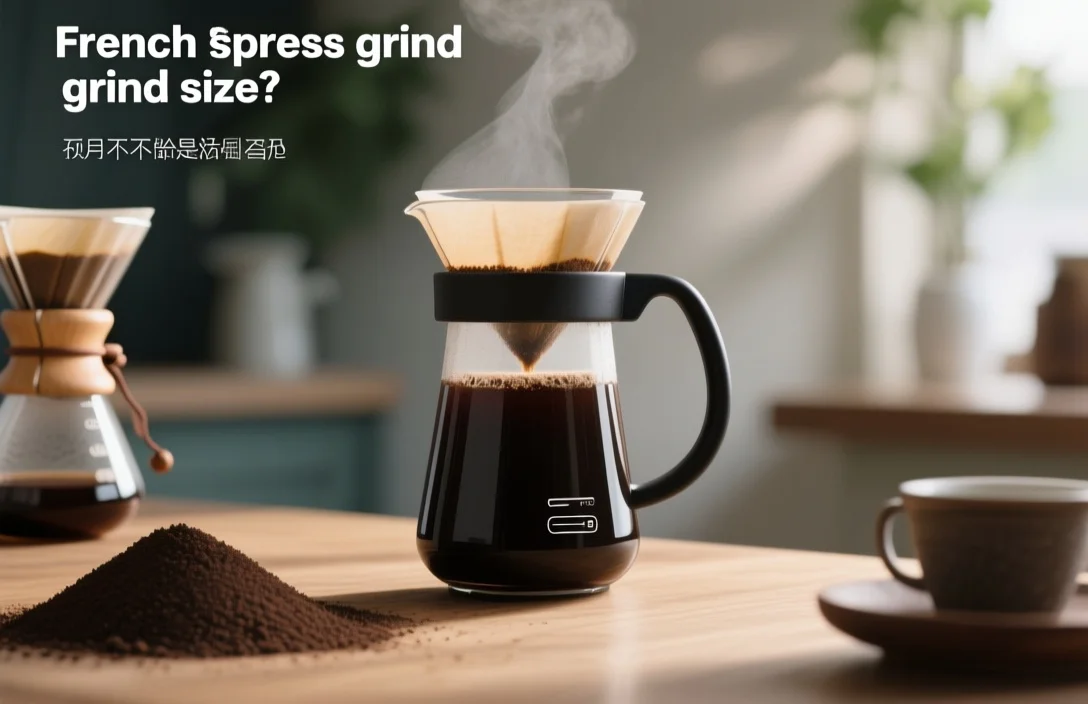
Use a coarse, even grind for French press to get fuller body, less bitterness, and fewer fines that pass through the metal mesh. Coarse means chunky particles with visible texture – think coarse sea salt or breadcrumbs rather than powder – and an even particle distribution matters more than the exact measurement.
What coarse grind size means for French press
Coarse grind refers to coffee particles that are large enough to slow extraction and to limit the amount of fine dust that slips through a metal mesh filter. Chunkier particles expose less surface area to hot water, which keeps extraction gentler and preserves the coffee’s oils and mouthfeel. Visible particle size and uniformity are the two practical checks you can use: if every particle is a similar chunk rather than a mix of dust and shards, you’re in the right ballpark.
Grind uniformity impacts three things at once: flavor balance, sediment, and the effort required to plunge. Uneven grinds create simultaneous under-extraction (from large pieces) and over-extraction (from fines) inside the same brew. Plunger resistance increases when many fines and very small fragments are present; consistent, coarse particles let the mesh filter do its job without turning your cup gritty.
Why grind size controls extraction and flavor
Extraction depends on exposed surface area, particle uniformity, and contact time with hot water. Larger particles extract more slowly because less surface area is exposed per volume. That slower extraction means acids, aromatics, and some sugars dissolve at different rates than when you use a fine grind, so the coffee tastes different even with the same beans and water.
Surface-area effects create predictable trade-offs for French press. A coarser grind reduces bitterness tied to over-extraction of bitter compounds, while increasing body and oil presence because the metal filter allows oils through. Extraction balance becomes a movement along a spectrum: push too fine and bitterness and astringency rise; push too coarse and the brew can taste thin or sour. Taste and mouthfeel are the indicators to adjust toward slightly finer or coarser.
How to achieve a consistent coarse grind
Choose a burr grinder rather than a blade grinder if you want repeatable coarse results. Conical and flat burr designs both produce more uniform particle sizes than blade grinders, which cut unevenly and create a mix of fines and large bits. Manual burr grinders can be good if you want a compact, affordable option, but check the grind settings and adjustability at coarse ranges.
Adjustability matters because manufacturer markings and stepped clicks on cheap grinders do not match across models. Mark a reference point, then make small, consistent adjustments and record the result. Test two or three doses, observe particle distribution visually and by feel, and then brew. Consistent coarse grind comes from a mix of the right grinder and a quick calibration routine.
Important trade-offs appear when comparing grinder types: portability, noise, price, and the coarsest stable setting differ widely. A heavy-duty electric burr with wide adjustment range will usually give the cleanest, most even coarse settings for a French press. Manual grinders are quieter and more portable but need more time and consistent technique. Blade grinders should be used only if you have no alternative; expect more sediment and inconsistent extraction.
Grinder comparison table and buying
Comparing the main grinder categories side by side, the key difference is particle uniformity at coarse settings and how finely you can control adjustments.
| Name | Price / Key Spec | Best For |
|---|---|---|
| Blade grinder | Entry-tier – chops irregularly; creates fines | Casual use where convenience matters more than clarity |
| Conical burr grinder | Wide price range – stepped or stepless adjustment; consistent coarse setting | Most users who want repeatable French press results |
| Flat burr grinder | Mid-to-high range – very uniform particle distribution | Users seeking the cleanest coarse profile and repeatability |
| Manual burr grinder | Low-to-mid range – portable, hand-crank | Travelers or budget-conscious brewers who value grind control |
Checklist before you buy:
- Look for a stepless or finely stepped adjustment at coarse settings.
- Prefer grinders with larger burr diameters for stability at coarse sizes.
- Confirm build quality and ease of cleaning around the burrs.
- Avoid blade grinders if you prioritize clarity and minimal sediment.
- Consider how much noise and footprint you can tolerate.
How to dial in grind size
Start with a baseline coarse setting and use small, incremental adjustments while tasting and observing. This simple drill makes trial-and-error efficient.
- Measure a consistent dose and grind it at a chosen coarse setting.
- Stir the grounds and water briefly after adding water to distribute extraction, then steep.
- Plunge with steady pressure and taste a clean sample first.
- Adjust the grinder one small step finer if the brew tastes thin or sour.
- Adjust one small step coarser if the brew tastes bitter or overly heavy.
- Repeat the cycle and keep a short log of settings and tasting notes.
Testing focuses on taste and texture rather than chasing specific numbers. Record your grinder setting, any marks you use, and a short flavor note each run. Over time, those notes quickly reveal how a given setting interacts with roast level, origin, and freshness.
Common problems, how to recognize them, and fixes
Excessive sediment, slow plunging, sourness, and bitterness each point to different grind-related causes.
- Sediment and a gritty cup: A mixture of very fine particles usually causes this. Fix by making your grind coarser and using a burr grinder if you currently use a blade model. A short rest after grinding can sometimes allow fines to settle before pouring.
- Difficulty plunging or a sludgy texture: Overly fine material or compacting of grounds causes high resistance. Fix by coarsening your grind and plunging more slowly with steady pressure; consider a coarser setting or flattening the bed before plunging.
- Sour or underdeveloped flavor: Particle size too large or under-extraction leads to sour notes. Fix by slightly finer grinding or increasing contact/agitation responsibly.
- Bitter or astringent taste: Too many fines or too fine a grind cause over-extraction. Fix by coarsening the grind and reducing agitation or steep time.
Taste-driven adjustments are safer than large, simultaneous changes to both grind and brew technique. Change only one variable per test so you know what worked.
Grind size and equipment interactions
French press designs and filter types change how the grind behaves. A larger-diameter press usually tolerates a slightly coarser setting without increasing under-extraction, while metal-mesh filters allow more oils and fines than paper filters. Materials of the press – stainless versus glass – matter mostly for heat retention and durability, not grind size.
When the press uses a finer mesh or an additional paper filter, you can push the grind a bit finer with reduced sediment. Coffee bags or cloth sleeves achieve a different balance altogether and are not the same as a standard metal French press filter. Grind size also interacts with water dispersion and agitation; vigorous stirring or pouring can increase extraction and push you to a coarser setting to avoid over-extraction.
Consider dose uniformity too. Larger doses compact more and can increase plunge resistance if too many fines are present. For single-serve or small-volume brews, use consistent grinding and tamping practices; for larger volumes, pay closer attention to circulation and how the grounds settle.
Roast, freshness, and how they change your ideal grind
Roast level and bean age shift the sweet spot for grind size. Lighter roasts are denser and generally need more extraction energy, so dialing slightly finer can help open aroma and acidity. Darker roasts decompose more and extract easily; coarsening helps prevent dominance of bitter, charred notes.
Freshly roasted beans release more CO2 and can create a frothy bloom when water first hits them; that bloom interacts with grind by changing how water penetrates the bed. Allowing a brief rest after grinding can moderate this effect; a very short degassing can reduce channeling and make extraction more uniform. Storage and freshness control – keeping beans in an airtight container away from light – keeps grind behavior predictable day to day.
A note about single-origin vs blends: single-origin coffees often show sharper, more transparent flavors, so minor grind adjustments will be more audible in the cup. Blends can be forgiving and may accommodate a wider range of coarse settings without tasting unbalanced.
Maintenance, calibration, and practical tips
Calibrate your grinder by marking a reference and testing regularly. Clean grinder burrs and housings on a schedule so old oils and tiny particles don’t alter particle size or flavor. Small changes in burr alignment or buildup produce changes in particle distribution that produce inconsistent cups.
Record simple logs: date, grinder setting, roast date, and tasting notes. That record becomes a rapid lookup for future brews and reduces trial-and-error time. Use a dedicated scoop or scale for dosing so variations in dose don’t disguise the effects of grind adjustments. Replace burrs per manufacturer guidance or when you notice a decline in clarity and particle uniformity.
Simple transportable tests work well. Grind a small cup’s worth and check visually: if you see a lot of dust and powder, shift coarser; if you see almost all large shards with few mid-sized particles, shift a touch finer. Repeat until the visual field looks evenly distributed.
FAQ
What is the ideal French press grind size?
A coarse, consistent grind is ideal; think chunky pieces similar to coarse sea salt or rough breadcrumbs. Focus on uniformity: a mix of large chunks and dust indicates a need for better grinding or a different grinder.
Can I use a blade grinder for French press?
You can, but expect more fines and sediment. Blade grinders produce an uneven particle mix that increases bitterness and grit. A burr grinder is the better long-term choice for repeatable coarse settings.
Why does my French press taste bitter if I use a coarse grind?
Bitter flavor with coarse grinds usually points to excessive agitation, over-steeping, or a grind with too many fines despite an otherwise coarse setting. Try coarsening the grind slightly, reducing stirring, or adjusting steeping parameters.
How do I tell if my grind is too coarse?
A too-coarse grind yields a thin, underdeveloped cup with pronounced sourness or lack of body. If the flavor lacks sweetness or aromatic complexity, nudge the grind a little finer and retest.
How should I store grounds and beans for French press?
Store whole beans in an airtight container away from light and heat, then grind just before brewing. Ground coffee loses volatile aromatics quickly; freshly ground coffee produces a clearer, fuller cup.
Practical verdict and next
Coarse and consistent beats precise numeric targets for French press grind size. Start by switching to a burr grinder if you haven’t already, calibrate with small adjustments, and keep brief tasting notes. Next step: pick one grinder setting, brew a single test cup, then adjust only the grind until the flavor and texture match your preference.

- Espresso Tastes Watery? 10 Common Causes and How to Fix It - October 23, 2026
- 10 Common Coffee Equipment Cleaning Mistakes and How to Avoid Them - October 23, 2026
- 17 Common Coffee Grinder Problems and How to Fix Them - October 23, 2026