
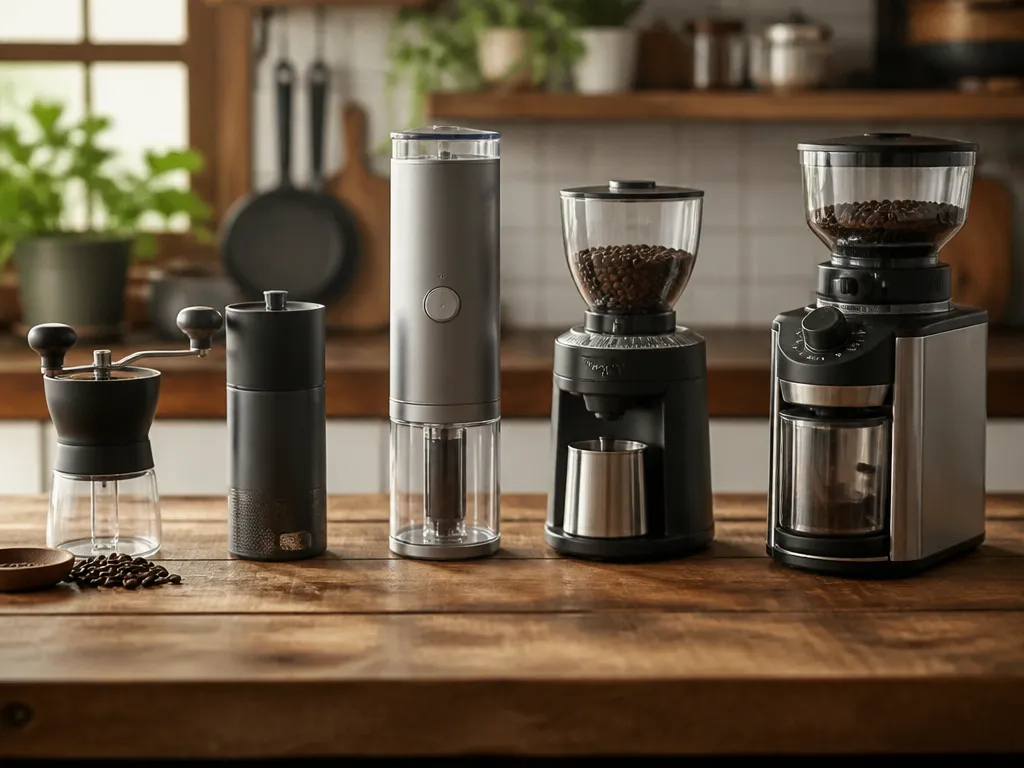
Good coffee starts with a consistent grind, and the grinder type has more influence than most other equipment choices. For most people, the decision comes down to burr versus blade, then conical versus flat burr, and finally the precision of the adjustment system. Match those features to your brew method, daily routine, and budget.
Coffee grinders mainly differ in how they break apart beans, which determines grind consistency. Burr grinders produce more even particles for espresso and filter coffee, while blade grinders create a mix of fine and coarse grounds that often extracts unevenly. Choose burr if flavor and repeatability matter; choose blade only if low cost and simplicity come first.
The Short Answer on Coffee Grinder Types
- Particle size drives extraction. Burrs shear beans into a more even particle size.
- Espresso needs consistency. Use a burr grinder if you pull espresso regularly.
- Conical and flat both work. Conical burrs often feel forgiving, while flat burrs often aim for cleaner particle separation.
- Dose control changes workflow. Dose-controlled grinders save time, while non-dose models can cost less.
- Stepless is not magic. Stepped settings can dial in well when the steps are practical.
- Pick by brew style. Match the grinder and adjustment system to espresso, pour-over, or French press.
Coffee Grinder Types Compared by Grind Consistency
Grind consistency affects extraction. Evenly sized grounds extract more uniformly, which usually produces a sweeter, less harsh cup. Inconsistent grounds create a mix of over-extracted fines and under-extracted larger pieces.
Blade grinders chop beans rather than shear them, so they tend to produce a wide spread of particle sizes. That creates problems in espresso, where small changes in grind size can quickly change extraction. Burr grinders, whether conical or flat, repeatedly cut beans to a narrower distribution, making the results easier to predict and adjust.
A practical comparison looks like this:
- Blade grinder: wide particle-size spread and less predictable extraction.
- Burr grinder, conical or flat: tighter particle-size spread and more repeatable results.
- Hand burr vs electric burr: both can produce consistent grounds, but electric grinders maintain that consistency faster across repeated doses.
Burr Grinders vs Blade Grinders for Espresso
Espresso exposes grinder weaknesses quickly. Blade grinders produce fine particles alongside larger chunks, so water can channel unevenly through the puck. The resulting shot may taste bitter in some areas and sour in others.
Espresso dial-in already requires balancing dose, yield, and time. Random grind-size variation makes every adjustment harder to interpret. With a burr grinder, the cause and effect is clearer: a finer grind should generally increase resistance and extraction, while a coarser grind should reduce both.
For espresso, I would draw a firm line:
- Get a burr grinder if espresso is a regular part of your routine.
- Skip blade unless you use it occasionally and accept inconsistent results.
A common compromise is to use one burr grinder for espresso and another for filter coffee. One versatile burr grinder can also handle both methods if it offers a suitable range of fine settings.
Conical Burr vs Flat Burr Differences
Conical and flat burr grinders can both produce consistent grounds. Their different geometries affect heat, grind behavior, and how the adjustment system feels during use.
Conical burrs are common in home grinders. They are often described as forgiving across grind settings, and many users find them easier to dial in with smaller changes. Some conical grinders also produce less static-related mess, although that depends on the specific grinder and workflow.
Flat burrs are common in grinders aimed at enthusiasts. They can produce clear separation between particle sizes, and many users like their consistent behavior at espresso fineness. If you measure shots and care about repeatability, a flat burr grinder may suit your approach to brewing.
Use this rule of thumb:
- Choose conical burr if you want approachable adjustments and solid results without scrutinizing every parameter.
- Choose flat burr if espresso is your priority and you prefer a precise adjustment and measurement process.
Burr size, burr material, and motor control matter too. Geometry is only one part of the grinder’s performance.
Dose-Controlled vs Non-Dose Grinders Workflow
Dose control changes the workflow more than it changes the coffee. A dose-controlled grinder automatically dispenses a target amount, which helps if you make multiple drinks or want a consistent starting point.
With a non-dose grinder, you usually weigh or measure the grounds yourself. That takes longer and can introduce small dose differences from cup to cup. For single-dose espresso, however, a non-dose grinder may fit better because you are already weighing each dose.
Dose-controlled grinders typically let you select a dose in grams through the grinder interface. The convenience is useful for drip coffee and everyday milk drinks. The trade-off is that you may need to recalibrate the dose over time. The amount dispensed can drift slightly with bean freshness, grind setting, and burr-chamber cleanliness.
The workflow difference is straightforward:
- Dose-controlled: faster, more repeatable grams per drink, and less measuring.
- Non-dose: more control and a natural fit for single-dose espresso, but you handle the measuring.
Dose control is often worth it if you serve guests or make the same drink back-to-back. If you weigh every dose, a non-dose grinder may be simpler in the long run.
Manual vs Electric Grinders for Daily Use
Manual grinders can produce excellent espresso and filter grinds, but they take longer. Electric grinders are faster, and that speed matters because grind quality is only useful when the grinder is convenient enough to use consistently.
Manual grinding works well if you enjoy the process or make one drink at a time. For families and busy mornings, an electric grinder reduces effort and makes daily grinding easier to maintain.
Electric grinders also handle retention differently from manual grinders. Many electric models have a grind chamber and dosing path that leave some grounds behind, affecting the difference between the first dose and later doses. Manual grinders are often easier to manage for single dosing because you can grind directly into a portafilter or container, although each dose still requires physical effort.
Choose based on your routine:
- Manual: best for small batches, espresso hobbyists who single-dose, and people who do not mind the extra minute.
- Electric: best for daily use, multiple drinks, and anyone who wants fast, repeatable dosing.
If daily use means two to four drinks, electric usually wins on convenience.
Stepped vs Stepless Settings and Adjustment Precision
Stepless grinders let you move between grind sizes in tiny increments. That can help with espresso dial-in, but the adjustment system also needs to be precise and repeatable.
Stepped grinders use discrete clicks or settings. The system may feel restrictive at first, but a good stepped grinder has increments small enough for meaningful adjustments. Evenly spaced steps can be just as practical as stepless control when you can consistently reach a setting that tastes right.
Stepless grinders suit people who measure and track their brewing closely. The downside is that intermediate settings can be harder to find again unless the grinder has clear markings or you use a consistent system. Some people mark settings, count rotation turns, or pair the grinder with a weight-based workflow.
The practical choice is:
- Choose stepped if you want reliable repeatability with less ambiguity.
- Choose stepless if you want fine adjustments and are willing to track settings carefully.
The important test is not whether the grinder is stepped or stepless. It is whether you can reproduce the same setting weeks later and get similar flavor.
Choosing the Right Coffee Grinder for Your Brew
Start with the brew method, then match the workflow to your day. Espresso and pour-over both benefit from consistency, but espresso is more sensitive to particle-size distribution and precise dial-in. French press is more forgiving, so you can spend less or tolerate a wider particle-size range.
If you make espresso and milk drinks, prioritize a fine adjustment range and repeatable settings. For pour-over, consistent particle sizes still help, while dose control can make it easier to use the same grind weight each morning. For French press, you do not need to obsess over micro-adjustments.
Use this cheat sheet:
- Espresso, regular: fine range and easy-to-repeat settings.
- Pour-over, daily: consistent settings and a workflow that preserves freshness.
- AeroPress or immersion: flexible settings and easy dosing.
- French press, occasional: approximate settings are less punishing.
Budget matters, but the priority is easy to miss. Decide on burr versus blade first, then compare conical versus flat burrs, dose control, and adjustment style.
FAQ
What is the most consistent coffee grinder type?
The burr approach described above is the most consistent because it produces a narrower particle-size distribution. Blade grinders chop rather than shear, creating a wider mix of fine and coarse grounds. Espresso and pour-over are especially sensitive to this variation.
Can a blade grinder make decent coffee?
A blade grinder can make drinkable coffee, especially with forgiving methods such as French press. The trade-off is grind-size variation, which often causes uneven extraction and harsher flavors.
Do I need stepless adjustment for espresso?
No. Many stepped grinders dial in espresso well because their clicks are close enough for meaningful changes. Stepless adjustment helps if you measure and track settings closely, but repeatability and a usable fine range matter more than continuous adjustment.
Is a dose-controlled grinder worth it?
A dose-controlled grinder is worth considering if you make multiple drinks or want faster, more repeatable dosing without weighing every time. If you single-dose espresso and already weigh your grounds, a non-dose grinder may fit your workflow and cost less. The decision mainly depends on how quickly you want to work and how precisely you want to measure.
What’s the most common grinder mistake people make?
Many people buy based on grinder type but ignore adjustment range and daily workflow. A grinder with poor fine control can still make espresso dialing frustrating. Another common mistake is assuming setting numbers transfer perfectly between grinders without calibration and tracking.
Prioritize consistency, usable adjustment range, and a workflow you will actually use every day.

- Unlocking the Venti: Discover the Perfect Shot Count for Your Drink - October 13, 2026
- Unpacking the Buzz: Caffeine Levels in Café Bustelo Espresso - October 13, 2026
- How to Fix Bitter Coffee: 10 Expert Ways to Improve the Taste - October 4, 2026