
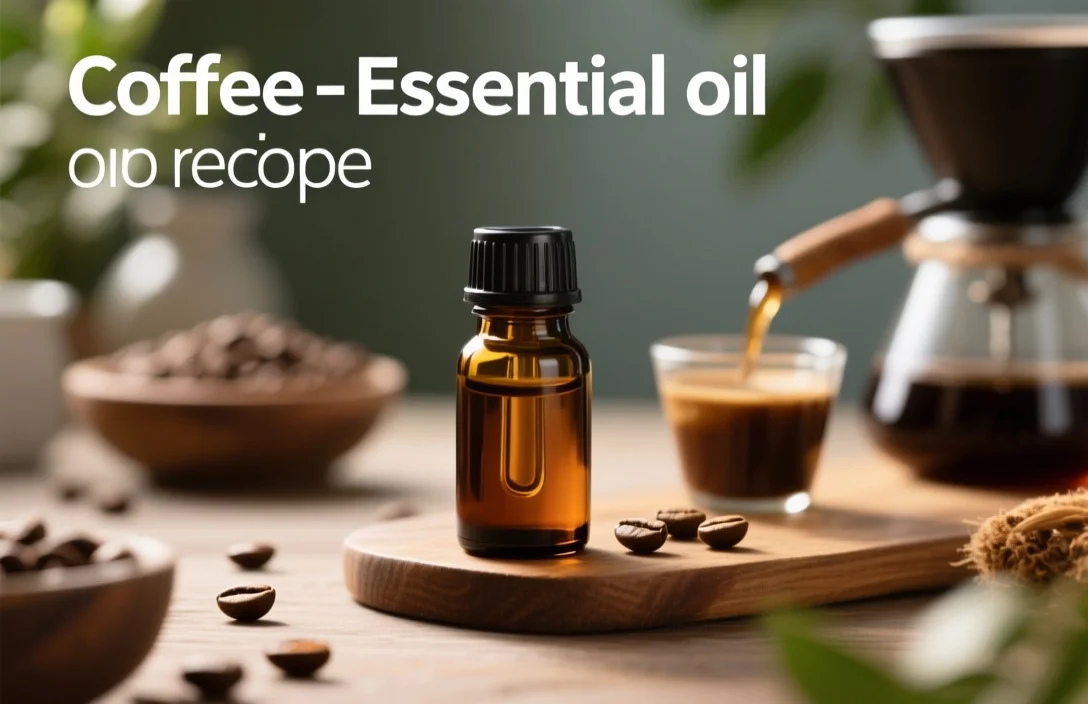
You can make a coffee-scented oil at home by infusing coffee beans in a neutral carrier oil; that yields a richly aromatic coffee-infused oil suitable for cosmetic or scent uses but not a chemically true essential oil. This coffee essential oil recipe gives a reliable kitchen-friendly method, timing, doneness cues, substitutions, storage advice, and troubleshooting so you finish with a stable, fragrant product.
What this recipe produces and why it matters
This recipe produces an aromatic oil that carries the volatile aromas of roasted coffee. Commercial “coffee essential oil” is usually produced by industrial solvent extraction or CO2 extraction and concentrates volatile compounds far beyond what home infusion can achieve; your kitchen infusion recreates scent and some oil-soluble aroma compounds, not a high‑concentration essential oil.
I compared three practical home approaches for coffee scent extraction – cold infusion, warm (decoction-style) infusion, and short steam/modern distillation attempts – and chose the warm-infusion method here as the best compromise between extraction speed, aroma strength, and safety for home users. Cold infusion is gentler on delicate notes but takes weeks and often smells flatter. Attempting steam distillation at home risks poor yields and bitter grassy notes unless you have lab-grade equipment; avoid it unless you understand steam-distillation technique and safety.
Ingredients and equipment
Start with high-quality ingredients and a few basic tools. Freshness of the coffee beans and the choice of carrier oil are the two variables that most influence aroma.
Ingredients (yields ~250-300 mL infused oil):
- 1 cup whole roasted coffee beans (medium to dark roast recommended)
- 2 cups neutral carrier oil (jojoba, fractionated coconut oil, sweet almond oil, or grapeseed oil)
- Optional: 1 tablespoon finely powdered roasted coffee for a stronger initial hit (strain carefully)
Equipment:
- Clean 500-750 mL glass jar with tight lid (preferably amber or dark)
- Small saucepan or double boiler (for warm infusion)
- Fine mesh strainer and two layers of cheesecloth or a nut milk bag
- Dark glass storage bottles with dropper or pump
- Scale or measuring cups
- Funnel and labels
Choose a carrier oil with low aroma to let the coffee character show. Jojoba behaves chemically like a liquid wax and is one of the most stable choices for scented oils; fractionated coconut oil stays liquid at room temperature and is odorless. Sweet almond and grapeseed will add a faint nutty background and perform well for topical use.
Timing, temperature, and yield expectations
Expect time to be the trade-off: longer and cooler yields smoother, subtler aroma; warmer and shorter yields bolder, more roasted scent. Yield below refers to finished infused oil volume, not essential-oil concentrate.
Warm infusion schedule (recommended):
- Active prep and heat time: 30-45 minutes
- Steeping time off heat: 24-48 hours
- Total time before first straining: about 1-2 days
Cold infusion schedule:
- Active prep: 10-20 minutes
- Steeping time at room temperature or cool dark place: 1-4 weeks
- Mild daily agitation improves extraction
For warm infusion, keep temperatures low – do not exceed roughly 60-70°C (140-158°F) at the oil surface – to avoid burning volatile aromatics or cooky flavors. Use a double boiler to maintain gentle, even heat. Expect a finished aromatic oil equal to the carrier oil volume minus minimal absorption by grounds; losses are primarily filtration-related.
Method – step-by-step numbered process
Measure ingredients and follow these steps exactly for the recommended warm-infusion method. Each step begins with a verb.
- Grind: Coarsely crack or crush the whole beans, not fine-ground powder; aim for a texture between coarse-sand and rough kosher salt. Crushing increases surface area while limiting fines that make straining harder.
- Combine: Place the crushed beans and carrier oil in your glass jar at a roughly 1:2 volume ratio (coffee:oil). Add the optional tablespoon of powdered coffee only if you plan to filter with a fine cloth.
- Heat: Warm the jar contents in a double boiler using low-to-medium heat for 20-30 minutes with occasional stirring. Maintain a temperature below boiling; avoid prolonged high heat that will darken or scorch aromatics.
- Steep: Remove the jar from heat, cap it, and let it steep in a warm, dark location for 24-48 hours. Flip or gently invert the jar 1-2 times to redistribute oils and solids.
- Strain: Pour the oil through a fine mesh strainer lined with two layers of cheesecloth or a nut milk bag into a clean bowl. Press gently to extract trapped oil but avoid forcing sediment through.
- Rest: Allow the strained oil to sit for several hours; any remaining sediment will settle. If cloudiness remains, repeat filtration through fresh cheesecloth or a coffee filter.
- Bottle: Transfer the clear infused oil into dark glass bottles using a funnel. Label with contents and date.
- Age (optional): Letting the bottled oil sit for 1-2 weeks allows aromatics to mature and any harsh green notes to mellow.
Warm infusion extracts oil-soluble scent components faster than cold infusion. Cold infusion requires less heat risk and preserves subtle top notes, but it takes longer and may need a second infusion to reach the same strength.
Doneness cues and how to judge aroma strength
Recognizing the right moment to stop steeping prevents overly roasted or stale notes and ensures extraction is complete.
Visual and olfactory cues:
- Aroma intensity: Smell the oil after 24 hours. A properly infused oil will smell distinctly of roasted coffee without burnt or bitter undertones. If aroma is weak, re-seal and steep another 24-48 hours.
- Color change: Expect the carrier oil to deepen from pale to medium-brown. A very dark, muddy brown may indicate overheated or over-extracted oil with harsher notes.
- Sediment: Fine coffee particles will settle. Minimal suspended particles are normal; very cloudy oil suggests too many fines passed through during filtration.
- Skin test (for cosmetic use): Apply a small drop to an inner forearm and wait 24 hours to check for irritation before larger topical use. Patch testing is essential with new formulations.
If the scent shifts toward burnt, acrid, or overly astringent, stop the infusion, strain, and consider blending with fresh carrier oil to soften the edge.
Substitutions and scent adjustments
Swapping beans, roast, or carrier oil creates different aroma profiles and functional uses. Match choices to final use – perfumery, massage oil, or room scent.
Beans:
- Dark roasts emphasize smoky, chocolatey, and caramelized notes.
- Medium roasts preserve brighter, slightly acidic notes and more fruity/floral top notes.
- Espresso blends often give a deep, concentrated aroma suitable for perfume blends.
Carrier oils:
- Jojoba: Most stable and least odorous, best for scented oils intended for skin application.
- Fractionated coconut oil: Odorless and lightweight; ideal for body oils and roll-ons.
- Sweet almond oil: Adds a skin-softening feel and faint nutty background.
- Grapeseed oil: Light, sinks in quickly; choose for massage applications.
Scent boosters and harmonizers (use sparingly):
- Vanilla absolute or vanilla-infused oil: 1-2% by volume to add sweetness and round edges.
- Bergamot or orange essential oil: Small percentages (0.5-1%) to lift top notes, but perform a patch test when blending with citrus EO.
- Cocoa absolute: Use with dark-roast infused oil to enhance chocolatey facets.
Avoid adding heat-sensitive essential oils until after infusion and cooling. Keep blend ratios conservative; home-infused oils are already aromatic and can overpower added essential oils.
Storage, shelf life, and packaging
Proper storage preserves aroma and prevents rancidity. Treat coffee-infused oils like other natural oil products.
Packaging:
- Use amber or cobalt blue glass bottles to limit light exposure.
- Keep containers airtight; minimize headspace once most oil is used.
- Label each bottle with ingredients and the bottling date.
Temperature and shelf life:
- Store in a cool, dark place away from direct sunlight and heat sources.
- Shelf life depends primarily on the carrier oil’s stability. Stable carriers like jojoba can extend aroma life; less stable carriers may oxidize sooner.
- Monitor for off smells (rancid or sour) and visual signs (cloudiness that does not clear, mold) and discard if present.
Refrigeration slows oxidation but can cause some carrier oils (non-fractionated coconut, almond) to cloud or solidify temporarily. Return to room temperature before use; scent should rebound.
Troubleshooting: common mistakes and fixes
A short problem/fix list addresses issues readers commonly face. Each entry explains cause and remedial steps.
- Problem: Oil smells flat or weak.
Fix: Re-infuse using fresh grounds at a lower grind and repeat warm infusion for another 24-48 hours. Use more whole beans for a stronger aromatic ratio.
- Problem: Oil smells burnt or acrid.
Fix: Stop infusion immediately, strain, dilute with fresh carrier oil (1:1) to soften the bite, and blend in a tiny amount of vanilla-infused oil to round the profile.
- Problem: Sediment or gritty texture in finished oil.
Fix: Filter again through a coffee filter placed inside a fine mesh sieve, then decant carefully. Allow oil to settle between filtrations.
- Problem: Skin irritation after topical use.
Fix: Perform a patch test next time with a 1% dilution of aromatic oil in carrier. If irritation occurs, stop use and consult medical advice when necessary.
- Problem: Mold or cloudy growth in jar.
Fix: Discard immediately. Use fully dry, sterile jars and ensure all grounds are submerged completely in oil to reduce moisture pockets.
Cleanliness prevents contamination. Sterilize jars with boiling water or alcohol wipe and dry completely before starting.
How a home infusion differs from commercial coffee essential oil
Home infusions extract oil-soluble aroma compounds and fat-soluble components; industrial processes capture a wider range of volatiles. Knowing the chemical and practical differences helps set correct expectations.
Industrial extraction methods:
- CO2 extraction and solvent (hexane) extraction access both volatile aromatics and nonvolatile aroma precursors, yielding concentrated coffee absolutes or extracts that smell far stronger and closer to the bean’s full aroma profile.
- Steam distillation selectively collects volatile compounds and can produce an essential oil from some botanicals; roasted coffee’s complex, heat-generated aroma profile does not lend itself well to straightforward steam distillation in a home setup.
Home method limits:
- Carrier oil will dilute aroma significantly relative to concentrated commercial extracts.
- Some desirable volatile esters and small molecules that create “top notes” are lost during roasting or heat; cold infusion can preserve lighter notes better but still cannot match industrial concentration.
- Solvent-free infusions remain suitable for cosmetic or scent use but are inadequate when a concentrated essential oil is required for perfumery or flavor manufacture.
After comparing practical outcomes from different methods, warm oil infusion stands out for home users aiming for safety, aroma clarity, and manageable time investment.
Safety and legal notes for topical use
Treat scented oils with the same precautions used for essential oils and topical cosmetics. Safety steps reduce allergic reactions and legal exposure if you intend to sell.
- Always patch test: Apply a diluted drop on inner forearm and check after 24 hours for redness or itch.
- Keep dilutions safe: For general topical use, keep aromatics at low percentages – home-infused oil already contains coffee aroma; do not exceed 2-5% added essential oils without proper guidance.
- Label allergens: If you use nut-based carriers (almond) or additives, label clearly for others who may have allergies.
- Cosmetic regulations: Selling homemade oils may trigger local labeling and registration requirements; check state and local rules if you plan to commercialize.
Do not attempt solvent extraction or industrial-scale methods at home; those require controlled hazardous materials handling and specialized equipment.
Quick substitution table: method comparison
| Method | How it works | Best for | Pros | Cons |
|---|---|---|---|---|
| Cold infusion | Coffee steeped in oil at room temp for 1-4 weeks | Preserving delicate top notes | Low heat damage; simple | Long time; milder aroma |
| Warm infusion (this recipe) | Gentle heat extracts aroma faster, then cool steep | Most home users wanting fast strong scent | Faster extraction; stronger aroma | Heat can change some volatile notes |
| Steam distillation (industrial-style) | Steam passes through plant material to collect volatiles | Professional essential oil production (not typical for roasted coffee) | Can concentrate certain volatiles | Poor yields for roasted coffee; requires equipment |
| Solvent/CO2 extraction (commercial) | Solvent or CO2 extracts and concentrates coffee aroma compounds | Commercial absolutes and perfumery | Produces strong concentrated extract | Not safe/feasible at home; requires industrial setup |
Table notes: this comparison highlights suitability and practical trade-offs rather than specific yield figures.
Practical
Give practical finishing ideas that turn your infused oil into products readers can use immediately.
- Room and linen spray: Combine 20-30 mL of infused oil, 5 mL high-proof vodka or solubilizer, and 100 mL distilled water in a spray bottle. Shake before each use.
- Massage oil: Use infused oil as-is or blend with 5-10% lavender essential oil for a relaxing massage formulation. Patch test and keep dilution modest.
- Solid perfume: Mix 20 g beeswax with 80 g infused oil, melt gently, pour into tins, and cool. Solid format concentrates the scent on skin contact.
- Soap or candle fragrance: Use small percentages of infused oil where recommended by your base recipe; test burn/saponification properties first.
Always test small batches when adapting to recipes to ensure scent stability and compatibility.
FAQ
Can I make a true coffee essential oil at home?
A concentrated coffee essential oil produced by CO2 or solvent extraction cannot be replicated safely at home with kitchen tools. Home infusions create aromatic oils but not industrial-grade extracts.
Which roast gives the best scent for infusion?
Dark roasts provide deep, chocolatey and smoky characteristics, while medium roasts preserve brighter, more floral top notes. Choose based on the scent you prefer; dark roast is a safe default for strong coffee scent.
How long will my coffee-infused oil keep?
Shelf life depends on the carrier oil; stable carriers like jojoba extend aroma retention. Store in dark glass away from heat and check for off odors; discard if rancid or moldy appears.
Is it safe to put coffee-infused oil on my face?
Use caution: cosmetic-grade carrier oils and low concentrations are safer. Patch test first, and avoid leaving oils on acne-prone or highly reactive skin without dermatologist guidance.
Can I reuse the coffee grounds to make more oil?
Reusing grounds yields diminished scent and increases sediment risk. If you want to extend use, perform a second, shorter infusion with fresh carrier oil and accept a weaker aroma.
Verdict and next
This warm-infusion coffee essential oil recipe gives a fast, safe, and repeatable way to capture roasted coffee aroma in a carrier oil suitable for topical and scent uses. Your next step is to pick a carrier oil (jojoba for longevity, fractionated coconut for neutral feel), buy a fresh bag of whole beans that match your scent preference, and try a single 250-300 mL batch following the method above. Keep notes on bean roast, infusion times, and final aroma so you can refine your process into a signature blend.

- Espresso Tastes Watery? 10 Common Causes and How to Fix It - October 23, 2026
- 10 Common Coffee Equipment Cleaning Mistakes and How to Avoid Them - October 23, 2026
- 17 Common Coffee Grinder Problems and How to Fix Them - October 23, 2026