
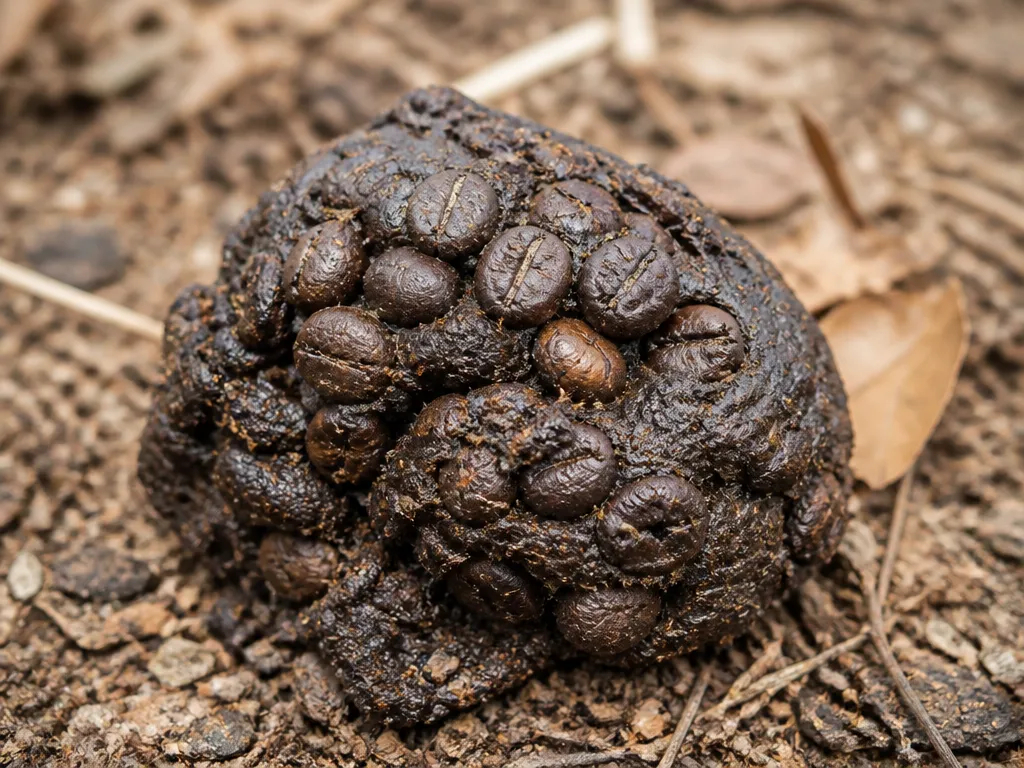
“Coffee beans from poop” are real in a limited sense: some specialty coffees use seeds recovered after an animal eats coffee cherries and passes the seeds through its digestive system. Civet coffee and elephant-processed coffee are the best-known examples. The recovered seeds are washed, dried, sorted, and roasted before they become drinkable coffee.
The phrase can also refer to an internet rumor about making coffee from human waste. That is not a safe or legitimate home process. Commercial coffee comes from roasted seeds of the Coffea plant, and any animal-processed product still depends on sanitation, testing, and normal coffee roasting.
Key Takeaways
- The etymology is separate from the poop story. “Coffee” entered English in 1582 from Dutch koffie.
- Myths exaggerate the process. Commercial coffee still relies on Coffea seeds and roasting.
- Species affect the result. The two most grown types are C. arabica and C. robusta, while different animals can produce different processing effects.
- Digestive processing is real. Animal-processed seeds are recovered, washed, dried, and roasted.
- Safety is non-negotiable. Untreated feces are a sanitation risk and should never be used to make coffee.
- Most coffee is conventional. The global industry trades green coffee beans, then roasts and brews them.
Where the “Coffee Beans From Poop” Phrase Comes From
The phrase “coffee beans from poop” is modern, messy shorthand. It usually refers to coffee seeds that passed through an animal, not to the origin of the word “coffee.” That word entered English in 1582 through Dutch koffie, which came from Ottoman Turkish kahve and ultimately Arabic qahwah. The etymology describes the beverage’s name, not how its seeds are processed.
Coffee is brewed from roasted, ground coffee beans. Botanically, those “beans” are seeds inside the fruit of a Coffea plant, commonly called a coffee cherry. When people say “coffee from poop,” they are usually describing an unusual route from fruit to roasted seed: an animal eats the cherry, the seed passes through its gut, and people later recover and process it.
Two separate questions often get mixed together:
- Where does the word “coffee” come from?
- Can coffee seeds pass through an animal and still be used?
The first answer has a clear linguistic history. The second describes a niche processing method that is real for some animal-processed coffees but does not make untreated waste safe.
How Animal-Processed Coffee Became a Legend
The earliest reports of coffee drinking are tied to Yemen in the middle of the 15th century. By the end of the 17th century, much of the world’s coffee had been imported from Yemen. That history concerns coffee trade and culture, not fecal processing.
The animal-processed coffee story follows a simple pattern: an animal eats ripe coffee cherries, the seeds pass through its digestive system, and people recover the seeds afterward. Civet coffee and elephant-processed coffee became the modern “poop coffee” archetypes because their beans are collected after digestion. A real product still requires washing, drying, careful handling, sorting, and roasting.
Internet versions of the story often add two unsupported ideas. One claims that digestion automatically makes coffee better. The other suggests that people can safely reproduce the process at home using untreated waste. Neither assumption is sound. Digestion may alter the seeds and their flavor, but it does not guarantee quality or eliminate pathogens.
How Species and Animals Change the Coffee
The coffee plant still sets the basic flavor profile. The two most commonly grown types are C. arabica and C. robusta, and their different chemistry affects acidity, body, and bitterness after roasting. Digestive processing can alter the flavor, but it cannot erase the characteristics of the original seed.
Coffee plants are cultivated in over 70 countries, mainly in equatorial regions of the Americas, Southeast Asia, the Indian subcontinent, and Africa. Species, growing environment, and farm conditions all affect the crop before an animal ever eats the fruit. Anyone comparing animal-processed coffees still needs to know the plant type and origin.
The animal matters too. Digestion time, gut bacteria, and the time between eating and passing the cherries can vary by species. Two gut-passed coffees may therefore taste different even when their original variety and growing region are similar. “Poop coffee” is not one standardized product; it is a processing route applied to coffee that already varies by plant, farm, and region.
A useful product description should identify the coffee variety, such as arabica or robusta, its origin, the animal involved, and the steps taken after recovery. If a listing emphasizes the poop angle but provides none of those details, it is selling novelty more than useful coffee information.
How Animal-Processed Coffee Is Produced
Commercial coffee starts with Coffea fruit and its seeds, regardless of how those seeds are later described. In conventional production, seeds are removed from coffee cherries to create unroasted green coffee beans. Those beans are dried, stored, roasted, ground, and brewed.
Animal-processed coffee changes one part of that supply chain. An animal eats ripe cherries, and people recover the seeds later instead of removing them directly at the farm. Cultivation, cherry harvesting, drying, sorting, and roasting still matter. The relevant production question is not “how do you grow poop coffee?” but “how is the animal-processed supply collected and handled?”
Mainstream coffee is traded as an agricultural commodity, with supply chains built around harvest lots, drying, storage, and roasting schedules. Animal-processed coffee is usually more limited and logistically difficult because recovery and sorting depend on animal behavior and additional labor. That scarcity can raise the price, but it does not prove superior quality.
How the Seeds Are Cleaned and Made Safe
The safe, commercial version of “poop coffee” is a processed food product, not raw fecal material. Animal digestion does not reliably sanitize bacteria. Consumer safety depends on recovering the seeds, washing them, drying them, sorting them, and roasting them under controlled conditions.
Once the seeds become green coffee, they follow the normal path to roasting and grinding. Roasting is part of coffee production, but it does not excuse unsafe handling earlier in the process. The recovery and sanitation steps before roasting are critical because contaminated seeds can create risks during collection, transport, and preparation.
Skip any home recipe that suggests fermenting, soaking, or processing human or animal waste into coffee. Kitchen methods cannot reliably verify contamination levels or confirm that pathogens have been controlled. A claim that the method “works” says nothing about whether the finished product is safe.
Animal-Processed Coffee, Pests, and Environmental Trade-Offs
Animal-processed coffee does not provide automatic pest control. Coffee farms still face pests and other management challenges, while animals eating ripe fruit can change local interactions around the crop. The digestive route is primarily a way to recover seeds after fruit consumption, not a replacement for agricultural pest management.
The environmental effects depend on how the animals and coffee are sourced. Animals feeding in unmanaged or semi-managed areas may be part of a more biodiverse setting, but their behavior can make coffee collection and quality less predictable. Keeping animals near production areas or encouraging them to feed there creates additional welfare and management concerns.
Claims about ecological benefits need farm-level details. A responsible product should explain where the coffee comes from, how animals are involved, and what farming practices are used. “Poop is natural” is not an environmental assessment.
Why Most Coffee Is Not Animal-Processed
Most coffee sold in the United States comes from a large-scale system based on green coffee trading and industrial or specialty roasting. Green, unroasted coffee is traded as an agricultural product; later, the beans are roasted, ground, and brewed, often through high-volume supply chains.
Colonial trade helped turn coffee into a global staple. Up to the end of the 17th century, much of the world’s coffee was imported from Yemen. Later trade routes spread coffee production and consumption to other regions. Reliable global trade made large-scale supply, standardized roasting, and widespread availability possible.
Animal-processed coffee sits on top of that system as a specialty niche. It is not the source of the world’s coffee supply. Gut-passed beans are a small fraction of the market because collection depends on animal behavior and labor-intensive recovery and sorting. Conventional cultivation, processing, and roasting drive mass production.
FAQ
Are “coffee beans from poop” actually real?
Yes, in the limited sense that some specialty coffees use seeds recovered after animals eat coffee cherries. The seeds are then washed, dried, sorted, and roasted like other coffee before they are brewed. Making “poop coffee” at home from untreated feces is neither safe nor legitimate.
Why do people pay more for animal-processed coffee?
Animal-processed coffee can require extra labor because the seeds must be recovered, cleaned, and sorted after digestion. It is also usually produced in smaller volumes, which can make supply tighter. A higher price does not guarantee better taste, so check the variety, such as Coffea arabica or Coffea robusta, along with the origin and roast details.
Is poop coffee safe to drink?
A commercial animal-processed coffee should be safe when it has been properly recovered, washed, dried, roasted, and handled as a food product. Safety depends on those controls, not on digestion alone. Avoid anything marketed as homemade, raw, or made from untreated waste.
How can I buy a trustworthy “poop coffee” product?
Choose a roaster that clearly lists the origin, processing method, roast date, and lot information. Look for details about washing and drying after seed recovery, as well as whether the coffee is arabica or robusta. If the description relies on shock value and omits basic coffee information, treat it as a novelty product.
What is the most common mistake people make with this topic?
They assume that passing through an animal automatically sanitizes the seeds. Digestive processing may change flavor, but it does not replace washing, drying, roasting, or quality controls. The mistake is focusing on the gross origin while ignoring food safety and coffee quality.

- Espresso Tastes Watery? 10 Common Causes and How to Fix It - October 23, 2026
- 10 Common Coffee Equipment Cleaning Mistakes and How to Avoid Them - October 23, 2026
- 17 Common Coffee Grinder Problems and How to Fix Them - October 23, 2026