
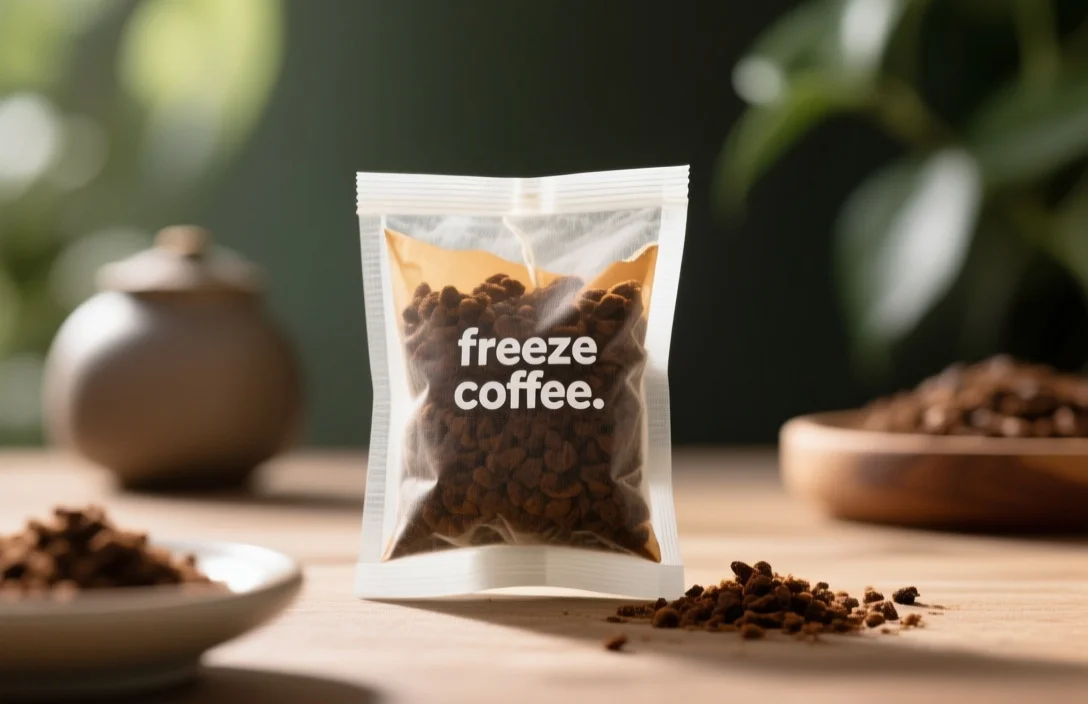
Freeze dried coffee is instant coffee made by freezing brewed coffee and removing the ice by vacuum-driven sublimation, a process that preserves more of the coffee’s aroma than high-heat spray-drying. Use it when you want a fast cup that stores compactly, performs well in camping and emergency kits, and tastes closer to brewed coffee than many other instant options.
What freeze dried coffee is
Freeze dried coffee is simply brewed coffee that has been frozen solid and then placed in a vacuum so the ice turns directly to vapor and leaves dry coffee granules behind. That definition applies to ready-to-drink brew processed for long-term storage and also to industrially produced instant coffee labeled “freeze-dried.” Processing aims to keep volatile aroma compounds intact by avoiding the high temperatures used in spray-drying.
Manufacturers start with brewed coffee or concentrated extract and then freeze it quickly to form small ice crystals. After freezing, a low-pressure chamber removes the ice through sublimation; this keeps the soluble solids and most flavor compounds in place instead of driving them off with heat. The result is a porous, often flaky or granular product that dissolves quickly in hot water.
How freeze-drying preserves aroma and flavor
Low temperature and low pressure are the technical levers that set freeze-drying apart from other drying methods. Rapid freezing traps volatile aromatics inside the ice matrix rather than letting them evaporate, and sublimation avoids a liquid phase that would otherwise dissolve and carry away flavor molecules.
Porosity is another important outcome. Granules made by freeze-drying are highly porous, which allows hot water to penetrate quickly and extract flavor more completely during rehydration. That physical structure also helps aroma release when you stir or smell the cup. Taste differences between freeze-dried and spray-dried products often come down to how much of those volatile aromatics survive the process.
Freeze-dried vs spray-dried vs ground coffee – quick comparison
Comparing the main options side by side clarifies where freeze-dried coffee fits. The short table below compares common choices on price/key spec and the situations each is best for. Exact retail prices were not available in the sources I checked, so the Price/Key Spec column uses qualitative descriptors rather than dollar values.
| Name | Price / Key Spec | Best For |
|---|---|---|
| Freeze-dried instant coffee | Higher preservation of aroma; porous granules; usually rehydrates quickly | Camping, emergency kits, quick cups for people who prioritize aroma |
| Spray-dried instant coffee | Smaller, powdery particles; cheaper to produce at scale; more heat-exposed | Lowest-cost instant, large-scale foodservice, baking ingredients |
| Soluble micro-ground (agglomerated) | Larger particles made by rewetting/aggomerating powders; balanced solubility and aroma retention | Instant mixes and premium instant offerings |
| Whole-bean coffee | No processing beyond roasting and grinding; highest aroma fidelity when freshly ground | Home brewing, espresso, pour-over |
| Ground coffee (pre-ground) | Convenient but loses volatile aromatics faster than whole bean | Home/office where brewing equipment is available |
After comparing these options side by side, freeze-dried coffee stands out where storage life and aroma retention are both priorities but brewing equipment is unavailable or impractical.
Who should choose freeze-dried coffee?
Frequent travelers, backpackers, boaters, and people assembling emergency kits will find the trade-offs favorable. Portability, low weight for the caffeine delivered, and fast rehydration are real advantages when you cannot carry beans and a grinder or when fuel and water are limited.
Office users who prioritize convenience over the ritual of brewing may also prefer it, especially when they want a cup with fewer of the “flat” flavor notes associated with cheap spray-dried instant. Home baristas who care about espresso shot fidelity should opt for whole-bean or freshly ground coffee instead, because crema and extraction behavior cannot be replicated by instant products.
How to evaluate freeze-dried coffee before you buy
After comparing the main options side by side, look at three practical criteria: ingredient list, granule appearance, and packaging. Ingredient lists that read only “100% coffee” or “coffee” indicate minimal additives; watch out for listings that include sugar, artificial creamer, or stabilizers if you expect plain black coffee.
Examine the granules visually if possible. Large, irregular, flaky granules typically indicate a freeze-dried product and tend to rehydrate more cleanly than fine powders. Smell the product through the packaging when allowed; when aroma is present in the sealed package it usually indicates better preservation. Finally, packaging that is vacuum-packed or nitrogen-flushed with a resealable barrier will slow oxidation after opening.
A practical buying checklist:
- Read the ingredient list for single-ingredient coffee.
- Prefer granules that look porous and flaky over fine powder.
- Choose opaque, resealable packaging with a one-way freshness valve or oxygen barrier when available.
- Consider brand transparency about roast origin and roast date if you want a specific flavor profile.
How to prepare freeze-dried coffee for best flavor
Follow these steps for a consistently better cup:
- Heat water to the temperature you prefer for brewing; 195-205°F is standard for brewed coffee but exact temperature can be lower for instant coffee depending on taste.
- Measure coffee by level teaspoon or manufacturer guideline; start with a little less and adjust upward if the cup tastes weak.
- Add a small amount of hot water first, just enough to wet the granules, and stir to release aroma.
- Top up with the remaining hot water and stir again to ensure complete dissolution.
- Taste and adjust strength with additional coffee or water as needed.
An alternative preparation trick is to use a short bloom step – wet the granules and wait 10-15 seconds before adding the rest of the water. That encourages dissolved aromatics to release and can reduce any flatness. Cold rehydration is possible but highlights different flavor traits; stirring longer or using a fine whisk helps.
Storage, shelf life, and emergency prep
Shelf-stability is a primary reason people buy freeze-dried coffee, but storage conditions determine how long quality lasts. Store unopened containers in a cool, dark place away from heat sources, and move opened product into an airtight container with an oxygen absorber if you plan to keep it long-term.
Exact shelf-life numbers were not available in the materials I reviewed, so avoid trusting headline claims on packaging without cross-checking the brand’s published guidance. Typical manufacturer statements are often conservative for safety rather than flavor – coffee can remain safe to drink long after aromatic quality declines. For emergency kits, rotate stock every few years and test a packet before relying on it in a survival scenario.
Practical storage tips:
- Keep packaging sealed between uses.
- Use silica packets or oxygen absorbers when transferring to jars.
- Freeze an opened jar for very long-term storage if you will not use it frequently; do not re-freeze after moisture exposure.
- Label containers with the date you opened or repackaged them.
Can you freeze-dry coffee at home?
Industrial freeze-drying requires consistent low temperatures and a reliable vacuum system and is not a simple kitchen project. Household freezers and consumer vacuum sealer combinations do not achieve the pressure, temperature, or controlled heat inputs that industrial lyophilizers use. Attempting to replicate the process at home will usually produce poor results and risks contamination if not done hygienically.
Home possibilities include buying a small consumer freeze-dryer designed for hobbyists and food preservation. Those units exist but are relatively expensive and operate slowly; they are better suited to preserving home-grown produce or meal preps than to saving cost on coffee. Buying pre-made freeze-dried instant will typically be more economical unless you already have a hobby-grade freeze-dryer and a need to preserve many different foods.
Taste expectations and how to tell quality
Expect a cup made from high-quality freeze-dried granules to taste brighter and more aromatic than one made from spray-dried instant. Flavor nuances – acidity, citrus or chocolate notes, body – will still be muted compared with freshly brewed coffee, but a well-made freeze-dried product can approximate brewed character surprisingly well.
Assessing quality involves three sensory checks: aroma out of the jar, clarity of flavor in the cup, and absence of off-notes such as cardboard or sourness. Brewing technique affects perception; over-dilution and under-extraction (using too-cool water or too-few granules) can make even premium instant taste lifeless. Tasting multiple brands in controlled conditions – same water temperature and ratio – gives a direct comparison.
Common mistakes and how to avoid them
People commonly make avoidable errors when switching to freeze-dried coffee. Using too little coffee, pouring boiling water directly without letting it cool slightly, and failing to stir are frequent causes of subpar cups. Another mistake is storing opened jars in humid kitchens; moisture causes clumping and accelerates stale flavors.
Corrective actions are straightforward:
- Measure: start with the manufacturer’s guidance or one level teaspoon per cup, then calibrate.
- Heat control: avoid pouring water straight off a rolling boil; a short pause yields better extraction.
- Stir and bloom: wet the granules briefly before adding the final water volume.
- Store properly: reseal jars and keep them in dry, cool locations.
When freeze-dried coffee is not the right choice
Instant forms cannot reproduce fresh espresso, crema, or the tactile ritual of grinding and brewing. People aiming for espresso-based milk drinks or those who enjoy single-origin tasting sessions should stick to whole-bean coffee and proper equipment. Similarly, if you prioritize price above all else and have easy access to brewing gear, bulk ground coffee probably offers a lower cost-per-cup.
Conserving caffeine while minimizing packaging waste may also steer some consumers away from single-use instant sachets. Bulk packaging with a reusable container reduces per-serving packaging and environmental impact compared to individually portioned sticks.
Brand transparency and labeling to look for
Labels that list roast date, origin, and roast level indicate a company that cares about quality and traceability. Brands that only state “instant coffee” without origin information are not necessarily low-quality, but informed buyers will prefer those that disclose more. Look for specific descriptors such as “freeze-dried from brewed Arabica” or “single-origin” if you’re chasing a particular flavor profile.
Cold brew concentrates that are freeze-dried are a niche product but exist; check ingredient lists carefully because those offerings sometimes include soluble sugars or additives intended for ready-made mixes. When in doubt, choose single-ingredient packaging for the purest comparison.
Environmental and cost trade-offs
Manufacturing freeze-dried coffee uses energy for freezing and vacuum cycles, which can be more energy-intensive per kilogram than spray-drying at large scale; precise environmental impact depends on the factory’s energy source and processes. Packaging choices matter more to many buyers – bulk containers lower per-cup packaging waste compared with single-serve sachets.
Cost comparisons are brand- and market-dependent, and the exact current retail prices were not available in the materials I reviewed. Plan purchases by unit weight rather than by package count, and consider per-serving volume because granule density varies between types. Expect a higher price premium for freeze-dried products positioned as “premium instant.”
Which product to pick
Case 1 – Weekend camping: choose freeze-dried granules sold in light, resealable bags for quick wake-up cups with minimal gear.
Case 2 – Emergency preparedness: opt for large jars sealed against oxygen with an eye to shelf-stability and rotate on a schedule.
Case 3 – Office convenience: select single-ingredient agglomerated freeze-dried instant if you want a taste closer to brewed coffee without equipment.
Case 4 – Daily specialty brewing at home: buy whole-bean fresh-roasted coffee and a grinder instead of any instant product.
FAQ
Is freeze-dried coffee the same as instant coffee?
Freeze-dried coffee is a type of instant coffee made by freezing brewed coffee and removing ice through sublimation; instant coffee also includes spray-dried products, which use heat and produce a different particle structure and flavor profile.
How long does freeze-dried coffee last?
Specific shelf-life labels vary by brand and packaging; I did not find reliable exact shelf-life numbers in the sources I checked, so follow the manufacturer’s guidance and store the product sealed in a cool, dry place for best quality.
Can I use freeze-dried coffee in cold brew or iced coffee?
Yes, cold rehydration is possible but requires more stirring or agitation to dissolve fully; using a small whisk or shaking the mixture helps. Flavor will shift compared with hot rehydration.
Is freeze-dried coffee healthier than ground coffee?
Nutritionally, freeze-dried instant and brewed coffee are similar in caffeine and basic composition when made from 100% coffee. Health differences depend more on added ingredients like sugar or creamers included in some instant mixes.
Are there single-serve freeze-dried coffee sachets worth buying?
Single-serve sachets are convenient and reduce guesswork on dosing, but they produce more packaging waste per cup. Look for high-quality brands that offer single-ingredient sachets if you want convenience without additives.
Verdict and next
Freeze-dried coffee is a practical middle ground when you need portability and better aroma retention than basic instant coffee. Buyers who value convenience for travel, emergencies, or quick office cups should sample a few reputable freeze-dried products, comparing aroma out of the package and flavor in a controlled brew. Start by buying a small package of a brand that lists “100% coffee” or roast origin, then use the preparation steps above to dial in strength and temperature.

- Espresso Tastes Watery? 10 Common Causes and How to Fix It - October 23, 2026
- 10 Common Coffee Equipment Cleaning Mistakes and How to Avoid Them - October 23, 2026
- 17 Common Coffee Grinder Problems and How to Fix Them - October 23, 2026