
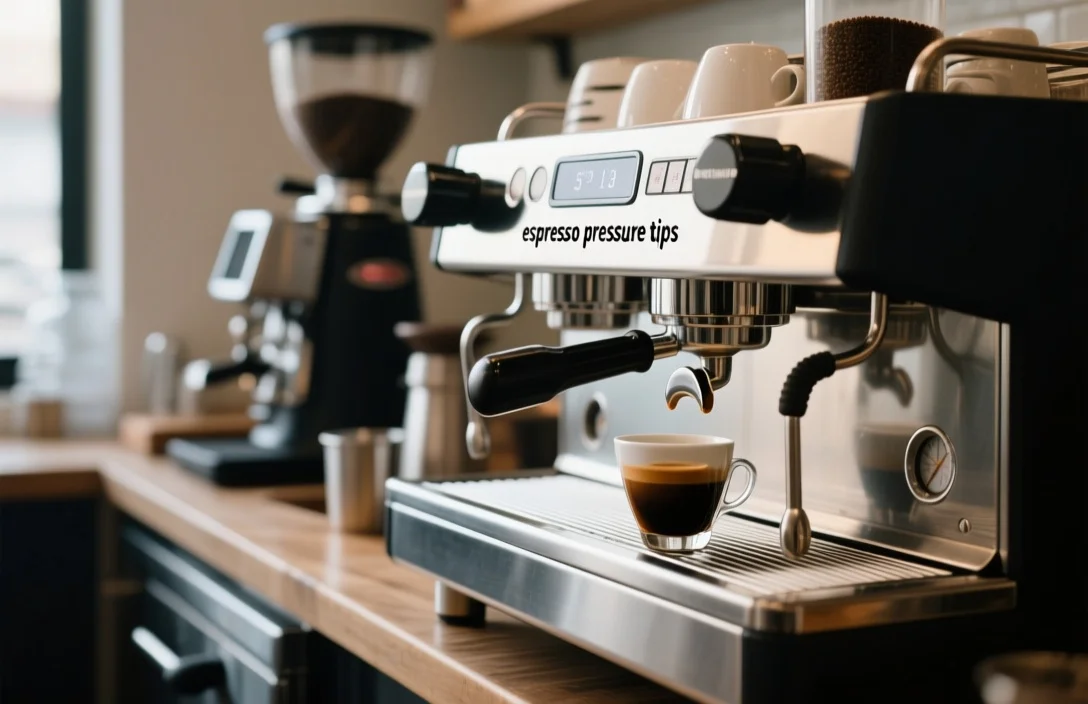
Short answer: espresso pressure matters because it controls how quickly water moves through the coffee puck, which directly affects extraction, crema, and flavor balance. Use a mix of grind, dose, tamp, distribution, pre-infusion, and machine upkeep to influence effective pressure at the puck; follow a repeatable test plan to dial in results.
Why pressure matters for espresso
Pressure is the hydraulic force that drives hot water through finely ground coffee and creates the concentrated, crema-topped beverage called espresso. Changes in how that water flows – faster or slower, channeled or even – create under-extraction (sour, thin) or over-extraction (bitter, astringent); both are outcomes linked to pressure as experienced inside the group head and the puck.
Shot time and flow rate are useful proxies for pressure at the puck because most home baristas cannot measure puck pressure directly. The Specialty Coffee Association recommends dialing in your grind so your shot pulls within the 20-30 second range for a balanced extraction; use that timing as a guide while you change variables that alter apparent pressure. Consistent puck resistance is the goal: stable flow that starts steady, forms a honey-like stream, and ends without violent sputtering.
How pressure and other variables interact
Grind size, dose, and tamp create the physical resistance the water sees. Finer grind increases resistance and slows flow; coarser grind reduces resistance and speeds flow. Dose matters because more coffee in the basket increases overall bed thickness and resistance. Tamping compresses and evens the puck surface; uneven tamping produces inconsistent channeling, which changes local pressure and ruins extraction.
Equipment-level features also change how pressure plays out. Pre-infusion briefly wets the puck at low flow to reduce immediate channeling and encourage even initial extraction. An adjustable over-pressure valve (OPV) or pressure profiling feature changes how the machine limits pump output and how pressure ramps during the shot. Worn group seals, clogged shower screens, or loose portafilters reduce effective pressure and make results inconsistent.
Symptoms to recognize and their likely pressure causes
Identifying whether your issue relates to “too much” or “too little” effective pressure at the puck helps pick the right fix. Table below summarizes common symptoms, what they usually indicate about resistance or flow, and immediate corrective actions.
| Symptom | Likely puck condition (pressure-related) | Immediate corrective action |
|---|---|---|
| Extremely fast stream, thin crema, sour or weak shot | Low resistance (too coarse grind, low dose, under-tamped, basket bypass) | Grind finer, increase dose slightly, tamp firmer and more even |
| Very slow drip, dark/bitter/tar-like flavours, prolonged shot time | High resistance (too fine grind, overdosing, excessive tamp) | Grind coarser, reduce dose slightly, reduce tamp pressure |
| Channeling (uneven jet, spurts, holes in puck) | Localized low-resistance paths that divert flow | Re-distribute grounds, use WDT or distribution tool, clean basket rim |
| Sputtering or sudden flow changes mid-shot | Blocked or partially blocked flow, leaking seals, or steam | Backflush machine, clean group and shower screen, check seals |
| Weak crema and watery body despite normal timing | Low extraction due to coarse grind, stale beans, or low pump output | Use fresher beans, grind finer, confirm machine is heating properly |
Practical espresso pressure tips to dial your shot
After comparing common approaches side by side, these practical rules of thumb give the largest, most repeatable effects on how pressure translates to extraction. Rank-ordered by how much impact they change puck resistance: grind > dose > tamp > distribution > equipment adjustments.
- Dial grind first. Small grind changes create large changes in flow. Make adjustments in single notches on your grinder and pull a test shot after each change.
- Stabilize dose next. Use a scale and keep dose consistent to eliminate variables when changing grind.
- Standardize tamp technique. Press straight, level, and consistent force for repeatable puck density. Consider a calibrated tamper if hand technique varies.
- Improve distribution. A simple WDT (Weiss Distribution Technique) with a thin needle or a distribution tool reduces channeling more reliably than aggressive tamping changes.
- Use pre-infusion when available. A short, low-flow pre-infusion reduces initial channel formation and gives a more even extraction.
- Maintain equipment. Clean shower screens, portafilter baskets, and group seals regularly. Dirty equipment changes flow faster than subtle adjustments to grind.
Follow a structured dialing process so you change only one variable at a time. Keep a log with grind setting, dose, tamp method, pre-infusion on/off, and resulting shot time and taste notes. That log will be the quickest path to predictable pressure control.
Step-by-step testing plan for home baristas
Adopt this repeatable plan to isolate whether your pressure-related problem is technique, coffee, or machine. Each step is designed to change only one thing so you can see its effect.
- Weigh your dose and zero a scale with the portafilter on it.
- Set grinder to your current setting and pull a baseline shot, noting time and tasting.
- Change only the grind one small notch finer. Pull a shot and record changes in flow and taste.
- Return to baseline grinder, change dose by 0.2-0.5 g (if you have a precise scale), and test again.
- Keep dose constant; change tamp method (use light, medium, heavy or a consistent calibrated tamper) and test.
- If channeling appears, use a distribution tool or WDT, then test again before changing grind.
- If flow is unstable or equipment behaves inconsistently, run a backflush cycle and clean group parts, then repeat tests.
- When shots fall in the 20-30 second window with steady flow and balanced tasting notes, lock in grind and dose and make small taste-driven refinements.
A notebook with at least five iterations normally reveals the direction to move. Taste notes are as important as timing – sourness points toward under-extraction and too-low resistance, bitterness toward over-extraction and too-high resistance.
Machine-level interventions and trade-offs
Minor pressure issues are usually solved with grind, dose, tamp, and distribution. Machines offer adjustments that can shape pressure when those variables cannot fully compensate. Pre-infusion, OPV adjustment, or pressure profiling require more mechanical access or a knowledgeable technician.
Pre-infusion is low-risk and often available via a setting on consumer and prosumer machines. Use it to promote even puck saturation before full flow begins. OPV changes alter how hard the pump can push against the group head; lowering OPV reduces maximum flow resistance but may reduce crema and body, while increasing it raises puck resistance but can push extraction toward bitterness if you don’t change grind or dose. Pressure profiling – intentionally changing pressure during a shot – gives creative control over sweetness and texture, but demands careful time/flow awareness and consistent technique.
Service-related fixes address effective pressure loss caused by hardware problems. Leaky group seals, worn portafilter gaskets, clogged shower screens, and old or poorly seated dispersion plates all make pressure inconsistent. Regular cleaning and scheduled servicing will stabilize your baseline so that puck-level adjustments work predictably. Balance the cost of machine modifications against how often you brew and what flavor outcomes you want; small shops and serious home baristas justify deeper interventions more than casual users.
Puck preparation, baskets, and how they change flow
Basket choice and puck preparation shape how uniform the resistance is. A narrow, deep basket concentrates grounds and increases resistance for a given dose; a shallow basket reduces it. Espresso basket types and volume vary across machines, so standardize by using the same basket when dialing.
Distribution methods have outsized value because they prevent early channeling that ruins shots regardless of pressure. A quick WDT pass before tamp removes clumps and creates an even surface for tamping. After tamping, inspect the basket rim and wipe any stray grounds; leaks at the rim create localized low-resistance points. If you see an irregular crema pattern or one-sided flow, rework distribution rather than immediately changing grind – the fix is often technique, not pressure.
Backflushing with an appropriate detergent for machines designed for it clears oils and scale that alter how water fans out through the shower screen. Scale buildup raises local temperatures and changes flow paths, which feels like a mysterious pressure issue. Keep a maintenance schedule and log to separate machine drift from technique errors.
Common mistakes that wreck pressure-related results
Beginner and intermediate baristas commit a few recurring mistakes that mimic pressure problems but are solved with technique. Recognize and stop these to save time.
- Relying on tamp pressure as a primary adjustment. Over-tamping or inconsistent tamping creates more variability than it solves.
- Changing multiple variables at once. That practice makes it impossible to know what actually fixed the shot.
- Ignoring bean freshness and roast. Stale beans extract poorly and will not respond to pressure adjustments the way fresh beans do.
- Skipping equipment cleaning. Dirty baskets, shower screens, and gaskets change flow faster than grinder drift.
- Believing a single “pressure number” is the whole answer. No single gauge reading captures puck resistance; taste and flow timing still matter most.
If you eliminate those habits, pressure adjustments become simpler and more predictable. Track and replicate what works so you can return to a known good baseline after experimentation.
When to call a technician or change hardware
Minor taste-based or timing tweaks belong at the grinder and technique level. Call a technician when you see mechanical symptoms: dramatic and persistent flow changes, squirting, grinding noise changes during pump operation, or visible leaks around group seals. A professional service will check OPV, pump health, and group head seals – elements that directly affect how pressure appears at the puck.
Hardware upgrades have clear trade-offs: spending on a better grinder often yields larger quality gains than upgrading a machine’s pump or OPV, because grind consistency is the most powerful control for puck resistance. Save machine-level interventions for recurring mechanical failures, or when you want specific advanced features such as pressure profiling and you understand the extra maintenance those features require.
Quick checklist: 10-minute pressure troubleshooting routine
Use this short routine when a shot tastes off and you need to isolate pressure-related causes quickly.
- Taste the shot and note sour/weak or bitter/heavy.
- Observe flow: fast thin stream or slow drippy stream.
- Check dose on scale to confirm quantity.
- Inspect puck for holes, cracks, or signs of channeling.
- Clean and dry portafilter and basket rim.
- Wipe group head and run a blank shot to flush.
- Adjust grind one notch in the direction indicated by taste/flow.
- Re-distribute with WDT and tamp consistently.
- Pull test shot and note time vs previous baseline.
- Repeat one more small adjustment if needed.
That sequence reduces wasted attempts and ensures you address the highest-impact variables first.
FAQ
What is the ideal espresso shot time?
The Specialty Coffee Association recommends dialing grind so a shot pulls within the 20-30 second range for balanced extraction. Use that timing as a guide while you tune grind, dose, tamp, and distribution.
How much does tamp pressure matter for espresso pressure?
Tamp technique matters for consistency and to avoid channeling, but small variations in tamp force have less effect than grind and dose. Focus on a straight, even tamp and use distribution to get consistent puck density.
Can pre-infusion fix channeling or pressure problems?
A short pre-infusion cycle helps stabilize extraction by wetting the puck and reducing early channel formation. Use pre-infusion as one tool alongside distribution and grind adjustment; it does not replace poor puck prep.
How often should I service machine parts that affect pressure?
Clean group screens, baskets, and gaskets weekly with regular use; backflush per your machine maker’s guidance. Replace worn gaskets and request a professional inspection if you notice leaks, sputtering, or persistent flow instability.
Will a better grinder solve all pressure-related issues?
A more consistent grinder, particularly a flat burr model, reduces grind distribution variance and usually delivers the biggest improvement in predictable extraction. Technique and maintenance still matter, but better grind uniformity raises your ceiling for reliable espresso.
Should I adjust OPV or pump pressure myself?
Adjust OPV or pump settings only if you understand the mechanical consequences and your machine allows safe adjustments. Unskilled changes can worsen extraction or damage the machine; consult a technician for permanent modifications.
Short verdict: prioritize grind, dose, and distribution, use pre-infusion when available, and keep equipment clean. After that, test methodically and only pursue machine adjustments if maintenance and technique do not solve the issue. Start by pulling a few timed shots and logging grind setting, dose, tamp method, and taste – that single habit will make pressure-related problems solvable rather than mysterious.

- Espresso Tastes Watery? 10 Common Causes and How to Fix It - October 23, 2026
- 10 Common Coffee Equipment Cleaning Mistakes and How to Avoid Them - October 23, 2026
- 17 Common Coffee Grinder Problems and How to Fix Them - October 23, 2026