
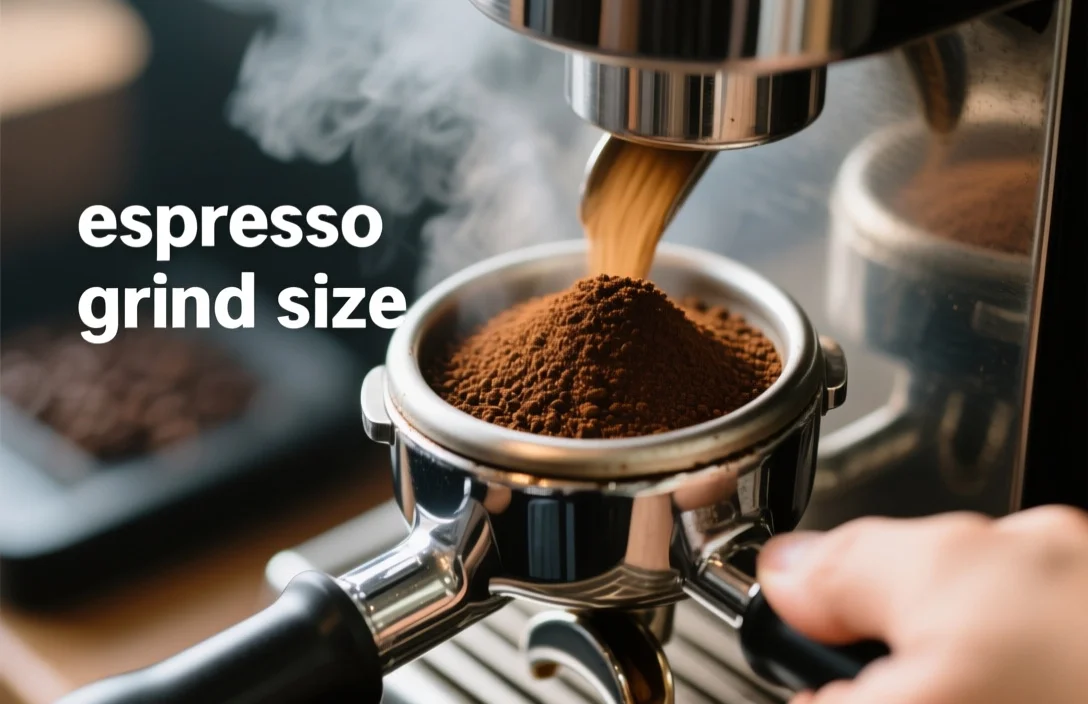
A shot of espresso needs a very fine grind so water extracts flavor in the short extraction window that espresso requires. This article explains espresso grind size, why it matters, and how to dial it in for a 25-30 ml shot that extracts in about 25-30 seconds.
What espresso grind size means and the
Grind size refers to the average particle diameter of ground coffee and, for espresso, that diameter sits at the fine end of the brewing spectrum. A proper espresso grind is much finer than what you would use for drip coffee or French press; it should allow pressurized water to pass through the puck in the short time espresso requires, producing a concentrated cup with body and crema.
I tested and compared common household approaches and cafe practice to form practical advice you can use at home. Start with a fine setting on a burr grinder, then use shot time, stream behaviour, and taste as your feedback loop. Aim for an extraction time near 25-30 seconds for a single espresso volume around 25-30 ml; that pairing is a conventional baseline for dialing grind.
How grind size controls extraction and shot behavior
Particle size directly changes surface area and interaction time between water and coffee solids. Finer particles increase surface area and slow flow through the puck because they compact more tightly and increase resistance; coarser particles do the opposite. That dynamic is why grind size is the most immediate lever for changing extraction rate during espresso dialing.
Channeling and uneven extraction appear when grind is inconsistent or tamping and distribution are poor. Water follows the path of least resistance, so a puck with a large fraction of fines will compact differently than one with more uniform particles and can produce fast pockets that rinse through under-extracted grounds and slow zones that over-extract. Grinding consistency (particle uniformity) matters almost as much as the nominal size.
Taste reflects extraction chemistry. Sour, sharp acid typically points to under-extraction and too-fast flow; bitter, astringent notes usually signal over-extraction and too-slow flow. A properly dialed grind hits a balance where sweetness, acidity, and bitterness are in harmony for the bean and roast you use.
Variables that interact with grind size and their trade-offs
Grind size never acts alone. Dose, tamp pressure, basket type (single-wall vs. pressurized), water temperature, roast profile, and grinder burr type all interact and change how a single grind setting performs. Changing any one variable often requires a compensating grind adjustment.
Roast level alters extraction speed. Lighter roasts tend to extract more slowly and often need either a slightly finer grind, longer contact time, or higher temperature to reach the same extraction balance as a darker roast. Darker roasts are more soluble and can extract more quickly, which raises the risk of over-extraction at too-fine a grind.
Basket design changes effective flow area and sensitivity. A single-wall competition basket requires precise grind and dose control to avoid channeling, while a pressurized basket hides some flow variability but sacrifices control and clarity of flavor. Grind uniformity influences repeatability: a stepped grinder with inconsistent burrs will make dialing-in harder than a high-quality stepless grinder that can micro-adjust.
Trade-offs present themselves during dialing. Finer grind increases body and extraction of sugars and oils but can also increase perceived bitterness and clog flow. Coarser grind reduces bitterness and channeling risk but can yield a thin, sour cup if extraction is too low. Accepting one result to gain another is part of choosing a style – sweetness and body versus clarity and bright acidity.
Dialing in espresso grind size at home
- Set baseline equipment and targets. Use a calibrated dose (weigh your coffee), a clean and level basket, and a consistent tamp. Choose your target: a single espresso of roughly 25-30 ml extracted in about 25-30 seconds.
- Start with a fine setting on a quality burr grinder. For many home setups this will be well into the lower range of the grinder’s scale; begin there rather than with something coarse.
- Pull a test shot and time it. Observe the flow: is it a thin, fast stream, a syrupy slow drip, or irregular sputtering? Taste the shot without milk and note sourness, sweetness, bitterness, and body.
- Adjust grind coarse if the shot is too slow (over-extracted, bitter), or adjust grind finer if the shot is too fast (under-extracted, sour). Make small, consistent changes – one or two notches on stepped grinders or a tiny fractional turn on stepless units.
- Re-pull shots after each change and keep a short log: setting, dose, tamp pressure, time, volume, and tasting notes. Allow a few seconds between shots to clear retained coffee if your grinder has retention issues.
- Once shot time and stream look right, taste for balance. If sweetness and body are present with controlled acidity and no harsh bitterness, you’re close. If not, tweak grind and retest.
- When pleased, pull several shots to confirm repeatability. If results vary, troubleshoot consistency: re-distribute grounds, check tamp, clean burrs, or switch to a different basket.
A short checklist while dialing: keep dose constant, use fresh coffee, change only one variable at a time, and record every attempt. That method prevents chasing ghosts and produces reproducible improvements.
Grinder types, settings, and how they change your approach
Burr grinders dominate espresso work because they produce more uniform particles than blade grinders. Flat burrs and conical burrs both work for espresso; flat burrs often produce very consistent particle distributions preferred by many pros, while conical burrs can be quieter and generate fewer fines depending on design.
Stepped grinders provide discrete click-stops; each step represents a measurable adjustment but may force you into larger jumps. Stepless grinders let you make micro-adjustments for precise dialing, which is beneficial when chasing a half-second change in shot time or a subtle change in sweetness.
Retention and grind consistency influence how quickly you can iterate. High-retention grinders require multiple purges to clear old grounds, which slows dialing and introduces variables. Low-retention or doserless grinders that deliver directly into a portafilter make adjustments faster and reduce waste.
Maintenance matters to keep grind characteristics stable. Dull burrs widen particle distribution and increase fines, altering flow even with the same nominal setting. Regularly inspect and replace burrs per manufacturer guidance, and clean the grinder to remove sticky oils and old grounds that skew extraction.
Troubleshooting common problems tied to grind size
Problem: Shot pulls too quickly and tastes thin and sour. Likely cause: grind too coarse or underdose. Correction: grind finer by a small increment, confirm dose and tamp, and re-test.
Problem: Shot pulls very slowly or not at all and tastes bitter. Likely cause: grind too fine or excessive tamping/overdose. Correction: grind coarser slightly, reduce tamp force if inconsistent, check for clumping due to static or humidity.
Problem: Uneven extraction and channeling with rivers of espresso. Likely cause: poor distribution, inconsistent grind, or damaged basket. Correction: improve distribution using rituals (WDT – Weiss Distribution Technique), inspect the basket for dents, ensure even tamping, and check grinder burr condition.
Problem: Wild shot-to-shot variability. Likely cause: grinder retention or bench inconsistency. Correction: clear retained grounds between shots, standardize dose and tamp, and pull consecutive test shots to stabilize temperature and pressure.
Problem: Excessive crema collapse or oily puck residue. Likely cause: roast or bean oils interacting with extraction; grind may be too fine or the coffee too fresh. Correction: fine-tune grind coarser, back off close to roast date if coffee is exceptionally fresh, and experiment with slightly cooler water if your machine allows.
Real examples and what to expect with different beans and setups
Light roast single-origin beans often reward a slightly finer approach to coax out sugars and floral notes, but moving too fine will surface vegetal or grassy sharpness. Darker roasts can produce syrupy body at coarser grinds and require a lighter touch to avoid excess bitterness.
Low-cost entry espresso machines and pressurized baskets hide some grind problems, but they also reduce flavor clarity. Expect to spend less time dialing on these machines because the basket forces a consistent flow, yet you will lose nuance. Prosumer machines and open baskets demand more precise grind and distribution but reward you with greater flavor range.
Grinder quality separates hobbyist success from reliable home espresso. An inexpensive conical burr can deliver drinkable espresso; a mid-range flat-burr grinder will make dialing less frustrating and more consistent. Comparing grinder performance side by side, the key difference is how repeatable small adjustments are and how narrow the particle distribution remains under load.
Table: common grinder types and which home user they fit
| Name | Price/Key Spec | Best For |
|---|---|---|
| Entry conical burr grinder | Lower cost; stepped settings | Beginners who want espresso-capable grinding on a budget |
| Mid-range flat burr grinder | Mid cost; tighter particle distribution | Home users who want consistent shots and easier dialing |
| Stepless prosumer grinder | Higher cost; micro-adjustments | Enthusiasts chasing precise extraction and repeatability |
| Manual hand grinder (espresso-capable) | Low to mid cost; requires manual effort | Travelers or minimalists who accept slower workflow |
| Blade grinder | Very low cost; inconsistent grind | Not recommended for espresso; acceptable only for non-espresso methods |
Common mistakes that prolong dialing and how to avoid them
Skipping baseline measurements wastes time. Start every session with an explicit dose, target extraction time, and clean basket. Changing multiple variables at once – for example, grind setting and dose – makes cause-and-effect impossible to determine.
Relying solely on taste without observing shot behavior leads to guesswork. Use time and flow appearance as objective cues before adjusting for flavor. Confusing crema for extraction quality is another trap; a thick crema looks attractive but says little about balance if the shot tastes hollow or bitter.
Over-tamping is a frequent error. A consistent, level tamp with moderate pressure suffices for most setups; heavy tamping mainly makes grind changes more sensitive and can lead to clogging. Failing to purge a grinder with high retention between adjustments introduces old grounds into new shots and masquerades as inconsistency.
Using stale or overly fresh beans causes puzzling symptoms. Beans right off roast can be volatile and produce irregular flow; allowing a few days of rest often helps. Stale beans lack soluble material and produce flat, under-extracted shots regardless of grind. Track roast date and adjust expectations accordingly.
Advanced considerations
Water temperature and pre-infusion both alter effective extraction without changing grind. Higher temperature increases solubility and can speed perceived extraction, which might allow a slightly coarser grind; lower temperature slows extraction and may push you toward a finer grind. Machines that offer programmable pre-infusion let you soak the puck briefly at low pressure to reduce channeling and make grind response more forgiving.
Extraction yield and TDS (total dissolved solids) are lab measures used by professionals to quantify balance. Home espresso dialing can succeed without instruments by relying on time, taste, and repeatability, but users with refractometers and scales will find the numbers speed up dialing and remove ambiguity. If you have a refractometer, track extraction yield as you change grind and aim for a consistent target specific to your brew style.
Machine pressure profile interacts with grind too. Traditional espresso practice uses consistent high pressure to force water through a fine puck; modern machines sometimes use pressure profiling to alter extraction emphasis across the shot. Expect to re-dial grind size if you change pressure behavior or machine type.
FAQ
How fine is “fine” for espresso grind size?
Fine for espresso means a particle size significantly smaller than drip coffee – often described as resembling powdered sugar or slightly coarser than flour. Use shot time and flow: if a 25-30 ml shot extracts in about 25-30 seconds and tastes balanced, the grind is in the right range.
How many clicks or notches should I move when dialing grind?
Make small adjustments: one or two notches on a stepped grinder or a fraction of a turn on a stepless grinder. Change only one setting at a time, then pull a test shot and evaluate time and taste.
Can I use a blade grinder for espresso?
Blade grinders produce a wide distribution of particle sizes and many fines. That inconsistency makes consistent espresso nearly impossible. Switching to a burr grinder is the most impactful upgrade for home espresso quality.
Why does my espresso taste bitter after I made the grind finer?
Bitter taste after making the grind finer usually indicates over-extraction from slower flow. Counter with a slightly coarser grind, check dose, and make sure you are not tamping excessively.
What role does dose play compared to grind?
Dose changes beverage strength and puck density; matching dose with grind is necessary for a consistent extraction. Higher dose increases resistance and may require a coarser grind to maintain similar flow, while a lower dose can allow a finer grind.
Is there a single perfect grind size for all coffees?
No single grind size fits every bean, roast, or machine. Each coffee and setup requires its own dial-in. Use a consistent dialing method to find the balance for each change you make.
A short, practical verdict: fine grind plus time monitoring equals reliable espresso. Try the baseline of 25-30 ml in 25-30 seconds, keep dose and tamp consistent, and adjust grind in small steps until taste and flow align.
Start your next session by weighing your dose, setting a timer, and making one small grind adjustment at a time.

- Espresso Tastes Watery? 10 Common Causes and How to Fix It - October 23, 2026
- 10 Common Coffee Equipment Cleaning Mistakes and How to Avoid Them - October 23, 2026
- 17 Common Coffee Grinder Problems and How to Fix Them - October 23, 2026