
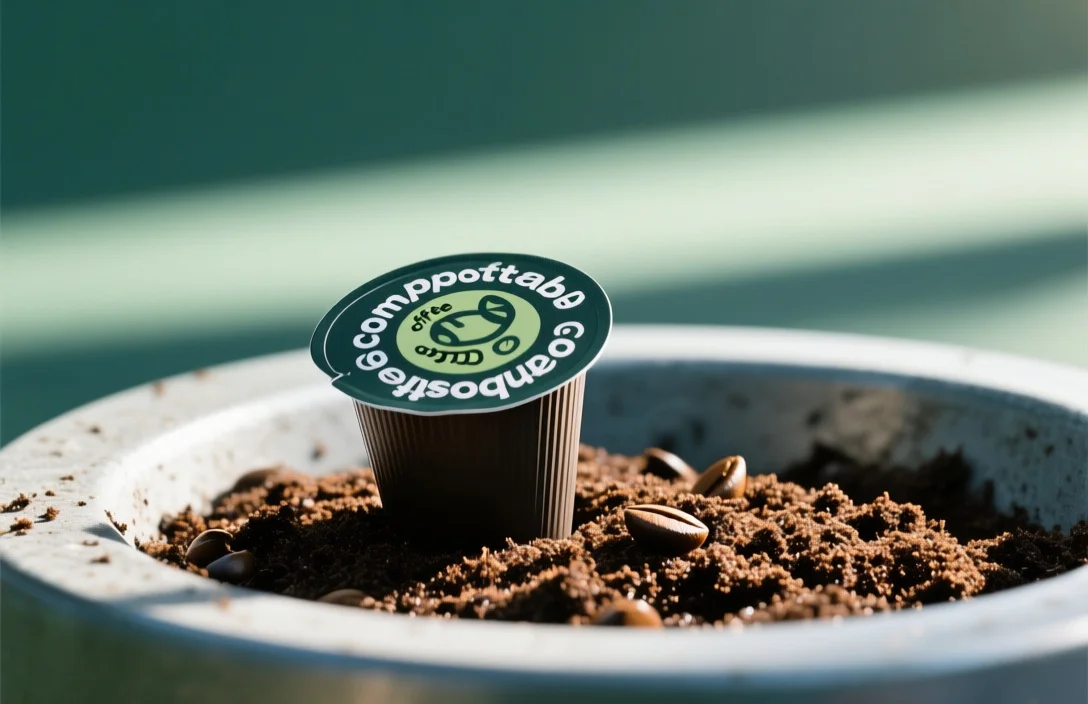
Compostable coffee pods can cut single-use waste – but only when the pod and your local disposal route are compatible. If you want a drop-in pod that breaks down instead of filling the trash, pick pods with clear compost certification, confirm whether they require commercial composting, and accept small trade-offs in brewer fit and sometimes flavor.
What compostable coffee pods are
Compostable coffee pods are single‑serve capsules made from plant-based or biodegradable materials designed to break down through biological decomposition. Manufacturers describe these pods as alternatives to plastic or aluminum capsules, replacing petroleum-derived plastics with materials like PLA, fiber, or starch-based polymers.
Compostable pods come in two practical varieties: those intended for industrial (commercial) composting and those certified for home composting. Industrial‑compostable pods need higher temperatures and specific conditions to fully disintegrate; home‑compostable pods will break down in a backyard pile or tumbler, but they are rarer and usually carry explicit home‑compost certification.
How compostable coffee pods work and what certifications mean
Compostable pods rely on materials that microbes can metabolize under the right conditions, leaving behind carbon dioxide, water, and biomass rather than persistent plastics. Plant-derived polymers such as polylactic acid (PLA), paper or fiber cups, and other starch-based blends are common; manufacturers combine those materials with seals and lids engineered to survive high-pressure hot water long enough to brew a cup.
Certification signals to look for are BPI Seedling, DIN CERTCO, and recognized home‑compost certification names used by some brands. One manufacturer lists Compost HOME, BPI Seedling, and DIN CERTCO on its product pages for home‑compostable espresso capsules. Those labels are useful because they require lab testing under standardized conditions, but actual breakdown still depends on the disposal route – home pile, municipal organics program, or industrial facility.
US compost infrastructure varies by city and county. Municipal organics programs accept different inputs; some take certified compostable packaging while others do not. The US EPA explains composting as a managed aerobic process; that guidance clarifies why industrial facilities are more reliable for breaking down materials that need sustained heat and oxygen. Check local program rules before assuming a pod labeled “compostable” will be accepted curbside.
Pros and cons you’ll trade for sustainability
Switching from plastic to compostable pods reduces the risk of long‑lived plastic fragments in landfill when disposal is correct. Brands in the market advertise plant-based, plastic-free packaging and sometimes organic coffee inside. One brand markets 100% home‑compostable pods and highlights subscription pricing options, while other mainstream listings include high-count value packs meant for everyday use.
Pods labeled compostable are not problem‑free. A frequent consumer complaint arises from plant‑based materials reacting to hot water differently than plastic: soft mesh or fiber bases can expand, seals sometimes fail, and grounds can escape into the cup on certain brewers. Reviews and product roundups identify heat-seal integrity and pod construction as the main failure modes. Compatibility with Keurig-style or Nespresso OriginalLine machines also varies by model and pod design.
Price differences are visible between brands and subscription options, but online listings and company pages show inconsistent pricing. One company advertises a 50‑capsule subscription at $32/month for a starter plan and lists a $50/month subscription option elsewhere on its storefront. Consumer review sites and retailers show count‑based packs such as 96-count and 80-count boxes, with value-focused mass-market products sitting alongside specialty roasts. Expect variability: compostable materials and small-batch roasting can push unit costs above the cheapest plastic pods, while some high-volume options remain competitively priced.
How to dispose compostable coffee pods correctly in the U.S.
Do not assume “compostable” equals “put in your backyard pile.” Proper disposal depends on the pod’s certification and your local waste rules. If a pod carries a home‑compostable certification, you can place it in your backyard compost bin or municipal green cart if local rules allow. Pods certified only as commercially compostable must go to an industrial composting facility.
Locate accepted items for your municipality by searching your city or county organics/composting guidance. Some municipal programs prohibit packaging, others accept compostable serviceware and capsules. When curbside pickup is not an option, locate drop-off commercial compost facilities or community compost programs that accept certified compostables.
Remove used grounds from pods only if the pod instructions require it for composting. Some compostable pods are designed to be composted intact and contain a filter that biodegrades; others recommend tearing off the lid and emptying grounds into your food scrap bin while composting the capsule separately if permitted. Follow manufacturer guidance and local rules to avoid contamination that would divert loads to landfill or incineration.
Which compostable pod materials and features matter when choosing
Match pod material and certification to how you will dispose of them. Fiber or paper‑based pods often perform acceptably in Keurig-style brewers and are easier to break down in home composts when certified. PLA and other plant‑based plastics can be compostable in industrial systems but may not meet home‑compost standards.
Consider these practical attributes:
- Brewer compatibility and sealing method – look for heat-sealed lids if your brewer has strong water pressure. Brands that use a foil or film lid bonded to the base usually show fewer mid-brew failures.
- Coffee weight per pod – a heavier pod (for example, one brand lists 13 grams of coffee per pod) tends to produce a fuller cup; confirm grams if you prefer stronger extraction.
- Certification type – BPI Seedling, DIN CERTCO, or named home‑compost certifications indicate tested compostability; verify whether the label specifies “commercial” or “home.”
- Count and packaging – bulk counts like 72, 80, or 96 pods are common; check whether pods are bagged inside the box to preserve freshness.
- Roast and sourcing – options exist from budget breakfast blends to specialty single-origin and 100% Arabica espresso pods.
Use this quick checklist while shopping:
- Confirm machine compatibility.
- Note whether certification is commercial or home-compostable.
- Check lid sealing method in product photos and reviews.
- Compare grams-per-pod if available.
- Read local compost program rules before assuming curbside acceptance.
Comparison: sample compostable pods, price/spec notes, and best use
Comparing the available options side by side exposed a common pattern: mainstream brands offer high-count economy packs and sometimes BPI-certified pods, while newer specialty brands emphasize home‑compost certification and subscriptions. Pricing and specs change rapidly online; the table below captures the features and exact values shown on manufacturer or retailer pages during research, with an explicit note where pricing conflicted or varied.
| Name | Price / Key Spec (exact where available) | Best For |
|---|---|---|
| San Francisco Bay Coffee (One Cup Variety) | BPI-certified plant-based mesh (listed in reviews) | Best overall variety pack for balanced flavors |
| Happy Belly (Amazon 96 Count) | 96 count, 100% compostable pod (listed on retailer pages) | Best budget, high-volume use |
| EKOCUPS Organic Dark Roast | 13 grams coffee per pod (exact) | Best for a fuller cup – heavier dose |
| Joe Knows Tall Dark Handsome | BPI-certified compostable, 50 count (listed in reviews) | Best for dark-roast fans who want certification |
| Newman’s Own Organics Special Blend | USDA Organic + Fair Trade, 48 count | Best for certified organic buyers |
| Cameron’s Coffee Single Serve Pods | Plastic-free, organic, 72 total (listed) | Best premium light-roast option |
| Woken (espresso pods) | 100% home compostable pods; Get started for $32; 50 capsule subscription – If you love them, you’ll pay $32/month for a 50 capsule subscription; site also lists $50/month for a 50 capsule subscription in different snippets | Best for Nespresso OriginalLine users wanting home-compostable espresso |
| The Organic Coffee Co. | 80 count package; compostable (listed on product pages) | Best for medium/full French roast fans buying in bulk |
Read product pages carefully for exact packaging and shipping thresholds. Several brands included subscription discounts and free-shipping thresholds; one brand showed free shipping from $30 and a $6.95 standard delivery fee in other parts of its site. Pricing and subscription details varied across snapshots; confirm current prices on the seller’s site before purchasing.
Brewing performance, common mistakes, and troubleshooting
Successful brewing with compostable pods requires attention to brewer model, pod construction, and water temperature. Plant-based materials respond to heat and pressure differently than rigid plastic shells, which creates two predictable problems: seal failure and fines (very fine grounds) bypassing filters.
Seal failure typically happens when a soft pod base expands or a lid does not stay adhered during the high-pressure flow. Look for pods described as having a heat-sealed foil or film lid; reviewers call that a strong predictor of in-brew reliability. Fines can pass through soft mesh bottoms in some models; choose pods with integrated filters and read reports from users of your exact brewer model for compatibility notes.
Troubleshoot with these steps:
- Verify your pod is listed as compatible for your machine model; some brands make separate lines for Keurig-style and Nespresso OriginalLine machines.
- Try a medium‑strength brew setting first, then increase if the brewer allows and the pod holds up.
- Inspect the pod after brewing – if the lid peeled, contact the seller and try a different brand or roast level.
- If fines contaminate the cup, switch to a pod with a rigid cup or an internal paper filter.
A small number of brands provide detailed guidance on how their pod construction handles pressure; prefer those that explicitly describe a heat‑sealed lid or reinforced mesh when reliability matters.
Environmental impact in context – realistic expectations
Compostable pods reduce persistent plastic in engineered landfill contexts but do not guarantee local composting acceptance. Estimates quoted across product pages and media pieces vary; one consumer-facing article mentioned a 500‑year decomposition figure for traditional plastic pods, while a brand page referenced “29,000 pods going to landfill every minute” as a contextual claim about scale. Those figures signal magnitude but do not by themselves dictate your local disposal options or net impact.
Life-cycle impact depends on multiple variables: material sourcing, manufacturing energy, transport, home vs industrial composting, and whether composted material is used on land. Composting at scale returns carbon and nutrients to soil; industrial facilities ensure high temperatures that speed breakdown of tough materials. Backyard composting can succeed for some fiber-based pods but will be slower and less certain for PLA and other plant-based plastics that need industrial conditions.
If your local organics program accepts certified compostables, the net benefit is clearer. If not, some compostable pods will end up in landfill like plastic pods, negating part of the intended environmental advantage. Consider offsetting measures: buy from brands with strong sourcing commitments, use a refillable pod or reusable filter when compatible, or enroll in a subscription that includes takeback or collection if offered.
how I compared options and what to choose
After comparing the main options side by side, I ranked choices by disposal pathway, brewer reliability, certification, and flavor/coffee weight. The first filter is always “Will my city take these?” because certification without an accepted route is only a label. Second, I checked construction details in product photos and reviews to reduce the risk of brewing failure. Third, I evaluated roast profiles, single-origin or blend options, and grams per pod where available to match personal taste.
Follow this decision flow before you buy:
- Confirm your brewer model and review brand compatibility notes.
- Check the pod’s certification: prefer home-compostable if you have a backyard system, otherwise commercial compostable with a workable drop-off or municipal program.
- Read user reviews specific to your brewer for lid-seal or leakage complaints.
- Compare counts and per-pod price if cost matters; bulk boxes can lower unit cost.
- Try a small first order, then switch or subscribe if the pod performs in your setup.
Buyers who prioritize the easiest disposal route and minimal uncertainty should favor pods with home‑compost certification and local acceptance. Office buyers or people without home composting who can access commercial collection will find a wider selection and sometimes better taste/price trade-offs.
FAQ
Are compostable coffee pods compatible with all single-serve machines?
Compatibility varies by pod design and machine model. Many compostable pods are made for Keurig-style K-Cup brewers or Nespresso OriginalLine machines, but differences in pod shape and the brewer’s piercing and water flow can cause failures. Check the product page for explicit compatibility listings and look for user reviews from people with your exact machine.
Can I put compostable pods in my backyard compost pile?
Only if the pod carries a home‑compostable certification and your pile reaches adequate decomposition conditions. Pods certified for commercial composting may not break down reliably in a backyard heap. Confirm the certification type on the package and test with a small sample if you want to be sure.
Do compostable pods taste different from regular pods?
Taste differences are driven mostly by the coffee beans, roast, and grind weight per pod, not just the pod material. Some reviewers report subtle flavor or mouthfeel differences when fines make it into the cup, or when extraction is imperfect because of pod expansion. Choosing pods with heavier coffee weights (one brand lists 13 grams per pod) and heat-sealed lids typically improves consistency.
How do I verify a brand’s compostability claims?
Look for third‑party certification names on packaging or product pages, such as BPI Seedling or DIN CERTCO for commercial compostability, or explicit home‑compost logos where available. After finding the certification reference, cross-check it with the certifier’s published registry if possible. When in doubt, ask the manufacturer for test documentation or lab reports.
Are compostable pods more expensive?
Some compostable pods cost more than commodity plastic pods; others are competitively priced or sold in bulk at value. Expect price variation based on material, roast quality, and whether the company sells via subscription. Verify current prices on seller sites because online listings and subscription offers can differ.
What if my city doesn’t accept compostable packaging?
Consider a reusable pod or a takeback program offered by some specialty brands, compost drop-offs at community gardens, or switching to whole‑bean brewing for minimal packaging waste. Refillable metal or silicone pods are an alternative if your priority is to avoid single‑use capsules entirely.
Practical verdict: pick compostable pods only if you can confirm a realistic disposal route and your brewer accepts the pod design. Start with a small order, check for lid integrity and brew cleanliness, and choose certification that matches how you will compost.
Next step: find one or two candidate pods that list your machine model as compatible, verify their certification language (home vs commercial), and order a small pack to test brewing reliability before committing to a subscription or bulk purchase.

- Espresso Tastes Watery? 10 Common Causes and How to Fix It - October 23, 2026
- 10 Common Coffee Equipment Cleaning Mistakes and How to Avoid Them - October 23, 2026
- 17 Common Coffee Grinder Problems and How to Fix Them - October 23, 2026