
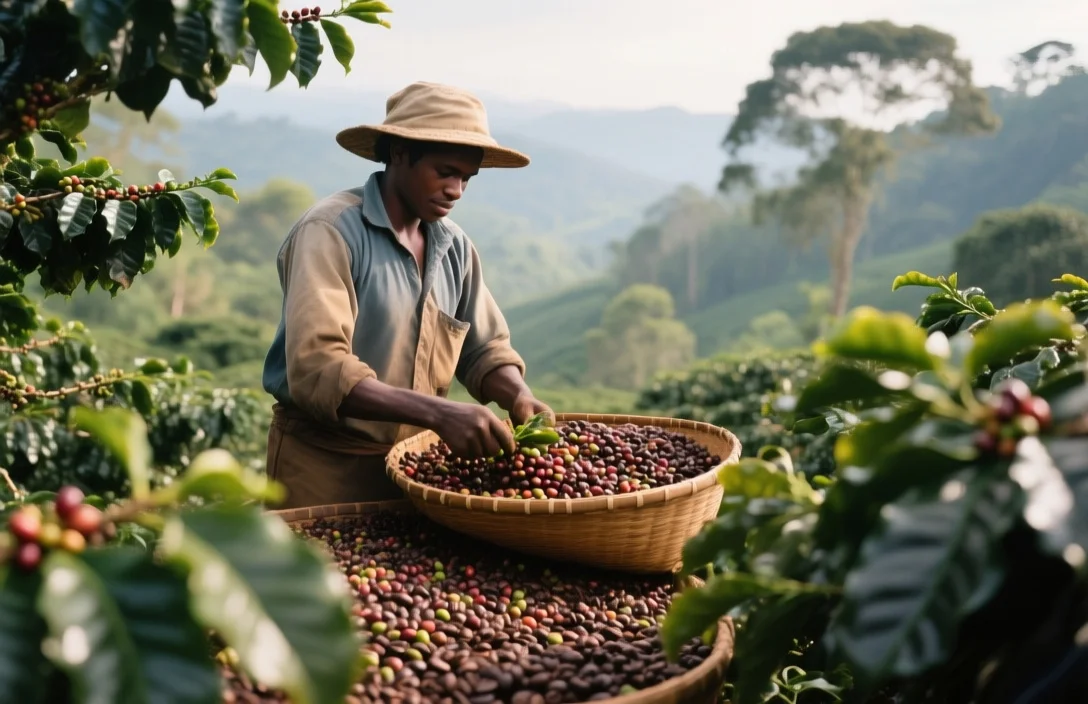
Coffee harvesting methods shape cherry quality, labor needs, and post-harvest processing; the most common approaches are selective hand-picking, strip harvesting (manual or mechanical), and machine-assisted shaking. Coffee harvesting methods influence whether you get cleaner, riper cherries suited to specialty roasters or a fast bulk harvest better for commodity markets.
How coffee harvesting methods differ and why it matters
Selective removal of only ripe cherries prioritizes cup quality by avoiding underripe or overripe fruit. Strip harvesting removes all cherries from a branch at once and speeds up harvest cycles but mixes fruit at different maturity stages. Machine-assisted systems mechanically detach cherries either by shaking the tree or running vibrating arms along branches; these trade harvesting speed and labor savings against potential damage to trees and lower fruit sorting precision.
Quality, cost, speed, and terrain are the four dimensions that determine which method a farm chooses. Quality describes uniformity of ripeness and defect rate, cost covers cash labor plus capital and maintenance for machines, speed measures how fast a hectare or acre can be harvested, and terrain restrictions include slope, tree spacing, and presence of shaded understory. After comparing the main options side by side, the key trade-off becomes clear: higher selectivity usually costs more in labor and time but produces cherries better suited for higher-priced specialty channels.
Choice of method also affects downstream processing. Cleanly picked ripe cherries reduce sorting work at the mill, lower fermentation variability in washed processing, and limit over-fermented flavors in natural/dry processing. Smallholders, co-ops, and estates face different constraints; a method that makes sense for a flat, tightly planted estate will often be impractical on steep, fragmented smallholder land.
Selective hand-picking
Selective hand-picking uses pickers who harvest only cherries at peak ripeness, often making multiple passes through the same plants over a harvest window. Farmers and harvest managers use visual cues for color and feel to distinguish ripe cherries from those still developing. Selective picking is labor-intensive and requires trained workers, but it consistently yields the highest proportion of ripe cherries and the fewest defects in the lot.
Small batches harvested selectively are easier to manage during sorting and processing. Processors can send selectively picked cherries straight into wet mills for pulping and fermentation with minimal pre-sorting, which tightens fermentation control and reduces off-flavors. Roasters that pay premiums for traceable, high-quality lots look for this level of harvesting because it reduces the variance in cup profiles.
Labor availability and cost are the main constraints on selective picking adoption. Farmers who cannot afford repeated passes or who face seasonal labor shortages often cannot use selective methods at scale. Picking efficiency also depends on farm layout: narrow terraces and shade trees make quick movement harder, while uniform rows favor pickers covering ground faster. Training pickers to select only ripe cherries and to use picking bags or harvesting poles without damaging branches is a small investment with measurable quality benefits.
when speed and simplicity win
Strip harvesting removes all cherries from a branch or entire tree in a single action, whether by hand or with mechanical assistance. Manual strip harvesting often involves running a hand along a branch and collecting fallen fruit into a bag. Mechanical strip harvesting uses machines that swipe or compress branches to release cherries. This method minimizes the time a farm spends in field harvesting and lowers per-unit labor when cherry volumes are high.
Suitability for commodity-focused production makes strip harvesting common in regions where price premiums for uniform ripeness are absent. Processors receiving strip-harvested lots typically expect a higher percentage of underripe or overripe cherries, so mills dedicate extra sorting capacity or adopt processing regimes that tolerate mixed ripeness. When processing for natural/dry methods, strip-harvested cherries can work well because drying whole cherries can reduce immediate sorting needs, though cup variability tends to increase.
Risk management with strip harvesting requires attention to post-harvest sorting and quality control. Producers can mitigate mixed-ripeness problems by staging harvests – stripping lower branches earlier, then upper branches later – or by combining manual strip harvest for the bulk of fruit with subsequent selective picking of prime micro-lots. Cooperatives or buying stations that purchase strip-harvested cherries often have strict grade categories; farms selling into such channels should expect variable pricing based on visible defects and moisture content.
Mechanical harvesting
Machine-assisted harvesting ranges from hand-held vibrators that loosen cherries to full-field harvesters that straddle rows and harvest mechanically. One common approach uses shaker machines that vibrate the trunk or branches so cherries fall onto catching frames or tarps. Another design uses harvesters with combing arms that sweep through the canopy. Machines vary by power source, footprint, and row-width requirements.
Operational suitability hinges on planting design and slope. Flat, widely spaced plantings with uniform tree training are ideal for many mechanical harvesters. Terraced or steep plantations with irregular spacing are often incompatible with most mechanized equipment. Tree architecture also matters; practices like pruning and canopy training that produce consistent branch positions are prerequisites for reliable machine performance.
Maintenance and capital are two large mechanical-harvesting considerations. Machines need routine service, parts replacement, and operator training. Farms that invest in harvesters must amortize the machine over multiple seasons and consider storage, fuel, and safety. Serviceability and local parts availability are practical constraints in many producing regions; farms without local technical support should factor long downtime risks into purchasing decisions.
How harvest method interacts with processing
Harvest ripeness and uniformity directly influence processing choices and outcomes. Washed processing benefits most from selectively picked cherries because consistent sugar content and minimal defects allow predictable fermentation kinetics and clearer flavor lines. Producers aiming for precise acidity and clarity in the cup commonly pair selective picking with washed processing.
Natural or dry processing can tolerate wider ripeness variability but amplifies fruit and fermentation-derived flavors. When cherries are left to dry whole, underripe cherries can contribute vegetal notes and overripe ones can introduce fermentation off-notes; uneven drying also raises the risk of spoilage. Strip harvesting is therefore often paired with natural processing where labor constraints or drying capacity make quick harvest and sun-drying attractive.
Honey processing – where cherries are pulped but some mucilage is left on – sits between washed and natural approaches in sensitivity to cherry uniformity. Even partial mucilage retention requires consistent sugar and mucilage thickness across the lot to prevent uneven fermentation during drying. Producers that plan honey or experimental processing should prioritize better sorting and at least partial selectivity at harvest to control flavor outcomes.
Practical decision steps for choosing a harvesting method
Follow a short decision framework to align method with goals, resources, and terrain:
- Assess the target market: decide whether specialty premiums matter enough to justify selective picking.
- Map the terrain and tree spacing: identify plots where machines could operate safely and where manual work is unavoidable.
- Calculate labor availability: determine whether repeated passes for selectivity are realistic during harvest windows.
- Evaluate processing capacity: confirm whether on-farm or cooperative mills can handle mixed-ripeness lots or require uniform cherries.
- Pilot a hybrid approach: test combining strip harvesting for the bulk and selective picking for micro-lots destined for specialty buyers.
- Plan maintenance and training: if choosing mechanization, budget for service, operator training, and spare parts.
Smallholders and cooperatives often use a mix of methods across different plots. Producers can protect higher-value lots by reserving the best-trained pickers for specific blocks while using faster methods on lower-grade fields. Trialing a change over one season reduces risk; run a controlled comparison where harvest, processing, and cupping of different methods are documented so buyers and internal quality teams can see the results.
Record-keeping during those trials matters. Track box or bag counts, harvest duration per hectare or acre, spoilage rates during drying, and sample cuppings. That qualitative and operational data helps translate harvesting choices into tangible business outcomes for the next cycle.
Common mistakes, warning signs, and how to fix them
A frequent mistake is underestimating the downstream sorting workload when switching to faster harvest methods. Buyers receiving mixed-ripeness lots often reduce payment or refuse shipments that exceed defect thresholds. If a mill is overwhelmed with sorting, quality degrade is likely; farms switching to strip or mechanical harvesting should coordinate extra sorting capacity or accept the pricing consequences.
Another common error is applying mechanical harvesting to terrain or tree architecture that cannot support it. Machines used on steep terraces, irregular spacing, or multi-tier shade systems will either damage trees or deliver poor harvest efficiency. Fixes include redesigning planting microzones for future mechanization or reserving machines for blocks compatible with equipment.
Over-reliance on a single method without quality controls is also risky. Pickers left unsupervised will sometimes sweep through quickly and collect underripe fruit even when instructed otherwise. Implementing simple field checks, like random cherry sampling per row or a daily cupping of processed lots, offers early warning. Buying stations can also provide feedback loops; insist on frequent grader feedback from your buyers and keep sample lot records.
Skipping maintenance on mechanical equipment shortens lifespan and raises downtime risk. A proactive maintenance schedule, basic operator training, and an inventory of critical spare parts (belts, bearings, electrical components) reduce unexpected costs during harvest peaks. If local technical support is absent, consider a service contract with a regional provider or cooperative-owned machines shared among nearby farms.
Labor strategies, social considerations, and certification impacts
Labor management determines both cost and social outcomes of harvest choices. Selective picking supports employment and can provide stable seasonal income for communities but requires structured payment systems so pickers are properly incentivized. Payment by weight, by bag, or by piece each has behavioral effects on selectivity and care in harvesting.
Certification programs and many buyers require traceability and evidence of labor standards. Switching to faster, mechanized methods does not remove those obligations; documentation on payments, working hours, and machine safety can satisfy auditors. Cooperatives frequently centralize such reporting, making it easier for smallholders to comply with certification requirements.
Social impacts of mechanization must be considered in any community. Machines that replace manual pickers can produce short-term unemployment; phased adoption, re-skilling, and redeployment to processing or machine operation are common mitigations. Cooperative ownership of harvest equipment spreads benefits across members and can reduce the risk that one farm bears the entire capital burden.
Comparison of common harvesting methods
| Name | How it works | Best for |
|---|---|---|
| Selective hand-picking | Pickers harvest only ripe cherries through multiple passes | Specialty lots, high-quality washed processing |
| Manual strip harvesting | Worker strips all cherries from branches in one pass | Low-cost commodity production, fast field turnover |
| Mechanical shaking | Machines vibrate trees or branches, catching fallen cherries | Flat, uniformly spaced estates seeking speed |
| Mechanical combing/arm harvesters | Harvesting arms comb through canopy, collecting cherries | Large plantations with trained tree architecture |
| Hybrid (strip + selective) | Bulk harvest by strip, then selective passes for premium blocks | Farms selling mixed channels – commodity + specialty |
Real actions you can take this season
Decide on a short pilot rather than a full-method switch. Choose one block for selective picking and another for strip or mechanical harvesting, then process each block under consistent conditions to isolate harvest method effects. Invite your buyer or a trusted cupper to grade both lots so you receive direct feedback on market value.
Document labor hours and costs in parallel with cup scores. That operational data creates a direct comparison between price premiums (or penalties) and the extra time or capital invested. If mechanization is on your roadmap, schedule a maintenance and training budget now so a machine purchase later does not stall due to operator or parts problems.
Talk with neighboring producers or cooperatives about shared equipment models. Shared ownership reduces per-farm capital needs and builds local capacity for repair and operator training. If your region lacks technical service, factor in transport to the nearest service center or the time to train an in-house mechanic.
FAQ
What is the single best harvesting method for quality?
Selective hand-picking generally produces the highest quality cherries because it allows pickers to harvest only ripe fruit, which reduces defects and stabilizes fermentation behavior. Specialty buyers look for this precision; farms aiming for higher cup scores typically invest in selective picking even though it requires more labor.
Can mechanical harvesters match the quality of hand-picking?
Mechanical harvesters can approach commodity-level quality on well-managed, uniformly planted estates, but they usually cannot match the pick-by-pick selectivity of trained hand harvesters. Consistent tree training, careful timing, and post-harvest sorting are necessary to narrow the gap in quality.
Is strip harvesting suitable for natural/dry processing?
Strip harvesting is commonly used with natural/dry processing because whole-cherry drying tolerates some ripeness variability, and speed reduces the window for post-harvest spoilage. Producers should still monitor drying closely and sort visibly defective cherries to reduce off-flavors.
How should a smallholder with limited labor proceed?
Start with small trials: protect a small, high-potential block for selective picking and use faster methods on lower-yielding plots. Joining or forming a cooperative can give access to shared processing facilities and sometimes shared equipment, which helps smallholders balance labor constraints and quality goals.
What are the maintenance needs for mechanical harvesters?
Routine checks on belts, bearings, hydraulic lines, and fasteners are typical. Operators should follow manufacturer schedules for lubrication and electrical inspections, and farms need a plan for spare parts and trained maintenance personnel or a local service provider.
How do harvest method choices affect price and buyer relationships?
Buyers that pay premiums for traceable, uniform lots expect selective harvesting and rigorous sorting. Commodity buyers typically accept strip or mechanical harvests but may apply stricter grading and lower prices for lots with higher defect rates. Clear communication with buyers about your harvest method and expected lot quality helps set realistic expectations.
Final practical verdict: pick the method that aligns with your market target, terrain, labor realities, and processing capacity, then run a controlled trial before committing farm-wide. Start by testing one block this season and track harvest labor, processing workload, and sample cuppings to convert observations into a concrete plan for next year.

- Espresso Tastes Watery? 10 Common Causes and How to Fix It - October 23, 2026
- 10 Common Coffee Equipment Cleaning Mistakes and How to Avoid Them - October 23, 2026
- 17 Common Coffee Grinder Problems and How to Fix Them - October 23, 2026