
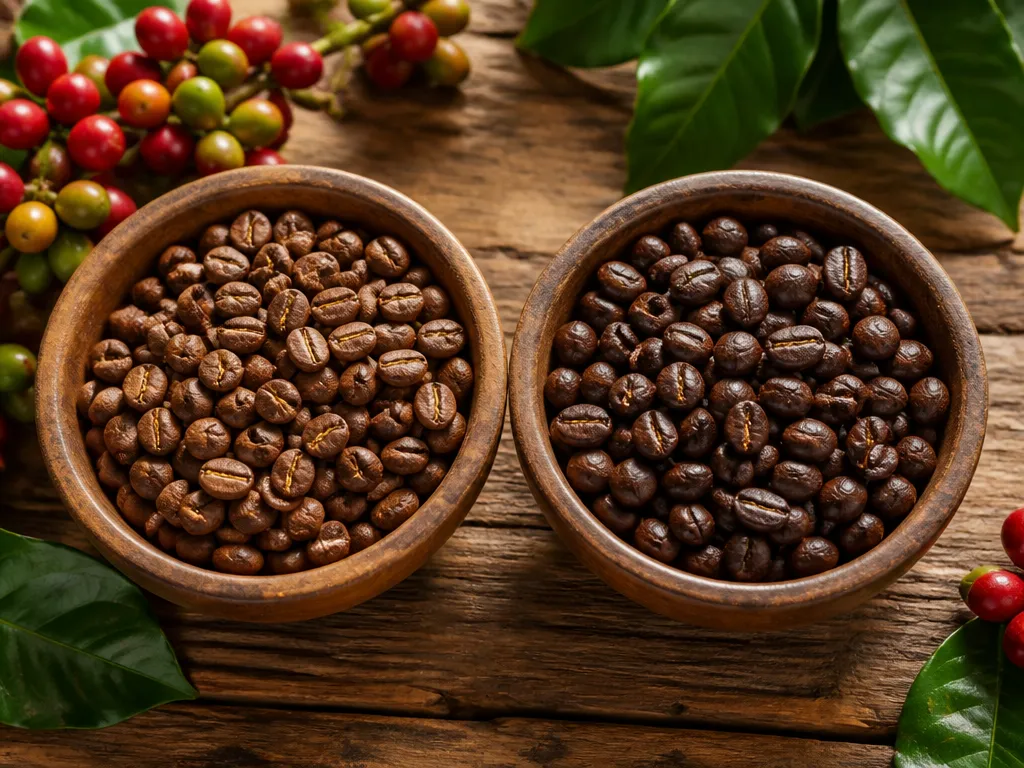
Arabica is the better default for flavor; Robusta is the better pick for caffeine, bitterness, and a heavier body. Arabica usually tastes smoother, sweeter, and more aromatic, while Robusta brings more bite and a stronger, more direct coffee flavor. Your brewing method matters too: Arabica suits filter coffee, pour-over, and flavor-forward milk drinks, while Robusta works well in bold drip coffee and espresso blends.
Arabica green beans contain about 1.2% – 1.5% caffeine (and up to 2.4% in roasted beans), but Robusta generally contains more caffeine. Choose Arabica for flavor clarity and aroma; choose Robusta for a stronger caffeine kick and fuller crema.
Key Takeaways
- Growing conditions shape flavor: Arabica prefers higher elevations, usually about 1,200-2,500 meters.
- Processing affects quality: Hand-picking ripe cherries is common for higher-quality Arabica.
- Roast level changes the cup: Dark roasting reduces perceived acidity and can make either species taste harsher.
- A blend can balance both: An Arabica-forward blend with some Robusta adds body, crema, and caffeine without overwhelming the cup.
Arabica vs Robusta
The difference begins with the plants themselves: they grow in different conditions, tolerate different stresses, and produce beans with different natural chemistry.
Arabica is more demanding to grow. It prefers higher elevations, typically between 1,200 and 2,500 meters (about 4,000 to 8,200 feet), and performs best within specific temperature and rainfall patterns. Its optimal growth at 15-24°C (59-75°F) makes it less tolerant of heat and environmental stress. Those growing requirements can raise production costs, which helps explain why specialty coffee usually leans heavily toward Arabica.
Robusta is more rugged and grows at lower elevations. It handles heat and stress better, so it is often less expensive to produce. In the cup, that resilience usually translates into more bitterness, heavier body, and a straightforward coffee flavor rather than the fruit, floral notes, and acidity associated with many lighter-roasted Arabicas.
Arabica Coffee Characteristics and Flavor
Arabica comes from the Coffea arabica plant and is the species many people mean when they describe coffee as smooth. It often tastes sweeter and more complex, with aromatic notes that make it a common choice for specialty coffee.
Arabica cherries mature in 6-8 months after flowering. Ripe cherries typically turn red or yellow, depending on the variety. Quality-focused farms often hand-pick ripe cherries and leave unripe fruit behind, which can produce a cleaner, less harsh cup. Arabica beans are also generally larger and more elongated than Robusta beans.
Common Arabica flavor notes include chocolate, caramel, nuts, and fruit such as berries. Roast level changes how clearly those flavors come through, but Arabica usually offers more distinct flavor layers and less aggressive bitterness than Robusta.
Where Arabica Grows
Arabica grows best in mountain regions that provide the elevation and climate it needs. A common range is 1,200 to 2,500 meters, where cooler temperatures and steady moisture can support slower bean development.
Arabica typically performs best around 15-24°C (59-75°F), with annual rainfall often between 1,200-2,000 mm. Flowering also depends on dry periods and can require up to five dry months. The plant does not tolerate frost well.
Shade can improve bean quality, and productive farms manage Arabica trees carefully over time. Arabica varieties often begin producing fruit about 3 years after transplanting. Many varieties yield well for 40-50 years, although older traditional varieties may need stumping every 6-7 years.
Arabica vs Robusta Caffeine
Arabica green beans contain about 1.2% – 1.5% caffeine, while roasted beans can contain up to 2.4%. Robusta generally contains more caffeine than Arabica.
Your brewing method and grind size affect how much caffeine ends up in the cup, but the species baseline still favors Robusta. A blend with visible Robusta content will usually provide more caffeine than a 100% Arabica coffee brewed in the same way.
Roast level can make the comparison confusing. Dark roasts often taste stronger and more bitter, even when their caffeine content shifts with processing. Bitterness and smoky flavors can make a coffee feel more powerful than it actually is. If you want more caffeine, choose a coffee labeled as a Robusta blend and keep your brewing method consistent rather than relying on a dark roast alone.
Which Is Better for Flavor and Strength?
Flavor notes such as chocolate, fruit, nuts, or flowers are easier to identify when harsh bitterness does not dominate the cup.
Many espresso blends include some Robusta because it can add a thicker mouthfeel and more pronounced crema.
For most US coffee drinkers, the practical choice is straightforward:
- Choose Arabica for filter coffee and pour-over brewing.
- Choose Arabica for milk drinks when you want sweetness and aroma to remain noticeable.
- Choose Robusta for a bold, bitter cup with a direct coffee flavor.
- Choose a Robusta blend for espresso with more body, crema, and caffeine.
- Choose an Arabica-forward blend if you want a middle ground.
How to Choose an Arabica Variety
The best Arabica variety depends on how you brew. A light-roast pour-over benefits from varieties associated with aroma and clarity. An espresso drinker who prefers chocolate and body may want a variety that retains sweetness when roasted more deeply.
Popular Arabica varieties include Typica, Bourbon, Caturra, Catimor, Geisha, and SL28. Each has its own tendencies, but the farm’s processing method and the roaster’s profile also shape the final cup.
Use these preferences as a starting point:
- For sweet and complex coffee, start with Bourbon.
- For balanced body and mild acidity, try Typica.
- For smooth, mild, floral notes, look for Blue Mountain when available.
- For resistance to leaf rust, often a farm preference that can improve consistency, consider Castillo.
- For smooth, rich, low-acidity coffee, try Kona.
- For high aroma and floral or jasmine notes, choose Geisha.
Variety is only part of the decision. Roast level controls how much acidity and bitterness you perceive. Light-roast Arabica tends to show delicate acidity and origin character. Medium roast often balances sweetness and acidity. Dark roast moves toward bold, smoky flavors and can taste more bitter.
Choose Arabica by Brewing Goal
| What you want in the cup | What to buy (Arabica direction) | Roast level that usually fits |
|---|---|---|
| Clear flavors, bright aroma | Typica, Geisha | Light to medium |
| Sweetness and complexity | Bourbon | Medium |
| Smooth, easy drinking | Kona | Medium to medium-dark |
| Mild acidity, balanced body | Caturra | Medium |
| Bold and smoky | Any Arabica variety used for dark roasts | Dark |
Freshness and grind consistency matter as much as variety. Even the “best Arabica variety” can taste flat when stale, ground inconsistently, or brewed with the wrong grind size, such as a grind that is too fine for a French press.
Which Country Produces the Most Arabica?
Colombia and Brazil are often top contenders, but the country producing the most Arabica depends on the year and how production data separates coffee types. For US shoppers, the useful rule is that much of the Arabica supply comes from Latin America, with additional production in East Africa and Asia.
Arabica grows widely across Latin and Central America, East Africa, and Asia. It performs best in regions that can provide its preferred elevation and climate, including areas where farms sit around 1,200-2,500 meters.
Origin can help you predict flavor, but “Arabica” alone tells you little about the specific cup. Look for a bag that names a country and, when available, a region or farm. Different origins can produce noticeably different levels of acidity, sweetness, and aroma even when they use the same species.
FAQ
Is Arabica or Robusta Cheaper in the US?
Robusta is often cheaper because it is generally easier to grow and more tolerant of difficult conditions. Arabica usually costs more because it requires higher elevations and quality-focused production practices such as hand-picking ripe cherries.
An Arabica blend can offer some of Arabica’s smoother flavor at a lower price than a premium 100% Arabica coffee.
Which Has More Caffeine, Arabica or Robusta?
Robusta typically has more caffeine than Arabica. Arabica green beans contain about 1.2% – 1.5% caffeine, while roasted beans can reach up to 2.4%.
The amount in the cup also depends on the brew method and serving size.
Is Arabica Better for Espresso?
Flavor-forward espresso often emphasizes chocolate, sweetness, and aromatic clarity. Espresso blends that include some Robusta usually deliver more intensity, body, and crema.
An Arabica-forward blend can combine clear flavor with a heavier texture.
How Should I Choose Between Arabica and Robusta for Milk Drinks?
Milk drinks made with Arabica tend to retain noticeable sweetness and aroma, while a Robusta blend stands up more aggressively against the milk with a darker and more bitter edge.
Roast level matters too. A dark roast can mute fruity notes and emphasize smoky intensity, regardless of whether the beans are Arabica or Robusta.
What Is the Most Common Mistake When Buying Arabica vs Robusta?
The common mistake is choosing based on the species label alone and ignoring roast level and brew method. A light-roast Arabica pour-over tastes very different from a dark-roast Arabica drip coffee. Robusta bitterness can also overwhelm a milk drink when the coffee is roasted too dark or ground too fine.

- Unlocking the Venti: Discover the Perfect Shot Count for Your Drink - October 13, 2026
- Unpacking the Buzz: Caffeine Levels in Café Bustelo Espresso - October 13, 2026
- How to Fix Bitter Coffee: 10 Expert Ways to Improve the Taste - October 4, 2026