
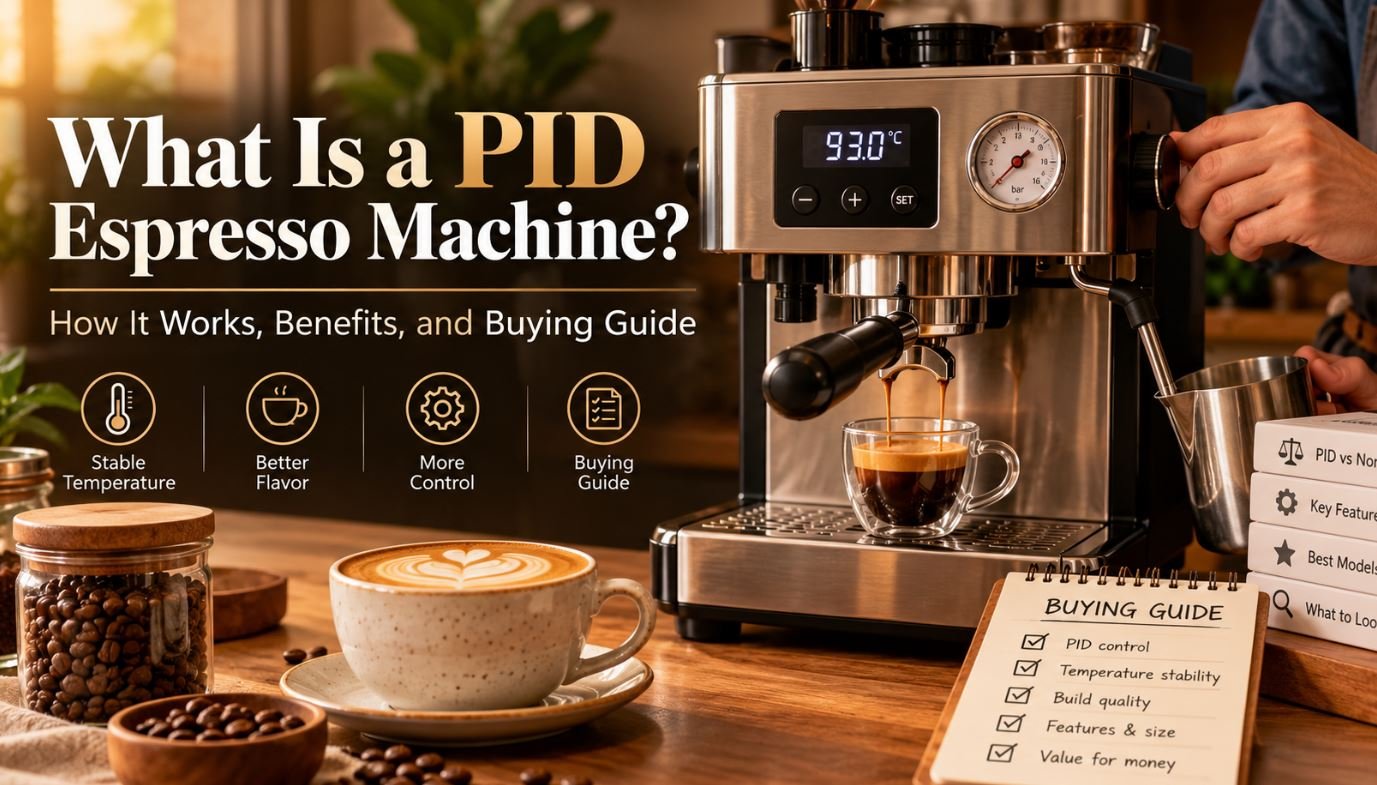
PID in espresso machines stands for Proportional-Integral-Derivative, an electronic control system that helps regulate brewing temperature. It uses a temperature sensor to monitor the heating system and adjusts the heating element to reduce temperature fluctuations. Unlike a basic thermostat, which switches heating on and off within a set range, PID control responds to temperature changes more precisely. This helps home baristas achieve consistent brewing conditions and experiment with different coffee beans. However, PID does not automatically guarantee better espresso. Grind size, coffee dose, water quality, puck preparation, and machine design still affect extraction. Understanding PID technology helps you decide whether this feature is worth having.
What Is PID in Espresso Machines?
PID is a temperature-control technology found in many modern espresso machines. It helps maintain a selected temperature by continuously monitoring the heating system and adjusting its response. This makes brewing conditions more predictable than those of some machines using basic thermostats. For home baristas, the main advantage is improved consistency rather than a guarantee of better-tasting coffee.
What Does PID Stand for in Espresso Machines?
PID stands for Proportional-Integral-Derivative. These three terms describe the calculations used by an electronic controller to regulate temperature.
Although the name sounds complicated, its purpose is straightforward. The controller checks how far the measured temperature is from the selected setting and adjusts heating to reduce the difference. This makes it easier for the machine to maintain stable conditions during normal operation and between espresso shots.
What Is the Main Purpose of a PID Controller?
The main purpose of a PID controller is to regulate the temperature of a boiler, thermoblock, or another heated component. It uses feedback from a temperature sensor to determine when additional heating is needed.
Instead of relying only on a basic heating cycle, the controller adjusts its response as conditions change. This can help reduce temperature overshooting and improve consistency when preparing multiple espresso shots.
How PID Temperature Control Differs From a Regular Thermostat
A traditional thermostat usually switches the heating element on or off when the temperature reaches certain limits. This can allow the heating system to move through a wider temperature range.
A PID controller evaluates the temperature difference and how that difference changes over time. It can adjust heating more gradually, helping the system stay closer to the selected target. Actual performance still depends on machine design.
Why PID Technology Matters for Espresso Brewing
Temperature affects how water extracts flavor compounds from ground coffee. When brewing conditions vary considerably, two shots prepared with the same recipe may taste different.
PID technology can reduce one source of variation. Its practical advantages include:
- More predictable brewing: Helps maintain consistent heating conditions.
- Temperature adjustment: Many machines allow users to change the brewing target.
- Repeatable recipes: Makes comparisons between espresso shots more meaningful.
- Convenient operation: Reduces the need for manual temperature-management routines on some machines.
These benefits complement good coffee preparation rather than replacing it.
How Does a PID Controller Work in an Espresso Machine?
A PID controller works by comparing a measured temperature with a target temperature. A sensor provides feedback, and the controller adjusts the heating element to reduce the difference. This process continues as the machine operates. The controller responds to temperature changes caused by heating, incoming water, and normal brewing activity, helping the system remain near its intended setting.
How Temperature Sensors Measure Boiler Temperature
A temperature sensor is commonly positioned in or against a boiler or another heated component. It sends readings to the PID controller, allowing the system to monitor changes during operation.
The reading represents the temperature at the sensor’s location. It may not be identical to the temperature of water reaching the coffee puck. Plumbing, group-head design, and heat transfer can create differences between these measurements.
How the PID Controller Adjusts the Heating Element
When the measured temperature falls below the selected target, the controller increases the heating response. As the system approaches its target, it reduces heating to help avoid unnecessary overshooting.
Many espresso machines accomplish this through controlled switching of the heating element. The actual method depends on the electronics and machine design. This feedback-based approach supports more stable heating than simple switching in many applications.
Understanding Proportional, Integral, and Derivative Control
PID uses three calculations to help regulate the heating system. Each responds to a different aspect of temperature behavior.
- Proportional: Responds to the current difference between measured and target temperature.
- Integral: Helps correct temperature differences that persist over time.
- Derivative: Responds to how quickly the temperature is changing.
- Combined control: Balances these responses to improve stability and limit overshooting.
Manufacturers normally configure these values. Home users should not change factory PID tuning parameters without explicit technical guidance.
How PID Reduces Temperature Fluctuations During Brewing
Brewing introduces cooler replacement water into certain espresso machine heating systems. This can disturb the temperature, requiring the machine to recover.
The PID controller detects changes at its sensor and adjusts heating accordingly. This helps the machine return toward its target temperature. However, it cannot eliminate every fluctuation, especially when boiler capacity, heating power, or overall thermal design limits recovery performance.
What Are the Benefits of PID in Espresso Machines?
PID temperature control offers several practical benefits for espresso preparation. It can improve temperature stability, support more repeatable shots, and provide adjustable brewing settings on compatible machines. These advantages are particularly useful for enthusiasts who experiment with different coffees. However, the difference users notice depends on the quality of the machine and how consistently they prepare their espresso.
More Consistent Brewing Temperature Between Shots
When a machine maintains more predictable heating conditions, users can prepare consecutive shots with less uncertainty about temperature changes.
This is helpful when comparing recipes or making drinks for several people. A PID cannot guarantee identical temperatures at the coffee puck every time, but it can improve control over the heating system. Consistency also depends on adequate warm-up and the machine’s recovery capability.
Better Control Over Espresso Extraction
Many PID-equipped machines allow users to select different temperature settings. This provides another variable to explore when adjusting espresso flavor.
Temperature can influence how soluble compounds are extracted, but it works alongside grind size, brewing ratio, and shot time. Users generally achieve better results by establishing a consistent recipe first, then making small temperature adjustments rather than changing several variables simultaneously.
Adjustable Temperature Settings for Different Coffee Beans
Different coffee beans and roast styles can respond differently to brewing temperature. PID-equipped machines with user-adjustable settings make it easier to test these differences.
A useful approach is to begin with the manufacturer’s default temperature, prepare a consistent shot, and evaluate the flavor. If needed, adjust the temperature slightly and compare results. There is no single setting that works perfectly for every coffee.
Improved Repeatability for Home Baristas
Repeatability is one of the strongest reasons to consider a PID espresso machine. Stable heating conditions can make it easier to understand how other brewing changes affect the final cup.
For better repeatability:
- Use a consistent coffee dose.
- Weigh the espresso yield.
- Keep the grinder setting stable during comparisons.
- Allow the machine to reach operating temperature.
- Change one brewing variable at a time.
PID supports this process, but a capable grinder and consistent preparation remain essential.
PID vs Non-PID Espresso Machines: What Is the Difference?
The main difference between PID and non-PID espresso machines is how their heating systems are regulated. Basic thermostats commonly operate within a switching range, while PID controllers continuously evaluate temperature feedback and adjust heating. Both approaches can produce good espresso. The value of PID becomes clearer when temperature adjustment, consistency, and repeatable brewing conditions are important to the user.
Traditional Thermostat vs PID Temperature Control
A conventional thermostat switches heating on and off based on predetermined temperature limits. This simple approach can work well, but it may produce noticeable heating cycles depending on the machine.
A PID controller calculates its response using temperature feedback, often allowing tighter regulation. However, overall temperature stability still depends on the boiler, sensor placement, heating power, and group design. PID is not a substitute for sound engineering.
Comparing Temperature Stability and Brewing Consistency
PID systems often help machines maintain a more consistent heating temperature. This can reduce one source of variation between espresso shots.
Non-PID machines may require users to understand their heating cycles or follow particular warm-up procedures. Some can still produce excellent espresso. The comparison should focus on real brewing performance rather than assuming every PID machine is automatically better than every thermostat-controlled model.
Differences in Price, Features, and Maintenance
PID-equipped machines may cost more than simpler alternatives, although price also depends on boiler configuration, construction, pump design, and additional controls.
The electronic controller adds complexity, but this does not necessarily mean the machine will require more frequent repairs. Buyers should consider manufacturer support and parts availability. A reliable non-PID machine may be a better purchase than a poorly supported PID model.
Is a PID Espresso Machine Worth the Extra Money?
PID can be worthwhile if you make espresso regularly or want more control over brewing temperature. For occasional users, the additional expense may be less important.
| Feature | PID espresso machine | Non-PID espresso machine |
|---|---|---|
| Temperature regulation | Feedback-based electronic control | Often thermostat-based |
| Temperature adjustment | Frequently available | Often limited |
| Heating fluctuations | Generally better controlled | May have wider cycles |
| Brewing repeatability | Can improve consistency | Depends on design and technique |
| Equipment cost | May be higher | Simpler models may cost less |
| Best fit | Users seeking control and repeatability | Users prioritizing simplicity |
Neither type guarantees better coffee. Compare the entire machine before deciding.
What Is the Best PID Temperature for Espresso?
There is no universal PID temperature setting that produces the best espresso from every coffee. A commonly used espresso brewing-water range is approximately 195–205°F, or 90–96°C. However, the displayed temperature may represent a boiler sensor rather than the actual water temperature at the coffee puck. Use manufacturer guidance as your starting point and make adjustments based on taste.
Recommended Espresso Brewing Temperature Range
For many espresso recipes, approximately 200°F, or 93°C, is a reasonable starting reference when the machine’s controls correspond appropriately to brewing-water temperature.
Some coffees perform better at slightly different temperatures. Avoid treating a recommended range as an exact requirement for every machine. Sensor location, temperature offsets, and group design affect the relationship between the displayed setting and actual extraction conditions.
PID Temperature Settings for Light, Medium, and Dark Roasts
Roast level can influence how readily coffee compounds dissolve during extraction. Some lighter roasts may respond well to higher brewing temperatures, while darker roasts may taste balanced at lower settings.
These are tendencies rather than fixed rules. Before changing temperature, make sure the grind, dose, and beverage yield are reasonable. Adjust gradually, taste the difference, and use the results to guide your preferred settings.
Boiler Temperature vs Actual Water Temperature at the Coffee Puck
A PID display commonly reports the temperature measured by a boiler sensor or a calculated value derived from that measurement.
Water can gain or lose heat as it travels through the brewing system. Some manufacturers use a temperature offset to make the display approximate brew temperature. Others display boiler temperature directly. Consequently, identical numbers on two machines do not guarantee identical water temperatures at the coffee.
How to Adjust PID Temperature Settings for Better Espresso
The safest approach is to change only the normal user-accessible brew-temperature setting, following the machine’s manual.
- Begin with the recommended factory setting.
- Use the same coffee dose and beverage yield.
- Change the temperature by a small increment.
- Allow the machine to stabilize.
- Taste several shots before making another change.
Avoid changing advanced PID tuning values or temperature offsets unless the manufacturer explicitly instructs you to do so.
How Does PID Work in Different Types of Espresso Machines?
PID technology appears in several heating-system designs, including single-boiler, dual-boiler, heat exchanger, and thermoblock machines. Its practical effect varies because these systems heat and deliver water differently. Understanding the machine’s architecture helps buyers assess whether its PID controls provide direct brewing-temperature adjustment, indirect temperature management, or another form of heating regulation.
PID Control in Single-Boiler Espresso Machines
Single-boiler espresso machines use one boiler for both brewing and steaming, generally at different temperatures. A PID can improve regulation during brewing and may allow users to change the brew-temperature setting.
However, switching between espresso and steam modes still takes time. PID cannot remove this limitation because the same boiler must serve both functions. Users who frequently prepare milk drinks may prefer another configuration.
PID Control in Dual-Boiler Espresso Machines
Dual-boiler machines have independent heating systems for brewing and steaming. Some use separate temperature controllers, allowing more precise adjustment of each boiler.
This arrangement is convenient for households preparing multiple cappuccinos or lattes because brewing and steaming can occur simultaneously. However, dual-boiler systems typically cost more and occupy additional counter space. The benefits should be considered alongside the buyer’s actual daily routine.
PID Control in Heat Exchanger Espresso Machines
Heat exchanger machines commonly use a steam boiler to supply heat to a separate brewing-water pathway. A PID often controls the steam boiler’s temperature rather than directly measuring water at the group head.
This makes the relationship between the displayed setting and brewing temperature more indirect. Some heat exchanger machines require specific flushing or warm-up procedures. Always follow the instructions for the exact model.
PID Temperature Control in Thermoblock Espresso Machines
Thermoblock machines heat water as it travels through heated channels. Some use electronic feedback control to manage the block’s temperature or another measured point in the system.
Different designs provide different levels of stability and adjustment. A digital display alone does not prove that a machine uses a conventional PID algorithm.
| Machine type | Typical PID control point | Important consideration |
|---|---|---|
| Single boiler | Shared boiler | Brew-to-steam switching |
| Dual boiler | Brew boiler and sometimes steam boiler | Independent temperature control |
| Heat exchanger | Often the steam boiler | Indirect relationship to brew temperature |
| Thermoblock | Heating block or associated sensor | Performance depends on flow and design |
Compare the complete heating system rather than relying only on the PID label.
Does PID Actually Improve Espresso Taste and Quality?
PID can improve the consistency of brewing conditions, but better temperature regulation does not automatically produce better-tasting espresso. Flavor depends on how effectively water extracts compounds from coffee grounds. Brewing temperature contributes to this process alongside grind size, dose, pressure, flow, and extraction yield. PID is most useful when these other variables are already reasonably controlled.
How Brewing Temperature Influences Espresso Flavor
Brewing temperature influences the rate at which coffee compounds dissolve into water. A temperature adjustment may change the balance of acidity, sweetness, bitterness, and body in the resulting espresso.
However, flavor changes are not always predictable from temperature alone. Different beans and recipes respond differently. Temperature experiments are most useful when other variables remain consistent and changes are evaluated through tasting.
Does PID Help Prevent Sour or Bitter Espresso?
PID can reduce unwanted temperature variation, which may help users reproduce balanced espresso. However, it does not directly prevent sourness or bitterness.
Sour espresso may be associated with insufficient extraction, while excessive extraction can contribute to unpleasant bitter flavors. Both situations can have several causes. Before changing temperature, check grind size, dose, beverage yield, coffee freshness, and puck preparation.
Why PID Alone Cannot Guarantee Better Coffee
Even a machine with excellent temperature control can produce poor espresso when the coffee is ground incorrectly or prepared inconsistently.
A PID cannot fix:
- An unsuitable grind size.
- An unevenly prepared coffee puck.
- Incorrect coffee dose or beverage yield.
- Poor-quality or improperly stored beans.
- Unsuitable brewing water.
Think of PID as a tool for controlling one important variable. It works best as part of a balanced espresso setup.
How Grind Size, Coffee Dose, and Extraction Time Affect Results
Grind size changes how easily water flows through the coffee puck. Dose determines how much ground coffee is used, while beverage yield influences the strength and extraction of the finished drink.
Shot time provides useful feedback but should not be treated as the only measure of quality. A consistent recipe helps users understand whether a temperature adjustment improves flavor or simply changes an already unstable brewing process.
Common PID Espresso Machine Problems and Troubleshooting
PID systems can experience problems involving temperature sensors, heating components, electrical controls, or incorrect settings. However, small display fluctuations are often normal as the machine responds to changing conditions. Troubleshooting should begin with the user manual and ordinary operating checks. Internal electrical testing, boiler repairs, and controller replacement require qualified personnel because espresso machines contain dangerous voltages and hot, pressurized components.
Why the PID Temperature Display Keeps Fluctuating
A PID display may change slightly while the heating system operates or recovers after a shot. This does not necessarily indicate a fault.
The controller continuously responds to measured changes, so some movement is expected. If fluctuations become unusually large or persistent, check whether the machine has completed warm-up. Consult the manual for normal operating behavior before assuming the sensor or controller is defective.
PID Espresso Machine Not Reaching the Set Temperature
If the machine never reaches its selected temperature, first verify that it is in the correct operating mode and has completed its recommended warm-up procedure.
Some models use energy-saving settings or display different temperatures for brewing and steaming. Persistent heating failure may involve a sensor, heating element, or control system. These possibilities require proper diagnosis rather than replacement based on symptoms alone.
Understanding PID Temperature Sensor and Heating Problems
Temperature regulation depends on several components working together. A malfunctioning sensor can provide incorrect feedback, while a damaged heating component may prevent the machine from responding as intended.
Possible warning signs include:
- Persistent temperature error messages.
- Failure to reach normal operating temperature.
- Repeated abnormal overheating behavior.
- Sudden changes in heating performance.
Stop using the machine if it smells burnt, trips electrical protection, or overheats. Do not open the housing to inspect electrical components.
When to Seek Professional PID Controller Repair
Professional service is appropriate when normal operating checks do not resolve temperature errors, when heating fails repeatedly, or when the machine behaves unpredictably.
A technician can distinguish a faulty controller from sensor problems, electrical faults, or heating-element failure. Avoid replacing the PID simply because the display looks unusual. Accurate diagnosis can prevent unnecessary costs and reduce the risk of damaging additional components.
How to Choose an Espresso Machine With PID Temperature Control
Choosing a PID espresso machine involves balancing temperature regulation with brewing performance, workflow, price, and long-term maintenance. Buyers should think about how often they prepare espresso, whether they make milk-based drinks, and whether adjustable settings will be useful. A reliable machine with good temperature control and accessible service may be a better investment than a feature-heavy model with limited support.
Important PID Features to Look for Before Buying
Not every PID-equipped machine provides the same level of control. Some allow easy temperature adjustment, while others regulate heating internally without exposing detailed settings.
When comparing models, consider the display, adjustment increments, heating-system design, and warm-up behavior. Check whether the manufacturer explains what the displayed temperature represents. Clear documentation makes it easier to use temperature controls correctly without changing advanced settings unnecessarily.
Entry-Level vs Premium PID Espresso Machines
Entry-level PID machines may provide adjustable brewing temperature with a relatively simple heating system. Premium models may add independent boilers, programmable features, pressure profiling, or more sophisticated displays.
These additions can be valuable for experienced enthusiasts, but they also increase complexity and sometimes ownership costs. Buyers should prioritize features that improve their routine rather than selecting the machine with the longest specification list.
Choosing PID, Dual Boilers, and Other Brewing Features
PID and dual boilers are separate features. PID regulates temperature, while a dual-boiler arrangement allows brewing and steaming to use independent heating systems.
Before purchasing, identify your priorities:
- Mostly straight espresso: A single-boiler PID machine may be sufficient.
- Frequent milk drinks: Dual boilers can improve workflow.
- Limited counter space: Check compact heating-system options.
- Advanced experimentation: Look for useful temperature adjustments and repeatable controls.
- Long-term ownership: Prioritize parts availability and qualified service support.
The best configuration depends on how the machine will be used.
Comparing U.S. Prices, Warranty Coverage, and Service Support
For American buyers, compare total ownership costs rather than focusing only on the advertised price. A suitable espresso grinder, water filtration, cleaning products, shipping, and maintenance may add significantly to the overall investment.
Confirm the electrical requirements of the exact U.S. model and review warranty coverage in writing. Replacement-part availability and technician support also matter, especially for machines intended for many years of home use.
Frequently Asked Questions About PID in Espresso Machines
Many espresso machine buyers want to know whether PID is necessary, whether it improves warm-up times, and whether an existing machine can be upgraded. These questions are important because PID is often promoted as a premium feature. Understanding what it can and cannot do helps buyers make practical decisions based on brewing needs rather than marketing claims.
Is PID Necessary for Making Good Espresso?
No. PID is not essential for producing good espresso. Many well-designed non-PID machines can deliver excellent results with suitable coffee and consistent technique. PID becomes more valuable when users want adjustable temperature settings and repeatable brewing conditions, particularly when experimenting with different beans.
Does PID Make Espresso Machines Heat Up Faster?
Not necessarily. PID primarily improves temperature regulation rather than increasing the heating system’s physical capacity. Warm-up time depends on heating power, boiler size, group-head design, and other thermal characteristics. A PID may manage heating efficiently, but it does not guarantee that the entire machine becomes ready faster.
Can You Add PID to an Espresso Machine Without It?
Some espresso machines can be fitted with model-specific aftermarket PID kits. However, installation may involve electrical wiring, temperature sensors, and modifications to existing controls. Compatibility and warranty implications vary. Because electrical and heating-system modifications can be hazardous, professional installation is recommended.
Is PID Better Than a Traditional Thermostat?
PID generally offers more refined temperature regulation than a basic on/off thermostat, particularly when the system is properly designed and configured. However, a well-built thermostat-controlled machine can still make excellent espresso. Overall brewing performance, reliability, and usability matter more than the temperature controller alone.
Final Thoughts: Is PID Worth Having in an Espresso Machine?
PID is a useful technology for home espresso enthusiasts who value consistent brewing conditions and greater temperature control. By monitoring a sensor and adjusting heating, it helps keep the machine closer to the selected temperature than many basic thermostat systems.
Its main advantages are repeatability, adjustable brewing settings, and reduced temperature fluctuations. However, PID does not directly control grind size, coffee dose, puck preparation, or every aspect of extraction.
For beginners, a machine with reliable heating, straightforward controls, and a good grinder may be more important than advanced temperature adjustments. For experienced users who enjoy experimenting with different coffees, PID can provide meaningful flexibility.
A PID espresso machine is worth considering when temperature consistency and control matter to your brewing routine, but it should be evaluated as part of the complete machine rather than as a guarantee of better espresso.

- What Espresso Machines Does Starbucks Use? Mastrena Models, Features, and Buying Guide - October 26, 2026
- What Is PID in Espresso Machines? How It Works, Benefits, and Temperature Control - October 26, 2026
- 3-Way Solenoid Valve in Espresso Machines: How It Works, Problems, and Maintenance - October 26, 2026