
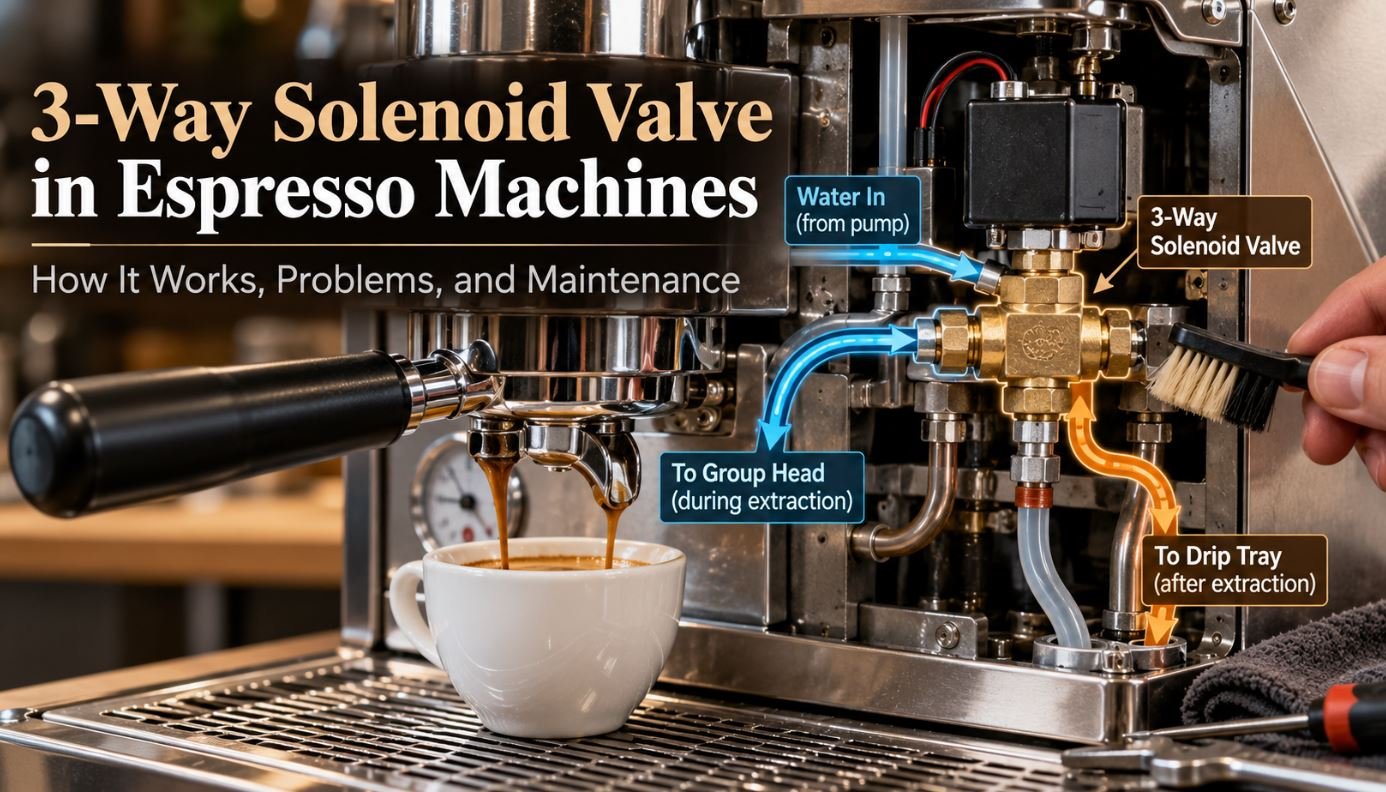
A 3-way solenoid valve in an espresso machine is an electrically controlled component that manages water flow during brewing and releases remaining pressure after extraction. When you start making espresso, the valve allows pressurized water to travel toward the group head. When brewing stops, it redirects residual water and pressure through a discharge line, usually into the drip tray. This helps prevent a sudden release of hot water when removing the portafilter and supports cleaning procedures such as backflushing on compatible machines. Understanding how this valve works can help you recognize brewing problems, maintain your espresso machine, and decide when professional repair is necessary.
What Is a 3-Way Solenoid Valve in an Espresso Machine?
A 3-way solenoid valve is a small electrically operated valve found in many home and commercial espresso machines. It controls the path water takes through the brewing circuit and provides a route for releasing remaining pressure after extraction. Although it is often hidden inside the machine, it plays an important role in espresso preparation, cleaning, and everyday operation.
What Does a Three-Way Solenoid Valve Do?
A three-way solenoid valve directs water toward the group head when brewing begins and provides an exhaust route when the shot ends. This allows pressurized water remaining above the coffee puck to escape.
The result is a more controlled end to the brewing cycle. Instead of leaving substantial pressure trapped in the group, the valve helps depressurize the brewing circuit before the user removes the portafilter.
Why Espresso Machines Use Solenoid Valves
Espresso machines rely on several components working together to control water movement. Solenoid valves make it possible to open or close specific pathways using electrical signals from the machine’s controls.
This automation helps the machine respond when users start or stop extraction. In three-way brewing systems, the valve also helps manage residual pressure, allowing the group head to return to a depressurized state after a shot.
Where Is the Solenoid Valve Located?
The valve’s location depends on the machine’s design. In many traditional espresso machines, it is installed inside the housing near the boiler, group head, or associated brewing-water connections.
Because it is an internal component, owners generally cannot inspect it without removing panels. The best way to identify its location is through the manufacturer’s parts diagram. Avoid opening the machine solely to locate the valve.
Main Components of a Three-Way Solenoid Valve
Although designs vary, most three-way solenoid assemblies use similar operating components.
- Solenoid coil: Creates a magnetic field when energized.
- Movable plunger: Changes position in response to the magnetic field.
- Valve body: Contains the internal water passages.
- Spring: Returns the internal mechanism toward its normal position.
- Seals and connections: Help direct water through the intended paths.
These parts work together to control flow. Their dimensions, materials, and electrical requirements vary by machine, so replacement components must match the exact model.
How Does a 3-Way Solenoid Valve Work?
A typical three-way brewing valve changes the connection between three water passages: the supply, the group head, and the exhaust line. During brewing, it allows water to reach the coffee. After brewing, it closes the supply route and opens a discharge path. The exact sequence depends on the valve design and the machine’s control system.
How the Solenoid Coil Controls Water Flow
The solenoid coil creates a magnetic field when the machine supplies the appropriate electrical signal. This magnetic field moves an internal plunger, changing which passages inside the valve are open.
When the signal ends, a spring commonly returns the plunger to its resting position. This allows the machine to change water routes automatically without requiring the user to operate a separate mechanical valve.
What Happens When Espresso Brewing Starts?
When a user activates brewing, the machine starts the necessary water-delivery components and changes the solenoid valve’s position. Water can then travel through the brewing circuit toward the group head.
As water reaches the coffee puck, resistance from the grounds helps determine how pressure develops. The solenoid provides a water pathway, but it is not responsible for independently creating or regulating the entire brewing pressure.
How the Valve Releases Pressure After Extraction
When brewing stops, the valve changes position and opens the exhaust path. Water remaining under pressure around the group head can then travel through the discharge line.
This reduces the pressure above the coffee puck. It also helps limit unwanted water release when removing the portafilter. The system should still be operated according to the manufacturer’s safety instructions.
Why Water Drains Into the Drip Tray After Brewing
A brief discharge of water into the drip tray after a shot is normal on many machines equipped with three-way valves. It indicates that the brewing circuit is releasing remaining pressure.
The operating sequence can be summarized as follows:
| Operating stage | Typical valve behavior | Result |
|---|---|---|
| Machine idle | Brewing supply closed; group exhaust path open | Group can remain depressurized |
| Brewing | Water supply connected to group; exhaust closed | Water reaches the coffee |
| Brewing stops | Supply closes; exhaust opens | Residual pressure is released |
| Compatible backflushing cycle | Valve alternates between brewing and exhaust states | Cleaning solution can exit through the discharge path |
The exact sequence varies by machine. Normal discharge water should not be mistaken for an internal leak without further evidence.
Benefits of a 3-Way Solenoid Valve for Espresso Brewing
A three-way solenoid valve offers practical advantages beyond opening the water supply. Its most noticeable benefit is releasing pressure after extraction, which makes daily brewing more convenient. It can also help reduce retained water above the coffee puck and enables certain cleaning procedures. These benefits depend on the valve operating correctly and the machine being designed around it.
Faster Pressure Release After Each Espresso Shot
When a brewing cycle finishes, residual pressure can remain in the group head. A functioning three-way valve provides a controlled route for that pressure to dissipate.
This allows users to begin the next preparation step more conveniently. It is especially useful when making several drinks in succession. However, the portafilter and coffee grounds may still be hot, so normal handling precautions remain necessary.
Cleaner Portafilter Removal and Less Mess
Releasing pressure before removing the portafilter reduces the chance of a sudden spray of coffee grounds and hot water. It can also leave the used coffee puck relatively dry.
A dry puck is not guaranteed, however. Coffee dose, grind size, basket design, and extraction conditions can affect how much moisture remains. Wet grounds alone do not prove that the valve has failed.
How the Valve Helps Stop Water Flow After Brewing
When brewing ends, the three-way valve changes the water pathway so the supply is separated from the group and the residual pressure can escape.
This helps create a clearer end to extraction. Although a small amount of dripping may still occur, continuous unexpected flow can indicate a restriction, sealing problem, or another issue that deserves investigation.
Why a Three-Way Valve Makes Backflushing Possible
On compatible machines, a three-way valve provides the discharge path needed for traditional backflushing. A blind basket temporarily prevents water from passing through the portafilter, allowing the cleaning cycle to direct water through the group circuit and exhaust.
Before backflushing:
- Confirm the manufacturer explicitly permits it.
- Use the specified blind basket or cleaning accessory.
- Choose only approved espresso cleaning products.
- Follow the machine’s prescribed cleaning cycle.
- Never force a backflush on an unsupported machine.
A three-way valve is an important part of this process, but its presence alone does not replace model-specific cleaning instructions.
3-Way vs 2-Way Solenoid Valves: What’s the Difference?
The difference between a two-way and three-way solenoid valve is the number of fluid connections and the routing functions they can perform. A two-way valve generally opens or closes one flow path. A three-way valve can switch between two connected paths, making it useful for directing brewing water and releasing group-head pressure.
How a Two-Way Solenoid Valve Works
A two-way solenoid valve has an inlet and an outlet. Depending on its design, electrical activation opens or closes the passage between them.
Espresso machines may use two-way valves for water admission, boiler filling, or other specific functions. Their operation depends on the system in which they are installed. A two-way valve is not inherently inferior; it simply performs a different routing function.
Three-Way Valve Design and Water Flow Paths
A three-way valve typically has three fluid connections and changes which passages communicate with one another. In a common espresso brewing arrangement, one path supplies the group while another provides an exhaust route.
During extraction, water travels toward the coffee. After extraction, the valve redirects residual water toward the discharge line. This ability to change the flow path makes it particularly useful.
Differences in Pressure Release and Brewing Functions
A two-way valve can control water admission but does not automatically provide a separate exhaust path for the brewing group. A three-way valve can perform both water-routing and pressure-release functions when designed for that purpose.
The complete hydraulic arrangement matters. Some espresso machines use additional valves or alternative mechanisms to manage pressure, so valve type alone does not describe every operating feature.
Which Valve Type Is Better for Espresso Machines?
Neither type is universally better because their purposes differ.
| Feature | Two-way solenoid valve | Three-way solenoid valve |
|---|---|---|
| Fluid connections | 2 | 3 |
| Typical function | Opens or closes a flow path | Switches between flow paths |
| Can control water admission | Yes | Yes |
| Can provide a separate group exhaust route | Not by itself | Yes, in a suitable design |
| Used for group depressurization | Depends on additional components | Common application |
| Typical espresso applications | Fill and supply functions | Brewing and pressure release |
Some espresso machines use both types. The correct choice depends on the machine’s engineering rather than the number of ports alone.
Common 3-Way Solenoid Valve Problems and Symptoms
Like other mechanical and electrical components, three-way solenoid valves can develop problems over time. Coffee residue, scale, worn internal parts, or electrical faults may interfere with operation. Symptoms can include restricted water flow, unexpected dripping, or incomplete pressure release. However, these symptoms overlap with other espresso machine problems, making careful diagnosis important.
Espresso Machine Pump Runs but No Water Comes Out
If the pump operates but water does not reach the group head, a blocked or non-operating solenoid valve is one possible cause. A valve that fails to open may interrupt water delivery.
However, the problem could also involve an empty reservoir, air trapped in the circuit, a clogged water filter, or a pump issue. Check these possibilities before assuming the valve needs replacement.
Water Continues Dripping From the Group Head
Unexpected water dripping from the group head while the machine is idle may indicate that a valve is not sealing properly. Debris, wear, or a mechanical fault can prevent the valve from closing completely.
A small amount of water immediately after brewing may be normal, depending on the machine. Persistent dripping should be evaluated in the context of the exact model and its operating behavior.
Pressure Does Not Release After Brewing
If the portafilter remains unusually pressurized after a shot, the group exhaust route may not be functioning properly. A blocked discharge passage or sticking valve can contribute to this symptom.
Do not force the portafilter open. Hot water and coffee grounds may be released unexpectedly. Stop brewing, follow the manufacturer’s safe shutdown instructions, and arrange service if pressure does not release normally.
Clogged Solenoid Valve, Mineral Buildup, and Coil Failure
Several different problems can interfere with valve operation.
- Coffee residue: Oils and fine particles may accumulate in passages associated with the brewing circuit.
- Mineral scale: Unsuitable water can contribute to deposits in narrow passages.
- Sticking mechanism: Internal wear or contamination can prevent normal movement.
- Electrical failure: A damaged coil or control circuit may stop the valve from activating.
These causes require different repairs. Electrical testing and internal disassembly should be performed by qualified technicians.
How to Troubleshoot a 3-Way Solenoid Valve Safely
Troubleshooting should begin with observable symptoms and safe checks rather than opening the machine. A missing water supply, clogged basket, or blocked group head can resemble a failed solenoid. By identifying when the problem occurs and whether other machine functions work, owners can provide useful information to a technician without disturbing electrical or pressurized components.
Checking the Symptoms Before Suspecting the Valve
Observe whether the machine powers on, completes its warm-up, and operates the pump. Note whether water reaches the group head and whether the drip tray receives a discharge after brewing stops.
Compare the behavior with your machine’s normal operation. A valve may be worth investigating if water flow or pressure release changes suddenly, but a single symptom is not a definitive diagnosis.
Inspecting Water Flow and Drainage Without Opening the Machine
Some manufacturers permit a brief group-head water-flow test without the portafilter. This can help determine whether water reaches the group independently of coffee resistance.
Keep a suitable container beneath the group and follow the manual carefully. Do not touch hot water or attempt the test if the machine is already behaving dangerously. Check the drip tray for unusual discharge patterns without removing internal panels.
Distinguishing Solenoid Problems From Pump and Group Head Blockages
Several faults can produce similar brewing symptoms. Compare what the machine does before concluding that the solenoid is responsible.
- Empty or incorrectly seated tank: Water may never reach the pump.
- Airlock: Water delivery may become interrupted after the reservoir runs dry.
- Blocked basket: Water may flow normally without coffee but not during extraction.
- Group-head restriction: Flow may remain weak despite a working pump.
- Possible solenoid fault: Water routing or pressure release may behave abnormally.
These observations narrow the possibilities but cannot replace a complete technical diagnosis.
When to Contact a Qualified Espresso Machine Technician
Professional service is appropriate when water delivery remains interrupted after approved checks, the group fails to depressurize, or unexplained dripping continues.
Stop immediately if you notice burning smells, electrical trips, smoke, or water reaching electrical components. Internal valve work involves electricity, hot water, and pressurized plumbing. An experienced technician can assess the coil, control signal, mechanical passages, and related components safely.
How to Clean and Maintain a 3-Way Solenoid Valve
Keeping the brewing system clean can reduce the likelihood of residue-related restrictions affecting the solenoid valve. Backflushing, where supported, helps remove accumulated coffee oils from the group circuit. Water treatment also matters because mineral scale can restrict narrow passages. Proper maintenance should follow the manufacturer’s schedule and never involve unnecessary internal disassembly.
Why Coffee Oils and Mineral Deposits Cause Blockages
Coffee contains oils and small particles that can accumulate inside brewing components. Over time, these residues may narrow passages and interfere with water flow.
Minerals in unsuitable water can also form deposits on heated surfaces and inside narrow channels. Cleaning and water treatment address different types of buildup, so an espresso detergent is not a replacement for a suitable water-management plan.
How Backflushing Helps Clean the Brewing Circuit
Backflushing uses a compatible blind basket and a manufacturer-approved procedure to clean portions of the brewing circuit. When the machine cycles, water and cleaning solution can move through the group and discharge path.
The procedure helps remove coffee residue from components exposed to the cleaning flow. It does not guarantee removal of every internal blockage, and it should not be performed on machines that do not support backflushing.
Choosing Approved Espresso Cleaning Products
Cleaning products should be selected for the specific machine and maintenance task.
- Espresso cleaning detergent: Helps remove coffee oils when used according to instructions.
- Group brush: Removes accessible residue around the group area.
- Approved blind basket: Supports backflushing on compatible models.
- Water filter or treatment system: Helps manage incoming water chemistry.
- Descaling product: Should only be used when specifically approved for the machine.
Avoid mixing chemicals or substituting household cleaners. Improper products can damage seals, metal surfaces, or internal components.
How Often Should You Backflush and Service Your Machine?
Backflushing frequency depends on machine design, usage, and manufacturer recommendations. A busy commercial machine may require more frequent cleaning than one used occasionally at home.
Follow the specific instructions for water-only rinsing, detergent backflushing, and periodic servicing. Monitor coffee residue, drainage behavior, and water quality. If normal cleaning fails to restore proper operation, arrange professional inspection rather than repeatedly using stronger chemicals.
Repairing or Replacing a Faulty 3-Way Solenoid Valve
A faulty three-way solenoid valve does not automatically mean the entire espresso machine needs replacement. Depending on the fault, a technician may recommend cleaning, repairing associated connections, or replacing the valve assembly. The correct decision depends on diagnosis, compatible parts, labor costs, and the machine’s overall condition. A written estimate helps avoid unnecessary spending.
Signs That Professional Valve Repair May Be Necessary
Service may be needed when water repeatedly fails to reach the group, pressure does not release normally, or water continues flowing when brewing is stopped.
A technician should confirm that the symptoms originate from the valve rather than another component. This may involve checking the control signal, water passages, and mechanical response. Owners should not attempt internal electrical tests or valve removal without suitable training.
Solenoid Coil Problems vs Mechanical Valve Blockages
An electrical coil failure and a mechanical blockage may produce similar symptoms, but their causes are different. A failed coil may prevent the internal mechanism from moving, while scale or debris may obstruct the valve even when the electrical control works.
Correct diagnosis matters because cleaning will not repair a failed coil, and replacing electronics may not solve a blocked passage. A technician can identify the necessary repair.
Factors That Affect Repair and Replacement Costs in the USA
The cost of repairing a solenoid valve varies by machine, accessibility, replacement-part availability, and labor requirements.
Important cost factors include:
- Diagnosis: Time required to establish the actual cause.
- Part compatibility: Original equipment and approved alternatives may differ in cost.
- Labor: Valve access and replacement complexity vary by model.
- Additional damage: Related seals or connections may need attention.
- Service location: Shipping, mobile service, and regional labor rates can affect the total.
Request an itemized estimate rather than relying on a generic repair price.
How to Find a Compatible Replacement Valve for Your Machine
A replacement valve must match the machine’s specified part, including its electrical characteristics, hydraulic connections, and intended operating function.
Use the manufacturer’s model information, serial number, and official parts documentation when requesting service. Two valves that look similar may not be interchangeable. Do not substitute components based only on appearance or an advertised three-way design.
Does Your Espresso Machine Need a 3-Way Solenoid Valve?
A three-way solenoid valve is a useful component, but not every espresso machine requires one to make coffee. Some machine designs handle brewing and pressure release differently. For home buyers, the important questions are whether the machine supports the desired cleaning procedures, how it releases pressure, and whether its design matches the intended brewing routine.
Espresso Machines With and Without Three-Way Valves
Many traditional pump-driven espresso machines include a three-way valve, but some entry-level or alternative brewing designs do not.
Machines without this valve may use different pressure-release arrangements. Owners might need to wait before removing the portafilter, depending on the system. Always follow the model’s instructions rather than assuming the procedure is identical across espresso machines.
Is a Three-Way Valve Important for Home Espresso?
A three-way valve is helpful because it provides a controlled pressure-release route and can support compatible backflushing procedures.
However, its presence does not automatically guarantee better espresso flavor. Temperature stability, grinder quality, brewing pressure, and coffee preparation remain essential. Treat the valve as a practical convenience and maintenance feature rather than a direct indicator of drink quality.
How to Check Whether Your Machine Has One
The most reliable way to confirm whether your espresso machine uses a three-way solenoid valve is to check its official specifications, user manual, or parts diagram.
Some observable signs may provide clues, including a brief discharge into the drip tray after brewing. These signs are not conclusive for every design. Do not remove the housing simply to identify the valve.
What to Consider Before Buying an Espresso Machine With a Solenoid Valve
A three-way valve can be a useful buying feature, but it should be evaluated alongside the rest of the machine.
- Brewing system: Check temperature control and pressure regulation.
- Cleaning procedure: Confirm whether manufacturer-approved backflushing is supported.
- Parts availability: Make sure compatible components can be sourced.
- Service network: Look for accessible qualified repair support in the United States.
- Daily workflow: Consider portafilter removal, drip-tray capacity, and cleaning convenience.
Choose a balanced espresso machine rather than focusing on one internal component.
Frequently Asked Questions About Espresso Machine Solenoid Valves
Three-way solenoid valves can seem complicated because they operate inside the machine, usually out of sight. However, their basic function is straightforward: control the brewing-water path and release remaining pressure after extraction. The following answers address common concerns about valve failures, brewing problems, pressure, and service life.
What Happens When a 3-Way Solenoid Valve Fails?
A failed three-way solenoid valve may cause restricted group-head water flow, unexpected dripping, or incomplete pressure release after brewing. The exact symptom depends on how the valve fails. Similar problems can also result from pump faults, blockages, or water-supply issues, so professional diagnosis is important.
Can an Espresso Machine Work Without a 3-Way Solenoid Valve?
Yes. Some espresso machines use alternative hydraulic designs and do not require a traditional three-way valve. They can still brew espresso, although pressure-release behavior and cleaning procedures may differ. A machine designed to use a three-way valve, however, should not be operated with that component bypassed or disabled.
Can a Clogged Solenoid Valve Cause Low Espresso Pressure?
A restricted valve can interfere with water delivery and may affect the pressure and flow available to the brewing circuit. However, low pressure can also involve the pump, water supply, coffee puck, or other restrictions. The three-way valve does not normally set the machine’s brewing pressure; that function depends on the overall hydraulic system.
How Long Does an Espresso Machine Solenoid Valve Last?
There is no universal service life for every three-way solenoid valve. Longevity depends on its design, usage frequency, water quality, electrical conditions, and maintenance. Some valves operate through many brewing cycles before requiring attention. Regular cleaning and suitable water treatment help reduce avoidable problems, but individual components can still fail.
Final Thoughts: Is a 3-Way Solenoid Valve Important?
A three-way solenoid valve is an important component in many espresso machines because it manages water routing during brewing and helps release pressure afterward. It supports convenient portafilter removal and makes conventional backflushing possible on compatible machines.
When the valve develops a problem, symptoms may include interrupted water delivery, persistent group-head dripping, or incomplete pressure release. However, these symptoms should not be treated as proof of valve failure because other components can produce similar behavior.
The best approach is to maintain the machine according to its manual, use suitable water, and follow approved cleaning procedures. If internal valve repair becomes necessary, arrange service with a qualified technician.
Understanding the valve’s function helps espresso machine owners recognize normal operation, identify possible problems, and avoid replacing parts based on guesswork.

- What Espresso Machines Does Starbucks Use? Mastrena Models, Features, and Buying Guide - October 26, 2026
- What Is PID in Espresso Machines? How It Works, Benefits, and Temperature Control - October 26, 2026
- 3-Way Solenoid Valve in Espresso Machines: How It Works, Problems, and Maintenance - October 26, 2026
1 thought on “3-Way Solenoid Valve in Espresso Machines: How It Works, Problems, and Maintenance”